Our Short List of 3

- Best for: players who split time between MOBA queues and MMO raids and want one mouse for both.
- Sensor: Razer Focus Pro 30K optical sensor
- Maximum sensitivity: 30,000 DPI
- Buttons: 19+1 programmable, with 12, 6, and 2-button swappable side plates
- Connectivity: HyperSpeed 2.4 GHz wireless, Bluetooth, USB-C wired

- Best for: wireless MOBA players who want a full thumb grid without a charging routine.
- Sensor: Razer Focus Pro 30K optical sensor
- Buttons: 19 programmable
- Connectivity: HyperSpeed 2.4 GHz wireless and Bluetooth
- Battery life: up to 250 hours on HyperSpeed, up to 400 hours on Bluetooth
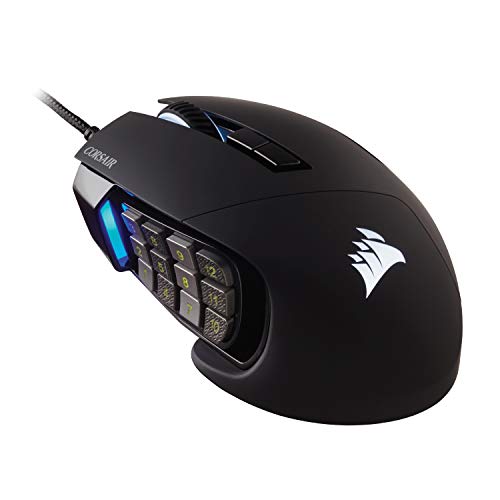
- Best for: wired players whose thumb never quite lands right on fixed-grid mice.
- Sensor: PixArt PMW3391 optical sensor
- Maximum sensitivity: 18,000 DPI, adjustable in 1 DPI increments
- Buttons: 17 fully programmable, including 12 side buttons
- Side panel: patented Key Slider control system, adjustable position
All 5 Picks at a Glance
| Product | Specs | Action |
|---|---|---|
| Razer Naga V2 Pro |
| Check price on Amazon |
| Razer Naga V2 HyperSpeed |
| Check price on Amazon |
| Corsair Scimitar RGB Elite |
| Check price on Amazon |
 Logitech G600 |
| Check price on Amazon |
 Redragon M908 Impact |
| Check price on Amazon |
Key takeaways
- Compare the best MOBA gaming mice with 12-button thumb grids, from the swappable Razer Naga V2 Pro and Corsair Scimitar to the Redragon M908 Impact.
Choosing a MOBA mouse is really a decision about your thumb. In League of Legends or Dota 2, the keyboard hand is busy with movement and camera control, so the players who climb fastest are usually the ones who move item actives, summoner spells, and ping commands onto a thumb grid they can hit without looking down. Button count alone is not the answer, though: the grid has to be shaped so each key feels distinct, and the mouse still needs a sensor and shape that hold up during last-hitting and team fights.
This roundup is for MOBA players who want that extra command layer, from ranked grinders who bind every active item to MMO crossovers who want one mouse for both genres. Every pick below was chosen from its Amazon product page: the button layout, sensor, and connection type in each listing title and spec table are what earned it a place here.
Quick Picks
As an Amazon Associate we earn from qualifying purchases
| Product | Best for | Key spec from title |
|---|---|---|
| Razer Naga V2 Pro | Players who switch between MOBA and MMO | 19+1 programmable buttons with 3 swappable side plates |
| Razer Naga V2 HyperSpeed | Wireless players who hate charging | 19 programmable buttons, up to 400 hr battery life |
| Corsair Scimitar RGB Elite | Wired players with any thumb size | 17 programmable buttons, 18,000 DPI optical sensor |
| Logitech G600 | Players who want a modifier key on the mouse | 20 programmable buttons with G-Shift |
| Redragon M908 Impact | First thumb-grid mouse on a tight budget | 12 side buttons, up to 12,400 DPI |
How to Choose
Count the buttons your build actually uses
A MOBA rotation needs fewer inputs than an MMO raid bar, so map your real bindings before choosing a grid size. Most players actively use four to six extra commands: two summoner spells, two or three item actives, and a trinket or ping. A fixed 12-button grid covers that with room to grow, while a swappable design like the Naga V2 Pro lets you drop to a 6-button plate for MOBA and save the full grid for MMO nights. Buying the biggest grid by default often leaves half the keys unbound and harder to tell apart by touch.
Decide how the grid is laid out, not just how many keys it has
Twelve identical flat buttons are slower than eight well-separated ones, because your thumb finds keys by shape and spacing, not by sight. Look for grids with textured or angled rows, a distinct anchor key you can locate blind, or an adjustable panel: the Scimitar RGB Elite slides its whole side panel forward or back so the grid sits under your thumb joint instead of forcing your grip to adapt. If a listing shows the side buttons as one smooth slab with no separation, expect a longer learning curve and more mis-presses during crowded fights.
Pick wired or wireless based on your desk, not habit
A wired mouse never needs charging and never drops a connection mid-fight, which is why two picks here are cable-only. Wireless models remove drag on wide mouse sweeps, but check the battery system in the listing: the Naga V2 HyperSpeed runs up to 250 hours on its 2.4 GHz connection from a single AA cell, while the Naga V2 Pro uses a rechargeable pack rated up to 150 hours on HyperSpeed. Bluetooth modes stretch battery further on both, but the higher polling of the 2.4 GHz link is the mode you want in ranked play.
Check the software and profile storage behind the buttons
A thumb grid is only useful if the bindings survive outside one app on one PC. Listings that mention onboard memory or saved profiles mean your item actives travel with the mouse to a laptop or a tournament machine. Software also decides how deep you can go: Logitech’s G-Shift turns the G600’s ring-finger button into a modifier that doubles every grid key, while Corsair iCUE and Razer Synapse handle macros and per-game profiles. If you play on multiple computers, favor the mouse whose profiles live on the device itself.
The 5 Best Options
Razer Naga V2 Pro
- Best for: players who split time between MOBA queues and MMO raids and want one mouse for both.
- Sensor: Razer Focus Pro 30K optical sensor
- Maximum sensitivity: 30,000 DPI
- Buttons: 19+1 programmable, with 12, 6, and 2-button swappable side plates
- Connectivity: HyperSpeed 2.4 GHz wireless, Bluetooth, USB-C wired
players who split time between MOBA queues and MMO raids and want one mouse for both.
at 134 g it is far heavier than the ultralight mice most FPS players use, and the wireless charging dock and puck are sold separately.
The Naga V2 Pro is the pick for players who refuse to own two mice. Its magnetic side plates swap in seconds: the 12-button plate handles MMO ability bars, the 6-button plate is the sweet spot for MOBA item actives and summoner spells, and the 2-button plate keeps things simple for shooters. Underneath, the Focus Pro 30K sensor and optical switches keep clicks instant, and the HyperScroll Pro wheel switches between free-spin and tactile modes. It is a substantial mouse, so small hands should read the dimensions before ordering.
Razer Naga V2 HyperSpeed
- Best for: wireless MOBA players who want a full thumb grid without a charging routine.
- Sensor: Razer Focus Pro 30K optical sensor
- Buttons: 19 programmable
- Connectivity: HyperSpeed 2.4 GHz wireless and Bluetooth
- Battery life: up to 250 hours on HyperSpeed, up to 400 hours on Bluetooth
wireless MOBA players who want a full thumb grid without a charging routine.
the AA battery is replaceable rather than rechargeable, and the fixed grid cannot shrink to a 2-button layout the way the Pro model’s plates can.
Where the Pro model chases flexibility, the Naga V2 HyperSpeed chases uptime. It keeps a fixed 12-button thumb grid and 19 programmable buttons in total, runs the same Focus Pro 30K sensor, and stretches a single AA battery to as much as 250 hours on the HyperSpeed connection or 400 hours over Bluetooth. At 95 g it is noticeably lighter than its sibling, which suits players who lift and reset the mouse often during laning. The dual-mode HyperScroll wheel flips between free-spin and notched scrolling for long shop menus.
Corsair Scimitar RGB Elite
- Best for: wired players whose thumb never quite lands right on fixed-grid mice.
- Sensor: PixArt PMW3391 optical sensor
- Maximum sensitivity: 18,000 DPI, adjustable in 1 DPI increments
- Buttons: 17 fully programmable, including 12 side buttons
- Side panel: patented Key Slider control system, adjustable position
wired players whose thumb never quite lands right on fixed-grid mice.
there is no wireless version in this listing, and the full feature set depends on running iCUE on your PC.
The Scimitar RGB Elite solves the fit problem that fixed grids ignore. Its patented Key Slider system lets the entire 12-button side panel slide forward or backward and lock, so the grid lines up with your thumb whether your hand is large or small. The 17 programmable buttons are backed by a PixArt PMW3391 optical sensor that adjusts in single-DPI steps up to 18,000, and the Omron switches are rated for 50 million clicks. It is wired only, with a braided cable, and Corsair’s iCUE software handles remaps, macros, and lighting across four RGB zones.
Logitech G600
- Best for: players who want two layers of commands under one thumb, especially control-group and ward bindings.
- Buttons: 20 programmable, including a 12-button thumb grid
- Modifier: G-Shift button doubles the thumb grid commands
- Maximum sensitivity: 8,200 DPI
- Backlighting: RGB backlit buttons
players who want two layers of commands under one thumb, especially control-group and ward bindings.
this is a long-running model sold largely by third-party sellers on Amazon now, so check the seller and condition on the listing before ordering.
The G600 is the veteran of this group, and its party trick still matters for MOBA: the G-Shift button under your ring finger acts as a modifier, doubling the 12-button thumb grid to 24 commands without moving your hand. That makes it a natural home for layered bindings, such as normal item actives on the grid and wards, pings, and control groups on the shifted layer. The sculpted right-handed shell suits palm grips, the side buttons are backlit so profiles are easy to tell apart, and the sensor tops out at 8,200 DPI, which is plenty for MOBA cursor work.
Redragon M908 Impact
- Best for: players trying a MOBA thumb grid for the first time, or a second setup for a laptop bag.
- Sensor: Pixart PAW3327 optical sensor
- Maximum sensitivity: 12,400 DPI, adjustable in 100 DPI steps via software
- Buttons: 18 programmable, including 12 side buttons
- Polling rate: 1000 Hz
players trying a MOBA thumb grid for the first time, or a second setup for a laptop bag.
the software is more basic than Razer Synapse or iCUE, and the wide shell will feel bulky to small-handed fingertip grippers.
The M908 Impact is the low-risk way to find out whether a thumb grid suits your play. It packs 12 side buttons and 18 programmable inputs in total around a Pixart PAW3327 optical sensor that reaches 12,400 DPI, with the polling rate set at 1000 Hz. DPI can be fine-tuned in steps of 100 through Redragon’s software, and five onboard memory profiles keep separate bindings for different champions or roles. The shell is a wide, right-handed ergonomic shape with a comfort grip, and the RGB lighting can be switched off if you prefer a plain desk.
Which One Fits Your Situation
You play MOBA on weekdays and an MMO on weekends
Get the Naga V2 Pro. Snap on the 6-button plate for item actives during the week, then swap to the 12-button plate when your MMO rotation needs a full ability bar. No other mouse in this list changes its own button layout, and the shared sensor and software mean your settings carry across both games without relearning a new shell.
Your mouse always dies at the worst moment
Choose the Naga V2 HyperSpeed. A single AA cell delivers up to 250 hours on the low-latency connection, and swapping a battery takes seconds compared with tethering a rechargeable mouse mid-session. It keeps the full 12-button grid and the same 30K sensor as the Pro, so you give up the swappable plates, not performance.
Your thumb never lands on the grid properly
The Scimitar RGB Elite was built for exactly this complaint. Slide the side panel until the middle row sits under the pad of your thumb, lock it, and the grid stops feeling like it belongs to someone else’s hand. You also get the most granular DPI adjustment here, in single steps, if you like fine-tuning cursor speed per champion.
You bind everything, including wards and control groups
Take the Logitech G600. G-Shift effectively gives you two grids, so actives live on the main layer and wards, pings, and control groups live on the shifted layer. Just confirm the seller on the listing first, since new stock of this older model mostly comes from third-party sellers now rather than from Logitech directly.
Common Mistakes
- Binding all 12 grid keys on day one, then mis-pressing under pressure; start with four to six commands and add more as muscle memory forms.
- Judging a MOBA mouse by maximum DPI, when grid feel, shape, and button separation matter far more at typical MOBA sensitivity settings.
- Ignoring hand size: these are wide, tall mice built for palm grips, and small hands or fingertip grips often struggle to reach the top row.
- Forgetting that wireless modes differ; Bluetooth is fine for battery life, but ranked play should use the 2.4 GHz connection for its polling behavior.
- Skipping the software setup, leaving the grid on default bindings that duplicate keyboard keys instead of holding the commands you actually need.
Frequently Asked Questions
Do MOBA players really need 12 side buttons?
Most do not use all twelve. A typical setup binds two summoner spells, two or three item actives, and a trinket, which is five or six keys. The extra buttons become spares for pings, control groups, or a second game. If your bindings stay under six, a swappable-plate mouse lets you fit the smaller plate and keep the grid easier to navigate by touch.
Is a wired or wireless mouse better for MOBA?
Both work at the level MOBA demands. Modern 2.4 GHz wireless, like Razer’s HyperSpeed, polls fast enough that connection lag is not a practical factor in lane trades or team fights. Wired models such as the Scimitar and G600 remove battery management entirely. Choose based on whether cable drag on your desk bothers you more than charging or swapping batteries.
How long does a thumb grid take to learn?
Expect roughly a week of regular play before the main keys feel automatic. Bind only your most-used actives first, keep them in the middle rows where your thumb rests naturally, and resist moving them between sessions. Players who rebind constantly never build the muscle memory that makes a grid faster than reaching for the keyboard.
Can these mice store bindings without the software running?
Yes, within limits. The Redragon M908 keeps five profiles in onboard memory, and the Naga models and G600 save core bindings to the mouse as well, so basic layouts travel between computers. Advanced macros and lighting effects generally need the companion software installed, so check the listing details if you play on machines you cannot install software on.
FAQ
Do MOBA players really need 12 side buttons?
Is a wired or wireless mouse better for MOBA?
How long does a thumb grid take to learn?
Can these mice store bindings without the software running?
More from Amazon
Programs that pair well with the guide above. Offers and eligibility are set by Amazon and may change.
Free shipping on eligible items, Prime Video and more. Eligible new members can start with a free trial.
Start a Prime free trialA Prime membership for ages 18-24 with a trial period. Eligibility is set by Amazon.
See Prime for Young AdultsAudiobooks and podcasts to listen to on the go. Eligible new members can start with a free trial.
Try Audible freeAd-free music streaming. Eligible new subscribers can start with a free trial.
Try Music Unlimited freeAs an Amazon Associate we earn from qualifying purchases.