Our Short List of 3

- Tri-band WiFi 7 at the BE9300 class with a 6 GHz band at up to 5,760 Mbps
- All five Ethernet ports run at 2.5 Gbps, including the WAN port
- Coverage up to 2,000 square feet and EasyMesh expansion
- Internal antennas cannot be angled toward a far room

- Tri-band WiFi 7 at the BE19000 class with combined speed up to 19 Gbps
- Coverage up to 3,500 square feet and support for up to 200 devices
- 10 Gig internet port for the fastest fiber plans
- The largest and most demanding pick here, in size and in the plan needed to use it fully

- Tri-band WiFi 6E with a 6 GHz band at up to 2,402 Mbps
- 2.5 Gbps WAN port and six external antennas that can be angled toward far rooms
- 1.7 GHz quad-core CPU with 512 MB of memory stated on the listing
- No coverage area or device count stated on the listing, so confirm both on the listing
All 5 Picks at a Glance
| Product | Specs | Action |
|---|---|---|
| 1. TP-Link Archer BE550 — Best WiFi 7 Value |
| Check price on Amazon |
| 2. NETGEAR Nighthawk RS700S — Best WiFi 7 Flagship |
| Check price on Amazon |
| 3. TP-Link Archer AXE75 — Best WiFi 6E Pick |
| Check price on Amazon |
 4. ASUS RT-AX86U Pro — Best WiFi 6 Pick for Control |
| Check price on Amazon |
 5. TP-Link Archer AX73 — Best Straightforward WiFi 6 Upgrade |
| Check price on Amazon |
Key takeaways
- Our guide to the best wifi routers compares standalone WiFi 6, WiFi 6E and WiFi 7 models by bands, ports, coverage and device capacity for your home.
As an Amazon Associate I earn from qualifying purchases.
The Short Answer
The best wifi routers for most homes are standalone units that match the internet plan, the size of the home, and the number of connected devices, rather than the model with the largest headline speed figure. For a household moving to WiFi 7 with a fast plan, the TP-Link Archer BE550 gives tri-band WiFi 7 with every Ethernet port running at 2.5 Gbps. For the largest single-router coverage figure here, the NETGEAR Nighthawk RS700S states coverage up to 3,500 square feet with WiFi 7 speeds up to 19 Gbps. For a 6 GHz band without the jump to WiFi 7, the TP-Link Archer AXE75 adds WiFi 6E at the AXE5400 class. For control and a dedicated gaming port, the ASUS RT-AX86U Pro remains the strongest WiFi 6 pick, and the TP-Link Archer AX73 covers the essentials at the AX5400 class. Every router below is a standalone router, not a mesh kit or a modem combination.
Our Top Picks
- Best WiFi 7 value: TP-Link Archer BE550 — tri-band BE9300 with full 2.5 Gbps ports and coverage up to 2,000 square feet.
- Best WiFi 7 flagship: NETGEAR Nighthawk RS700S — tri-band BE19000 with a 10 Gig internet port and coverage up to 3,500 square feet.
- Best WiFi 6E pick: TP-Link Archer AXE75 — tri-band AXE5400 with a 6 GHz band and a 2.5 Gbps WAN port.
- Best WiFi 6 pick for control: ASUS RT-AX86U Pro — dual-band AX5700 with a 2.5G port, a dedicated gaming port, and AiMesh expansion.
- Best straightforward WiFi 6 upgrade: TP-Link Archer AX73 — dual-band AX5400 with six-stream radios and long-range coverage.
Quick Comparison
| Router | WiFi | Class | Bands | Wired ports | Coverage |
|---|---|---|---|---|---|
| TP-Link Archer BE550 | WiFi 7 | BE9300 | Tri-band | 1 x 2.5G WAN + 4 x 2.5G LAN | Up to 2,000 sq. ft. |
| NETGEAR Nighthawk RS700S | WiFi 7 | BE19000 | Tri-band | 10 Gig internet + 10 Gig LAN + gigabit LAN | Up to 3,500 sq. ft. |
| TP-Link Archer AXE75 | WiFi 6E | AXE5400 | Tri-band | 2.5 Gbps WAN + 4 gigabit LAN | Not stated |
| ASUS RT-AX86U Pro | WiFi 6 | AX5700 | Dual-band | 2.5G port + 4 gigabit LAN | Not stated |
| TP-Link Archer AX73 | WiFi 6 | AX5400 | Dual-band | Gigabit WAN + 4 gigabit LAN | Long-range stated |
How to Choose
Match the WiFi generation to the devices in the home
WiFi 6 is the safe baseline for most homes today. It handles dozens of phones, laptops, televisions, and smart-home devices with OFDMA and MU-MIMO, which let the router serve several devices at once. WiFi 6E adds a 6 GHz band, which is wide and usually uncongested, so newer phones and laptops get a clear lane for large downloads and video calls. WiFi 7 adds wider channels, multi-link operation across bands, and lower latency under load. Buy WiFi 7 when the household already owns WiFi 7 devices.
Read the speed class with care
A speed class such as AX5400, AXE5400, BE9300, or BE19000 is a combined figure across all bands, not the speed any single device will reach. A dual-band model splits its total between two bands, while a tri-band model adds a third. The band speeds matter more than the combined figure: the Archer BE550 states 5,760 Mbps on 6 GHz, 2,880 Mbps on 5 GHz, and 574 Mbps on 2.4 GHz, while the Archer AXE75 states 2,402 Mbps on 6 GHz, 2,402 Mbps on 5 GHz, and 574 Mbps on 2.4 GHz. Walls, distance, and interference cut real-world throughput well below the stated figures.
Check the internet port before the wireless figures
The internet port, usually labelled WAN, sets a hard ceiling on the connection. A gigabit WAN port caps any plan faster than a gigabit, no matter how fast the wireless radios are. That is why the 2.5 Gbps WAN port on the Archer AXE75 and the Archer BE550 matters for households on multi-gigabit plans, and why the 10 Gig internet port on the Nighthawk RS700S suits the fastest fiber plans. Four LAN ports cover a typical entertainment center without an extra switch.
Match coverage to the floor plan, not to the box
Coverage figures describe open, favorable layouts, so a house with brick interior walls, a metal roof, or a long single-story footprint will get less reach than the same square footage in an open two-story build. The Nighthawk RS700S states coverage up to 3,500 square feet, and the Archer BE550 states coverage up to 2,000 square feet. Trim those figures mentally for construction and for the distance to the farthest room. A central, elevated position, clear of metal shelving and large appliances, does more for coverage than any antenna specification.
Count devices and weigh the software
A modern home accumulates connected devices quietly: phones, laptops, televisions, cameras, doorbells, bulbs, and speakers all hold a connection at once. The Nighthawk RS700S states support for up to 200 connected devices. Where a listing states no device count, as with the Archer AXE75 and the Archer AX73, judge by the processor and the band layout instead: a quad-core processor and a tri-band design handle a busy evening better than a dual-core processor with two bands. On software, look for WPA3 security, a guest network, parental controls, and quality of service controls that prioritize gaming or video-call traffic. Mesh expansion matters too: the Archer BE550 works with EasyMesh, the Archer AXE75 works with OneMesh, and the ASUS RT-AX86U Pro works with AiMesh, so a compatible node can be added later without replacing the main unit. Confirm on the listing which companion models each system accepts, because mesh compatibility is brand-specific.
The Picks in Detail
1. TP-Link Archer BE550 — Best WiFi 7 Value
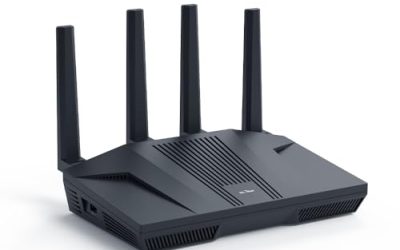
- Tri-band WiFi 7 at the BE9300 class with a 6 GHz band at up to 5,760 Mbps
- All five Ethernet ports run at 2.5 Gbps, including the WAN port
- Coverage up to 2,000 square feet and EasyMesh expansion
- Internal antennas cannot be angled toward a far room
The Archer BE550 is the WiFi 7 pick for households that want the new standard without paying for a flagship. Its tri-band design runs WiFi 7 at the BE9300 class, with 5,760 Mbps stated on the 6 GHz band, 2,880 Mbps on the 5 GHz band, and 574 Mbps on the 2.4 GHz band. All five Ethernet ports run at 2.5 Gbps, so a multi-gigabit plan is not capped at the front door and wired devices keep the same headroom. The listing states coverage up to 2,000 square feet, and EasyMesh expansion allows a compatible TP-Link node to be added later for a far room.
Pros
Cons
2. NETGEAR Nighthawk RS700S — Best WiFi 7 Flagship
- Tri-band WiFi 7 at the BE19000 class with combined speed up to 19 Gbps
- Coverage up to 3,500 square feet and support for up to 200 devices
- 10 Gig internet port for the fastest fiber plans
- The largest and most demanding pick here, in size and in the plan needed to use it fully
The Nighthawk RS700S is the flagship single router in this guide, built for large homes on fast plans. It is a tri-band WiFi 7 router at the BE19000 class, with combined wireless speed up to 19 Gbps stated on the listing. NETGEAR states coverage up to 3,500 square feet and support for up to 200 connected devices, the largest coverage figure and the largest device count in this group. A 10 Gig internet port passes a multi-gigabit fiber plan through at full speed. NETGEAR Armor security is included for one year. Confirm the exact LAN port count and speed on the listing before ordering, because the listing describes the LAN ports as gigabit ports and the count varies between sources. Also confirm the model number RS700S-100NAS in the title.
Pros
Cons
3. TP-Link Archer AXE75 — Best WiFi 6E Pick
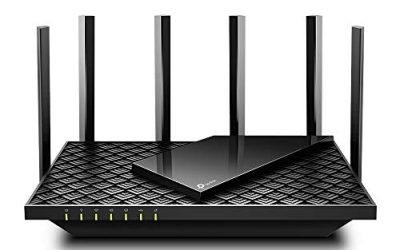
- Tri-band WiFi 6E with a 6 GHz band at up to 2,402 Mbps
- 2.5 Gbps WAN port and six external antennas that can be angled toward far rooms
- 1.7 GHz quad-core CPU with 512 MB of memory stated on the listing
- No coverage area or device count stated on the listing, so confirm both on the listing
The Archer AXE75 is the WiFi 6E pick for households that want a 6 GHz band without paying for WiFi 7. Its tri-band design runs at the AXE5400 class, with 2,402 Mbps stated on the 6 GHz band, 2,402 Mbps on the 5 GHz band, and 574 Mbps on the 2.4 GHz band. The 6 GHz band gives newer phones and laptops a clear lane, while older devices continue on the 5 GHz and 2.4 GHz bands. Six external antennas can be angled toward the rooms that need signal most. A 2.5 Gbps WAN port leaves room for a faster internet plan later, and four gigabit LAN ports cover a desktop and a console. The listing states a 1.7 GHz quad-core CPU with 512 MB of memory, and OneMesh support allows a compatible TP-Link node to extend coverage later.
Pros
Cons
4. ASUS RT-AX86U Pro — Best WiFi 6 Pick for Control
- Dual-band WiFi 6 at the AX5700 class with a 2.0 GHz quad-core processor
- Dedicated gaming port (one of four gigabit LAN ports) plus a 2.5G port
- AiProtection security, parental controls, and AiMesh expansion
- Dual-band only, so there is no 6 GHz band for newer devices
The ASUS RT-AX86U Pro is the WiFi 6 pick for households that want the most control over their network. It is a dual-band WiFi 6 router at the AX5700 class, with a 2.0 GHz quad-core processor and 1 GB of memory stated in its specifications. Beamforming, MU-MIMO, and OFDMA give it strong range for its class, and a dedicated gaming port gives a console or PC a wired connection that receives priority automatically. A separate 2.5G port and four gigabit LAN ports cover the entertainment center, and one of those four LAN ports is the dedicated gaming port. AiProtection network security, parental controls, adaptive quality of service, and built-in VPN support are included without a subscription requirement for the core security tools described by ASUS, and AiMesh compatibility means a node can be added later.
Pros
Cons
5. TP-Link Archer AX73 — Best Straightforward WiFi 6 Upgrade
- Dual-band WiFi 6 at the AX5400 class with six-stream radios
- Long-range coverage stated on the listing
- Four gigabit LAN ports plus a USB 3.0 port
- Gigabit WAN port only, so it caps any plan faster than a gigabit
The Archer AX73 is the straightforward WiFi 6 upgrade in this guide. It is a dual-band router at the AX5400 class, with six-stream radios and combined wireless speed up to 5.4 Gbps stated on the listing. Six-stream radios help when streaming, calls, and downloads run at the same time. TP-Link describes it as a long-range router, and its six antennas support that claim for a home with the router placed centrally. A gigabit WAN port suits a gigabit plan, four gigabit LAN ports handle a desktop, a console, and a television, and a USB 3.0 port adds storage and printer sharing. HomeShield security tools, WPA3, and parental controls are included, and the Tether app simplifies setup. Confirm the device capacity on the listing, because no device count is stated there.
Pros
Cons
Who Should Choose What
Choose the TP-Link Archer BE550 when the household is moving to WiFi 7 and wants every Ethernet port at 2.5 Gbps in a single compact unit. EasyMesh gives it a path to cover a far room later.
Choose the NETGEAR Nighthawk RS700S when the home is large and the plan is fast. Its stated coverage up to 3,500 square feet and support for up to 200 devices make it the pick for a big, device-heavy household.
Choose the TP-Link Archer AXE75 when newer phones and laptops already support 6 GHz and the household wants that clear band without paying for WiFi 7. The 2.5 Gbps WAN port leaves room for a faster plan later.
Choose the ASUS RT-AX86U Pro when control matters most. Parental controls, AiProtection security, adaptive quality of service, and a dedicated gaming port suit a household that wants to shape traffic and manage devices closely, and AiMesh leaves room to grow. Choose the TP-Link Archer AX73 when the goal is a simple, reliable WiFi 6 upgrade with six-stream radios and long-range coverage.
Common Mistakes
The most common mistake is buying speed class instead of coverage. A BE19000 router placed in a basement corner still loses to walls and distance, while a well-placed AX5400 router in the center of the home reaches every room. Place the router high, near the center, and clear of metal shelving and large appliances before judging its reach.
A second mistake is ignoring the internet port. A router with a gigabit WAN port caps a multi-gigabit plan, and no wireless figure can fix that. Check the WAN port speed against the internet plan first, then compare wireless figures. A third mistake is counting bands instead of devices: if every phone and laptop is older, a dual-band router with strong radios serves just as well.
A fourth mistake is forgetting the wired devices. A console or desktop PC on a cable stays steady when the wireless network gets busy, so count the LAN ports before ordering and keep a port free for the most important machine. A fifth mistake is ordering the wrong variant: several routers here share a family name with mesh kits and modem combinations. Confirm the model number in the title, confirm the pack size where a pack size is stated, and confirm on the listing that the unit is a standalone router before ordering.
FAQ
Do I need WiFi 7, or is WiFi 6 enough?
WiFi 6 is enough for most homes today. WiFi 7 earns its place when the household already owns WiFi 7 devices, runs a multi-gigabit plan, or wants the router to stay in place for several years. WiFi 6E sits between the two, adding the 6 GHz band without the full jump to WiFi 7.
Can one router cover a large home without mesh?
It can, when the coverage figure matches the floor plan. The Nighthawk RS700S states coverage up to 3,500 square feet. When the modem sits in a far corner, or the home has brick walls and several floors, a mesh-ready router with a compatible node added later covers the far rooms more reliably.
What is the difference between WiFi 6, WiFi 6E, and WiFi 7?
WiFi 6 improves efficiency for many devices at once with OFDMA and MU-MIMO. WiFi 6E adds a 6 GHz band to that foundation, giving newer devices a wide, uncongested lane. WiFi 7 adds wider channels, multi-link operation across bands, and lower latency under load.
How many LAN ports do I need?
Four LAN ports cover a typical entertainment center: a desktop PC, a console, a television, and one spare connection. Households with more wired devices should count them before ordering and plan on a small switch.
Should the main gaming PC or console use WiFi or a cable?
A cable is the steadier choice for the main gaming machine. Latency on a wired connection does not swing when a microwave runs, a neighbor network gets busy, or a door closes. Keep the most important machine wired.
Does a 6 GHz band help if my devices are older?
No. Only devices with WiFi 6E or WiFi 7 radios can use the 6 GHz band. Older devices continue on the 5 GHz and 2.4 GHz bands, so a household with no 6 GHz devices gains nothing from the extra band today. Spend the budget on stronger radios or a better placement instead.
Conclusion
The best wifi routers are the ones that fit the home they serve. The TP-Link Archer BE550 leads for most WiFi 7 upgrades, with full 2.5 Gbps ports and tri-band radios in a compact unit. The NETGEAR Nighthawk RS700S leads for large homes on fast plans. The TP-Link Archer AXE75 leads for households that want a 6 GHz band without WiFi 7. The ASUS RT-AX86U Pro leads for control, with the strongest software and a dedicated gaming port. The TP-Link Archer AX73 leads for a simple WiFi 6 upgrade. Match the WiFi generation to the devices, check the internet port against the plan, place the router centrally, and confirm the model number on the listing before ordering.
FAQ
Do I need WiFi 7, or is WiFi 6 enough?
Can one router cover a large home without mesh?
What is the difference between WiFi 6, WiFi 6E, and WiFi 7?
How many LAN ports do I need?
Should the main gaming PC or console use WiFi or a cable?
Does a 6 GHz band help if my devices are older?
More from Amazon
Programs that pair well with the guide above. Offers and eligibility are set by Amazon and may change.
Free shipping on eligible items, Prime Video and more. Eligible new members can start with a free trial.
Start a Prime free trialA Prime membership for ages 18-24 with a trial period. Eligibility is set by Amazon.
See Prime for Young AdultsAudiobooks and podcasts to listen to on the go. Eligible new members can start with a free trial.
Try Audible freeAd-free music streaming. Eligible new subscribers can start with a free trial.
Try Music Unlimited freeAs an Amazon Associate we earn from qualifying purchases.