Our Short List of 3

- Best Overall: TP-Link Archer AX73 — AX5400 Wi-Fi 6, six streams, strong all-round capacity for gigabit Xfinity plans. Check on Amazon
- Best Value: TP-Link Archer AX55 — AX3000 Wi-Fi 6, four streams, the simplest fit for smaller homes. Check on Amazon
- Best for Larger Homes: NETGEAR Nighthawk RAX50 — AX5400 Wi-Fi 6 with a stated coverage figure of up to 2,500 sq. ft. Check on Amazon
- Best for Gaming and Wired Setups: ASUS RT-AX86U Pro — AX5700 Wi-Fi 6 with a 2.5 gigabit port and a dedicated gaming port. Check on Amazon
All 5 Picks at a Glance
| Product | Specs | Action |
|---|---|---|
| Our Top Picks |
| Check price on Amazon |
 2. TP-Link Archer AX55 — Best Value | Check price on Amazon | |
 3. NETGEAR Nighthawk RAX50 — Best for Larger Homes | Check price on Amazon | |
 4. ASUS RT-AX86U Pro — Best for Gaming and Wired Setups | Check price on Amazon | |
 5. TP-Link Archer AXE75 — Best Wi-Fi 6E Pick | Check price on Amazon |
Key takeaways
- Searching for the best routers for xfinity? Here are 5 standalone Wi-Fi 6 and Wi-Fi 6E routers that pair with an Xfinity modem for fast, reliable home coverage.
As an Amazon Associate I earn from qualifying purchases.
The Short Answer
If you want the best routers for Xfinity without overthinking it, buy the TP-Link Archer AX73. It is a dual-band Wi-Fi 6 router with AX5400 wireless speed and six streams, giving a busy household on a gigabit Xfinity plan plenty of capacity. For a smaller home, the TP-Link Archer AX55 gives you the same Wi-Fi 6 foundation at AX3000 speed. If you want a 6 GHz band for newer phones and laptops, the TP-Link Archer AXE75 adds Wi-Fi 6E. Gamers should look at the ASUS RT-AX86U Pro for its 2.5 gigabit port and dedicated gaming port, while the NETGEAR Nighthawk RAX50 suits larger single-router homes.
One thing to understand before you buy: Xfinity delivers internet to your home through a cable modem, and the routers in this guide are standalone routers, not modems. Each one plugs into a modem with an Ethernet cable and creates your home Wi-Fi network. If you rent a gateway from Xfinity, put it in bridge mode so the new router handles your network. If you own a modem, confirm it is on the Xfinity approved device list.
Our Top Picks
- Best Overall: TP-Link Archer AX73 — AX5400 Wi-Fi 6, six streams, strong all-round capacity for gigabit Xfinity plans. Check on Amazon
- Best Value: TP-Link Archer AX55 — AX3000 Wi-Fi 6, four streams, the simplest fit for smaller homes. Check on Amazon
- Best for Larger Homes: NETGEAR Nighthawk RAX50 — AX5400 Wi-Fi 6 with a stated coverage figure of up to 2,500 sq. ft. Check on Amazon
- Best for Gaming and Wired Setups: ASUS RT-AX86U Pro — AX5700 Wi-Fi 6 with a 2.5 gigabit port and a dedicated gaming port. Check on Amazon
Quick Comparison
| Router | Wi-Fi Standard | Wireless Class | Bands | Key Ports | Best For |
|---|---|---|---|---|---|
| TP-Link Archer AX73 | Wi-Fi 6 | AX5400 | Dual-band | Gigabit WAN and LAN, USB 3.0 | Most Xfinity households |
| TP-Link Archer AX55 | Wi-Fi 6 | AX3000 | Dual-band | Gigabit WAN and LAN, USB 3.0 | Smaller homes and lighter budgets |
| NETGEAR Nighthawk RAX50 | Wi-Fi 6 | AX5400 | Dual-band | Gigabit WAN and LAN, USB 3.0 | Larger single-router homes |
| ASUS RT-AX86U Pro | Wi-Fi 6 | AX5700 | Dual-band | 2.5 gigabit port, gaming port, USB 3.2 | Gaming and wired-heavy setups |
| TP-Link Archer AXE75 | Wi-Fi 6E | AXE5400 | Tri-band with 6 GHz | 2.5 gigabit WAN, Gigabit LAN, USB 3.0 | Newer devices with 6 GHz support |
How to Choose
Start with your Xfinity plan speed
Your router should match or exceed the download speed of your Xfinity plan. An AX3000 router suits plans up to a few hundred megabits, while an AX5400 or AX5700 router gives a gigabit plan room to breathe when several devices stream at once. A router cannot make your internet faster than the plan you pay for.
Confirm the modem side first
Every router in this guide needs a modem. Xfinity cable internet arrives over coaxial cable, and a standalone router has no coaxial input. You need either a separate cable modem approved for Xfinity or a rented Xfinity gateway. If you rent a gateway, switch it to bridge mode before connecting the new router, or two routers on the same network will cause dropped connections.
Count your devices and your rooms
A household with a dozen connected devices needs less capacity than one with forty. Wi-Fi 6 routers handle many simultaneous devices better than older Wi-Fi 5 models thanks to OFDMA and MU-MIMO, which let the router serve several devices in the same transmission window instead of one at a time. If your home has thick walls or more than one floor, a single router may struggle, and a mesh system becomes the better answer.
Look at the ports, not just the wireless numbers
Wireless speed numbers describe combined throughput across all bands, not the speed any single device reaches. A 2.5 gigabit port helps if your plan exceeds gigabit speed or you move large files between wired devices. Four LAN ports cover a TV, a console, and a desktop, and a USB port lets you share a drive or a printer.
Think about the 6 GHz band
Wi-Fi 6E adds a 6 GHz band that is less crowded than the 2.4 GHz and 5 GHz bands, which helps in apartments where dozens of neighboring networks compete for airtime. The catch is that only newer phones, laptops, and consoles support 6 GHz. If your devices are older, the 6 GHz radio will sit idle until you upgrade your gear.
Security and software matter
Every router here supports WPA3 security, which is the current standard for protecting your home network. Some include a security suite or parental controls, and some of those features require a subscription after a trial period. Check the listing for what becomes a paid subscription, set strong passwords during setup, and keep the firmware updated.
The Picks in Detail
1. TP-Link Archer AX73 — Best Overall
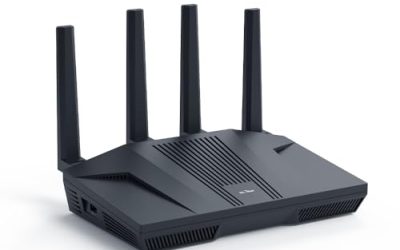
The Archer AX73 is the pick for most Xfinity households because it balances speed, capacity, and simplicity. It is a dual-band Wi-Fi 6 router classed as AX5400, with six streams that let it serve many devices at once without the slowdowns that hit older routers when the whole family is online. The listing describes long-range coverage, and the six external antennas are built to push signal into far rooms. Four gigabit LAN ports and a USB 3.0 port cover wired devices and storage, and OFDMA and MU-MIMO handle simultaneous streaming, calls, and gaming. The AX73 has no 6 GHz band and no multi-gigabit port, so households on faster plans should look at the AXE75 instead.
Pros:
– AX5400 Wi-Fi 6 speed with six streams for busy households
– Four gigabit LAN ports plus USB 3.0 for wired devices and storage
– Six antennas and OFDMA plus MU-MIMO for simultaneous use
– Simple app-based setup with HomeShield security included
Cons:
– No 6 GHz band for Wi-Fi 6E devices
– No 2.5 gigabit port for plans above gigabit speed
– Some HomeShield features require a subscription, confirm on the listing
2. TP-Link Archer AX55 — Best Value
The Archer AX55 is the sensible pick when your home is smaller and your plan is modest. It is a dual-band Wi-Fi 6 router classed as AX3000, with 574 Mbps on the 2.4 GHz band and 2,402 Mbps on the 5 GHz band using 160 MHz channels. Four external antennas, OFDMA, and MU-MIMO give it solid multi-device handling, and four gigabit LAN ports plus USB 3.0 cover the wired basics. It supports EasyMesh, so you can add a compatible extender or satellite later if one room stays out of reach, and it includes VPN client and server support plus HomeShield security. The AX55 is a four-stream router, so it has less capacity than the six-stream AX73, and the listing states no coverage figure, so very large homes should step up. Match the Archer AX55 name and ASIN exactly, because several similar TP-Link AX3000 listings exist.
Pros:
– AX3000 Wi-Fi 6 with 160 MHz channels on the 5 GHz band
– Four gigabit LAN ports plus USB 3.0 and VPN client and server support
– EasyMesh support for adding coverage later
– Compact design that fits on a shelf without dominating the room
Cons:
– Four streams give it less capacity than the six-stream AX73
– No 6 GHz band and no multi-gigabit port
– No stated coverage figure on the listing, confirm on the listing
3. NETGEAR Nighthawk RAX50 — Best for Larger Homes
The Nighthawk RAX50 is the coverage-led pick in this guide. It is a dual-band Wi-Fi 6 router classed as AX5400, and its listing title states coverage of up to 2,500 sq. ft., which is the only coverage figure printed on any listing in this roundup. That number makes it the easiest pick to match against a floor plan. The six-stream design supports up to 25 devices according to the listing, and four gigabit LAN ports plus USB 3.0 handle wired devices and storage. A 1.5 GHz triple-core processor runs the routing. The RAX50 is a single router, not a mesh kit, so very large homes may still need more than one unit. Its wired ports are gigabit only, and NETGEAR Armor turns into a paid subscription after the trial. A Renewed version and a separate RAX54S bundle circulate under other codes, so confirm the listing is the new RAX50-100NAS tied to the ASIN below before ordering.
Pros:
– Stated coverage of up to 2,500 sq. ft. on the listing title
– AX5400 Wi-Fi 6 with a six-stream design for up to 25 devices
– Four gigabit LAN ports plus USB 3.0
– Nighthawk app for setup and network management
Cons:
– Gigabit-only wired ports, no multi-gigabit port
– Single router, so very large homes may need mesh coverage
– NETGEAR Armor becomes a paid subscription after the trial
– Renewed units circulate under other codes, confirm the model before ordering
4. ASUS RT-AX86U Pro — Best for Gaming and Wired Setups
The RT-AX86U Pro is the wired-first pick here. It is a dual-band Wi-Fi 6 router classed as AX5700, with 861 Mbps on the 2.4 GHz band and 4,804 Mbps on the 5 GHz band. A 2.5 gigabit port gives a wired PC or console a faster link than gigabit Ethernet, and a dedicated gaming port prioritizes traffic from what is plugged into it. A 2.0 GHz quad-core processor runs routing, security, and game prioritization, with a 3-year warranty. Mobile Game Mode pushes phone traffic ahead of other devices, and AiMesh lets you add another ASUS router later. It stands upright with three external antennas and needs shelf space with depth. AiProtection Pro is included without a subscription, with VPN Fusion and Instant Guard for VPN and mobile security. The older base RT-AX86U is now on ASUS’s end-of-life list, and a Renewed version circulates under a different ASIN, so confirm the model reads RT-AX86U Pro and the listing is new before ordering.
Pros:
– AX5700 Wi-Fi 6 with a 2.5 gigabit port and a dedicated gaming port
– 2.0 GHz quad-core processor with a 3-year warranty
– Mobile Game Mode and Adaptive QoS prioritize game traffic
– AiProtection Pro security included without a subscription
– AiMesh support extends coverage with another ASUS router
– VPN Fusion and Instant Guard included
Cons:
– Dual-band only, with no 6 GHz band
– Upright design needs shelf depth
– Easy to confuse with the older base RT-AX86U, now end-of-life, and Renewed listings
5. TP-Link Archer AXE75 — Best Wi-Fi 6E Pick
The Archer AXE75 is the only Wi-Fi 6E router in this guide, and it earns its place for households with newer devices. It is a tri-band router classed as AXE5400, with 574 Mbps on 2.4 GHz, 2,402 Mbps on 5 GHz, and 2,402 Mbps on the new 6 GHz band. The 6 GHz band is the least crowded of the three, which helps in apartments where neighboring networks compete for airtime. A 2.5 gigabit WAN port gives it a faster internet link than gigabit-only routers, and four gigabit LAN ports plus a USB 3.0 port cover wired devices. A 1.7 GHz quad-core processor runs the routing, and the router supports OneMesh, VPN, and WPA3 security. Only newer phones, laptops, and consoles support 6 GHz, so older devices will use the 2.4 GHz and 5 GHz bands. The LAN ports are gigabit, so wired devices cannot exceed gigabit speed.
Pros:
– Tri-band Wi-Fi 6E with a dedicated 6 GHz band for less crowded airtime
– 2.5 gigabit WAN port for plans above gigabit speed
– Quad-core processor with four gigabit LAN ports and USB 3.0
– OneMesh, VPN, and WPA3 support included
Cons:
– Only newer devices support the 6 GHz band
– LAN ports are gigabit, so wired devices top out at gigabit speed
– Six antennas need clear shelf space for best signal
Who Should Choose What
- Most Xfinity households: Buy the TP-Link Archer AX73. AX5400 Wi-Fi 6 and six streams cover a gigabit plan and a busy family.
- Smaller homes and lighter budgets: Buy the TP-Link Archer AX55. AX3000 Wi-Fi 6 covers the essentials, with EasyMesh for adding coverage later.
- Larger single-router homes: Buy the NETGEAR Nighthawk RAX50. The stated coverage of up to 2,500 sq. ft. makes it the easiest pick to match against a floor plan.
- Gamers and wired-heavy setups: Buy the ASUS RT-AX86U Pro. The 2.5 gigabit port and gaming port suit a console or PC that lives on a cable.
- Households with newer devices: Buy the TP-Link Archer AXE75. The 6 GHz band gives Wi-Fi 6E devices a quieter channel, and the 2.5 gigabit WAN port suits faster plans.
Common Mistakes
Buying a modem-router combo by accident. This guide covers standalone routers only. A combo replaces both your modem and your router, and its modem side must be approved for Xfinity. If you already own an approved modem or rent a gateway, a standalone router is the right purchase.
Skipping bridge mode on a rented gateway. If you plug a new router into a rented gateway without switching it to bridge mode, you end up with two networks fighting over the same devices. Enable bridge mode and let the new router handle Wi-Fi, addressing, and security.
Choosing by the biggest wireless number alone. AX5400 and AX5700 describe combined throughput across all bands, not the speed any single device reaches. Match the router class to your plan speed and device count instead.
Ignoring the ports. A router with gigabit-only ports cannot pass wired speeds above gigabit, even on a faster plan. If your plan exceeds gigabit speed, or you move large files between wired devices, a 2.5 gigabit port matters. Count your wired devices before you buy.
Placing the router in a cabinet or behind the TV. Wi-Fi signal weakens through wood, metal, and walls. Put the router in the open, near the center of your home, with the antennas upright. A strong router hidden inside a closed cabinet performs like a weak one.
Forgetting the modem check. A standalone router cannot connect to Xfinity on its own. Confirm your modem is approved for Xfinity and supports your plan speed before the router arrives.
FAQ
Do these routers work with Xfinity?
Yes. Each router here has an Ethernet WAN port, so it connects to Xfinity through a separate cable modem or a rented gateway in bridge mode. The router itself needs no Xfinity approval. Confirm your modem is on the Xfinity approved device list and supports your plan speed.
Do I still need a modem with one of these routers?
Yes. A standalone router has no coaxial input and cannot receive a cable signal on its own. You need a separate cable modem approved for Xfinity, or a rented Xfinity gateway set to bridge mode. If you want one box that does both jobs, look for a modem-router combo instead.
What is the difference between a router and a modem-router combo?
A modem connects your home to the internet provider over the cable line, and a router creates your home Wi-Fi network and connects your devices to the modem. A combo puts both jobs in one box. A standalone router lets you upgrade the router without replacing the modem, while a combo means fewer boxes.
Is Wi-Fi 6E worth it for Xfinity?
Wi-Fi 6E is worth it if your phones, laptops, or consoles support the 6 GHz band and you live somewhere with many neighboring networks, such as an apartment building. The 6 GHz band is less crowded. If your devices are older and do not support 6 GHz, a Wi-Fi 6 router is the better buy.
How do I set up a new router with Xfinity?
Connect the router’s WAN port to your modem or bridged gateway, plug in the power, and follow the setup app for the router brand. Give your network a name, set a strong Wi-Fi password, and update the firmware when prompted. If you rent a gateway, switch it to bridge mode first, and restart the modem before connecting the new router.
Conclusion
The best routers for Xfinity are standalone routers that pair with a compatible modem and match your plan speed, your home size, and your devices. The TP-Link Archer AX73 is the pick for most households, with AX5400 Wi-Fi 6 speed and six streams for a gigabit plan. The TP-Link Archer AX55 covers smaller homes at AX3000, the NETGEAR Nighthawk RAX50 brings a stated coverage figure for larger single-router homes, the ASUS RT-AX86U Pro adds a 2.5 gigabit port and gaming features for wired setups, and the TP-Link Archer AXE75 adds a 6 GHz band for newer Wi-Fi 6E devices. Confirm your modem is approved for Xfinity, put a rented gateway in bridge mode, and check the exact model and ASIN before ordering.
FAQ
Do these routers work with Xfinity?
Do I still need a modem with one of these routers?
What is the difference between a router and a modem-router combo?
Is Wi-Fi 6E worth it for Xfinity?
How do I set up a new router with Xfinity?
More from Amazon
Programs that pair well with the guide above. Offers and eligibility are set by Amazon and may change.
Free shipping on eligible items, Prime Video and more. Eligible new members can start with a free trial.
Start a Prime free trialA Prime membership for ages 18-24 with a trial period. Eligibility is set by Amazon.
See Prime for Young AdultsAudiobooks and podcasts to listen to on the go. Eligible new members can start with a free trial.
Try Audible freeAd-free music streaming. Eligible new subscribers can start with a free trial.
Try Music Unlimited freeAs an Amazon Associate we earn from qualifying purchases.