Our Short List of 3

- Best for: Owners of a turntable with no built-in preamp who want a single cable run from deck to speakers.
- Powered bookshelf speakers (pair), black
- 1″ aluminum LTS tweeter on a 90° × 90° Tractrix horn
- 4″ copper-spun TCP woofer
- Built-in phono input with ground screw terminal
- Best for: A turntable with a built-in preamp (line output) used at a desk or in a small room.
- Powered Bluetooth bookshelf speakers (pair), wood finish
- 120 Watts RMS total power
- Optical input
- Two RCA/AUX line inputs (line-level only — no phono preamp)

- Best for: A medium room where one pair must handle a phono-output turntable, a television and phone streaming.
- Powered bookshelf speakers (pair), matte black (YU6MB)
- Built-in switchable phono preamp (RCA input with phono switch)
- 5.25″ Kevlar woofer; 1″ silk dome tweeter
- Class D amplifier, 200W peak (100W total RMS)
All 4 Picks at a Glance
| Product | Specs | Action |
|---|---|---|
| Klipsch Reference R-40PM Powered Bookshelf Speakers |
| Check price on Amazon |
| Edifier R2000DB Powered Bluetooth Bookshelf Speakers |
| Check price on Amazon |
| Kanto YU6 Powered Bookshelf Speakers |
| Check price on Amazon |
 Audioengine A5+ Powered Bookshelf Speakers (Wired) |
| Check price on Amazon |
Key takeaways
- Four powered speakers that pair with a turntable, split by built-in phono preamps and line-level inputs, with key specs and checks before you order.
The deciding question when buying speakers for a turntable is not size or finish — it is whether the speakers can take the tiny signal a phono cartridge produces. A deck with a phono output needs a phono preamp somewhere in the chain; a deck with a line output does not. Pick speakers without knowing which output your turntable has and you end up with music that is whisper-quiet and thin, or loud and distorted.
The four powered pairs below remove the receiver from the equation, but they split cleanly in two. The Klipsch R-40PM and Kanto YU6 carry built-in phono preamps, so any turntable connects directly. The Edifier R2000DB and Audioengine A5+ are line-level only and suit decks with a built-in preamp or an external stage. Each was chosen from its Amazon listing’s stated inputs, drivers and amplification, matched to the room sizes and listening habits they serve best.
Quick Picks
As an Amazon Associate we earn from qualifying purchases.
| Product | Best for | Key spec |
|---|---|---|
| Klipsch Reference R-40PM | Turntables with no built-in preamp | Built-in phono input with ground screw terminal |
| Edifier R2000DB | Line-output turntables at a desk | 120W RMS, optical and dual RCA inputs, line-level only |
| Kanto YU6 | Phono decks plus TV and phone streaming | Switchable phono preamp, 5.25″ Kevlar woofer |
| Audioengine A5+ (Wired) | Analogue-only vinyl corners | Analog amp with RCA and 3.5mm inputs, no phono or Bluetooth |
How to Choose
Sort Out the Phono Stage First
Start with your turntable’s output, because it decides which speakers are even candidates. A phono-level output is far quieter than a CD player or phone and needs a dedicated phono preamp to raise it to line level and apply RIAA equalisation. If your deck has no built-in preamp, choose speakers with one inside, like the Klipsch R-40PM or Kanto YU6. If your deck already offers a line output, any powered speaker works, including the line-level Edifier R2000DB and Audioengine A5+. Running a line output into a phono input overloads it, so match the switch or input to the signal.
Match Driver Size and Power to the Room
Woofer diameter and amplifier power decide how a pair fills your space. A 4-inch woofer, as in the R-40PM, keeps voices and acoustic records clear at desk or shelf distance but will not pressurise a large living room. The YU6’s 5.25-inch Kevlar woofer and 100 watts RMS of total Class D power reach further and hold together at higher volumes. Treat headline wattage cautiously: peak figures flatter, so compare RMS where a listing states both. Also weigh the pair itself — the YU6’s active speaker alone is 11.4 pounds, which matters for wall shelves and small stands.
Count the Inputs You Will Actually Use
Most turntable speakers end up serving the television and phone as well. Optical inputs suit a TV connection, and the R2000DB and YU6 each include them — the YU6 offers two. Bluetooth matters if you stream between records: the R-40PM, R2000DB and YU6 have it, while the wired A5+ deliberately does not. USB digital input on the R-40PM suits a computer-based setup. A 3.5mm auxiliary input, found on the YU6 and A5+, covers older phones and portable players. List every source you own before choosing, because adding an input later usually means adding another box.
Plan for Bass and Placement
Small powered speakers rarely produce deep bass on their own, so a subwoofer output is worth having even if you skip the sub today. The R-40PM provides an RCA line-level output for one, the YU6 has a dedicated subwoofer output, and the A5+ offers an RCA line output that can feed a sub or a second device. Placement matters as much: near-field designs like the R2000DB are voiced for close listening on a desk, while larger pairs need shelf space and breathing room behind them. Front or remote volume control — the R2000DB and YU6 include remotes — saves reaching behind a speaker daily.
The 4 Best Options
Klipsch Reference R-40PM Powered Bookshelf Speakers
- Best for: Owners of a turntable with no built-in preamp who want a single cable run from deck to speakers.
- Powered bookshelf speakers (pair), black
- 1″ aluminum LTS tweeter on a 90° × 90° Tractrix horn
- 4″ copper-spun TCP woofer
- Built-in phono input with ground screw terminal
Owners of a turntable with no built-in preamp who want a single cable run from deck to speakers.
Check which output your turntable uses before connecting — a line-level output fed into the phono input will sound loud and distorted, and the ground wire must reach the ground screw terminal or you may hear hum through quiet passages.
The R-40PM is the simplest route from a bare turntable to music. Its built-in phono input carries a ground screw terminal, so a deck with a phono-only output connects with a standard RCA cable and ground wire — no separate preamp, no receiver. The 1-inch aluminium LTS tweeter sits in a 90 by 90 degree Tractrix horn in front of a 4-inch copper-spun TCP woofer, a combination aimed at clear vocals and detail at modest volumes. Bluetooth, optical and USB digital inputs let the same pair handle a phone, television and computer between records.
Watch out for: Check which output your turntable uses before connecting — a line-level output fed into the phono input will sound loud and distorted, and the ground wire must reach the ground screw terminal or you may hear hum through quiet passages.
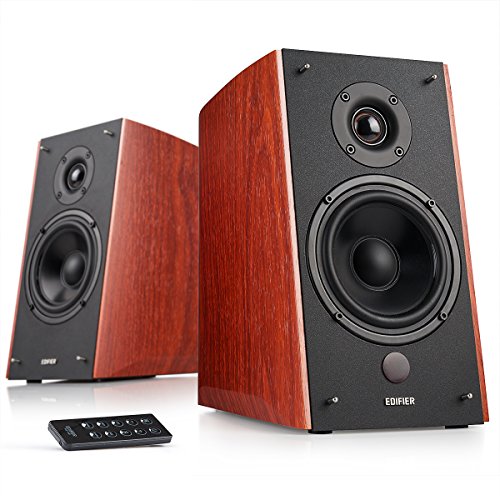
Edifier R2000DB Powered Bluetooth Bookshelf Speakers
- Best for: A turntable with a built-in preamp (line output) used at a desk or in a small room.
- Powered Bluetooth bookshelf speakers (pair), wood finish
- 120 Watts RMS total power
- Optical input
- Two RCA/AUX line inputs (line-level only — no phono preamp)
A turntable with a built-in preamp (line output) used at a desk or in a small room.
This pair is line-level only — a turntable without its own phono stage will sound extremely quiet and thin unless you add an external phono preamp. Also confirm the listing is the standard R2000DB in wood finish: a Warm Oak variant sold under a different model name is a separate listing.
Edifier positions the R2000DB as a near-field pair, and it suits listeners who sit close — at a desk, in a small room or beside the turntable shelf. Its 120 watts RMS of total power and on-speaker bass, treble and volume controls make it easy to tune for near listening, and a remote is included. Two RCA/AUX line inputs plus an optical input cover a turntable, a television and one more source. The catch is the phono question: there is no built-in phono preamp, so your deck must supply a line-level signal itself.
Watch out for: This pair is line-level only — a turntable without its own phono stage will sound extremely quiet and thin unless you add an external phono preamp. Also confirm the listing is the standard R2000DB in wood finish: a Warm Oak variant sold under a different model name is a separate listing.
Kanto YU6 Powered Bookshelf Speakers
- Best for: A medium room where one pair must handle a phono-output turntable, a television and phone streaming.
- Powered bookshelf speakers (pair), matte black (YU6MB)
- Built-in switchable phono preamp (RCA input with phono switch)
- 5.25″ Kevlar woofer; 1″ silk dome tweeter
- Class D amplifier, 200W peak (100W total RMS)
A medium room where one pair must handle a phono-output turntable, a television and phone streaming.
Availability signals on this listing conflict — its reproductions are months old and no current Amazon price could be pinned, even though recent roundups still list the model as buyable, so confirm a live featured offer for the exact ASIN B01N0YCWUY before ordering. Also check you are buying the original YU6: a newer G2 generation launched in November 2026 with different features, and its specs do not apply to this model.
The YU6 covers the widest ground in this group. A switchable phono preamp on its RCA input means a phono-output turntable connects directly, and flipping the switch lets the same input take a line-level source instead. The 5.25-inch Kevlar woofer and 1-inch silk dome tweeter are driven by a Class D amplifier rated at 100 watts RMS total, enough for a medium living room. Bluetooth with aptX and AAC, two optical inputs, a subwoofer output and a USB charge port round out a pair built to be the room’s only speakers.
Watch out for: Availability signals on this listing conflict — its reproductions are months old and no current Amazon price could be pinned, even though recent roundups still list the model as buyable, so confirm a live featured offer for the exact ASIN B01N0YCWUY before ordering. Also check you are buying the original YU6: a newer G2 generation launched in November 2026 with different features, and its specs do not apply to this model.
Audioengine A5+ Powered Bookshelf Speakers (Wired)
- Best for: A dedicated listening corner with a line-output turntable and no need for wireless or digital inputs.
- Powered bookshelf speakers (pair), wired model, black
- 150W peak total (50W RMS / 75W peak per channel)
- Built-in analog amplifier
- RCA and 3.5mm analog inputs (line-level only — no phono preamp, no Bluetooth)
A dedicated listening corner with a line-output turntable and no need for wireless or digital inputs.
Signals on this black wired listing conflict — its reproductions are months old and the fresh signal does not pin this colour’s ASIN, even though a late-November roundup lists the model as currently priced, so confirm a live featured offer for the exact ASIN B005OA3BSY before ordering. Do not confuse it with the A5+ Wireless: that sibling adds Bluetooth this model does not have, and it is a different listing.
The A5+ wired pair is the analogue purist’s option. A built-in analogue amplifier delivers 50 watts RMS per channel through aramid-fibre woofers and silk dome tweeters, and connections stop at RCA and 3.5mm inputs plus an RCA line output — no Bluetooth, no digital inputs, no phono stage. That simplicity suits a dedicated vinyl corner fed by a turntable with its own preamp, where nothing wireless is wanted. Audioengine bundles the speaker wire, power cord, mini-jack and RCA cables in the box, and a remote control is included for volume from the chair.
Watch out for: Signals on this black wired listing conflict — its reproductions are months old and the fresh signal does not pin this colour’s ASIN, even though a late-November roundup lists the model as currently priced, so confirm a live featured offer for the exact ASIN B005OA3BSY before ordering. Do not confuse it with the A5+ Wireless: that sibling adds Bluetooth this model does not have, and it is a different listing.
Which One Fits Your Situation
Your Turntable Has No Built-in Preamp
If your deck offers only a phono output, the shortlist narrows to two. The Klipsch R-40PM connects directly and adds a ground terminal for the deck’s ground wire, suiting a first vinyl setup. The Kanto YU6 also connects directly via its switchable phono input and brings more power and inputs for a larger room. The Edifier and Audioengine pairs would need an external phono stage added before they could play your records at proper volume.
Your Turntable Already Has a Line Output
A deck with a built-in preamp — or one running through an external stage you already own — can feed any powered speaker. The Audioengine A5+ rewards that setup with the strongest analogue amplification here and zero wireless extras. The Edifier R2000DB is the desk-friendly alternative, with near-field voicing and tone controls. You can still choose the R-40PM or YU6; just use their line-level setting or input rather than the phono stage.
Records at a Desk or in a Small Room
Close listening changes the priorities: you need controlled volume at low levels more than raw power. The R2000DB is voiced for near-field use and keeps bass and treble controls on the speaker, which helps at a desk. The R-40PM’s 4-inch woofer also behaves well at shelf distance and adds a phono stage if your deck lacks one. Keep either pair near ear level and away from the wall behind them.
One Pair for Vinyl, TV and Streaming
If the speakers must cover the whole room’s audio, input count decides. The Kanto YU6 is the strongest fit: phono input for the turntable, two optical inputs for a television and a streamer, and Bluetooth with aptX for phones. The R-40PM is the alternative when the turntable needs a phono stage and the TV can share a single optical input. The wired-only A5+ cannot take a TV’s digital output without extra hardware.
Common Mistakes
- Plugging a phono-output turntable into line-level speakers such as the R2000DB or A5+ and concluding the speakers are faulty when the music comes out faint and thin.
- Feeding a line-level output into a phono input, which overloads the stage and distorts — use the line setting on switchable models like the YU6 instead.
- Forgetting the ground wire on a phono connection; the ground screw terminal on the R-40PM exists to stop mains hum.
- Assuming a newer generation or wireless sibling shares the same listing — the YU6 G2 and the A5+ Wireless are different products with different features.
- Judging power by peak wattage alone instead of comparing RMS figures and driver size.
Frequently Asked Questions
Do I need a receiver with any of these speakers?
No. All four pairs are powered, with the amplifier built into one speaker of the pair, so a turntable connects straight to them and no AVR or separate amp is required. That is the main difference from passive bookshelf speakers, which are only drivers in a cabinet and produce nothing until an amplifier or receiver drives them.
How do I know if my turntable needs a phono preamp?
Check the deck’s rear panel or manual for its output type. A switch marked PHONO and LINE means the preamp is built in — set it to LINE for line-level speakers or PHONO for speakers with a phono input. A deck with only a phono output and a ground wire needs a phono stage somewhere: inside the speakers, or an external box.
Can I add a subwoofer later?
Yes, with three of the four. The Klipsch R-40PM has an RCA line-level output intended for a subwoofer, the Kanto YU6 has a dedicated subwoofer output, and the Audioengine A5+ has an RCA line output that can feed one. The Edifier R2000DB’s listing states no subwoofer output, so choose it only if its own bass is enough for your room.
Why does one speaker of a powered pair weigh more?
One cabinet houses the amplifier, inputs and controls, while the other is a passive satellite fed by speaker wire. Kanto’s listing gives the YU6’s active speaker at 11.4 pounds against 8.7 pounds for the passive one. Check both figures before choosing stands or shelves, and place the active speaker within reach of your sources and mains socket.
FAQ
Do I need a receiver with any of these speakers?
How do I know if my turntable needs a phono preamp?
Can I add a subwoofer later?
Why does one speaker of a powered pair weigh more?
More from Amazon
Programs that pair well with the guide above. Offers and eligibility are set by Amazon and may change.
Free shipping on eligible items, Prime Video and more. Eligible new members can start with a free trial.
Start a Prime free trialA Prime membership for ages 18-24 with a trial period. Eligibility is set by Amazon.
See Prime for Young AdultsAudiobooks and podcasts to listen to on the go. Eligible new members can start with a free trial.
Try Audible freeAd-free music streaming. Eligible new subscribers can start with a free trial.
Try Music Unlimited freeAs an Amazon Associate we earn from qualifying purchases.