Our Short List of 3
All 4 Picks at a Glance
| Product | Specs | Action |
|---|---|---|
 1. Monoprice Access Series 12 Gauge Speaker Wire, 100 Feet | Check price on Amazon | |
 2. KabelDirekt Pure Copper Speaker Cable, 14 AWG, 50 Feet | Check price on Amazon | |
 3. GEARit Pro Series 14 Gauge Speaker Wire, 100 Feet, White | Check price on Amazon | |
 4. Amazon Basics 16-Gauge Speaker Wire, 100 Feet | Check price on Amazon |
Key takeaways
- Find the best wire for speakers with clear gauge, copper and length guidance, plus four verified speaker wire picks for home theater, stereo and car audio.
Speaker wire looks simple, and that is exactly why it is easy to buy the wrong spool. Two wires that look identical on a shelf can behave very differently once they are run across a room, because one may be thick pure copper and the other thin copper clad aluminum. The gauge, the conductor material, and the length of the run decide how much resistance sits between an amplifier and a speaker, and resistance is the part of speaker wire that can actually affect sound. A wire that is too thin for a long run can soften bass control and waste amplifier power, while a correctly sized wire disappears from the system and simply carries the signal.
This guide focuses on the practical choices that matter for home theater, stereo, and car audio installs. It explains how to match gauge to run length and speaker impedance, how pure copper compares with copper clad aluminum, and when an in-wall rating is required. Four verified speaker wire spools are covered below, ranging from a heavy 12 gauge pure copper cable for long in-wall runs to a light 16 gauge spool for short, simple connections. Each pick is the same product type, speaker wire on a spool, so the comparison stays honest and useful.
As an Amazon Associate, we earn from qualifying purchases.
How to Choose the Best Wire for Speakers
Start With Gauge and Run Length
Gauge is the single most important decision. In the American Wire Gauge system, a lower number means a thicker wire. Thicker wire has less resistance per foot, so it suits longer runs and lower impedance speakers. As a general working rule, 16 gauge wire handles short runs in a typical living room, especially with standard 8 ohm speakers and modest amplifier power. Runs that stretch across a large room, around a home theater, or to surround speakers at the back of the space are better served by 14 gauge wire, which keeps resistance lower over distance. For very long runs, high power systems, or speakers that dip to 4 ohms, 12 gauge wire is the safer choice because its extra copper keeps total resistance down.
Total wire resistance should stay small compared with the lowest impedance of the speaker. Many speakers rated at 8 ohms dip lower at some frequencies, so a run can matter more than expected. When in doubt between two gauges for a long run, choosing the thicker wire is the conservative move.
Pure Copper Versus Copper Clad Aluminum
Conductor material is the second major decision. Oxygen free copper and pure bare copper are the stronger conductors. Copper clad aluminum, often shortened to CCA, uses an aluminum core with a thin copper coating. Aluminum is less conductive than copper, so a CCA wire behaves roughly like a thinner copper wire of the same printed gauge. That does not make CCA useless. For short runs, moderate power, and budget car audio or secondary room systems, a CCA spool in a generous gauge can do the job. The mistake is comparing a CCA spool and a copper spool as if the same gauge number means the same performance. If a system has long runs, low impedance speakers, or a powerful amplifier, pure copper is the better foundation.
What matters in practice is that the conductor is copper rather than aluminum at the core, that the gauge is honestly stated, and that the jacket makes the wire flexible enough to install without damage.
Two Conductors or Four Conductors
Most speaker wire is two conductor, one positive and one negative lead for a single speaker. That covers most stereo, home theater, and car door connections. Four conductor wire puts two channels inside one outer jacket, which helps in-wall and whole home work where pulling one cable is easier than pulling two. For a simple pair of speakers, two conductor wire is simpler to strip, route, and terminate.
Jacket Ratings for In-Wall and Outdoor Runs
Wire that disappears into a wall or ceiling needs the right fire safety rating for that use. CL2 rated wire is listed for in-wall use in residential buildings, and CL3 rated wire meets a higher voltage handling class and is also commonly listed for direct burial and outdoor use when the listing says so. A basic clear jacket spool with polarity markings is fine for visible runs along a baseboard, behind a rack, or inside a car door, but it should not be substituted for rated wire inside a wall. Always match the jacket rating to the location, and check local code requirements for permanent in-wall installation.
Polarity Markings, Stranding, and Terminations
Keeping polarity consistent matters more than exotic construction. If one speaker is wired with reversed polarity, bass can thin out and imaging can blur. Look for a printed line, a ribbed side, or color coded conductors so positive and negative stay straight from amplifier to speaker. Fine stranding makes a spool more flexible and easier to pull around corners.
Speaker wire is normally sold bare, without connectors. It can be used as bare wire in spring clips and binding posts, or finished with banana plugs or spade connectors for a cleaner connection. Bare wire works well when it is twisted neatly, fully inserted, and kept free of stray strands that could touch the neighboring terminal.
Length, Extra Slack, and Car Audio Notes
Measure each run before ordering, then allow extra length for routing and for service loops behind equipment. Cutting a run short is a common and avoidable problem. For car audio, protect wire where it passes through metal edges in doors, and remember that car speakers are often 4 ohm loads, which argues for a thicker gauge on longer door and trunk runs.
With those rules in mind, the four spools below cover the main buying cases: a heavy pure copper in-wall spool, a mid gauge pure copper spool for hi-fi and surround systems, a white CCA spool for car audio and home theater on a budget, and a light CCA spool for short and simple runs.
1. Monoprice Access Series 12 Gauge Speaker Wire, 100 Feet
The Monoprice Access Series spool is the heavy duty option in this group, and it is built for the runs where gauge and rating matter most. It is a 12 gauge, two conductor cable with conductors made of oxygen free pure bare copper, described by the manufacturer as greater than 99.95 percent pure. Each conductor is jacketed with color coded PVC for polarity identification, and the whole assembly sits inside a white CL2 rated PVC jacket for in-wall use in residential buildings. That combination makes it a strong fit for permanent home theater installation, long surround runs, and any system where the wire will be hidden inside a wall.
Because it is 12 gauge copper, resistance stays low over long runs, so a rear surround or second zone speaker does not become the weak link in the system. The trade off is handling. A 12 gauge jacketed cable is thicker and stiffer than a basic clear jacket spool, so it takes more care around tight bends. For exposed short runs it is more cable than necessary, but for in-wall work that stiffness comes with the rating and copper content the job requires.
Who It Suits
This spool suits home theater builders running wire inside walls, owners of low impedance or high power speaker systems, and anyone planning long runs where a thinner wire would add unwanted resistance. It is less suited to a quick, visible connection between nearby components, where a lighter and more flexible spool is easier to manage.
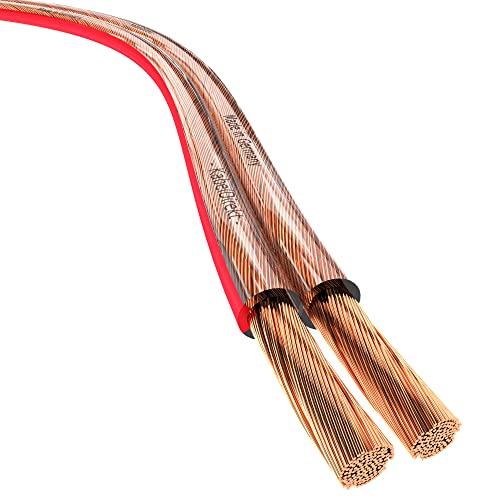
2. KabelDirekt Pure Copper Speaker Cable, 14 AWG, 50 Feet
The KabelDirekt cable is a 14 gauge pure copper speaker wire made in Germany, aimed at hi-fi speakers and surround sound systems where the runs are visible or routed around a room rather than buried in a wall. The conductors use fine pure copper strands of 0.2 millimeters inside a durable yet flexible PVC sheath, and polarity markings help keep positive and negative leads consistent at both ends. At 50 feet, the spool length fits a typical stereo pair or a front stage home theater setup without leaving a large amount of unused wire.
Fourteen gauge is a practical middle ground. It is thick enough for most living room and surround runs with standard speakers, yet easier to route than a 12 gauge jacketed in-wall cable. Pure copper construction also means the printed gauge delivers full copper conductivity, unlike a CCA spool of the same number.
Who It Suits
This cable suits stereo and home theater owners who want pure copper wire in a manageable gauge for room length runs, and who prefer a shorter 50 foot spool over a bulk roll. It is not the pick for in-wall installation, since it is presented as a hi-fi speaker cable rather than a fire rated in-wall cable, and longer whole home runs will need a longer spool.
3. GEARit Pro Series 14 Gauge Speaker Wire, 100 Feet, White
The GEARit Pro Series spool takes the opposite approach to the copper picks above. It is a 14 gauge, two conductor wire made from copper clad aluminum, in a white finish, and it is listed for car audio and home theater use. The listing is clear about the material, describing the conductors as aluminum with copper cladding, which is important information for a buyer. Used with that knowledge, a 14 gauge CCA spool can serve moderate power systems and typical car speaker runs well, and the generous 100 foot length covers a full vehicle or a multi speaker room setup from one spool.
The honest way to use CCA wire is to respect its limits. Keep runs as short as the install allows, avoid pairing it with very low impedance speakers on long distances, and step up to pure copper if the system grows in power or length. For a daily driver car audio upgrade or a secondary room, the white jacket blends with light trim, and the spool weighs less than an equivalent copper spool, which makes it easier to handle during a car install.
Who It Suits
This spool suits car audio installers and budget conscious home theater owners who need a long, light, easy to route wire for moderate power systems and ordinary run lengths. Buyers with long runs, 4 ohm speakers that dip lower, or high power amplifiers should choose one of the pure copper spools instead.
4. Amazon Basics 16-Gauge Speaker Wire, 100 Feet
The Amazon Basics spool is the simplest option here, a 16 gauge speaker wire on a hard plastic spool for easy dispensing and storage. It connects speakers to an audio video receiver or amplifier, and a line on one side of the wire indicates polarity for correct speaker phase alignment. The conductor is copper clad aluminum with a 65 strand construction, so this is a light duty wire and should be chosen for what it is: a convenient spool for short runs and modest systems, not a substitute for thick copper cable on a long home theater run.
Within those limits, it has real appeal. Sixteen gauge wire is thin, flexible, and easy to hide along a baseboard or behind a desk, and 100 feet covers several short connections in an apartment, office, or bedroom system. It also works as a spare spool for temporary setups and for testing speaker placement before a permanent in-wall run. Keeping runs short is the key condition, because a thin CCA wire adds resistance quickly as length grows.
Who It Suits
This spool suits apartment and desktop systems, bedroom and office speakers, temporary setups, and any short run where convenience and flexibility matter more than maximum copper content. It should be skipped for long surround runs, in-wall installation, and high power or low impedance systems, where the 12 gauge and 14 gauge copper picks above are the right tools.
FAQ
What gauge speaker wire is best for most home speakers?
For most home speakers, 14 gauge pure copper wire is a balanced default. It handles typical living room and home theater distances with standard 8 ohm speakers, stays easy to route, and keeps resistance low enough that the wire does not become a factor in sound. Short runs can use 16 gauge, while long runs, in-wall work, and low impedance speakers point to 12 gauge.
Is copper clad aluminum speaker wire bad?
Copper clad aluminum is not automatically bad, but it is less conductive than pure copper at the same gauge, so it behaves like a thinner copper wire. It can work well for short runs, moderate power, and budget car audio or secondary systems, as the GEARit and Amazon Basics spools in this guide show. For long runs and demanding speakers, pure copper is the safer and more predictable choice.
Does speaker wire need a rating to go inside a wall?
Yes, wire installed inside a wall or ceiling should carry the appropriate fire safety rating for that use, such as CL2 or CL3, and should meet local code requirements. The Monoprice Access Series spool in this guide is CL2 rated for residential in-wall use. A basic clear jacket spool made for visible runs should stay visible and should not be hidden inside a wall.
How much speaker wire should be ordered for a room?
Measure each run along the actual path the wire will take, including turns, rises, and drops, then add extra length for routing slack and a service loop behind the amplifier and each speaker. Ordering a spool that is longer than the bare measurement is wise, because a run that comes up short cannot be stretched, and leftover wire on a spool is useful for future moves or added speakers.
Final Verdict
The best wire for speakers is the wire that matches the run, not the wire with the boldest claim on the box. For permanent in-wall home theater work and long distances, the Monoprice Access Series 12 gauge pure copper spool is the strongest pick, combining thick copper with a CL2 rated jacket. For most stereo and surround systems in a single room, the KabelDirekt 14 gauge pure copper cable is the balanced choice, with honest copper conductivity in a flexible 50 foot length. Car audio and budget multi speaker projects are well served by the GEARit Pro Series 14 gauge CCA spool when its material limits are respected, and short, simple connections are exactly what the Amazon Basics 16 gauge spool was made for. Choose the gauge for the longest run in the system, choose copper when the system is demanding, keep polarity consistent, and the wire will do its job quietly for years.
Product and ASIN Reference
| Product name | ASIN |
|---|---|
| Monoprice Access Series 12 Gauge Speaker Wire, 100 Feet | B003L1AFL4 |
| KabelDirekt Pure Copper Speaker Cable, 14 AWG, 50 Feet | B07BBV1J4Z |
| GEARit Pro Series 14 Gauge Speaker Wire, 100 Feet, White | B00HZWYQZG |
| Amazon Basics 16-Gauge Speaker Wire, 100 Feet | B006LW0W5Y |
FAQ
What gauge speaker wire is best for most home speakers?
Is copper clad aluminum speaker wire bad?
Does speaker wire need a rating to go inside a wall?
How much speaker wire should be ordered for a room?
More from Amazon
Programs that pair well with the guide above. Offers and eligibility are set by Amazon and may change.
Free shipping on eligible items, Prime Video and more. Eligible new members can start with a free trial.
Start a Prime free trialA Prime membership for ages 18-24 with a trial period. Eligibility is set by Amazon.
See Prime for Young AdultsAudiobooks and podcasts to listen to on the go. Eligible new members can start with a free trial.
Try Audible freeAd-free music streaming. Eligible new subscribers can start with a free trial.
Try Music Unlimited freeAs an Amazon Associate we earn from qualifying purchases.