Key takeaways
- Five phono preamps with built-in headphone jacks for private vinyl listening, compared on cartridge support, gain, headphone power, and outputs.
A phono preamp with a headphone jack solves a narrow problem well: it lets you hear records through headphones without buying a separate headphone amplifier or powering up a full speaker system. The turntable signal is tiny and needs both RIAA equalization and a large gain boost before it sounds right, and the models in this guide add a headphone stage after that step, so the same small box handles the whole chain from cartridge to ears.

This guide suits late-night listeners, apartment dwellers, and anyone building a compact desk setup around a turntable. It also helps buyers digitizing records who want to monitor takes without speakers. Every model below was picked from its name and published specifications on Amazon pages, and each one has a headphone output listed among its outputs, so the comparison stays focused on that single feature.
Quick Picks
As an Amazon Associate we earn from qualifying purchases
| Product | Best for | Key spec |
|---|---|---|
| Fosi Audio Box X4 | Late-night MM listening with tone controls | 3.5mm headphone output, 16 to 300 ohm headphones |
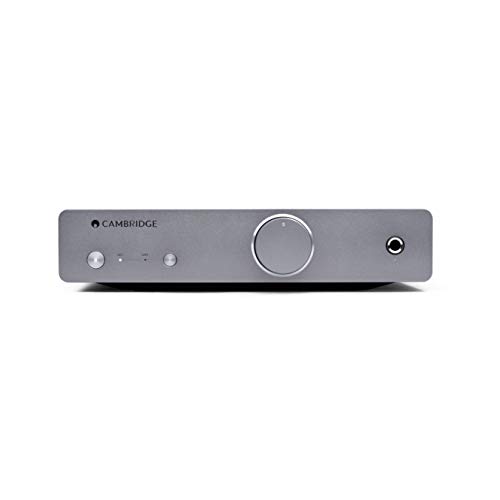
| Cambridge Audio Alva Duo | MM and MC turntables through full-size headphones | 6.35mm headphone output with volume control |
| ART USB Phono Plus PS | Digitizing records while monitoring on headphones | 1/8-inch headphone monitor output with level control |
| Douk Audio T9 | Tube warmth with MM/MC and tone controls | 3.5mm headphone jack, 250mW at 32 ohm |
| Douk Audio T4 PRO | Compact desktop tube preamp for MM turntables | 3.5mm headphone output, 150mW at 32 ohm |
How to Choose
MM vs MC Cartridge Support
Start with the cartridge on your turntable, because it decides which preamps can work at all. Moving magnet cartridges output a stronger signal and need less gain, so most compact preamps, including tube models built for MM only, cover them. Moving coil cartridges output far less signal and need much higher gain plus a different input impedance, so they need a stage with a dedicated MC input or a switchable MM/MC mode. Buying an MM-only box for an MC cartridge leaves the sound quiet and thin, while buying an MC-capable box for an MM cartridge costs more than the extra flexibility is worth. Check the cartridge model on your turntable before shortlisting anything.
Headphone Output Power and Volume Control
Not every headphone jack on a phono preamp is a proper headphone amplifier. Some are simple monitor outputs with a fixed level, while others have a dedicated amplifier circuit and a volume knob of their own. Check the impedance range the listing states: a model rated for 16 to 300 ohm headphones will drive most common pairs, while a model rated only to 32 ohm may struggle with high-impedance studio headphones. Also check whether the volume knob controls the headphones, the line output, or both, because on several models here it controls the headphones only. A separate monitor level control is useful when digitizing records, since it lets you set listening volume without changing the recording level.
Gain Settings and Loading
Gain is the amount the preamp boosts the cartridge signal, and the right amount depends on the cartridge type. Moving magnet cartridges usually need around 40dB of gain, while moving coil cartridges need roughly 60dB, so a fixed-gain stage must match the cartridge you own. Some preamps add a gain trim knob or a switch for different cartridge outputs, which helps when a cartridge is quieter or louder than average. Too little gain makes records sound faint and noisy, while too much gain distorts loud passages and overloads the next component in the chain. If your cartridge is unusual, favor a model with adjustable gain over one with a single fixed setting.
Extra Outputs and Connections
The headphone jack is the headline feature, but the other sockets decide how the preamp fits the rest of your system. A stereo RCA line output feeds powered speakers or an amplifier, and it is the connection most buyers will use alongside headphones. A 3.5mm AUX input lets a phone or tablet share the same speakers through the preamp, which suits a desk setup with several sources. USB and optical outputs matter when you plan to digitize records, since they carry the signal to a computer for recording. Before buying, list the devices the preamp must connect to, then confirm each one has a matching socket on the back of the unit.
The 5 Best Options
Fosi Audio Box X4
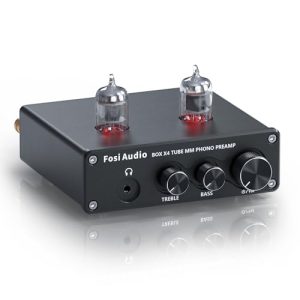
The Fosi Audio Box X4 suits a moving magnet turntable owner who wants tube character and headphone listening in one small box. Its two vacuum tubes sit on top of the metal case, and the front panel carries volume, bass, and treble knobs, so the tone can be shaped without touching another component. A 3.5mm AUX input takes a phone or tablet as a second source, and the RCA output feeds powered speakers or an amplifier when headphones are not in use. It is a practical pick for a bedroom or desk setup where space is tight and late-night listening matters.
Specs
- MM turntable input and 3.5mm AUX input
- RCA output and 3.5mm headphone output
- Headphones from 16 to 300 ohm
- Output level of 650mV at 1kHz
- Signal-to-noise ratio of 70dB
- Dimensions of 3.97 by 4.72 by 1.37 inches
- Two 5725W vacuum tubes included, with a DC 12V power adapter
Best for: Moving magnet turntable owners who want tube character, tone controls, and private headphone listening in one small box.
Watch out for: It supports MM cartridges only, so confirm your turntable uses a moving magnet cartridge before buying.
Cambridge Audio Alva Duo
The Cambridge Audio Alva Duo is the most system-ready pick in this guide, built for listeners who own either a moving magnet or a moving coil cartridge. Separate MM and MC inputs remove any switching guesswork, and the fixed gain figures suit standard cartridges of both types. Its 6.35mm headphone socket takes full-size headphones directly, with a volume dial on the front that controls the headphone feed alone. A subsonic filter helps with warped records, and the unit powers itself down after a period of inactivity. It fits a living-room system that also needs quiet headphone sessions.
Specs
- Separate MM and MC inputs
- Gain of 39dB for MM and 60dB for MC
- 6.35mm headphone output with its own volume control
- Nominal output of 300mV
- Input impedance of 47k ohm for MM and 100 ohm for MC
- Input capacitance of 100pF
- Subsonic filter and auto power down after 20 minutes
- Dimensions of 1.9 by 8.5 by 6.2 inches; weight of 2.1 lbs
Best for: Listeners with MM or MC cartridges who want a full-size headphone socket and a simple fixed-gain stage.
Watch out for: Gain and loading are fixed, so check that your cartridge matches the stated MM and MC inputs before buying.
ART USB Phono Plus PS
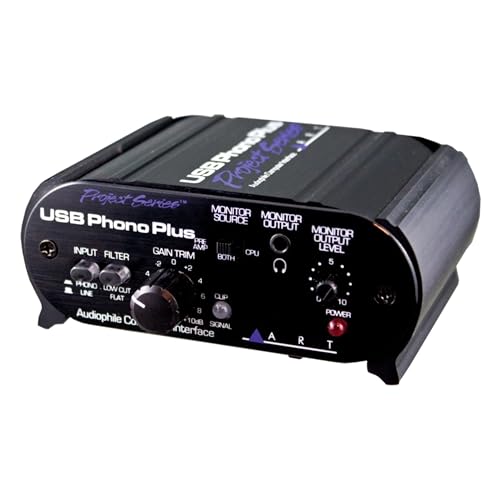
The ART USB Phono Plus PS is the pick for anyone whose main job is moving records onto a computer. Its USB connection carries the phono signal to recording software, while the headphone monitor output lets each take be checked as it is captured. Gain and monitor level controls sit on the front, and a low-cut filter trims rumble from warped or worn records. Optical and S/PDIF connections add flexibility for digital sources, and the switchable phono or line input means a tape deck or second source can share the same box. It earns its place as a digitizing tool rather than a plain listening stage.
Specs
- Switchable phono or line level stereo RCA input
- 1/8-inch headphone monitor output with independent level control
- Maximum gain of 45dB at 1kHz for phono
- Input impedance of 47k ohm and 100pF for phono
- Maximum input level of 40mV RMS at 1kHz for phono
- Maximum output level of 1.4V RMS
- Frequency response of 10Hz to 50kHz
- Digital conversion of 16-bit at 44.1kHz or 48kHz
- S/PDIF and optical inputs, plus optical output
- USB bus powered, with an optional external adapter
- Dimensions of 1.85 by 4.6 by 4.5 inches; weight of 1.35 lbs
Best for: Listeners digitizing a record collection who want to monitor each take on headphones while recording.
Watch out for: Digital conversion is limited to 16-bit at 44.1kHz or 48kHz, so it will not capture higher-resolution files.
Douk Audio T9

The Douk Audio T9 brings tube sound, tone controls, and MM/MC support together in a compact unit with a clear headphone focus. Two 6A2 signal tubes warm the sound, while two 6E2 tubes on the faceplate show signal level with a glow that can switch between green and orange. Bass and treble knobs sit on the front, so the balance can be adjusted for thin or boomy pressings without reaching for another device. The dedicated headphone amplifier drives a wide range of headphones, and the RCA output feeds an amplifier or powered speakers for shared listening. It suits listeners who enjoy tube presentation and direct control.
Specs
- Phono input for MM and MC cartridges, plus RCA AUX input
- Stereo RCA output and 3.5mm headphone jack
- Headphone impedance range of 16 to 300 ohm
- Headphone output power of 250mW at 32 ohm
- Phono input level of 0.005V RMS for MM and 0.0005V RMS for MC
- Phono output level of 0.6V RMS
- Input impedance of 47k ohm for MM and 330 ohm for MC
- Two 6E2 tubes and two 6A2 tubes
- Bass and treble controls
- Dimensions of 6.06 by 3.43 by 1.85 inches; net weight of 600g
Best for: Listeners who want tube sound, tone controls, and MM/MC support with a dedicated headphone output.
Watch out for: It is a preamp, not a power amplifier, so it needs an amplifier or active speakers downstream for room listening.
Douk Audio T4 PRO
The Douk Audio T4 PRO is the smallest tube option here, built for a desk where every centimeter counts. Its JAN5654 tubes give the sound a warm character, and the single volume knob controls both the headphone and RCA outputs at once, so one turn sets the level everywhere. A 3.5mm AUX input lets a phone or tablet join the turntable as a second source, and the built-in headphone amplifier handles common headphone impedances without extra hardware. It is a neat fit for a moving magnet turntable beside a computer, where the preamp doubles as the headphone station for the whole desk.
Specs
- MM phono input and 3.5mm AUX input
- Stereo RCA output and 3.5mm headphone jack
- Headphone impedance range of 32 to 300 ohm
- Maximum headphone output of 150mW at 32 ohm
- Two JAN5654 vacuum tubes included
- Output level of 1.5V with an input of 0.775V
- Frequency response of 20Hz to 20kHz for AUX input, standard RIAA for phono input
- Dimensions of 3.74 by 4.61 by 1.18 inches; net weight of 330g
- DC 12V power adapter and 3.5mm to RCA cable included
Best for: Desktop listeners with an MM turntable who want tube sound and headphones in a single small box.
Watch out for: It supports MM cartridges only, so moving coil turntables need a different preamp.
Which One Fits Your Situation
You listen late at night in a shared home
Fosi Audio Box X4 fits this situation best, because its front headphone jack and volume knob keep the music private without extra boxes. Plug in headphones, turn the volume down, and the turntable plays only for you, while the bass and treble knobs tame pressings that sound harsh at low volume. The RCA output stays available for daytime speaker listening, so one small unit covers both quiet nights and normal sessions.
You own a moving coil cartridge
Cambridge Audio Alva Duo is the match here, since it has a dedicated MC input with higher gain and the correct loading for low-output cartridges. An MM-only preamp would leave a moving coil cartridge too quiet, but the Duo switches the problem away by giving each cartridge type its own input. Its full-size headphone socket also means late sessions need no extra amplifier, and the fixed gain keeps setup simple.
You want to digitize a record collection
ART USB Phono Plus PS is built for this job, because it sends the phono signal to a computer over USB while the headphone monitor output lets you hear each take as it records. Gain and monitor level knobs help set a clean recording level, and the low-cut filter reduces rumble from worn records. It also works as a normal phono preamp through its RCA output, so the same box serves both archiving and everyday listening.
You want one small box for a desk setup
Douk Audio T4 PRO suits a crowded desk, because it combines an MM phono stage, an AUX input, and a headphone amplifier in a case not much larger than a paperback. One knob sets the volume for headphones and speakers together, and the tube stage adds warmth without extra components. Keep the turntable beside the computer, plug headphones into the front, and the whole vinyl chain lives in a single compact unit.
Common Mistakes
- Buying an MM-only preamp for a moving coil cartridge, which leaves the sound far too quiet to enjoy.
- Plugging the preamp output into a phono input on an amplifier, which applies equalization twice and distorts the sound.
- Skipping the ground wire, which lets hum build up behind the music on many turntables.
- Choosing headphones without checking the stated impedance range, then finding loud or quiet results.
- Expecting the headphone volume knob to change the RCA output level, when on several models it controls headphones only.
Frequently Asked Questions
Do I still need an amplifier if the phono preamp has a headphone jack?
No, not for headphone listening. The headphone output has its own amplifier stage, so headphones plug straight into the preamp and play. An amplifier or powered speakers are still needed when you want room sound, since the preamp only raises the cartridge signal to line level and cannot drive passive speakers on its own.
Will any headphones work with a phono preamp headphone output?
Most common headphones work, but check the impedance range in the listing first. Models here state ranges from 16 to 300 ohm, which covers everyday pairs and many studio models. Very high-impedance headphones may sound quiet on a modest headphone stage, while very sensitive earphones may reveal background hiss. Match the headphone impedance to the stated range before buying.
Can I use the headphone output and the RCA output at the same time?
It depends on the model. Some preamps keep both outputs live, so headphones and speakers play together unless the amplifier is switched off. Others give the headphone jack priority and silence the RCA output while headphones are plugged in. Check the listing or manual for the model you buy, and plan on unplugging headphones when you want speakers alone.
Does a phono preamp with a headphone jack work with MC cartridges?
Only if the model lists moving coil support. Several preamps in this guide are moving magnet only, and they cannot give a low-output MC cartridge enough gain. The Cambridge Audio Alva Duo and the Douk Audio T9 both list MC inputs, so they suit moving coil turntables. Always confirm the cartridge type on your turntable and match it to the inputs the listing states.
FAQ
Do I still need an amplifier if the phono preamp has a headphone jack?
Will any headphones work with a phono preamp headphone output?
Can I use the headphone output and the RCA output at the same time?
Does a phono preamp with a headphone jack work with MC cartridges?
More from Amazon
Programs that pair well with the guide above. Offers and eligibility are set by Amazon and may change.
Free shipping on eligible items, Prime Video and more. Eligible new members can start with a free trial.
Start a Prime free trialA Prime membership for ages 18-24 with a trial period. Eligibility is set by Amazon.
See Prime for Young AdultsAudiobooks and podcasts to listen to on the go. Eligible new members can start with a free trial.
Try Audible freeAd-free music streaming. Eligible new subscribers can start with a free trial.
Try Music Unlimited freeAs an Amazon Associate we earn from qualifying purchases.