Key takeaways
- Find the best 3D scanner for miniatures, from blue-light precision models to laser scanners that capture fine detail on painted figures without spray.
A miniature lives or dies on detail smaller than a grain of rice: the edge of a sword, the fold of a cloak, the expression on a 28 mm face. Choosing the best 3D scanner for miniatures means finding a machine fine enough to catch those features instead of melting them into smooth blobs, while covering the whole figure in one pass. Accuracy, point distance, and working distance matter more here than scan volume, because a scanner built for furniture will skip the details that make a miniature worth keeping.
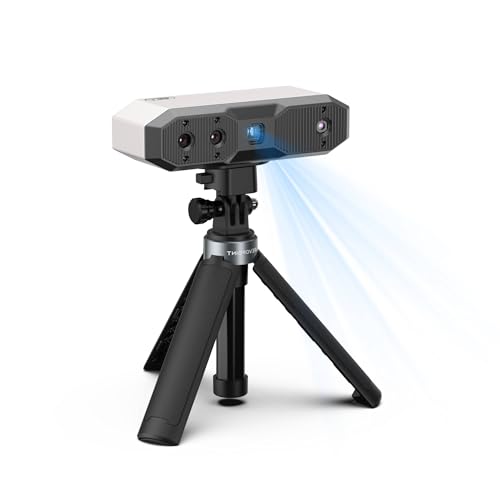

This guide is for tabletop gamers digitizing painted warbands, hobbyists archiving resin prints, and makers who want clean meshes for reprints or painting reference. Every scanner below was chosen from its name and listed specifications on its Amazon page, with attention to small-object modes, turntable support, color capture, and file exports that feed a slicer or a painting workflow. Match the scanner to the figures you scan most, not the biggest object it can handle.
Quick Picks
As an Amazon Associate we earn from qualifying purchases
| Product | Best for | Key spec |
|---|---|---|
| Revopoint MINI 2 | Finest detail on small figures | 0.02 mm precision, industrial blue light |
| 3DMakerpro Seal Lite Advanced | Fine blue-light detail on small figures | 0.02 mm accuracy, 10 fps |
| Creality CR-Scan Ferret | Fast color scans from a phone | 0.1 mm accuracy, 30 fps |
| 3DMakerpro Fox | First scanner for display pieces and busts | 0.07 mm accuracy, 10 fps |
| Revopoint INSPIRE 2 | Painted and dark figures without spray | 0.03 mm precision, multi-line laser |
How to Choose
Accuracy and Resolution for Small Scale
Point distance decides whether a sword edge stays sharp or turns to mush. A scanner with a point distance near 0.02 mm lays down a dense cloud of points across a 28 mm figure, so cheekbones, buckles, and weapon hilts survive the jump to a mesh. Accuracy near 0.05 mm keeps proportions honest when you reprint at the same scale. Anything coarser than 0.1 mm still works for chunky display pieces, yet it softens the fine lines painters care about. Check both numbers on the listing: accuracy describes how true each measurement is, while point distance describes how tightly the points sit together.
Scan Volume Versus Miniature Size
Miniatures sit at the small end of every scanner range, so minimum scan volume matters more than maximum. A scanner that starts at 10 mm cubes can frame a single 28 mm soldier without drowning it in empty space, while one that starts at 20 mm may still manage the same figure with careful framing. Working distance shapes the setup too: a close range of 120 to 250 mm suits a desktop tripod and turntable, while a longer reach helps when a figure sits inside a diorama. Match the smallest figure you own to the minimum volume, then confirm the largest piece you plan to scan fits inside the capture area.
Handling Painted and Dark Surfaces
Painted miniatures fight scanners in two ways: dark paint swallows light, and glossy varnish bounces it straight back. Infrared scanners often lose tracking on black armor or deep red cloaks, leaving holes in the mesh where the paint is darkest. Blue-light and laser modes cope better, since their projected patterns stay readable on muted tones. A light dusting of scanning spray fixes stubborn gloss, though it hides the finest paint texture and must be cleaned off afterward. Before buying, check whether the listing mentions dark-object scanning, and expect to scan matte-primed figures far more easily than varnished showpieces.
Software and Export for Printing and Painting
Good hardware turns useless without software that cleans, aligns, and exports the scan. Look for a program that fills small holes, smooths noise without erasing detail, and lets you cut away the turntable or base before export. STL and OBJ cover most slicers, while PLY keeps color data for painting reference or digital display. Some makers also want FBX or GLTF for game engines and virtual tabletops. Confirm the supported operating systems as well: several scanners run on Windows and macOS only, so a phone-only or Linux setup may need a different pick.
The 5 Best Options
Revopoint MINI 2
Built around blue structured light, the MINI 2 is the most detail-hungry scanner in this lineup, and the natural first stop for anyone scanning 28 mm figures. Its tight working distance and tiny minimum volume suit a desktop tripod and turntable, where a figure can rotate slowly while the scanner holds its framing. Color capture with flash LEDs records paint schemes alongside geometry, which helps when a scan doubles as painting reference. The trade is a short leash: blue light wants indoor lighting, and the close range rewards a patient hand.
Specs
- Dual-camera blue structured light with Class 1 blue light
- Single-frame precision up to 0.02 mm; single-frame accuracy up to 0.05 mm
- Point distance up to 0.02 mm; scan speed up to 16 fps
- Working distance 120 to 250 mm; minimum scan volume 10 x 10 x 10 mm
- Weight 175 g; size 132 x 53 x 36 mm
- 2-megapixel depth and RGB cameras with white flash LEDs
- Output formats PLY, OBJ, STL, ASC, 3MF, GLTF, FBX
- Wi-Fi 6 and USB Type-C; Windows, Android, iOS, and macOS support
Best for: Capturing the finest detail on 28 mm figures and small resin prints.
Watch out for: Blue light needs indoor lighting, and the recommended computer is fairly strong, so check the system requirements before buying.
ASIN: B0FPX96RST
3DMakerpro Seal Lite Advanced
The Seal Lite Advanced brings blue-light precision to the miniature bench at a hobbyist-friendly size. Its 0.02 mm accuracy resolves sword edges, cloak folds, and facial features on figures from 10 mm upward, while anti-shake lenses steady the capture when your hand drifts during a pass. At 190 g it is light enough to circle a figure on a turntable without tiring your arm, and the JMStudio software exports OBJ, STL, and ASC files that feed a slicer directly. Windows and macOS support covers the usual painting-desk setup, so the scanner slots into a resin-printing workflow without extra hardware.
Specs
- 0.02 mm accuracy with blue structured light, 400 to 500 nanometer wavelength
- 10 fps scanning speed
- Anti-shake lenses for steadier handheld capture
- Weighs 190 g
- JMStudio software with free over-the-air updates and support for eight languages
- Exports OBJ, STL, and ASC files
- Compatible with Windows and macOS
Best for: Fine blue-light detail on small figures, from 10 mm upward.
Watch out for: The listing names Windows and macOS only, so confirm your computer is covered before buying.
ASIN: B0FN7R56KL
Creality CR-Scan Ferret

Speed is the Ferret story. At 30 fps it sweeps around a figure quickly, which helps when you scan a whole squad or a diorama with several pieces. Full-color capture keeps paint schemes attached to the mesh, and phone support means a spare Android handset can run the session at a club table. The 0.1 mm accuracy sits a step behind the blue-light picks, so the finest facial lines may soften, yet weapons, armor plates, and poses come through cleanly. It suits makers who value fast sessions over microscopic detail.
Specs
- Up to 0.1 mm accuracy and 0.16 mm 3D resolution
- 30 fps scanning speed
- Full-color scanning
- Works with Android phones and Windows 10 and 11 PCs
- Item model number CR-Scan Ferret
- Handheld design
Best for: Fast color scans of squads and dioramas, including sessions run from a phone.
Watch out for: Accuracy is coarser than the blue-light scanners here, so check that 0.1 mm is fine for your smallest figures.
ASIN: B0F1JB4BBM
3DMakerpro Fox
The Fox is the entry-level route into this lineup, built for makers who want a first scanner without a steep learning curve. Its 0.07 mm accuracy and 0.10 mm resolution hold up well on display pieces and busts, while markerless AI tracking means no target dots stuck to a painted figure. At 210 g it is light enough for long handheld passes, and the manual turntable in the box handles hands-free rotation for larger pieces. JMStudio exports OBJ, STL, PLY, and ASC files for the slicer, and Windows and macOS support covers the usual desk setup.
Specs
- 0.07 mm accuracy and 0.10 mm resolution
- 10 fps scanning speed
- Near-infrared structured light with markerless AI tracking
- Scans objects from 40 mm to 1200 mm
- Single capture range 200 x 100 mm; working distance 150 to 400 mm
- Weighs 210 g; measures 115 x 70 x 35 mm
- Manual turntable included
- Exports OBJ, STL, PLY, and ASC files
- Compatible with Windows 10/11 and macOS 12/13
Best for: A first scanner for display pieces and busts, with hands-free turntable passes.
Watch out for: The recommended object range starts at 40 mm, so the smallest 28 mm figures sit below its sweet spot; reserve it for larger pieces.
ASIN: B0GYX9MLP5
Revopoint INSPIRE 2

Painted figures are the INSPIRE 2 brief. Its dual-mode capture pairs infrared structured light with an 11-line infrared laser, and the laser mode keeps tracking on dark armor and glossy varnish where ordinary scanners drop frames. A 0.03 mm point precision and 20 mm minimum object size keep it honest on small subjects, while wireless phone scanning frees the session from a desk. The Premium mobile kit suits club nights and painting meetups, where the scanner, a phone, and a pocket turntable are the whole setup.
Specs
- Point precision 0.03 mm; single-frame accuracy 0.05 mm; resolution 0.05 mm
- Dual-mode capture: infrared structured light plus 11-line infrared laser
- Scan speed up to 18 fps
- Object range 20 to 2000 mm
- Outdoor scanning rated to 20,000 lux
- Wireless scanning for iOS, Android, Windows, and macOS
- Premium mobile kit for phone-based scanning
Best for: Painted and dark figures that need laser tracking without spray.
Watch out for: Kit contents vary between editions, so confirm the Premium mobile kit listing includes the phone accessories you need.
ASIN: B0G4LXXB5W
Which One Fits Your Situation
You paint tabletop armies and want digital backups of finished squads
Painted squads need color and speed more than laboratory precision, and the Creality CR-Scan Ferret covers both. Its 30 fps capture moves through a unit quickly, full color keeps each paint scheme attached to the mesh, and phone support lets you scan at the club table right after a game. Keep the finest heroes for a blue-light pass later, and let the Ferret archive the rank-and-file troops.
You print resin miniatures and need clean meshes for reprints
Reprints punish every softened edge, so start with the Revopoint MINI 2. Its 0.02 mm point distance preserves the details your resin printer can reproduce, and the 10 mm minimum volume frames single figures without wasted space. Scan the master print on a turntable, export STL, and slice the mesh at the same scale. The indoor blue-light setup suits a desk, which is where most printing happens anyway.
You scan at a club or event with only a phone in your pocket
Club tables rarely have room for a laptop, tripod, and cables, which is where the Revopoint INSPIRE 2 Premium earns its keep. Wireless phone scanning and the mobile kit turn a pocket setup into a working station, while the laser mode handles the dark-painted figures other scanners miss. Scan a finished army between games, then process the mesh at home on a full computer.
You want the cheapest way to try scanning larger display pieces
Starting out with busts and display pieces calls for a patient, hands-free approach, and the 3DMakerpro Fox fits that brief. The manual turntable in the box does the rotating while the scanner stays fixed, so long sessions need no steady arm. Its accuracy suits bold shapes and big silhouettes, making it a fair first scanner for collectors who want to digitize a shelf before committing to a finer machine.
Common Mistakes
- Buying for maximum scan volume instead of minimum volume, then finding small figures lost in empty space.
- Scanning a freshly varnished figure and blaming the scanner when gloss breaks tracking.
- Skipping calibration and marker setup, then wondering why separate passes refuse to align.
- Exporting a raw point cloud straight to the slicer without cleaning holes or cutting away the turntable.
- Choosing a scanner whose software runs only on an operating system you do not own.
Frequently Asked Questions
Can a 3D scanner capture a 28 mm miniature?
Yes, when the scanner is built for small objects. Look for a minimum scan volume near 10 mm and a point distance near 0.02 mm, which together frame a single figure and keep facial features intact. The Revopoint MINI 2 meets both marks. Wider scanners built for furniture will still see the figure, yet fine detail will soften or vanish.
Do I need scanning spray for painted miniatures?
Not always. Matte-primed figures usually scan cleanly, while dark paint and glossy varnish cause most of the trouble. A laser-mode scanner such as the Revopoint INSPIRE 2 handles dark surfaces without spray, and a light dusting fixes stubborn gloss when needed. Spray hides the finest paint texture, so use it only on the areas that refuse to track.
What file format should I export for 3D printing?
STL is the safe default, since every common slicer opens it and it carries the mesh cleanly. OBJ adds material and texture data when you want to keep paint information alongside geometry. PLY preserves color too, which helps for painting reference and digital display. Export at the same scale you scanned, and check the mesh for holes before slicing.
Can one scanner handle both miniatures and larger models?
Yes, when its object range covers both ends. The Revopoint INSPIRE 2 scans objects from 20 mm to 2000 mm, so a single figure and a bust share one machine. The trade is precision: a scanner tuned for tiny detail usually beats a wide-range model on faces and weapons. Pick the range around the figures you scan most, not the largest object you might scan once.
FAQ
Can a 3D scanner capture a 28 mm miniature?
Do I need scanning spray for painted miniatures?
What file format should I export for 3D printing?
Can one scanner handle both miniatures and larger models?
More from Amazon
Programs that pair well with the guide above. Offers and eligibility are set by Amazon and may change.
Free shipping on eligible items, Prime Video and more. Eligible new members can start with a free trial.
Start a Prime free trialA Prime membership for ages 18-24 with a trial period. Eligibility is set by Amazon.
See Prime for Young AdultsAudiobooks and podcasts to listen to on the go. Eligible new members can start with a free trial.
Try Audible freeAd-free music streaming. Eligible new subscribers can start with a free trial.
Try Music Unlimited freeAs an Amazon Associate we earn from qualifying purchases.