Our Short List of 3
- Type: Cycling-specific insole for cycling shoes
- Arch profiles: Low, Medium and High
- Sizes: XS, S, M, L, XL and 2XL
- Arch system: 3D Dynamic Arch Technology (DAT) nylon composite bridge

- Base material: EVA (ethylene vinyl acetate)
- Profile: Thin, low volume
- Fit system: Heat moldable and wear moldable
- Intended footwear: Tight-fitting shoes, including cycling shoes and cleats per SOLE fit guidance

- Line: Running line, low-volume profile suited to tight athletic shoes
- Arch: Low arch Superfeet shape
- Stabilizer: Carbon fiber cap
- Fit: Trim-to-fit
All 4 Picks at a Glance
| Product | Specs | Action |
|---|---|---|
| 1. CURREX BikePro — Made Specifically For Cycling Shoes |
| Check price on Amazon |
| 2. SOLE Active Thin — Low-Volume And Moldable |
| Check price on Amazon |
| 3. Superfeet Run Support Low Arch (Carbon) — Thin Carbon Support |
| Check price on Amazon |
 5. Sof Sole AIRR Orthotic — Cushioned Gel Option That Names Cycling |
| Check price on Amazon |
Key takeaways
- Find the best insoles for cycling shoes in five verified footbeds, compared on arch height, thickness, moldability and sizing for road and MTB shoes.
As an Amazon Associate, I earn from qualifying purchases.
The insole that ships inside most cycling shoes is a thin, flat piece of foam with no arch shape at all. An aftermarket footbed replaces it with a shaped platform that supports the arch, cups the heel and spreads pressure across the forefoot, where the pedal pushes back for hours at a time. The catch is volume: cycling shoes are cut close, especially road and cross-country models, so thick cushioned insoles sold for running shoes often will not fit without lifting the heel or crowding the toes. The five footbeds below were chosen with that constraint first. One is designed specifically for cycling shoes, two are thin low-volume models their makers position for tight footwear, one is a moldable cork footbed with a built-in metatarsal pad for roomier mountain bike shoes, and one is a cushioned sport insole whose listing names cycling among its uses.
How To Choose Insoles For Cycling Shoes
Thickness and volume come first. An insole that is too thick raises your foot inside the shoe, which can cause heel lift, toe pressure against the upper and hot spots over the forefoot. Thin, low-volume footbeds suit snug road and XC shoes; medium-volume models need the extra room found in trail, enduro and winter mountain bike shoes. Compare the stock insole’s thickness with the replacement first: if the new one is much thicker at the forefoot, expect a tighter fit.
Arch height has to match your foot. Footbeds are sold in low, medium and high arch versions, or as a single shape that molds to the foot over time. A low arch under a high-arched foot leaves the midfoot unsupported, while a high arch under a flat foot can feel like standing on a stone. Matching the profile to your arch matters more than any single feature on the box.
Moldable versus fixed shapes. Heat-moldable footbeds soften in a low oven and take the shape of your foot as you stand on them; wear-moldable models do the same job gradually over the first rides. Fixed-shape insoles are ready straight from the packet but cannot adapt if the arch position feels wrong.
Metatarsal pads and forefoot shape. Cycling loads the ball of the foot rather than the heel, so several cycling footbeds add a small raised pad behind the toes to spread the forefoot. If your stock insoles leave the front of your foot feeling cramped on long climbs, a model with a metatarsal pad is worth a look; riders who prefer a flat forefoot feel should choose one without.
Sizing and trimming. Most of these footbeds are sold in whole shoe sizes or letter sizes that each cover a range, and most can be trimmed at the toe with scissors using the stock insole as a template. Buy for your shoe size first, then trim conservatively: you can always remove more material, and a footbed cut too short will slide.
The 5 Best Insoles For Cycling Shoes
1. CURREX BikePro — Made Specifically For Cycling Shoes
- Type: Cycling-specific insole for cycling shoes
- Arch profiles: Low, Medium and High
- Sizes: XS, S, M, L, XL and 2XL
- Arch system: 3D Dynamic Arch Technology (DAT) nylon composite bridge
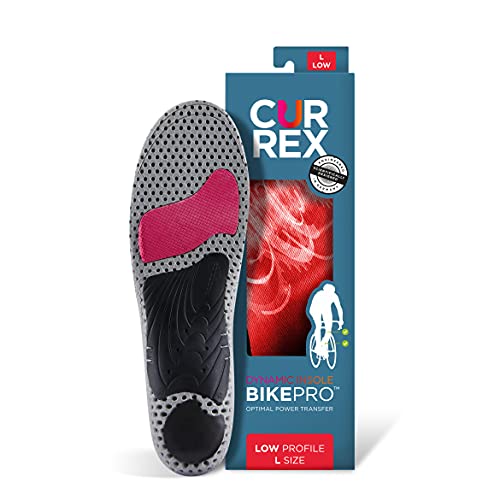
The BikePro is the only insole in this list designed from the start for cycling shoes, and its listing covers bicycle and motorcycle riding for men and women. Instead of one fixed arch, CURREX sells it in three profiles — Low, Medium and High — so you match the insole to your arch height, and six sizes from XS to 2XL cover the adult range. Support comes from the brand’s 3D Dynamic Arch Technology, a nylon composite bridge under the midfoot that flexes as you pedal instead of acting as a rigid plate. A metatarsal pad sits in the forefoot, and the maker describes PORON cushioning at the heel and ball of the foot, under a moisture-wicking top layer. The toe can be trimmed slightly for an exact fit. The listing this ASIN was verified against is the Low Arch variant in size 2XL, so check you are ordering the profile and size you need.
2. SOLE Active Thin — Low-Volume And Moldable
- Base material: EVA (ethylene vinyl acetate)
- Profile: Thin, low volume
- Fit system: Heat moldable and wear moldable
- Intended footwear: Tight-fitting shoes, including cycling shoes and cleats per SOLE fit guidance
SOLE builds its footbeds around molding: the Active Thin is both heat moldable and wear moldable, so it either takes the shape of your foot in a low oven before the first ride or settles into that shape gradually as you use it. The base is EVA, and the Thin is the lowest-volume model in the Active line. SOLE’s own fit guidance places its Thin footbeds in tight-fitting footwear, naming cycling shoes and cleats among them, which makes this the natural pick for snug road and XC shoes rather than the thicker Medium and Thick versions. The listing gives the material as ethylene vinyl acetate, and its size chart advises sizing down on half sizes. There is no separate arch-height choice, because molding sets the arch shape from your own foot.
3. Superfeet Run Support Low Arch (Carbon) — Thin Carbon Support
- Line: Running line, low-volume profile suited to tight athletic shoes
- Arch: Low arch Superfeet shape
- Stabilizer: Carbon fiber cap
- Fit: Trim-to-fit
This one comes from Superfeet’s running line, and it is included for one honest reason: its thin, low-profile carbon build fits inside close-cut cycling shoes where most running insoles cannot go. Superfeet lists it as a trim-to-fit insole for tight athletic shoes, with a low arch version of the brand’s signature shape and a carbon fiber stabilizer cap under the rear and midfoot. Sizing is sold in ranges pairing men’s and women’s sizes; the verified listing covers 7.5 to 9 in men’s sizes and 8.5 to 10 in women’s. Superfeet sells medium and high arch versions in the same line. It is not cycling-specific and offers no metatarsal pad, but as a thin, firm, low-arch footbed that disappears inside a snug shoe, it earns its place.
4. SOLE Performance Medium With Met Pad — Moldable Cork For Roomier Shoes
The second SOLE entry takes the opposite approach to the Active Thin: more structure, more cushion, and a built-in metatarsal pad, in exchange for a medium-volume profile that needs a roomier shoe. The base is SOLE’s ReCORK material, made from recycled wine corks, with 1.6 mm of non-compressing cushioning over it and a moisture-wicking synthetic topsheet with a Polygiene odor-control coating. Like the Active Thin it is heat and wear moldable, so the arch shape ends up matched to your foot rather than a generic last. SOLE describes this footbed as best suited to medium-fitting footwear such as running shoes and tennis shoes, so read that honestly: this is the pick for trail and enduro shoes with some internal volume, not a skin-tight XC race shoe. The verified listing is the men’s size 10 and women’s size 12 pairing, and the line is sold across a full run of sizes.
Specs
- Base material: ReCORK recycled wine cork
- Cushioning: 1.6 mm non-compressing cushion layer
- Forefoot: Built-in metatarsal pad
- Top sheet: Moisture-wicking synthetic with Polygiene odor-control coating
- Fit system: Heat moldable and wear moldable
- Volume: Medium, for medium-fitting footwear per SOLE
- ASIN: B07NZWZ3RB
5. Sof Sole AIRR Orthotic — Cushioned Gel Option That Names Cycling
- Heel: Encapsulated air chamber
- Forefoot: Polymer gel
- Arch: Reinforced nylon stability plate, for low to neutral arches
- Top cover: COOLMAX fabric
The AIRR Orthotic is the most cushioned insole here and the furthest from a cycling-specific design, so it comes with a clear label: this is a general sport insole whose own listing names cycling among its intended activities, alongside walking, running, jumping and cross training. An encapsulated air chamber sits in the heel, polymer gel pads the forefoot, and a reinforced nylon stability plate runs through the arch, aimed at low to neutral arch types. A COOLMAX fabric top cover wicks moisture. The trade-off is bulk: the listing’s dimensions for the men’s 9 to 10.5 size run to 1.18 inches at the thickest point, far thicker than the thin models above, so this one belongs in roomy shoes you ride in — not a snug road shoe. Sizes come in four men’s ranges from 7 up to 14. For flat-pedal riders and commuters with shoe volume to spare, it is a legitimate, honestly labelled option.
Fitting Notes Before You Ride
Whichever model you choose, fit it at home before the first ride. Remove the stock insole, lay it over the new footbed and trim the toe end to match, cutting a little at a time. For moldable models, follow the maker’s heating instructions exactly and stand in the shoes while they set. Give any new insole two or three shorter rides before a long day out, because a different arch shape changes how the foot sits. If a footbed makes a shoe feel too tight across the toes, it is too thick for that shoe — move it to a roomier pair.
Frequently Asked Questions
Can I put running insoles in cycling shoes?
Sometimes, but thickness decides it. Running insoles are usually built with thick heel cushioning for impact, and that extra volume often lifts the heel and crowds the toes inside a close-fitting cycling shoe. Thin, low-profile running models like the carbon Superfeet above can work well. If the shoe feels tight across the forefoot or your heel slips when you pull up on the pedals, the insole is too thick for that shoe.
How thick should an insole for cycling shoes be?
Match the replacement to the stock insole you removed. Snug road and cross-country shoes generally suit thin footbeds at the low-volume end of a maker’s range, while trail and enduro shoes with more internal room can take medium-volume models. SOLE’s Thin, Medium and Thick footbeds step up in total thickness, and its own guidance puts the Thin in tight footwear such as cycling shoes and cleats.
Should I choose a moldable insole or a fixed shape?
Choose moldable if your arches do not match the standard low, medium and high categories, or if one foot differs from the other, because the footbed takes its shape from your own feet. Choose a fixed shape if you want to ride immediately and your arch fits a standard profile well; models like the CURREX BikePro offer three fixed profiles so you can pick the closest match.
When should I replace the insoles in my cycling shoes?
Replace them when the signs of wear show up: a topsheet worn smooth or torn, a base cracked or permanently flattened at the forefoot, or an arch that no longer holds its shape when you press it. A footbed that has gone flat gives no more support than the stock foam it replaced. Riders who log long weekly hours wear through a pair sooner, so check the forefoot and heel whenever you clean your shoes.
Conclusion
The right insole for a cycling shoe supports your arch without stealing the shoe’s internal volume. The CURREX BikePro is the purpose-built choice, with three arch profiles and a cycling-specific shape. The SOLE Active Thin is the moldable low-volume pick for snug shoes, and the Superfeet Run Support Low Arch brings a thin carbon plate to low-arched feet. Roomier mountain bike shoes open the door to the moldable cork SOLE Performance Medium with its metatarsal pad, or the heavily cushioned Sof Sole AIRR for commuting and flat-pedal use. Measure your stock insoles, match the arch, and trim carefully.
FAQ
Can I put running insoles in cycling shoes?
How thick should an insole for cycling shoes be?
Should I choose a moldable insole or a fixed shape?
When should I replace the insoles in my cycling shoes?
More from Amazon
Programs that pair well with the guide above. Offers and eligibility are set by Amazon and may change.
Free shipping on eligible items, Prime Video and more. Eligible new members can start with a free trial.
Start a Prime free trialA Prime membership for ages 18-24 with a trial period. Eligibility is set by Amazon.
See Prime for Young AdultsAudiobooks and podcasts to listen to on the go. Eligible new members can start with a free trial.
Try Audible freeAd-free music streaming. Eligible new subscribers can start with a free trial.
Try Music Unlimited freeAs an Amazon Associate we earn from qualifying purchases.