Our Short List of 3
- Fabric: 95% Polyester, 5% Spandex
- Nursing access: Double layer front for breastfeeding
- Neckline: Scoop neck
- Sleeve: Short flutter sleeve

- Fabric: 50% Rayon, 45% Polyester, 5% Spandex
- Nursing access: Shoulder button design
- Neckline: Scoop neck
- Sleeve: Sleeveless

- Fabric: 93.1% Rayon, 6.9% Spandex
- Nursing access: Split front design for breastfeeding
- Neckline: Scoop neck
- Sleeve: Short sleeve
All 4 Picks at a Glance
| Product | Specs | Action |
|---|---|---|
| CzzzyL Floral Print Nursing Dress |
| Check price on Amazon |
| OUGES Nursing Dress With Shoulder Buttons |
| Check price on Amazon |
| Smallshow Split Long Dress |
| Check price on Amazon |
 QINYI Cotton Midi Nursing Dress |
| Check price on Amazon |
Key takeaways
- This guide to the best bike nursing dresses compares five breastfeeding dresses by nursing access, fabric, length, pockets, size chart and care notes.
A nursing dress earns its place in a wardrobe by doing two jobs at once: it has to look like an ordinary dress, and it has to open quickly and discreetly when a baby needs feeding. The five dresses below were all sold with a built-in way to nurse, whether that is a double layer front that lifts, a split panel, or buttons at the shoulder. None of them is a plain maternity dress with no feeding access, and each entry sticks to what its product page states about fabric, construction, sizing, and care.
As an Amazon Associate, I earn from qualifying purchases.
The five picks split along practical lines. Two are long maxi styles with short sleeves for everyday wear, one is a sleeveless midi with a side slit, one is a short sleeve dress with a hidden feeding opening, and one is a cotton midi with half sleeves and the widest size range of the group. Four of the five have pockets. Fabrics range from a cotton-rich blend to rayon-rich knits and polyester blends, and the care labels range from machine wash to hand wash, so the right choice depends on how the dress will actually be worn week to week.
What to Look For in a Nursing Dress
Start with the access design, because it decides how a feeding goes in public. The most common arrangement is a double layer front: an outer layer lifts up while an inner layer stays in place, which keeps the stomach and most of the chest covered. A second style uses a split or crossover panel that pulls aside. A third, used by the sleeveless dress below, puts buttons at the shoulder so one side of the neckline drops. Lift-up layers are usually the most discreet, while shoulder buttons are the fastest to work one-handed when the other arm is holding the baby.
Fabric matters more in a nursing dress than in an ordinary one, because the bodice gets pulled, lifted, and washed far more often. Every dress below contains spandex or elastane, which lets the access panel move without stretching out of shape. Cotton-rich fabric breathes well and feels soft against a baby’s face, but it can hold moisture; polyester blends dry faster and resist wrinkles; rayon-rich knits drape softly and feel cool, though they usually ask for gentler washing. Check the fabric line on the page and match it to your laundry habits before choosing.
Sizing is the third check. A nursing dress is worn on a body that is still changing, so the size chart on the exact product page matters more than the size you wore before pregnancy. The charts below give bust and length in inches for every size; measure the bust at its fullest point and compare it against the chart rather than guessing. Length figures are worth a glance too, since the dresses here range from a 42.5 inch chart length at the shortest to over 54 inches at the longest, which is the difference between a midi and a full maxi on the same wearer.
Finally, look at the ordinary dress details: pockets, sleeve coverage, and whether the dress still works after weaning. Four of these five have side pockets, which matter when hands are full. A dress whose access panel is invisible in normal wear, as all five of these are designed to be, keeps earning its place in the closet long after the feeding stage ends.
The Five Nursing Dresses Compared
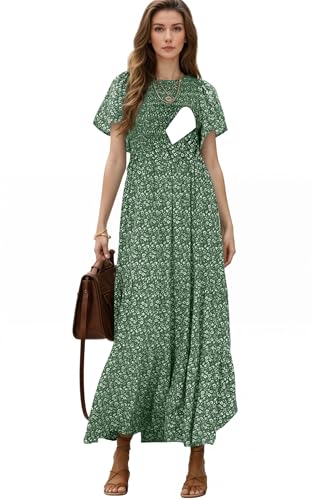
CzzzyL Floral Print Nursing Dress
- Fabric: 95% Polyester, 5% Spandex
- Nursing access: Double layer front for breastfeeding
- Neckline: Scoop neck
- Sleeve: Short flutter sleeve
This is a floral maxi built around a double layer front, the access style its page names directly: the outer layer lifts for breastfeeding while the dress keeps its shape. The bodice is smocked, which gives the high waist its stretch, and the skirt falls in tiers to maxi length; the size details give a 50.4 inch length for size Small. The fabric is 95% polyester and 5% spandex, a blend that resists wrinkles and holds a print well. Short flutter sleeves and a scoop neckline keep it in sundress territory, and there are pockets on both sides. The variant documented here is the Green in size Small. Choose it for a dressier long dress whose nursing access is worked into the bodice rather than added on.
OUGES Nursing Dress With Shoulder Buttons
- Fabric: 50% Rayon, 45% Polyester, 5% Spandex
- Nursing access: Shoulder button design
- Neckline: Scoop neck
- Sleeve: Sleeveless
The OUGES dress takes the opposite approach to access: instead of a layered front, it uses a shoulder button design, described on its page as allowing discreet and effortless nursing by unfastening one side. It is a sleeveless midi with a scoop neckline and a side slit in the skirt, cut from 50% rayon, 45% polyester, and 5% spandex, a blend the page calls lightweight, breathable, and stretchy. The size chart runs from Small to XXL, with bust from 32.5 to 43 inches and length from 48.8 to 52 inches, so despite the midi label it falls long on most wearers. The variant documented here is the Pink in size Large. Choose it if one-handed access matters more than sleeves, or for warm weather feeding.
Ekouaer Short Sleeve Nursing Dress
Ekouaer’s entry is a short sleeve long dress with the most plainly described access of the five: its page states a discreet feeding opening and instructs the wearer to lift up the front layer for breastfeeding. The fabric is 95% polyester and 5% spandex, the neckline is a round neck, and the skirt carries a side split that keeps the long hem easy to walk in. The listing title includes pockets, and the brand positions the dress for work, daily wear, and occasions such as baby showers and maternity photo shoots, as well as the postpartum period. The variant documented here is the Green in size Large. Choose it for a straightforward everyday dress whose feeding opening is hidden in a plain front.
Specs
- Fabric: 95% Polyester, 5% Spandex
- Nursing access: Discreet feeding opening; lift up the front layer
- Neckline: Round neck
- Sleeve: Short sleeve
- Silhouette: Long dress with side split
- Pockets: Yes, per listing title
- Color: Green
- ASIN: B0DQ1FR7MP
Smallshow Split Long Dress
- Fabric: 93.1% Rayon, 6.9% Spandex
- Nursing access: Split front design for breastfeeding
- Neckline: Scoop neck
- Sleeve: Short sleeve
Smallshow’s dress is named for its split front, the panel arrangement that opens for breastfeeding, and it is the softest fabric of the group: 93.1% rayon and 6.9% spandex, in a relaxed A-line cut with a scoop neck and short sleeves. It pulls on with no fastenings, and the care line is a simple machine wash. The size chart runs from Small to XXL, with length rising from 51.2 inches to 54.3 inches, making this a true maxi at every size. The page lists pockets among its features. The variant documented here is the Black. Choose it if comfort and drape come first and you want a long dress that needs no hardware at all to nurse in.
QINYI Cotton Midi Nursing Dress
- Fabric: 95% Cotton, 5% Spandex
- Nursing access: Nursing dress design for breastfeeding
- Neckline: Crew neck
- Sleeve: Half sleeve
The QINYI dress is the cotton option: 95% cotton and 5% spandex, a fabric its page describes as soft, breathable, and gentle against the skin, with the dress sold for both pregnancy and the postpartum stage. It has a crew neckline, half sleeves, an A-line silhouette with a mid waist, and pockets. Its size chart is the widest here, running from X-Small to 2X with bust from 30 to 50 inches and length from 42.5 to 46.5 inches, the shortest dress of the five. The care instructions allow hand wash or machine wash, and it pulls on. The variant documented here is the Mint Green Floral. Choose it if you prefer natural fiber against the skin and a shorter, lighter dress for warm weather.
Frequently Asked Questions
How does the nursing access on these dresses work?
Three of the five use a layered or split front: an outer panel lifts or pulls aside while an inner layer stays in place, which is the arrangement on the CzzzyL, Ekouaer, and Smallshow dresses. The OUGES dress instead unbuttons at the shoulder so one side of the neckline drops. The QINYI dress is sold as a nursing dress with breastfeeding access built into its bodice. All five are designed so the access is not visible when the dress is worn normally.
Can these dresses be worn during pregnancy as well as after?
Most of them, yes, according to their pages. The Ekouaer and QINYI listings both describe their dresses as suitable during pregnancy and in the postpartum period, and the high or empire waistlines on the CzzzyL and Smallshow dresses leave room at the waist. The access panels are the part designed for after the birth, so a dress bought for the third trimester keeps working once feeding starts.
Which fabric is easiest to care for?
The Smallshow dress is the simplest: a rayon and spandex knit with a machine wash instruction and no fastenings. The QINYI cotton dress allows hand wash or machine wash. Polyester-rich blends like the CzzzyL and Ekouaer dresses resist wrinkles and hold their prints, which suits dresses worn several times a week. Whichever fabric you choose, the bodice panel gets the most handling, so following the care line on the exact page protects the access design.
How should I choose a size in a nursing dress?
Use the size chart on the product page and measure the bust at its fullest point, then match that figure to the chart rather than ordering a pre-pregnancy size. The charts here give bust in inches for every size: the QINYI chart spans 30 to 50 inches across X-Small to 2X, and the OUGES chart spans 32.5 to 43 inches. If a measurement falls between two sizes, the stretch in every fabric here, each with spandex or elastane, makes the closer size workable.
FAQ
How does the nursing access on these dresses work?
Can these dresses be worn during pregnancy as well as after?
Which fabric is easiest to care for?
How should I choose a size in a nursing dress?
More from Amazon
Programs that pair well with the guide above. Offers and eligibility are set by Amazon and may change.
Free shipping on eligible items, Prime Video and more. Eligible new members can start with a free trial.
Start a Prime free trialA Prime membership for ages 18-24 with a trial period. Eligibility is set by Amazon.
See Prime for Young AdultsAudiobooks and podcasts to listen to on the go. Eligible new members can start with a free trial.
Try Audible freeAd-free music streaming. Eligible new subscribers can start with a free trial.
Try Music Unlimited freeAs an Amazon Associate we earn from qualifying purchases.