Our Short List of 3
- Best for: Gamers who want a quiet, full-featured RGB board with a wrist rest and spill resistance.

- Best for: Gamers and streamers who want per-key RGB lighting and deep customization on a membrane board.

- Best for: Gamers who want striking RGB lighting, quiet keys, and zero setup hassle.
All 4 Picks at a Glance
| Product | Specs | Action |
|---|---|---|
| 1. SteelSeries Apex 3 RGB Gaming Keyboard |
| Check price on Amazon |
| 2. Razer Cynosa V2 Gaming Keyboard |
| Check price on Amazon |
| 3. HyperX Alloy Core RGB Membrane Gaming Keyboard |
| Check price on Amazon |
 4. Corsair K55 RGB PRO Membrane Gaming Keyboard |
| Check price on Amazon |
Key takeaways
- Find the best membrane keyboards for quiet typing and gaming, from budget office boards to RGB gaming models, with our expert buying guide and top picks.
The best membrane keyboards prove that you do not need loud mechanical switches or a large budget to get a comfortable, reliable typing experience. A membrane keyboard uses a soft rubber dome under each key, so every press feels cushioned and quiet, and the whole board costs far less than a comparable mechanical model. That combination makes membrane boards the default choice for offices, shared bedrooms, late-night gaming sessions, and anyone who types for hours and wants their fingers, and their housemates, to stay happy.
Membrane keyboards have earned an unfair reputation as the cheap option that comes free in a box with a new computer. The truth is more interesting. Modern membrane boards include spill-resistant coatings, dedicated media controls, per-key RGB lighting, programmable macro keys, and anti-ghosting for gaming. The best models borrow ideas from premium mechanical keyboards while keeping the soft, quiet keystroke that defines the membrane design. This guide explains how membrane keyboards work, what to look for before you buy, and which four models stand out right now.
How Membrane Keyboards Work
A membrane keyboard registers keystrokes through three flexible plastic layers printed with conductive traces. Pressing a key pushes a rubber dome down until the top and bottom layers make contact, completing a circuit and sending the signal to your computer. When you release the key, the dome springs back to its original shape. There are no individual metal springs or separate switch housings under each key, which is why membrane boards are thinner, lighter, and quieter than mechanical keyboards.
That simple construction creates the signature feel of a membrane keyboard. The keystroke is soft at the top, firms up as the dome collapses, and lands with a gentle, muted thud instead of a sharp click. Travel is usually around 3 to 4 millimeters, with actuation happening near the bottom of the press. Some typists miss the crisp tactile bump of a mechanical switch, but many others prefer the forgiving, low-effort press of a rubber dome, especially during long writing sessions or fast-paced games where bottoming out is constant.
Durability is the honest trade-off. A typical membrane key is rated for around 5 to 20 million presses, while many mechanical switches are rated for 50 million or more. In practice, that difference matters less than it sounds. Even heavy typists rarely wear out a well-made membrane board within a few years, and the savings are substantial.
How to Choose the Best Membrane Keyboard
Choosing a membrane keyboard is mostly about matching the board to how you actually use it. A gaming board and an office board can share the same rubber-dome technology and still feel like completely different products. Work through the factors below before you buy, and you will end up with a keyboard that fits your desk, your hands, and your daily routine.
Layout and Size
Full-size keyboards include a number pad, function row, and navigation cluster, which suits office work, spreadsheets, and data entry. Tenkeyless boards drop the number pad and save roughly a quarter of the desk width, which is useful for smaller desks and for gamers who want more room to sweep the mouse. Compact 75 percent and 60 percent layouts go further, but they are rare in the membrane world, so most buyers choose between full-size and tenkeyless.
Key Feel and Noise
All membrane keyboards are quieter than clicky mechanical boards, but they are not all equally soft. Gaming membrane boards often use a firmer dome with a more defined actuation point so fast repeated presses feel responsive. Office boards tend toward a lighter, mushier press that stays comfortable over eight hours. If you share a room or type at night, look for boards marketed as whisper-quiet or silent, and check reviews for complaints about mushy or sticky keys.
Backlighting
Backlighting ranges from no lighting at all, to a single white glow, to full RGB with individually lit keys and multiple zones. RGB is mostly about style, but it has practical value too. Backlit legends are easier to read in a dim room, and per-key lighting lets you highlight your game controls. If you work in a bright office, backlighting matters far less, and a non-lit board saves money and keeps the design understated.
Spill and Dust Resistance
Look for an IP rating or a stated spill-resistance figure. Many gaming membrane boards are rated IP32 or IP42, meaning they resist splashes and dust ingress, and some advertise resistance to a specific volume of spilled liquid. No keyboard is fully waterproof unless it says so, but a sealed membrane sheet gives these boards a real advantage over open mechanical designs when coffee meets keyboard.
Extra Keys and Software
Dedicated media keys, a volume roller, programmable macro keys, and a detachable wrist rest all add real convenience. Macro keys matter most for gamers and streamers who trigger complex commands with one press. Companion software lets you remap keys, build lighting profiles, and sync effects with other gear. Boards that work without software are simpler, which some buyers prefer, while boards with deep software offer more control.
Connectivity
Most membrane keyboards are wired USB boards, which is the right choice for gaming because the connection is lag-free and never needs charging. Wireless membrane keyboards exist and suit tidy desks and living-room setups, but they add battery management and occasional latency. For a primary gaming or work keyboard, wired remains the safer pick.
Build Quality and Warranty
A good membrane keyboard feels solid when you pick it up, with minimal flex across the chassis and keycaps that do not wobble. Check the warranty length and the keystroke rating. A two-year warranty and a rating of 10 million presses or more are good signs that the manufacturer stands behind the dome sheet.
Top Picks
1. SteelSeries Apex 3 RGB Gaming Keyboard
- Best for: Gamers who want a quiet, full-featured RGB board with a wrist rest and spill resistance.
Gamers who want a quiet, full-featured RGB board with a wrist rest and spill resistance.
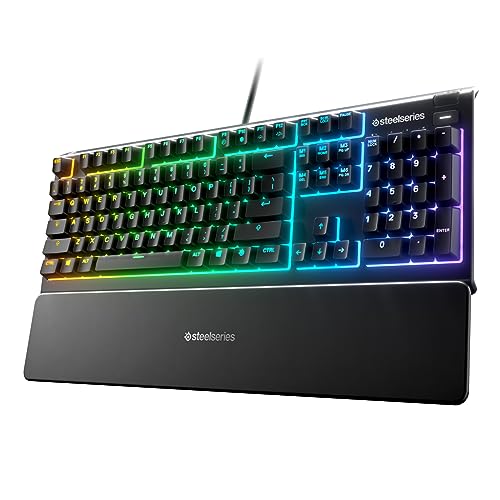
The SteelSeries Apex 3 is the best membrane keyboard for most gamers, and it is easy to see why. It pairs quiet, low-friction whisper-quiet gaming switches with 10-zone RGB lighting, a premium magnetic wrist rest, and IP32 water resistance, all in a full-size layout that works equally well for gaming and daily typing.
The key feel is the star here. Each press is soft and silent, with a smooth travel that never feels mushy, and the board handles fast repeated inputs without missed keystrokes. The dedicated media controls and clickable metal volume roller sit at the top right, so adjusting volume or skipping a track never interrupts a game. The magnetic wrist rest snaps on firmly and makes long sessions noticeably more comfortable.
Build quality is a step above most membrane boards. The chassis feels dense and stable, the keycaps are durable, and the IP32 rating means a spilled drink is an annoyance rather than a disaster. The 10-zone RGB lighting looks great and syncs with other SteelSeries gear through the companion software, where you can also remap keys and build macros.
Check the SteelSeries Apex 3 on Amazon
2. Razer Cynosa V2 Gaming Keyboard
- Best for: Gamers and streamers who want per-key RGB lighting and deep customization on a membrane board.
Gamers and streamers who want per-key RGB lighting and deep customization on a membrane board.
The Razer Cynosa V2 is the best membrane keyboard for RGB fans. Razer calls it the top-selling gaming membrane keyboard in the United States, and its individually backlit keys with full Chroma RGB support are the main reason. Every key can show its own color, and the lighting syncs with popular games, other Razer hardware, and smart lighting from partner brands.
The typing experience is soft and responsive, with Razer-designed membrane switches rated for up to 80 million clicks. Anti-ghosting with 10-key rollover keeps fast inputs accurate, and fully programmable keys with Razer Hypershift let you remap every key and layer secondary functions onto them. Dedicated media keys and a spill-resistant design round out a board that feels far more premium than its position in the lineup suggests.
Setup is simple. Plug the keyboard in, install Razer Synapse if you want the full lighting and macro controls, and you are ready. The cable routing underneath keeps the desk tidy, and the full-size layout includes a number pad for work and everyday use.
Check the Razer Cynosa V2 on Amazon
3. HyperX Alloy Core RGB Membrane Gaming Keyboard
- Best for: Gamers who want striking RGB lighting, quiet keys, and zero setup hassle.
Gamers who want striking RGB lighting, quiet keys, and zero setup hassle.
The HyperX Alloy Core RGB is the best membrane keyboard for gamers who want a signature look without a complicated setup. Its standout feature is the radiant light bar across the front edge, which pairs with six preset RGB lighting effects and three brightness levels to give your desk a bold glow with no software required.
The keys themselves are quiet soft-touch membrane keys with anti-ghosting, so fast gaming inputs stay accurate while the board stays silent enough for a shared room. Dedicated media buttons control volume and playback at a touch, and a dedicated Game Mode button locks the Windows key so an accidental press never kicks you out of a match. The spill-resistant design handles up to 120 milliliters of liquid, which is generous for a board in this class.
Everything about the Alloy Core RGB is designed to work out of the box. The lighting effects cycle from the keyboard itself, the layout is a standard full-size design that needs no learning curve, and the reinforced plastic frame feels sturdy on the desk. It is a strong choice for a first gaming keyboard or for anyone upgrading from a basic bundled board.
Check the HyperX Alloy Core RGB on Amazon
4. Corsair K55 RGB PRO Membrane Gaming Keyboard
- Best for: Streamers and gamers who want macro keys, Elgato integration, and strong spill resistance.
Streamers and gamers who want macro keys, Elgato integration, and strong spill resistance.
The Corsair K55 RGB PRO is the best membrane keyboard for players who want macro keys and streaming controls. Six dedicated macro keys with Elgato Stream Deck software integration set it apart, letting streamers trigger scenes, launch media, and run complex commands with a single press. That feature alone makes it a favorite for content creators.
The board uses quiet, responsive membrane keys with five-zone dynamic RGB backlighting, dedicated media and volume controls, and a detachable soft-touch palm rest. The IP42 dust and spill resistance rating is the strongest in this roundup, and the Windows key lock prevents accidental interruptions during play. iCUE software ties it all together, offering deep lighting customization, macro recording, and sync with other Corsair gear.
In daily use, the K55 RGB PRO feels like a board built for long sessions. The palm rest takes pressure off the wrists, the macro keys sit within easy reach of the left hand, and the full-size layout keeps the number pad available for work. It is the most feature-packed membrane board here, and the best pick if macros and streaming matter to you.
Check the Corsair K55 RGB PRO on Amazon
Comparison Table
| Keyboard | Layout | Lighting | Spill Resistance | Standout Feature |
|---|---|---|---|---|
| SteelSeries Apex 3 | Full-size | 10-zone RGB | IP32 water resistant | Magnetic wrist rest, quiet switches |
| Razer Cynosa V2 | Full-size | Per-key Chroma RGB | Spill-resistant design | Individually backlit keys, 80M click rating |
| HyperX Alloy Core RGB | Full-size | 6 RGB effects, light bar | Up to 120 ml spill resistant | Signature light bar, no software needed |
| Corsair K55 RGB PRO | Full-size | 5-zone RGB | IP42 dust and spill resistant | 6 macro keys, Elgato integration |
Membrane vs Mechanical Keyboards
The membrane versus mechanical question comes up in almost every keyboard buying guide, and the honest answer is that neither type is better for everyone. Mechanical keyboards offer a crisper, more tactile keystroke, individual switches that can be swapped, and longer rated lifespans. They also cost more, weigh more, and make more noise, even with silent switch options.
Membrane keyboards win on quiet operation, low weight, slim profiles, spill resistance, and cost. A good membrane board costs a fraction of a mid-range mechanical board while covering the same daily tasks. For office workers, students, casual gamers, and anyone typing in a shared space, the membrane advantage is real and practical. Competitive players who value the fastest possible actuation and the most precise tactile feedback may still prefer mechanical, but the gap has narrowed as membrane gaming boards have added anti-ghosting, faster polling, and firmer domes.
Try both types before you decide if you can. Many electronics stores have display models, and a few minutes of typing will tell you more than any specification sheet. If you value silence and value, membrane is the right call. If you value switch feel above all else and do not mind the noise or the cost, mechanical is worth the upgrade.
Who Should Buy a Membrane Keyboard
Membrane keyboards suit a wide range of users. Office workers get a quiet board that will not disturb colleagues on calls. Students get an affordable keyboard that survives dorm life and the occasional spilled drink. Casual and mid-level gamers get RGB lighting, media controls, and anti-ghosting without paying mechanical prices. Parents buying a first keyboard for a child get a durable, low-cost board that is easy to replace if it gets damaged.
There are a few cases where a mechanical board makes more sense. Competitive esports players chasing the lowest latency and the most consistent actuation may prefer mechanical switches. Keyboard enthusiasts who enjoy swapping switches and keycaps will find membrane boards limiting, since the dome sheet is not modular. Heavy typists who type all day, every day, for years may get more life from a mechanical board, though a quality membrane board still lasts a long time.
Frequently Asked Questions
Are membrane keyboards good for gaming?
Yes. Modern membrane gaming keyboards include anti-ghosting, 10-key rollover, dedicated media controls, and macro keys, which cover the features most gamers actually use. They are quieter than mechanical boards, which helps during late-night sessions, and they cost less. Competitive players who want the fastest actuation may still prefer mechanical, but for most gamers a good membrane board performs well.
Do membrane keyboards wear out faster than mechanical keyboards?
Membrane keys are typically rated for 5 to 20 million presses, while mechanical switches are often rated for 50 million or more. In everyday use, that difference rarely matters, because even heavy typists take years to approach those limits. A well-made membrane keyboard from a reputable brand should last several years of daily use.
Are membrane keyboards quieter than mechanical keyboards?
Yes, in almost every case. The rubber dome absorbs the impact of each keystroke, producing a soft, muted sound instead of a click or clack. Some membrane boards are marketed as whisper-quiet, and they are among the quietest keyboards you can buy. This makes them ideal for offices, libraries, bedrooms, and shared living spaces.
Can you replace the keycaps on a membrane keyboard?
Most membrane keyboards use keycaps that can be pulled off for cleaning, but replacement keycap sets are harder to find than for mechanical boards, because membrane keyboards do not follow a standard stem design. If custom keycaps matter to you, a mechanical keyboard is the better choice. For cleaning purposes, removing and replacing the original keycaps works fine.
Are membrane keyboards good for typing all day?
Yes, provided you choose a board with a comfortable key feel and a good layout. Look for a full-size board with a number pad if you do data entry, a wrist rest if you type for hours, and a key feel that is firm enough to avoid accidental presses but soft enough to stay comfortable. Many office workers prefer membrane boards precisely because the cushioned keystroke is gentle on the fingers over long sessions.
Conclusion
The best membrane keyboards deliver quiet comfort, useful gaming features, and real value in one package. The SteelSeries Apex 3 leads the pack with its silent switches, magnetic wrist rest, and spill resistance. The Razer Cynosa V2 is the pick for RGB lovers, with individually backlit keys and deep Chroma customization. The HyperX Alloy Core RGB stands out with its signature light bar and effortless setup. The Corsair K55 RGB PRO is the choice for streamers, thanks to its macro keys and Elgato integration.
Whichever model fits your desk, the key lesson is the same. A membrane keyboard is not a compromise. It is a deliberate choice for quiet typing, spill resistance, and smart spending, and the best models prove that every time you sit down to type or play.
Disclosure: As an Amazon Associate, we earn from qualifying purchases.
FAQ
Are membrane keyboards good for gaming?
Do membrane keyboards wear out faster than mechanical keyboards?
Are membrane keyboards quieter than mechanical keyboards?
Can you replace the keycaps on a membrane keyboard?
Are membrane keyboards good for typing all day?
More from Amazon
Programs that pair well with the guide above. Offers and eligibility are set by Amazon and may change.
Free shipping on eligible items, Prime Video and more. Eligible new members can start with a free trial.
Start a Prime free trialA Prime membership for ages 18-24 with a trial period. Eligibility is set by Amazon.
See Prime for Young AdultsAudiobooks and podcasts to listen to on the go. Eligible new members can start with a free trial.
Try Audible freeAd-free music streaming. Eligible new subscribers can start with a free trial.
Try Music Unlimited freeAs an Amazon Associate we earn from qualifying purchases.