Our Short List of 3
All 4 Picks at a Glance
| Product | Specs | Action |
|---|---|---|
 1. Canon EOS R50 with RF-S 18-45mm Lens Kit | Check price on Amazon | |
 2. Nikon Z30 with NIKKOR Z DX 16-50mm Lens Kit | Check price on Amazon | |
 3. Sony ZV-E10 with 16-50mm Power Zoom Lens Kit | Check price on Amazon | |
 4. Canon EOS Rebel T7 with EF-S 18-55mm Lens Kit | Check price on Amazon |
Our Top Picks
Introduction
Finding the best starter cameras can feel overwhelming when every model promises professional results and every review uses jargon you have not learned yet. The good news is that a first camera does not need to be complicated or expensive to take genuinely great photos. It needs to be easy to carry, simple to understand, and capable enough to grow with you as your skills improve.
This guide is built for people buying their very first interchangeable lens camera. Maybe you are moving up from a phone and want sharper portraits, better low light performance, and real background blur. Maybe you are starting a photography hobby, a YouTube channel, or a small side business and need a camera that handles both stills and video. Whatever your reason, the four cameras below are proven beginner favorites from Canon, Nikon, and Sony, and each one comes as a kit with a versatile zoom lens so you can start shooting the day it arrives.
We will walk through what actually matters when you choose a first camera, compare four strong options side by side, and answer the questions beginners ask most often. By the end, you should know exactly which camera fits your budget, your hands, and the kind of photos you want to take.
How to Choose Your First Camera
Start with a kit, not a body alone
A camera body without a lens cannot take a single photo, and choosing a first lens separately adds cost and confusion. Every camera in this guide is sold as a kit that includes a standard zoom lens, usually covering a range from wide angle to short telephoto. That single lens handles landscapes, portraits, street photography, and everyday family shots, which is exactly what a beginner needs. You can add specialized lenses later, once you know which focal lengths you actually use most.
Sensor size matters more than megapixels
Most beginner cameras use an APS-C sensor, which is much larger than a phone sensor and delivers cleaner images in low light, softer background blur, and more detail. All four cameras here have sensors in the 24 megapixel range, which is plenty for large prints, cropping, and social media. Do not chase the highest megapixel count. Instead, look at sensor size, autofocus performance, and how the camera feels in your hands.
Autofocus is your best friend
Modern beginner cameras use eye detection autofocus that locks onto a person’s or animal’s eyes and tracks them as they move. This single feature makes the biggest difference for new photographers, because it removes the hardest part of taking a sharp portrait. Canon’s Dual Pixel autofocus, Nikon’s subject detection, and Sony’s Real-time Eye autofocus all work well, so you can trust any of the cameras in this guide to keep your subjects sharp while you concentrate on composition and light.
Think about video from day one
Even if you only plan to take photos, video capability matters, because most beginners end up filming at least occasionally. Look for 4K video, a flip-out screen you can see while recording yourself, and a microphone input for better sound. Mirrorless cameras in this guide handle video far better than older DSLRs, with smoother autofocus during recording and screens that rotate to face you.
Mirrorless versus DSLR
Three of our picks are mirrorless cameras and one is a DSLR. Mirrorless cameras are smaller, lighter, and show you a live preview of your exposure on the screen or viewfinder before you press the shutter, which makes learning much faster. DSLRs use an optical viewfinder and have longer battery life, and the Rebel T7 remains popular because it is simple, affordable, and backed by a huge range of inexpensive lenses. Neither design is wrong for a beginner. Mirrorless is the future and the easier learning tool, while the DSLR is the budget-friendly classic.
Size, weight, and controls
A camera you leave at home because it is heavy is a wasted purchase. Hold each model in mind as you read: the Canon EOS R50 and Nikon Z30 are among the lightest interchangeable lens cameras available, while the Sony ZV-E10 is built for creators who film as much as they shoot. Simple dials, a touchscreen, and a guided menu system matter more than a long spec sheet when you are learning. All four cameras offer full auto modes that produce great results immediately, plus manual controls you can explore gradually.
Budget for the extras
A memory card, a spare battery, and a protective bag are the only accessories most beginners need right away. A fast SD card keeps burst shooting and 4K video running smoothly, and a spare battery saves the day on long outings. Resist the urge to buy a bag full of gadgets before your first shoot. Spend your first month learning the camera, then buy accessories that solve real problems you have actually encountered.
Top Picks
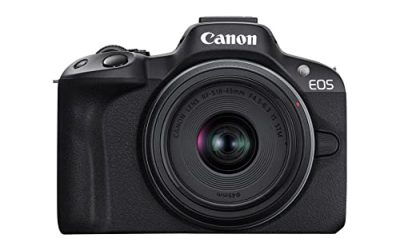
1. Canon EOS R50 with RF-S 18-45mm Lens Kit
The Canon EOS R50 is the most well-rounded starter camera on this list, and it is the one we recommend first to most beginners. Its 24.2 megapixel APS-C sensor produces detailed, clean images, and Canon’s Dual Pixel CMOS AF II autofocus locks onto eyes with impressive speed and accuracy. The camera records uncropped 4K video, has a fully articulating touchscreen that flips around for selfies and vlogging, and weighs so little that you will happily carry it all day.
What makes the R50 special for learning is how it teaches while you shoot. The Creative Assist mode lets you adjust background blur, brightness, and color with plain-language sliders instead of technical terms, so you learn what each setting does by seeing the result instantly. When you are ready, the full manual modes and the growing RF-S lens lineup give you room to grow for years. The included 18-45mm kit lens covers everyday shooting from wide landscapes to flattering portraits, and it collapses down small for travel.
This is the best choice if you want one camera that does everything well: family photos, travel, portraits, and video. It is equally at home in full auto mode on a birthday outing and in manual mode on a dedicated photo walk.
View the Canon EOS R50 on Amazon
2. Nikon Z30 with NIKKOR Z DX 16-50mm Lens Kit
The Nikon Z30 is the smallest and lightest camera in this guide, and it is the best starter camera for anyone who values portability above all else. Nikon removed the viewfinder to keep the body compact, which makes the Z30 feel more like a large point-and-shoot that happens to have a large APS-C sensor and interchangeable lenses. It slips easily into a small bag or jacket pocket with the retractable 16-50mm kit lens attached.
Despite its size, the Z30 is a serious photographic tool. Its 20.9 megapixel sensor delivers clean images with lovely color, and its autofocus reliably finds eyes and faces, even in video. The flip-out screen, built-in stereo microphone with wind reduction, and long 4K recording times make it a strong choice for vlogging and content creation. Nikon also includes a free video setting that records in a flat profile, giving you more flexibility when editing footage later.
Choose the Z30 if you want the most travel-friendly camera here, or if you plan to film yourself often. It is also a great second camera for anyone who already owns a larger Nikon and wants something light for daily carry. The main trade-off is the lack of a viewfinder, which matters most in bright sunlight, and a smaller native lens lineup than Canon’s, though Nikon’s Z DX lenses are excellent.
3. Sony ZV-E10 with 16-50mm Power Zoom Lens Kit
The Sony ZV-E10 is the best starter camera for creators who care as much about video as photos. Sony designed it from the ground up for vlogging, with a large directional microphone on top, a dedicated button that instantly blurs or sharpens the background, and a Product Showcase mode that shifts focus smoothly from your face to an object you hold up to the lens. Its 24.2 megapixel APS-C sensor and fast autofocus deliver sharp 4K video oversampled from 6K, which gives footage a crisp, detailed look.
For still photography, the ZV-E10 is a capable camera with Sony’s excellent Real-time Eye autofocus for people and animals, fast burst shooting, and access to the enormous Sony E-mount lens system, one of the largest selections of affordable lenses in the world. The vari-angle screen flips to the side for self-recording, and the camera can double as a high-quality webcam when connected to a computer, which makes it useful for streaming and video calls too.
Pick the ZV-E10 if your first camera will spend as much time filming as photographing, or if you plan to start a YouTube channel, stream, or create social media content. Pure photographers may prefer the R50’s viewfinder and more traditional controls, but creators will appreciate how the ZV-E10 is built around their workflow.
View the Sony ZV-E10 on Amazon
4. Canon EOS Rebel T7 with EF-S 18-55mm Lens Kit
The Canon EOS Rebel T7 is the classic beginner DSLR, and it remains the most affordable way to get a large sensor and interchangeable lenses. Its 24.1 megapixel APS-C sensor produces sharp, detailed photos, and the included 18-55mm kit lens covers the focal lengths beginners use most. Built-in Wi-Fi with NFC lets you transfer photos to your phone through Canon’s app, so sharing your work is quick and easy.
What the T7 offers that the mirrorless cameras do not is simplicity and battery life. The optical viewfinder shows the real world with no lag, the button layout is uncluttered, and a single battery charge lasts far longer than on a mirrorless camera. The huge EF and EF-S lens system means you can buy excellent used lenses for very little money, which is a genuine advantage when you are learning and experimenting with different focal lengths.
Choose the Rebel T7 if your budget is tight, if you mainly shoot still photos, or if you prefer the feel of a traditional DSLR. Its video is limited to Full HD rather than 4K, and its autofocus is slower than the mirrorless models, but for learning photography fundamentals on a budget, it is still a smart and proven choice.
View the Canon EOS Rebel T7 on Amazon
Comparison Table
| Camera | Sensor | Video | Screen | Best For |
|---|---|---|---|---|
| Canon EOS R50 | 24.2 MP APS-C | 4K uncropped | Fully articulating touchscreen | Best all-rounder for photo and video |
| Nikon Z30 | 20.9 MP APS-C | 4K | Flip-out touchscreen | Travel and vlogging in the smallest body |
| Sony ZV-E10 | 24.2 MP APS-C | 4K oversampled from 6K | Vari-angle touchscreen | Content creators and YouTubers |
| Canon EOS Rebel T7 | 24.1 MP APS-C | Full HD | Fixed LCD screen | Budget DSLR for learning photography |
What to Learn First
Buying the camera is only the beginning. The fastest way to improve is to learn a small set of fundamentals and practice them deliberately. Start with composition: the rule of thirds, leading lines, and framing your subject with elements in the foreground. Then learn the exposure triangle, which is the relationship between aperture, shutter speed, and ISO. You do not need to master these on day one, but understanding them will let you take control when auto mode makes a choice you disagree with.
Shoot every day, even if only for ten minutes. Photograph your morning coffee, your street, your pets, or your family. Review your photos on a larger screen, notice what works, and try again. The cameras in this guide all include guided modes and scene presets that help you learn while producing images you will be proud to share.
Editing matters too, and it does not need to be complicated. Free apps and entry-level software let you adjust exposure, crop, and correct color in minutes. Shoot in JPEG at first for simplicity, and switch to RAW once you want maximum control over editing. Your camera can record both formats at the same time, which is a useful safety net while you learn.
Finally, print your work. A printed photo reveals details and mistakes a phone screen hides, and it is deeply satisfying to hold a physical image you created. Even small prints will teach you about sharpness, exposure, and color in ways that scrolling never will.
Frequently Asked Questions
How much should a beginner spend on a first camera?
Spend enough to get a current APS-C mirrorless or DSLR kit with a zoom lens, and reserve a small amount for a memory card and spare battery. The cameras in this guide cover a range of budgets, and any of them will serve a beginner well for several years. Spending more mainly buys better video, faster autofocus, and weather sealing, none of which a beginner needs on day one.
Is a mirrorless camera better than a DSLR for a beginner?
For most beginners, yes. Mirrorless cameras show a live preview of your exposure, focus faster in live view and video, and are smaller and lighter. A DSLR like the Rebel T7 is still a fine choice if your budget is tight or you prefer an optical viewfinder, but mirrorless is where all new lens development is happening.
Do I need to buy extra lenses right away?
No. The kit lens included with each camera here covers wide angle to short telephoto, which handles landscapes, portraits, street photography, and everyday shooting. Use it for a few months, notice which focal lengths you use most, and then buy your next lens based on real experience. A fast 50mm prime lens is the most common second purchase for beginners who love portraits.
How many megapixels do I need?
Around 20 to 24 megapixels is plenty for a beginner. It allows large prints, generous cropping, and detailed images for any screen. Higher megapixel counts mainly benefit professionals who print very large or crop aggressively. Sensor size, lens quality, and autofocus matter far more than a few extra megapixels.
Can these cameras shoot good video for YouTube?
Yes. The Canon EOS R50, Nikon Z30, and Sony ZV-E10 all record 4K video with flip-out screens and reliable autofocus, which is exactly what a beginner YouTuber needs. The Rebel T7 records Full HD video, which is acceptable for casual use but less future-proof. For serious video work, add an external microphone, which improves sound quality more than any camera upgrade.
Conclusion
The best starter cameras are the ones that make photography enjoyable from the first day and still reward you as your skills grow. The Canon EOS R50 is our top overall pick because it balances photo quality, video, autofocus, and ease of use better than anything else at this level. The Nikon Z30 is the best choice for travel and vlogging in a tiny package, the Sony ZV-E10 is the best choice for creators who film as much as they shoot, and the Canon EOS Rebel T7 is the best budget DSLR for learning the fundamentals.
Whichever camera you choose, remember that the best camera is the one you actually carry and use. Pick the model that fits your hands and your budget, learn its controls one feature at a time, and shoot often. Your first camera is the start of a creative habit, not a final decision, and any of these four is a strong place to begin.
Disclosure: As an Amazon Associate, we earn from qualifying purchases.
FAQ
How much should a beginner spend on a first camera?
Is a mirrorless camera better than a DSLR for a beginner?
Do I need to buy extra lenses right away?
How many megapixels do I need?
Can these cameras shoot good video for YouTube?
More from Amazon
Programs that pair well with the guide above. Offers and eligibility are set by Amazon and may change.
Free shipping on eligible items, Prime Video and more. Eligible new members can start with a free trial.
Start a Prime free trialA Prime membership for ages 18-24 with a trial period. Eligibility is set by Amazon.
See Prime for Young AdultsAudiobooks and podcasts to listen to on the go. Eligible new members can start with a free trial.
Try Audible freeAd-free music streaming. Eligible new subscribers can start with a free trial.
Try Music Unlimited freeAs an Amazon Associate we earn from qualifying purchases.