Key takeaways
- A flexible steel frame that opens evenly without sharp bends.
- A diffusion cloth that is visibly translucent but not so open-weave that hotspots pass through.
- A separate cover rather than permanently sewn colored panels, making the translucent screen usable by itself.
- Double-stitched edges and a strong zipper, since the cover is commonly the first part to fail.
- A storage bag that is large enough to avoid forcing the folded frame inside.
Best Diffusers for Photography: Soften Any Light
The best diffusers for photography are usually a 5-in-1 collapsible reflector for portraits and outdoor work, a rigid scrim or diffusion panel for larger subjects, and a small softbox or dome diffuser for controlled product shots.
The right choice depends less on brand than on five practical specifications: the diffuser’s size, shape, diffusion fabric, packed portability, and the amount of light it absorbs. A compact circular diffuser may be ideal for one person in sunlight but too small to produce even reflections across a car, while a large overhead scrim can transform product lighting but is awkward to carry and unsafe in wind.
Our top picks


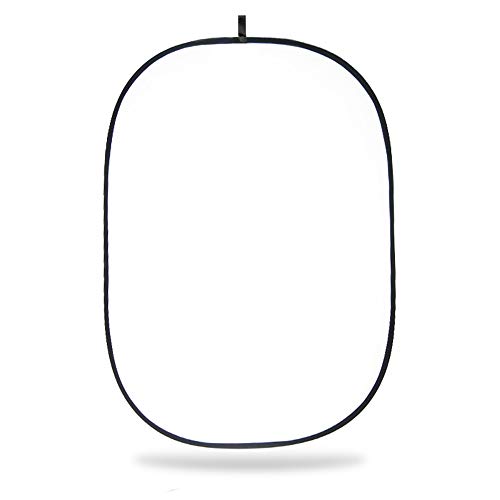
As an Amazon Associate we earn from qualifying purchases at no extra cost to you. Ratings are shown as listed on Amazon.
Quick comparison: which diffuser fits your shoot?
| Diffuser type | Typical working size | Typical light loss | Packed size and weight | Best use |
|---|---|---|---|---|
| Small pop-up panel | 30–60 cm | About 0.5–1 stop | 20–35 cm; 150–400 g | Headshots, tabletop items, travel |
| Medium 5-in-1 reflector | 80–110 cm | About 0.5–1 stop | 30–40 cm; 300–800 g | Portraits, interviews, outdoor fill |
| Large oval or rectangular reflector | 110–150 cm | About 0.5–1.5 stops | 40–55 cm; 600 g–1.5 kg | Full-length portraits, groups, broad soft light |
| Rigid scrim panel | 60 × 90 cm to 120 × 180 cm | About 0.5–2 stops | Usually flat; 1–4 kg with frame | Products, food, architecture, studio lighting |
| Speedlight softbox | 20 × 30 cm to 60 × 90 cm | About 1–2 stops | 25–50 cm; 200–700 g | On-camera or off-camera flash |
| LED fixture softbox or lantern | 60–120 cm | About 1–2.5 stops | 50–100 cm; 0.5–3 kg | Video, portraits, continuous product light |
These are useful planning ranges rather than universal specifications. A double-layer fabric, a grid, a deep softbox, or a highly reflective interior can change both light loss and softness.
Best all-around choice: a medium 5-in-1 reflector
For most photographers, an 80–110 cm collapsible 5-in-1 reflector offers the best balance. It normally includes a translucent white diffusion panel plus removable covers in white, silver, gold, and black. The diffusion panel softens direct sun or a flash, white provides gentle fill, silver increases brightness and contrast, gold warms skin tones, and black blocks or subtracts light.
Choose a medium circular or oval model if you photograph one or two people. It fits beside a camera bag, can be held by an assistant, and is large enough to soften light across a face and upper body. A 110–150 cm model produces more flattering full-length coverage, but it catches wind easily and often needs a stand, sandbag, or second person.
What to look for
- A flexible steel frame that opens evenly without sharp bends.
- A diffusion cloth that is visibly translucent but not so open-weave that hotspots pass through.
- A separate cover rather than permanently sewn colored panels, making the translucent screen usable by itself.
- Double-stitched edges and a strong zipper, since the cover is commonly the first part to fail.
- A storage bag that is large enough to avoid forcing the folded frame inside.
Products such as the Westcott 5-in-1 reflector range and Lastolite by Manfrotto reflector systems are established examples of this format. Comparable generic 5-in-1 reflectors can cost less, but inspect the frame tension and fabric opacity before choosing one for frequent professional use.
Best diffuser for portraits: large, white, and close to the subject
Portrait softness comes primarily from apparent size, not from the diffuser’s label. A 100 cm panel positioned 50 cm from a face is relatively large; the same panel placed 2 m away behaves like a smaller light source and creates harder transitions.
For outdoor portraits, place a translucent panel between the subject and strong overhead sun. Keep it close enough to cover the face and shoulders, then move your camera position until the subject’s eyes have even illumination. A white reflector on the shadow side can restore some brightness without reintroducing harsh sunlight.
In a small studio, a rectangular softbox is often more controllable than a handheld circular reflector. A 60 × 90 cm softbox produces a useful portrait shape while fitting in a modest room. A 90 × 120 cm or larger modifier gives softer cheek and jaw transitions, but requires more light output and more space around the stand.
Speedlight softboxes are convenient, but their small front surface limits softness. They can reduce glare and create a more pleasing spread, yet they cannot make a flash look as broad as a large panel placed close to the subject. When possible, bounce or use an off-camera flash through a larger translucent screen.
Best diffuser for product photography: use a scrim, not just a mini softbox
Product photography often needs controlled reflections rather than simply softer shadows. A translucent scrim placed between a large light source and the product creates a broad luminous surface that can appear as a clean highlight on glass, polished metal, cosmetics packaging, or automotive paint.
Choose a rigid rectangular frame when the diffuser must stay perfectly flat. Rectangles are easier to position beside bottles, boxes, and jewelry than circular panels, and their edges can be kept outside the camera frame while still shaping reflections. For small tabletop work, a 60 × 90 cm scrim is practical. For furniture, clothing, or reflective objects, a 120 × 180 cm panel offers more consistent coverage.
For shiny products, avoid placing a small light directly behind a diffuser. The diffuser may soften the illumination but still create a visible bright rectangle or hotspot. Instead, spread the light across the scrim, move the scrim closer to the product, and adjust its angle until the reflected shape follows the product’s contours.
Diffusion fabrics for product work
- White diffusion: the general-purpose option for reducing contrast while preserving a natural appearance.
- Silk-style fabric: often produces smooth, broad light and attractive reflections.
- Grid cloth: useful when you need diffusion with more control over spill, though it can absorb more light.
- Double diffusion: softer and more even, but commonly costs another stop or more of exposure.
- Black fabric: not a diffuser, but valuable for preventing unwanted reflections and increasing edge definition.
Best portable option for outdoor photography
Travel photographers should prioritize a diffuser that folds quickly, weighs under 800 g, and can be operated with one hand. A 60–90 cm pop-up panel is easier to manage outdoors than a 150 cm reflector. If you regularly work alone, choose a smaller panel and a clamp or collapsible support rather than buying the largest possible surface.
Wind is the main ownership problem. Even a lightweight 80 cm reflector can act like a sail. Never leave a diffuser mounted on a stand without weighting the stand, and lower or remove it between shots when gusts increase. A translucent panel is also more vulnerable to tearing when its frame is twisted against the ground.
For outdoor portraits, a 5-in-1 kit is more versatile than a dedicated white diffuser. For landscapes or environmental details, a compact translucent screen is usually enough to reduce harsh highlights on a nearby subject without dominating the frame or your luggage.
How much light will you lose?
Diffusion changes exposure, so calculate it before the shoot. Suppose a flash produces a correct exposure at ISO 100, f/8, and 1/200 second without a modifier. If the diffuser costs one stop, you can compensate with f/5.6, ISO 200, or twice the flash power. If you add a second diffusion layer and total loss reaches two stops, the equivalent settings are f/4, ISO 400, or four times the original flash output.
For continuous LED lighting, the same loss may force a slower shutter speed or a higher ISO. That matters for moving people and for video, where shutter speed is often constrained. A high-output light is therefore more useful than a very dense fabric when you need a large diffuser.
Decision matrix by budget, experience, and shooting space
| Your situation | Recommended choice | Why | Typical market range |
|---|---|---|---|
| Beginner, occasional portraits, limited budget | 80–110 cm 5-in-1 reflector | One purchase handles diffusion, fill, subtraction, and warming | $20–$70 |
| Frequent outdoor portraits, usually working alone | 60–90 cm translucent panel plus clamp | Lower wind load and easier one-person setup | $40–$120 |
| Small product table, controlled indoor space | 60 × 90 cm scrim or softbox | Rectangular reflections and repeatable positioning | $60–$200 |
| Professional product or food photography | Large rigid scrim system with interchangeable fabrics | More even coverage, stronger frames, and repeatability | $150–$600+ |
| Flash travel kit | Compact speedlight softbox plus pop-up diffuser | Combines portability with two different light-shaping options | $30–$150 |
Maintenance mistakes that shorten diffuser life
Do not machine-wash a diffuser unless the manufacturer specifically permits it. Dust and fingerprints can usually be removed with a soft brush, air blower, or lightly damp microfiber cloth. Let fabric dry completely before folding it into a bag; trapped moisture encourages mildew and can stain white diffusion material.
Fold collapsible reflectors using the frame’s natural twist rather than forcing one corner flat. Repeatedly bending the same section can create a permanent kink. Store the diffuser loosely when possible, and do not place heavy stands on top of it in a vehicle.
Inspect the seam, elastic trim, frame joints, and storage bag every few shoots. A small tear can spread quickly under frame tension. Clear repair tape may work temporarily, but a sewn repair or replacement fabric is preferable when the panel is used near expensive equipment.
Final buying advice
Choose the largest diffuser you can safely position, carry, and support—not simply the largest one in a product catalog. Start with an 80–110 cm 5-in-1 reflector for general portrait and outdoor use. Choose a rectangular scrim when reflections and repeatability matter for products. Select a softbox when your flash or LED needs controlled spill, and check the light-loss rating before assuming the modifier will work with a low-powered light.
Size, distance, and positioning determine softness; fabric determines how evenly light is spread; portability determines whether the diffuser will actually be used. Matching those factors to the assignment is more important than buying the most expensive diffuser.