Key takeaways
- Compare the best bike emf meters for workshop checks around chargers, motors and wiring, with field ranges, units and logging features explained.
A modern bike workshop runs on electricity. E-bike chargers sit on the bench for hours, hub motors spin on repair stands, smart trainers hum in the corner, and compressors, bench grinders and LED lighting all draw current through wiring that runs close to where you stand and work. Every one of those devices produces electromagnetic fields, and an EMF meter is the handheld instrument that measures them instead of leaving you guessing.
One clarification before the picks. An EMF meter is a field-measuring instrument, not an electrical tester. It is not a cycling power meter, which measures pedalling output in watts. It is not a multimeter, which measures voltage, current and resistance on a circuit you connect to. It is not a clamp meter, which reads current through a wire it surrounds. An EMF meter reports the strength of the magnetic, electric and radio frequency fields where you hold it, making it the tool for surveying a room, bench or charging corner.
As an Amazon Associate, I earn from qualifying purchases.
What You Are Measuring
Handheld EMF meters cover up to three field types. AC magnetic fields, produced by motors, transformers, chargers and current-carrying wiring, are shown in milligauss (mG) or microtesla (µT). AC electric fields, which radiate from live wiring and ungrounded equipment housings, are shown in volts per metre (V/m). Radio frequency fields, from Wi-Fi routers, phones, Bluetooth devices and smart meters, are shown as power density in milliwatts or microwatts per square metre (mW/m² or µW/m²).
Two design points matter when you compare models. First, the sensor layout: a triple-axis magnetic sensor reads the field from any orientation, while a single-axis sensor must be rotated to find the strongest reading. Second, RF frequency coverage. A meter whose RF range stops at 3.5 GHz will see 2.4 GHz Wi-Fi but not 5 GHz Wi-Fi, while wider-band models reach 6, 8 or 10 GHz. Alarm thresholds in the Specs lists are trigger levels set by each manufacturer in its own manual, presented as listed; they are device settings, not health guidance.
1. TriField TF2

The TriField TF2, made by AlphaLab, Inc. in Salt Lake City, Utah, is the reference design in this category. It combines three meters in one housing: an AC gaussmeter, an AC electric field meter and an RF power density meter. A single easy-turn knob selects the field type. Magnetic readings are true three-axis measurements, so the number stays consistent however you orient the housing, which is convenient when reaching behind a charger shelf or around a motor on a stand.
The TF2 offers standard and frequency-weighted modes for both magnetic and electric readings; the weighted modes emphasise higher frequencies. RF mode covers 20 MHz to 6 GHz, which spans Wi-Fi, Bluetooth, smart meters and lower-band 5G, and the display shows both an average figure and a peak figure in the upper corner, useful because wireless signals pulse rather than transmit continuously. A backlit LCD and an optional sound that rises with field strength help you home in on a source. Battery life is listed at over 20 hours with the backlight off.
Specs
- Field types: AC magnetic, AC electric, RF power density
- RF frequency range: 20 MHz to 6 GHz
- Magnetic measurement: three-axis, milligauss readout, standard and weighted modes
- RF readout: average and peak, in mW/m²
- Battery: 9V alkaline (included), over 20 hours with backlight off
- Weight: 11 ounces
- Dimensions: 1.5 x 2.75 x 5.25 inches
2. GQ EMF-390
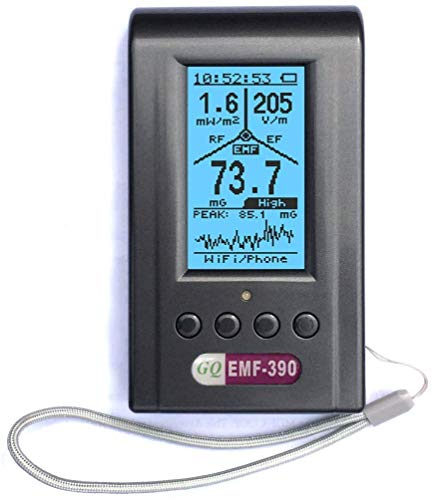
The GQ EMF-390 from GQ Electronics in Seattle is the data-focused pick. It measures three-axis electromagnetic fields, electric fields and RF, showing readings from all sensors on one display. Its RF detection reaches 10 GHz, the widest reach in this roundup, and it adds an RF spectrum analyser covering five bands up to 2.504 GHz plus an RF Browser view that visualises fast digital pulses from devices such as smart meters and phones. It can also identify common sources such as power lines, Wi-Fi, cell towers and microwaves.
For checks that run over time, the built-in flash memory logs EMF, EF and RF data every second with a timestamp, and the history downloads to a PC through the USB port using the manufacturer’s free software. That suits leaving it beside an e-bike charging station for a full charge cycle. The listing states plainly that the device detects non-ionizing radiation and is not designed to detect ionizing radiation such as gamma rays. Power comes from an internal rechargeable 3.7V battery charged over USB, which also allows continuous monitoring while plugged in.
Specs
- Magnetic field range: 0.0 to 500 mG (0.0 to 50 µT), triple-axis
- Electric field range: 0 to 1000 V/m, resolution 1 V/m
- RF range: 0.02 µW/m² to 9999 mW/m², detectable frequency up to 10 GHz
- RF spectrum analyser: five bands up to 2.504 GHz
- Data logging: built-in flash memory, one record per second with timestamp
- Battery: internal rechargeable lithium-ion, USB charging
- Weight: 10 ounces
- Dimensions: 5.5 x 3 x 1 inches
3. Cornet ED88TPlus 5G2

The Cornet ED88TPlus 5G2, sold by EMR Shielding Solutions, is a broadband tri-mode instrument for users who want frequency information alongside field strength. Its RF range runs from 100 MHz to 8 GHz, with a sampling rate of 25,000 times per second to catch short RF bursts, and a frequency counter for on-air digital signals from 100 MHz to 4.2 GHz. A sound signature function reproduces a detected signal audibly, and a moving LCD histogram shows recent power levels.
Low-frequency coverage is split into two magnetic ranges for finer resolution at low levels, plus a low-frequency electric field mode, which suits checks around mains wiring, transformers and motor controllers. The meter records data at programmable intervals from 0.5 seconds to 3 minutes, for up to 50 hours, and connects to a PC over USB. Hold, maximum, peak average and whole average functions are built in. The listing notes it can detect signal frequency up to 11 GHz with reduced sensitivity, beyond its main 8 GHz band. It runs on a single 9V battery in a compact 69 mm by 130 mm housing.
Specs
- RF range: 100 MHz to 8 GHz, peak power density 0.5 µW/m² to 1.8 W/m²
- LF magnetic range 1: 50 Hz to 10 kHz, 0.1 µT to 50 µT (1 mG to 500 mG)
- LF magnetic range 2: 50 Hz to 1 kHz, 0.01 µT to 1 µT (0.1 mG to 10 mG)
- LF electric field range: 50 Hz to 10 kHz, 10 V/m to 1000 V/m
- Sampling rate: 25,000 times per second
- Data logging: programmable intervals, up to 50 hours, USB interface
- Battery: 9V
- Weight: 11.2 ounces
4. ERICKHILL RT-100S

The ERICKHILL RT-100S takes the simplest approach of the group: switch it on and all three field strengths, electric, magnetic and RF, appear on the screen at once. The display uses a three-colour backlight, green, orange and red, that changes with the measured level, and the meter adds sound, screen and light alarms. The manufacturer manual sets the alarm thresholds at 40 V/m for electric fields, 0.4 µT (4 mG) for magnetic fields and 10 mW/m² for RF, and groups readings into three zones on screen.
Its RF coverage runs from 50 MHz to 3.5 GHz, so it sees 2.4 GHz Wi-Fi, Bluetooth and sub-6 GHz phone signals, though not 5 GHz Wi-Fi. Unit switching flips the magnetic readout between µT and mG. There is no data logging, which keeps the unit compact at just under four inches long. Charging is over a Type-C port with the included cable, the lithium polymer battery is built in, and an automatic shutoff conserves charge between checks.
Specs
- Electric field range: 1 to 1999 V/m, resolution 1 V/m
- Magnetic field range: 0.01 to 99.99 µT (0.1 to 999.99 mG)
- RF range: 0.01 to 300 mW/m², 50 MHz to 3.5 GHz
- Alarm thresholds: 40 V/m electric, 0.4 µT magnetic, 10 mW/m² RF
- Battery: lithium polymer (included), Type-C charging
- Dimensions: 3.94 x 2.36 x 1.57 inches
- Weight: 9.6 ounces
5. Extech 480823

The Extech 480823 is the specialist of the group, and its limits are stated up front: it measures one thing, extremely low frequency AC magnetic fields, and nothing else. There is no electric field mode and no RF mode. What it offers instead is a dedicated single-axis ELF meter with a bandwidth of 30 to 300 Hz centred on mains frequencies. That is the band produced by workshop motors, transformers, compressors and cables, so for checking the field around a bench grinder motor, a charger transformer or a run of wiring, its narrow focus matches the job.
The range runs from 0.1 to 199.9 milligauss, switchable to a microtesla readout from 0.01 to 19.99 µT. Because the sensor is single-axis, you rotate the meter slowly to find the highest reading at each point. If your checks involve wireless equipment or electric fields from ungrounded housings, one of the three-field models above is the appropriate tool. If the task is a careful survey of low-frequency magnetic fields around motors and wiring, this is the purpose-built option.
Specs
- Measurement: AC magnetic field only, single-axis
- Range: 0.1 to 199.9 mG (0.01 to 19.99 µT)
- Bandwidth: 30 to 300 Hz (ELF)
- Manufacturer: Extech Instruments
- Model: 480823
How to Choose
Start with the sources you need to check. If the question is about wireless gear or a router over the bench, RF coverage decides the pick: the GQ EMF-390 reaches 10 GHz, the Cornet ED88TPlus 5G2 covers 8 GHz with a frequency counter, the TriField TF2 covers 6 GHz, and the ERICKHILL RT-100S stops at 3.5 GHz. If the question is about motors, transformers and wiring, low-frequency coverage matters more, and every model here except the Extech adds an electric field mode for checking ungrounded housings.
Next, decide whether you need records. The GQ and the Cornet log readings over time and export them to a computer. The TriField and ERICKHILL are read-and-react instruments: immediate numbers, audible feedback on the TriField, colour-coded alarms on the ERICKHILL. Finally, match the sensor to the job. Triple-axis magnetic sensors forgive sloppy positioning; single-axis sensors such as the Extech demand a slower, deliberate sweep but are built for exactly that low-frequency work.
FAQ
Can an EMF meter find wiring hidden inside a workshop wall?
Yes, within limits. Live mains wiring produces AC electric and magnetic fields, and the TriField TF2 listing names locating live wiring in walls among its applications. Readings fall quickly with distance, so a meter traces the general run of a cable rather than pinpointing it, and it shows nothing for a circuit carrying no current.
Will one of these meters measure the output of my e-bike charger?
It will measure the fields around the charger, not the charger’s electrical output. Output in volts and amps is a job for a multimeter or clamp meter connected to the circuit. What an EMF meter adds is a picture of the magnetic and electric fields the charger and its cabling produce at bench distance, and logging models can record those fields across a full charge cycle.
Why do two meters give different readings at the same spot?
The Cornet listing addresses this directly: meters are built to different frequency ranges and sampling rates, so two instruments can legitimately report different values in the same place. A wider RF band sees signals a narrower one misses, and fast sampling catches short pulses that slower sampling averages away. Compare like with like, in the same position, before treating a difference as an error.
Do I need a triple-axis meter for workshop checks?
Not always. A triple-axis magnetic sensor, as fitted to the TriField TF2 and the GQ EMF-390, reads the combined field without rotating the meter, which speeds up a room survey. A single-axis meter such as the Extech 480823 needs to be turned to find the peak reading, which takes longer but suits focused low-frequency work.
FAQ
Can an EMF meter find wiring hidden inside a workshop wall?
Will one of these meters measure the output of my e-bike charger?
Why do two meters give different readings at the same spot?
Do I need a triple-axis meter for workshop checks?
More from Amazon
Programs that pair well with the guide above. Offers and eligibility are set by Amazon and may change.
Free shipping on eligible items, Prime Video and more. Eligible new members can start with a free trial.
Start a Prime free trialA Prime membership for ages 18-24 with a trial period. Eligibility is set by Amazon.
See Prime for Young AdultsAudiobooks and podcasts to listen to on the go. Eligible new members can start with a free trial.
Try Audible freeAd-free music streaming. Eligible new subscribers can start with a free trial.
Try Music Unlimited freeAs an Amazon Associate we earn from qualifying purchases.