Our Short List of 3

- Klipsch Reference Premiere RP-8000F II (Ebony, each) — Best overall for cinematic impact. A horn-loaded tower with dual 8-inch woofers that plays loud and clear. Check on Amazon
- SVS Prime Tower Speakers, Pair (Premium Black Ash) — Best for neutral, accurate sound. A sealed midrange and a refined crossover keep dialogue and music precise. Check on Amazon
- Polk Audio Reserve Series R700 Tower Speaker, Black — Best for deep bass without a subwoofer. Dual 8-inch woofers and a down-firing port deliver weighty low end. Check on Amazon
- Klipsch Reference Premiere RP-8000F II 5.0 Home Theater Pack — Best complete system. Two RP-8000F II towers, an RP-504C II center channel, and two RP-502S II surround speakers in one package. (The listing title names RP-600M II bookshelves, but its included-components field lists RP-502S II surrounds — confirm which surrounds ship on the listing before buying.) Check on Amazon

- Sealed midrange chamber keeps dialogue clean at high volume
- Neutral, balanced sound that suits movies and music alike
- Sold as a pair, so ordering is straightforward
- Slim cabinet fits rooms where wider towers would dominate

- Deep, controlled bass from dual 8-inch woofers and a down-firing port
- Dedicated 6.5-inch midrange keeps dialogue natural and separate from bass
- Hi-Res certification with Dolby Atmos and IMAX Enhanced support
- Ships with rubber feet for hard floors and spike feet for carpet
All 4 Picks at a Glance
| Product | Specs | Action |
|---|---|---|
| Our Top Picks |
| Check price on Amazon |
| 2. SVS Prime Tower Speakers, Pair (Premium Black Ash) |
| Check price on Amazon |
| 3. Polk Audio Reserve Series R700 Tower Speaker, Black |
| Check price on Amazon |
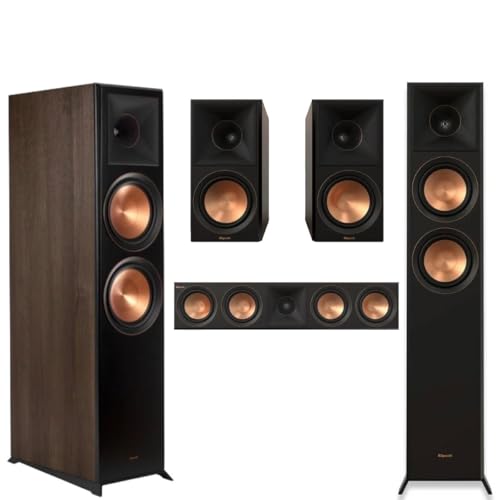 4. Klipsch Reference Premiere RP-8000F II 5.0 Home Theater Pack |
| Check price on Amazon |
Key takeaways
- The best high end home theater speakers compared: premium towers and a complete 5.0 system for clear dialogue, deep bass, and room-filling cinema sound.
As an Amazon Associate I earn from qualifying purchases.
The Short Answer
The best high end home theater speakers for most dedicated movie rooms are the Klipsch Reference Premiere RP-8000F II towers. Their large horn-loaded tweeter and dual 8-inch woofers deliver the dynamics and dialogue clarity that film soundtracks demand, and they fill a medium to large room without strain. If you want a more neutral, audiophile-leaning presentation, the SVS Prime Tower pair is the better choice, with a sealed midrange chamber that keeps voices clean at high volume. The Polk Audio Reserve R700 suits buyers who want deep, controlled bass from the towers themselves, while the Klipsch RP-8000F II 5.0 home theater pack is the simplest route to a complete front stage, with towers, a center channel, and surround speakers in one box.
High-end home theater speakers are not the same as everyday music speakers. Movie soundtracks swing from whispered dialogue to explosions in a fraction of a second, so a speaker built for cinema needs high sensitivity, strong dynamic range, and a center channel that anchors voices to the screen. Every pick below is a passive speaker, which means it needs an AV receiver or separate amplifier to produce sound. That is normal in this class, and it is also an advantage: a good receiver gives you room correction, bass management, and the power reserves that make action scenes feel alive.
Our Top Picks
- Klipsch Reference Premiere RP-8000F II (Ebony, each) — Best overall for cinematic impact. A horn-loaded tower with dual 8-inch woofers that plays loud and clear. Check on Amazon
- SVS Prime Tower Speakers, Pair (Premium Black Ash) — Best for neutral, accurate sound. A sealed midrange and a refined crossover keep dialogue and music precise. Check on Amazon
- Polk Audio Reserve Series R700 Tower Speaker, Black — Best for deep bass without a subwoofer. Dual 8-inch woofers and a down-firing port deliver weighty low end. Check on Amazon
- Klipsch Reference Premiere RP-8000F II 5.0 Home Theater Pack — Best complete system. Two RP-8000F II towers, an RP-504C II center channel, and two RP-502S II surround speakers in one package. (The listing title names RP-600M II bookshelves, but its included-components field lists RP-502S II surrounds — confirm which surrounds ship on the listing before buying.) Check on Amazon
Klipsch Reference Premiere RP-8000F II (Ebony, each) — Best overall for cinematic impact. A horn-loaded tower with dual 8-inch woofers that plays loud and clear. Check on Amazon
SVS Prime Tower Speakers, Pair (Premium Black Ash) — Best for neutral, accurate sound. A sealed midrange and a refined crossover keep dialogue and music precise. Check on Amazon
Polk Audio Reserve Series R700 Tower Speaker, Black — Best for deep bass without a subwoofer. Dual 8-inch woofers and a down-firing port deliver weighty low end. Check on Amazon
Klipsch Reference Premiere RP-8000F II 5.0 Home Theater Pack — Best complete system. Two RP-8000F II towers, an RP-504C II center channel, and two RP-502S II surround speakers in one package. (The listing title names RP-600M II bookshelves, but its included-components field lists RP-502S II surrounds — confirm which surrounds ship on the listing before buying.) Check on Amazon
Quick Comparison
| Pick | Type | Tweeter | Woofers | Best For |
|---|---|---|---|---|
| Klipsch RP-8000F II | Floorstanding tower, each | 1-inch titanium LTS with 90 x 90 Hybrid Tractrix Horn | Dual 8-inch Cerametallic | Cinematic impact and dialogue clarity |
| SVS Prime Tower, Pair | Floorstanding tower, pair | 1-inch aluminum dome | Dual 6.5-inch with 4.5-inch sealed midrange | Neutral, accurate sound |
| Polk Reserve R700 | Floorstanding tower, each | 1-inch Pinnacle ring radiator | Dual 8-inch long-throw with 6.5-inch midrange | Deep bass and full-range sound |
| Klipsch RP-8000F II 5.0 Pack | 5.0 speaker system | 1-inch titanium LTS across the set | Dual 8-inch in towers, dual 5.25-inch in surrounds | A complete front stage in one purchase |
How to Choose
Start with the room
Room size decides more than brand does. A large open living room needs towers with big woofers and high sensitivity, while a compact room can get by with smaller towers or bookshelf speakers paired with a subwoofer. Leave enough floor space for towers to breathe, pull them at least a foot away from the front wall, and angle them slightly toward the main seat.
Towers or a full system
A pair of towers is the foundation of a home theater, but dialogue lives in the center channel. If you already own a center speaker from the same product family, matching towers keep the tonal character consistent as sound moves across the screen. If you are starting from scratch, a matched 5.0 pack removes the guesswork: the towers, center, and surrounds are voiced to work together, and you only need to add a subwoofer and a receiver.
Sensitivity and amplifier power
Sensitivity tells you how much sound a speaker produces from a given amount of amplifier power. High-sensitivity towers, such as horn-loaded designs, need less power to play loud, which makes them a natural match for mid-range AV receivers. Lower-sensitivity towers can sound superb, but they ask more of the amplifier, so check the recommended power range on the listing and confirm that your receiver can drive the nominal impedance. A 4-ohm nominal speaker draws more current than an 8-ohm speaker, and not every receiver is comfortable with that load at high volume.
The center channel matters most
In a movie, the center channel carries the majority of the dialogue. A weak center makes voices hard to follow, no matter how good the towers are. When you buy towers from a particular series, look for the matching center channel from the same series, with the same tweeter technology. The RP-504C II in the Klipsch pack below is a good example: it shares the horn and driver family of the towers, so a voice stays consistent as it pans from left to center to right.
Placement and setup
Tower speakers sound their best placed symmetrically around the screen, with tweeters close to seated ear height. Avoid pushing them into corners, where bass can turn boomy, and avoid blocking rear ports. Most AV receivers include room correction, which measures your room and adjusts levels and timing for each speaker. Run that routine after placing the speakers.
What high-end means here
In this guide, high-end means premium driver materials, sturdier braced cabinets, and engineering aimed at low distortion at theater volume. A well-braced cabinet keeps resonance from coloring the sound, a dedicated midrange keeps voices separate from bass, and a careful crossover hands frequencies from one driver to the next without gaps. Confirm the exact driver layout, dimensions, and impedance on the listing before ordering.
The Picks in Detail
1. Klipsch Reference Premiere RP-8000F II (Ebony, each)
The RP-8000F II is the tower that defines this guide. It pairs a 1-inch titanium LTS tweeter with a larger 90 x 90 Hybrid Tractrix Horn, which controls dispersion so dialogue stays focused on the seating area instead of spraying sound around the room. Dual 8-inch Cerametallic woofers handle the low end, giving action scenes real weight without a subwoofer doing all the work. The 2.5-way design lets the woofers share bass and midrange duties in a way that keeps voices clear when the soundtrack gets busy.
This is a high-sensitivity speaker, which is exactly what a home theater needs. It plays loud with modest amplifier power, and it keeps its composure during the sudden dynamic swings that define modern film mixes. The Ebony finish is understated, and the cabinet is tall enough to place the tweeter near seated ear height in most rooms. Note that this listing is for a single speaker, so order two for a stereo pair, and confirm the quantity on the listing before checkout.
Pros:
- Horn-loaded tweeter keeps dialogue focused and intelligible at theater volume
- Dual 8-inch woofers deliver strong bass and dynamic impact
- High sensitivity works well with a wide range of AV receivers
- Matches the RP-504C II center channel for a consistent front stage
Cons:
- Sold as a single unit, so a pair requires two separate units
- Horn character is lively and forward, which may not suit listeners who prefer a softer top end
- Large cabinet needs real floor space and room to breathe
2. SVS Prime Tower Speakers, Pair (Premium Black Ash)
- Sealed midrange chamber keeps dialogue clean at high volume
- Neutral, balanced sound that suits movies and music alike
- Sold as a pair, so ordering is straightforward
- Slim cabinet fits rooms where wider towers would dominate
The SVS Prime Tower takes a different path to the same goal. Instead of a horn, it uses a 1-inch aluminum dome tweeter and a 4.5-inch midrange driver mounted in its own dedicated, completely sealed compartment. That separation keeps the midrange free from the pressure of the bass drivers, so voices and instruments stay clean and precise even when the low end is working hard. Dual 6.5-inch woofers deliver deep, articulate bass, and the proprietary SoundMatch 3.5-way crossover smooths the handoffs between the three driver types for accurate imaging.
This pair is sold as a matched set, which simplifies ordering, and the Premium Black Ash finish looks at home in a living room or a dedicated theater. The tower measures 36.6 inches high, 8 inches wide, and 11.6 inches deep, making it one of the slimmer towers in this guide. It rewards a good amplifier and careful placement, and it is the pick for listeners who want their movie sound neutral and faithful rather than deliberately forceful.
Pros:
Cons:
3. Polk Audio Reserve Series R700 Tower Speaker, Black
- Deep, controlled bass from dual 8-inch woofers and a down-firing port
- Dedicated 6.5-inch midrange keeps dialogue natural and separate from bass
- Hi-Res certification with Dolby Atmos and IMAX Enhanced support
- Ships with rubber feet for hard floors and spike feet for carpet
The Polk Reserve R700 is built to be a full-range tower that can anchor a home theater with or without a subwoofer. Its 1-inch Pinnacle ring radiator tweeter handles the top end, a 6.5-inch Turbine Cone midrange covers voices, and dual 8-inch long-throw woofers provide the bass. The cabinet uses a down-firing Power Port 2.0 with X-Port technology, so the port fires into the floor rather than at the wall behind the speaker, which reduces port noise and keeps placement more flexible.
The R700 is Hi-Res certified and supports Dolby Atmos and IMAX Enhanced formats, which makes it a natural fit for a modern AV receiver. The listing gives a frequency response of 38 Hz to 38,000 Hz, nominal impedance of 8 ohms, and recommended amplifier power of 50 to 300 watts, though Polk lists sensitivity at 88 dB, so a solid receiver is worth having. It stands 45 inches tall, 12.6 inches wide, and 16.9 inches deep, and weighs about 79 pounds, so plan the delivery and placement with a second person. This listing is for a single speaker in Black; confirm the finish and quantity on the listing.
Pros:
Cons:
4. Klipsch Reference Premiere RP-8000F II 5.0 Home Theater Pack
- Complete matched 5.0 system in a single purchase
- Center channel shares the towers’ horn and driver family for consistent dialogue
- Towers, center, and surrounds are voiced to work together
- Strong foundation that only needs a subwoofer and a receiver to complete
If you want a complete home theater speaker system in one purchase, this pack is the most direct route. It bundles two RP-8000F II floorstanding towers, an RP-504C II center channel speaker, and two RP-502S II surround speakers for surround duty. (The listing title names RP-600M II bookshelves, but its included-components field lists RP-502S II surrounds — confirm which surrounds ship on the listing.) Every speaker in the set shares the same Reference Premiere driver family, so the sound stays consistent as effects move around the room, and the center channel carries dialogue with the same horn-loaded clarity as the towers.
The pack is a 5.0 system, which means it has no subwoofer. The towers reach deep enough that many rooms will sound full without one, but a dedicated subwoofer is the logical next addition for the lowest film effects. The walnut finish option gives the set a warmer look than the Ebony towers, and buying the matched set avoids the risk of mixing driver families across the front stage. Confirm the exact bundle contents and finish on the listing, since pack configurations can change.
Pros:
Cons:
Who Should Choose What
Choose the Klipsch RP-8000F II towers if your priority is cinematic impact: loud, dynamic, dialogue-forward sound in a medium or large room, driven by a standard AV receiver. Choose the SVS Prime Tower pair if you want the most neutral and accurate presentation, and if you listen to as much music as you watch movies. Choose the Polk Reserve R700 if you want the towers themselves to supply deep bass, and if you have a capable receiver and the floor space for a tall, heavy cabinet. Choose the Klipsch 5.0 pack if you are building a theater from scratch and want the towers, center, and surrounds matched in one purchase, with only a subwoofer left to add.
Common Mistakes
The most common mistake is buying towers and skipping the center channel. Dialogue carries a film, and a mismatched or missing center makes voices thin and hard to follow. The second mistake is underpowering the speakers: a receiver that struggles at theater volume will clip and distort long before the speakers reach their limits, so match the recommended power range on the listing to your receiver. The third mistake is placement. Pushing towers tight against the wall or into a corner muddies the bass, while placing them too far apart leaves a hole in the middle of the soundstage. The fourth mistake is ignoring the subwoofer. Even strong towers benefit from a dedicated subwoofer handling the lowest frequencies, which frees the towers to play cleaner and louder. Finally, do not mix driver families across the front three speakers unless you have a clear reason: a horn-loaded tower with a soft-dome center can make a voice change character as it crosses the screen.
FAQ
Do I need a subwoofer with high-end tower speakers?
Not strictly, but it helps. Towers such as the Polk R700 and the Klipsch RP-8000F II reach deep enough for most music and much film content. A dedicated subwoofer still adds the lowest octave of movie effects and takes the hardest bass work off the towers, which lets them play cleaner at high volume.
How many speakers do I need for a home theater?
A 5.0 system, with left, center, right, and two surrounds, is the classic starting point, and adding a subwoofer makes it 5.1. The Klipsch 5.0 pack in this guide covers the five speakers; you add the subwoofer and receiver separately. Larger rooms can grow to 7.1 or add height channels, but a well-set-up 5.1 system satisfies most viewers.
Can I mix speaker brands in a home theater?
You can, but the front three speakers should match. The left, center, and right channels carry the most important sound, and matching them keeps voices consistent as they move across the screen. Surround speakers are less critical, so mixing brands there is a smaller compromise than mixing the front stage.
What receiver power do tower speakers need?
It depends on sensitivity and room size. High-sensitivity towers need less power to reach theater volume, while lower-sensitivity towers ask for more. Check the recommended amplifier power range on the listing, such as 50 to 300 watts for the Polk R700, and confirm that your receiver supports the speaker’s nominal impedance. When in doubt, a receiver with more clean power and room correction is the safer choice.
Are floorstanding speakers better than bookshelf speakers for movies?
For a dedicated home theater, usually yes. Towers move more air, reach deeper bass, and play louder with less strain, which suits film dynamics. Bookshelf speakers can work well in small rooms, especially with a subwoofer, but towers give a larger room the scale and impact that movies demand.
How far from the wall should tower speakers sit?
Give them room to breathe. Start with at least a foot of space behind a rear-ported tower, and more if the bass sounds boomy. Down-firing port designs such as the Polk R700 are more forgiving of wall placement, but every tower benefits from symmetric placement around the screen and a slight angle toward the main seat. Run your receiver’s room correction after final placement.
Conclusion
The best high end home theater speakers balance dynamics, dialogue clarity, and bass depth in a package your room and receiver can support. The Klipsch RP-8000F II towers lead this guide for cinematic impact, the SVS Prime Tower pair leads for neutral accuracy, the Polk Reserve R700 leads for full-range bass from the towers themselves, and the Klipsch 5.0 pack leads for buyers who want a complete matched system in one purchase. Whichever you choose, pair it with a matching center channel and a capable receiver, and confirm the exact configuration, finish, and quantity on the listing before ordering.
FAQ
Do I need a subwoofer with high-end tower speakers?
How many speakers do I need for a home theater?
Can I mix speaker brands in a home theater?
What receiver power do tower speakers need?
Are floorstanding speakers better than bookshelf speakers for movies?
How far from the wall should tower speakers sit?
More from Amazon
Programs that pair well with the guide above. Offers and eligibility are set by Amazon and may change.
Free shipping on eligible items, Prime Video and more. Eligible new members can start with a free trial.
Start a Prime free trialA Prime membership for ages 18-24 with a trial period. Eligibility is set by Amazon.
See Prime for Young AdultsAudiobooks and podcasts to listen to on the go. Eligible new members can start with a free trial.
Try Audible freeAd-free music streaming. Eligible new subscribers can start with a free trial.
Try Music Unlimited freeAs an Amazon Associate we earn from qualifying purchases.