Key takeaways
- Choosing between a 1080p and 4K dash cam is less about buying the highest resolution and more about deciding what you need the camera to prove after an incident. A 1080p model can be inexpensive, compact, and easy to use,…
What's inside
Choosing between a 1080p and 4K dash cam is less about buying the highest resolution and more about deciding what you need the camera to prove after an incident. A 1080p model can be inexpensive, compact, and easy to use, while a 4K camera may capture sharper license plates, road signs, and vehicle details at a greater distance. The trade-off is usually higher cost, larger video files, greater storage needs, and sometimes more heat.
Although this guide is written with home shoppers in mind, a dash cam is designed for a vehicle rather than indoor security. If you park outside your home, however, the camera can be part of your overall household safety setup. The right choice depends on your car, parking habits, driving conditions, phone or computer storage, and how much you value detail over simplicity.
As an Amazon Associate we earn from qualifying purchases at no extra cost to you. Product prices and availability are accurate as of the date shown and are subject to change.


![Akira - 4K & Blu-ray [4K UHD]](https://m.media-amazon.com/images/I/41-gM6ADceL._SL160_.jpg)
Quick Verdict
Choose 1080p if you want dependable evidence at the lowest price, drive mostly in daylight, or need a straightforward camera for occasional use. A good 1080p dash cam can record readable road activity and provide useful context after a collision.
Choose 4K if you frequently drive on highways, want the clearest possible view of distant details, or regularly park in busy areas where license plates and signs may matter. The improvement is most noticeable in daytime footage and when the subject is relatively far from the lens. It is not a guarantee of clear nighttime plates, since lens quality, exposure, glare, and lighting also matter.
Side by Side
| Consideration | 1080p Dash Cam | 4K Dash Cam |
|---|---|---|
| Image detail | Full HD; suitable for general traffic evidence | Much finer detail, especially in daylight and at distance |
| Comfort of ownership | Simple setup, smaller files, less frequent storage management | More demanding; may require faster cards and regular file transfers |
| Durability | Often produces less heat and places less demand on the memory card | Can run warmer; choose a heat-tolerant card and a reputable design |
| Typical price range | $25-$100 for basic to feature-rich models | $70-$250, with premium multi-camera systems costing more |
| Maintenance | Format a card about monthly and check the lens occasionally | Same routine, plus more frequent storage checks and larger file transfers |
| Space needed | Usually about 2.5-4 inches wide; compact on the windshield | Often about 3-5 inches wide, with a larger mount or lens housing |
| Look inside the car | Generally discreet and less visually noticeable | Can look more prominent, particularly with a screen and larger lens |
| Resale and reuse | Easy to move between cars and inexpensive to replace | Retains appeal for detail-focused buyers but may be harder to resell |
| Best for | Commuters, renters, older cars, and value-focused households | High-mileage drivers, highway travel, and maximum daytime detail |
Where Dash Cam 1080p Wins
The biggest advantage of 1080p is balance. A 1080p video frame contains enough detail to show traffic lights, lane positions, road conditions, and the general sequence of an incident without consuming excessive storage. A one-minute clip may occupy roughly 100-200MB, depending on bitrate and compression. A 4K clip can use two to four times as much space.
That difference affects everyday ownership. A 32GB card may hold several hours of 1080p footage, while the same card fills substantially faster with 4K video. Loop recording will overwrite older clips, but important footage still needs to be locked or copied promptly. A 64GB or 128GB high-endurance microSD card is a practical starting point for many systems, provided the camera supports that capacity.
1080p also tends to be the better fit for a small car or a tidy interior. Many units weigh about 2-5 ounces and use a compact adhesive or suction mount. Power requirements are commonly around 5 watts or less, usually supplied through a 12-volt adapter or USB connection. With less processing demand, these cameras may run cooler during long periods in a parked vehicle.
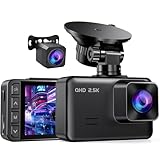
Budget shoppers can find dual-camera packages in the $35-$70 range. For example, a Dash Cam Front and Rear, 2.5K+1080P Dual Camera for Cars, 2″ IPS Screen is listed at $39.09. Its front resolution is higher than standard 1080p, but the broader buying lesson is that a front-and-rear system may provide more useful coverage than a sharper front-only camera.
Another value-oriented option in this category is a Dash Cam Front and Rear, 1296P Dash Camera for Cars, 3 Channel Car Camera Front Rear and Inside with 32GB Card, Loop Recording, Night Vision, HDR, 24Hr Parking, and G-Sensor, listed at $59.99. Features such as interior coverage, parking recording, and impact sensing may matter more to a family than moving from 1080p to 4K.
Where 4K Wins
4K is worthwhile when fine detail is central to your decision. With approximately four times the pixel count of 1080p, a 4K camera can preserve more information when you crop a clip or inspect a vehicle farther ahead. That can help with highway incidents, road signs, and identifying the make, color, or markings of another car.
The benefit is strongest when the camera has a good lens, a wide but not excessively distorted field of view, a suitable bitrate, and enough light. A poorly tuned 4K camera can still produce soft or noisy nighttime footage. Motion blur, headlight glare, rain, tinted glass, and a dirty windshield can reduce useful detail regardless of resolution.
Expect a higher purchase price, usually $70-$250 for a single-camera 4K model and more for front-and-rear or front-interior systems. Storage also matters. For regular driving, a 128GB high-endurance card is often more comfortable than 32GB, though maximum capacity depends on the camera. A 4K camera may draw roughly 5-10 watts, and parking mode can require a hardwire kit or an external battery pack to avoid draining the car battery.
Do not confuse 4K recording with every product labeled “4K.” An Amazon Fire TV Stick 4K Plus, listed at $39.99, is a streaming device for a television, not a vehicle camera. Likewise, Akira – 4K & Blu-ray [4K UHD], listed at $11.99, describes movie-video quality. In a dash cam listing, look specifically for recording resolution, frame rate, bitrate, camera channels, and night-performance features.
Cost Over 5 Years
A realistic five-year ownership estimate starts with the camera, then adds storage and installation. A basic 1080p setup might cost $40-$80 initially, plus $15-$30 for a high-endurance memory card and $0-$50 for installation. Replacing the card once during five years brings the approximate total to $70-$190.
A 4K setup may cost $90-$220, with $25-$60 for a larger, faster memory card and $0-$100 for installation or a hardwire kit. If the card needs replacement more than once because of heavier writing, the five-year total may reach about $150-$400. These are planning ranges, not guaranteed costs. A failed adapter, parking-mode battery, damaged mount, or replacement camera can increase either total.
Resolution should not be the only cost comparison. A front-and-rear 1080p package can offer more practical coverage than a single 4K camera, while a premium 4K system may include GPS, parking monitoring, and better sensors that explain its price.
Which One for Your Home
Small apartment
Choose 1080p if you have limited parking, a modest car, or a tight budget. Its smaller files are easier to transfer using a phone or laptop, and its compact appearance suits a small interior. If your apartment parking lot has frequent minor incidents, prioritize front-and-rear coverage and parking mode over maximum front-camera resolution.
Family with kids or pets
Consider a dual- or three-channel 1080p system if interior activity matters. A camera that covers the road, rear window, and cabin can document more context than a sharp front-only camera. Look for loop recording, a G-sensor, HDR, night vision, and a secure mount. If you routinely take long road trips, 4K may be worthwhile for clearer distant traffic details, but confirm that the storage card is included or budget for one.
Rental
Renters often benefit from a portable 1080p model with a suction mount or removable adhesive mount. Avoid permanent wiring unless your lease and installer allow it. A camera costing $35-$70 is easier to move between vehicles or replace at the end of a lease. Keep the power cable neatly routed so it does not interfere with airbags or visibility.
Long-term home
If you expect to keep the same vehicle for many years and drive extensively, 4K can be a sensible investment. It offers more flexibility when reviewing or cropping daylight footage and may better match a newer vehicle with an integrated, polished interior. Pair it with a high-endurance card, a reliable power connection, and a parking-mode plan. If most driving is local and daytime, a well-designed 1080p front-and-rear system remains the more economical choice.
FAQ
Is 4K always better than 1080p for a dash cam?
No. 4K provides more pixels, but lens quality, exposure, frame rate, bitrate, and night performance determine whether those pixels are useful. A strong 1080p camera can outperform a poorly designed 4K model in difficult lighting.
Can a 1080p dash cam read license plates?
It can sometimes capture readable plates, particularly when vehicles are nearby, stopped, and well lit. Speed, glare, distance, and motion blur can make plates unreadable. 4K improves the odds in favorable conditions but does not guarantee identification.
How much storage does a dash cam need?
For many drivers, 64GB is a practical minimum, while 128GB offers more recording time. A 1080p camera generally uses less space than 4K. Use a high-endurance card and check the manufacturer’s supported capacity before buying.
Should I choose front and rear coverage or 4K front video?
For everyday protection, front-and-rear coverage is often the better first upgrade because rear impacts are common and a single front camera cannot record what happens behind you. Choose 4K front video when distant daytime detail is your highest priority and your budget supports the additional storage and power demands.