Key takeaways
- More useful daytime detail: 4K footage can preserve small visual details better than 1080p, especially when the subject is reasonably close.
- Better cropping flexibility: You can enlarge part of a clip for an insurance claim or police report with less immediate loss of clarity.
- Strong evidence coverage: A front-and-rear kit records events ahead of you and behind you, rather than leaving one side undocumented.
- Modern image sensors: Cameras using newer STARVIS 2-style sensors can produce cleaner, more balanced footage than older budget cameras, although results still depend on the lens and software.
- Useful safety features: Many models include loop recording, impact detection, a screen or phone preview, and optional GPS data.
- Reasonable prices: You do not necessarily need to spend several hundred dollars. Good feature sets are available around $130 to $150, with premium systems costing more.
What's inside
The Short Answer
Is a 4k dash cam worth it? Yes—if you regularly drive on highways, park in busy areas, or want the clearest possible evidence after a crash. The one condition is that you must use a fast, reliable memory card and install the camera correctly; otherwise, the extra resolution may not deliver much practical benefit.
A 4K dash cam records at roughly 3840 by 2160 pixels, giving you more image detail than a standard 1080p model. That can make a difference when you are trying to read a nearby license plate, identify a road sign, or show exactly what happened in a collision. However, 4K is not a guarantee of perfect footage. Night performance, lens quality, exposure, mounting position, and video compression can matter just as much.
As an Amazon Associate we earn from qualifying purchases at no extra cost to you. Product prices and availability are accurate as of the date shown and are subject to change.

What You Actually Get
Most 4K dash cams use a wide-angle front camera, a suction or adhesive mount, a power cable, and a cigarette-lighter adapter. Many also include a rear camera, phone app, GPS, parking mode, and a memory card. Features vary significantly, so read the specifications rather than assuming every model includes everything.
A front 4K camera generally provides sharper daytime footage than a 1080p camera. The additional pixels give you more room to crop into a clip without making the picture immediately unreadable. That is useful when an incident occurs several car lengths away. It is less useful when a plate is tiny, heavily blurred by motion, blocked by glare, or recorded at night.
Dual-camera packages usually record 4K in front and a lower resolution in the rear. A rear camera is still valuable because it documents tailgating, rear-end collisions, and incidents while changing lanes. Expect to route a thin cable from the front windshield to the back of the vehicle. Depending on the car, this can take 30 minutes to two hours for a tidy installation.
Most compact dash cams measure approximately 2.5 to 4 inches across their main body and weigh about 2 to 6 ounces, excluding the mount and cable. They normally draw around 5 to 10 watts while recording. The included 12-volt adapter is usually enough for regular use, while continuous parking surveillance may require a separate hardwire kit and professional or careful DIY installation.
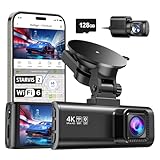
As a real-world price reference in 2026, the ROVE R2-4K Dual Dash Cam with front and rear recording, a STARVIS 2 sensor, and a 128GB card is listed at $149.99. The REDTIGER F7NP 4K front-and-rear package, also using a STARVIS 2 sensor and including a card, is listed at $129.99. These prices illustrate the current value range: roughly $130 to $150 for a feature-filled dual-camera kit, before optional hardwire installation.
Pros
- More useful daytime detail: 4K footage can preserve small visual details better than 1080p, especially when the subject is reasonably close.
- Better cropping flexibility: You can enlarge part of a clip for an insurance claim or police report with less immediate loss of clarity.
- Strong evidence coverage: A front-and-rear kit records events ahead of you and behind you, rather than leaving one side undocumented.
- Modern image sensors: Cameras using newer STARVIS 2-style sensors can produce cleaner, more balanced footage than older budget cameras, although results still depend on the lens and software.
- Useful safety features: Many models include loop recording, impact detection, a screen or phone preview, and optional GPS data.
- Reasonable prices: You do not necessarily need to spend several hundred dollars. Good feature sets are available around $130 to $150, with premium systems costing more.
Cons
- Large video files: A 4K recording can use considerably more storage than 1080p. A 128GB card may fill faster than expected, particularly with front and rear recording.
- Higher memory-card demands: Use a high-endurance microSD card with the speed rating recommended by the manufacturer. An ordinary low-cost card may corrupt footage or fail sooner under constant rewriting.
- Night footage has limits: Darkness, headlights, rain, reflections, and motion blur can make license plates difficult to read even at 4K.
- Heat can be a concern: A camera mounted behind a windshield can become very hot in direct sun. Excessive heat may shorten its lifespan or cause recording interruptions.
- More installation effort: Rear cameras require cable routing, and parking mode may require a hardwire kit. A poorly placed cable can obstruct visibility or interfere with airbags.
- Resolution can be overstated: Some cameras advertise 4K output while relying heavily on software processing or compression. A lower-resolution camera with a better lens may produce more natural footage in difficult conditions.
- Extra features may cost more: Cloud storage, cellular alerts, a hardwire kit, and larger memory cards can add $20 to $100 or more to the initial purchase.
Who Should Buy It
A 4K dash cam makes the most sense for frequent drivers, rideshare and delivery workers, commuters on fast roads, and anyone who has recently dealt with an unclear insurance dispute. It is also a sensible choice if you intend to keep the camera for several years. Paying more for sharper footage now may be worthwhile when the difference between “the other vehicle was there” and “the plate is visible” matters.
Choose a dual-camera kit if rear coverage is important or if your vehicle is frequently parked in public spaces. Look for a high-endurance card option, a stable mount, automatic file protection after an impact, and a clear return policy. If you want parking surveillance, confirm whether the camera supports buffered parking mode and budget for a compatible hardwire kit.
Who Should Skip It
Skip 4K if you drive only occasionally, use a second vehicle rarely, or mainly want a simple record of your route. A dependable 1080p camera may be enough for basic incident documentation and can cost substantially less. It is also a poor fit if you do not want to manage memory cards, route a rear-camera cable, or deal with a hardwired power connection.
Drivers who mostly travel at night should prioritize low-light image quality, a wide dynamic range, and good exposure control over the “4K” label alone. Likewise, if your windshield is heavily tinted, dirty, or covered by glare, higher resolution will not solve the underlying image problem.
Cheaper Alternatives
| Option | Cost | Trade-off |
|---|---|---|
| Basic 1080p front-only dash cam | $40–$80 | Lower detail and no rear coverage, but simple, compact, and inexpensive to replace. |
| 1080p front-and-rear dash cam | $70–$120 | Records both directions for less money, but front footage is less suitable for cropping or distant plates. |
| 1440p front-only dash cam | $80–$130 | A useful middle ground with more detail than 1080p, though it lacks the maximum resolution of 4K. |
| Used or older 4K dash cam | $80–$130 | Can provide high resolution at a discount, but may have an aging battery, outdated app, or limited support. |
FAQ
Does 4K make license plates easier to read?
Usually, but only when the plate is large enough in the frame and conditions are favorable. Daylight, a clean windshield, limited motion blur, and a properly focused lens help. At night or in heavy rain, glare and exposure can overwhelm the benefit of extra pixels.
Is a front-and-rear 4K dash cam better than a front-only model?
For most drivers, yes. Rear footage can clarify a collision, capture a hit-and-run, or document aggressive driving behind you. Keep in mind that many dual-camera systems use 4K in front and 1080p or 2K in the rear, so check the exact rear resolution before buying.
How much memory do I need for a 4K dash cam?
A 128GB high-endurance microSD card is a practical starting point for many systems, but recording time depends on resolution, frame rate, audio, and whether the rear camera is active. A 256GB card may be useful for frequent drivers if the camera supports it. Format the card in the camera regularly and replace it when the manufacturer recommends.
Is a $130 to $150 4K dash cam good enough?
It can be. Models in this range, including front-and-rear packages such as the ROVE R2-4K and REDTIGER F7NP, can offer strong value when they include a memory card and modern image sensors. Judge the purchase by its night footage, mounting system, warranty, app reliability, and card requirements—not resolution alone.
For most drivers, the final verdict is “yes, with expectations.” A 4K dash cam is worth the added cost when you value sharper daytime evidence and plan to use the camera regularly. If affordability and simplicity matter more, a reliable 1080p or 1440p model remains a perfectly reasonable choice.