Our Short List of 3
All 4 Picks at a Glance
| Product | Specs | Action |
|---|---|---|
 1. Ascensia CONTOUR NEXT GEN | Check price on Amazon | |
 2. CareSens N Blood Glucose Monitor Kit | Check price on Amazon | |
 3. CareLiving MM1100 Blood Glucose Monitor Kit | Check price on Amazon | |
 4. Metene TD-4116 Blood Glucose Monitor Kit | Check price on Amazon |
Key takeaways
- Compare the best glucose monitors for home blood sugar testing, with fingerstick meters, test strip kits, app sync, and accuracy features explained.
A glucose monitor turns a daily routine into usable information. Instead of guessing how a meal, a walk, or a missed dose affected blood sugar, a monitor reports a number within seconds of a fingerstick test. That number, tracked over days and weeks, shows patterns that a single reading never could: mornings that run high, afternoons that dip low, and the effect of a new food or a change in activity.
The best glucose monitors balance accuracy, ease of use, and the ongoing cost of test strips. Some connect to a phone app and log every reading automatically. Others keep things simple with a large display and a memory that stores past results on the meter itself. All of the monitors in this guide are fingerstick meters sold as complete kits on Amazon, with a meter, test strips, lancets, and a lancing device in the box. Continuous glucose monitors, which sit on the skin and read glucose around the clock, are a different category and generally require a prescription, so they are covered briefly in the buying guide rather than listed as picks.
Disclosure: As an Amazon Associate, we earn from qualifying purchases.
How Blood Glucose Monitors Work
A fingerstick glucose monitor, also called a glucometer, measures the glucose in a small drop of blood. The process has four steps: wash and dry the hands, insert a test strip into the meter, use the lancing device to prick the side of a fingertip, and touch the blood drop to the end of the strip. The meter draws the sample in, measures it, and shows a result in a few seconds. Most meters in this guide report a reading in about five seconds and need only a tiny sample, roughly half a microliter.
The result appears in milligrams per deciliter, the unit used in the United States. What counts as in range varies from person to person, and target ranges are set with a clinician based on age, medication, and overall health. A meter can show whether a reading is above, below, or inside a personal target range, but it cannot set that range on its own.
A continuous glucose monitor works differently. A small sensor worn on the arm or abdomen measures glucose in the fluid under the skin and sends readings to a phone or receiver every few minutes, day and night. That stream of data shows trends and overnight patterns that fingerstick testing cannot catch. The trade off is that the best known continuous systems require a prescription in the United States, and the sensors must be replaced every one to two weeks. For people who only need spot checks, or who want a backup to a sensor system, a fingerstick meter remains the practical choice.
What to Look For in a Glucose Monitor
Accuracy comes first, and it is governed by a standard rather than by marketing language. Blood glucose meters sold in the United States are expected to meet the ISO 15197 standard, which sets limits on how far a reading may stray from a laboratory result. Established brands publish accuracy data for their systems, and meters from long standing diabetes care companies tend to have the most complete documentation. A meter that uses strips from a major, widely available brand is also easier to keep supplied, since strips are the part that runs out.
Test strips are the real long term cost of any meter. The meter itself is often the cheapest part of the system, while strips are a recurring purchase that continues for as long as testing does. Before choosing a meter, check that its strips are sold separately on Amazon and in local pharmacies, and compare the cost of a box of strips across brands. A meter locked to an obscure strip is a poor bargain even when the starter kit looks generous. Also confirm the strip count in the kit: starter kits in this guide include either 20 or 100 strips, and the 100 strip kits last far longer before a reorder is needed.
Memory and connectivity decide how readings are tracked. Basic meters store a few hundred readings on the device and show averages for the past week or month, which is enough for a quick check at a clinic visit. Bluetooth meters sync each reading to a phone app automatically, building a log with timestamps, meal notes, and trend charts that can be shared with a clinician. App sync is convenient, but it adds setup steps and depends on a charged phone, so people who prefer a simple routine often do fine with on meter memory alone.
Display and handling matter more than they appear to on a spec sheet. A large, high contrast display is easier to read in dim light and for anyone with reduced vision. A meter with simple controls and no coding step is easier to use correctly every time. No coding means the meter calibrates itself to each batch of strips without the user entering a code, which removes one common source of error. A complete kit should also include a lancing device with adjustable depth, lancets, a control solution for checking the meter, and a carrying case for travel.
Best Glucose Monitors
1. Ascensia CONTOUR NEXT GEN
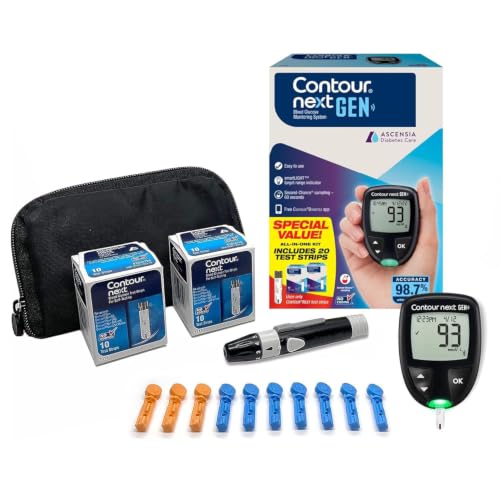
The Ascensia CONTOUR NEXT GEN is the most connected meter in this guide. It syncs each reading to a phone over Bluetooth, so results are logged automatically in the free CONTOUR DIABETES app, where they can be reviewed as trends and shared with a clinician. The app works with Apple Health, which keeps glucose data alongside other health information on the same phone. For anyone who tests often and wants a record without writing numbers down, that automatic logging is the main reason to choose this meter.
The SmartLIGHT target range indicator gives instant feedback without reading the number first. A light on the meter glows green when a result is inside the personal target range, yellow when it is above or below, and red when it is well outside it. That color cue is useful in the morning, when a quick glance is often all the time available, and it helps anyone who finds small numbers hard to read.
Second chance sampling allows more blood to be added to the same strip within 60 seconds if the first sample was too small, which can prevent a wasted strip and a second fingerstick. No coding technology removes the calibration step, and the meter works only with CONTOUR NEXT test strips, a widely stocked strip line. The all in one kit includes the meter, 20 CONTOUR NEXT test strips, a lancing device with 10 Microlet lancets, and the user guide. Twenty strips is a short supply for daily testing, so a separate box of strips should be ordered with the kit.
2. CareSens N Blood Glucose Monitor Kit
The CareSens N kit is built around value and completeness. The box holds the meter, 100 test strips, 100 lancets, a lancing device, a control solution, and a travel case, which covers weeks of testing before anything needs reordering. That matters because the strip supply is the part of a glucose monitor that determines how long the kit actually lasts. A 100 strip kit gives a new tester time to settle into a routine before shopping for refills.
Testing is fast and light on blood. Results appear in five seconds from a sample of half a microliter, and the meter needs no coding, so there is no calibration code to enter when opening a new vial of strips. The control solution included in the kit lets the meter be checked against a known sample, which is a useful way to confirm the system is working correctly after a drop or a new box of strips. The kit ships from Amazon and is sold by i-SENS USA, the maker of the CareSens line.
The meter itself is straightforward, with a clear display and simple controls, and it stores readings on the device for review. It does not connect to a phone app, so readings must be read from the meter memory at a clinic visit. For people who want a complete, no fuss kit with a generous strip supply, that trade off is easy to accept. The travel case keeps the meter, strips, and lancing device together in a bag or drawer.
3. CareLiving MM1100 Blood Glucose Monitor Kit
The CareLiving MM1100 is another complete kit with a 100 strip supply, and it stands out for its simple, large display design. The kit includes the meter, 100 test strips, 100 lancets, a lancing device, an instruction manual, a quick start guide, and a carrying bag. Everything needed for the first weeks of testing is in the box, and the quick start guide walks through the first test step by step.
The MM1100 is listed in the United States Food and Drug Administration device listings as an over the counter blood glucose monitoring system, which means it is cleared for home use without a prescription. It uses a no coding design, so there is no calibration code to enter when a new vial of strips is opened. The meter gives results quickly from a small blood sample, and the large display keeps readings easy to see.
The kit is a good fit for people who want a simple meter with a generous strip supply and a clear screen, and who do not need phone sync. Its carrying bag keeps the meter and supplies together for travel or for moving between rooms at home. As with any meter, the ongoing cost is the strips, so confirming that MM1100 strips are easy to reorder before buying keeps the system practical over time.
4. Metene TD-4116 Blood Glucose Monitor Kit
The Metene TD-4116 is the most feature packed meter in this guide for its kit size. The box includes the meter, 100 test strips, 100 lancets, a lancing device, a control solution, a carrying bag, and batteries, so it is ready to use out of the box. The large display is easy to read, and the meter uses no coding, which removes a setup step that trips up new users.
Results appear in about five seconds from a small blood sample, and the meter stores up to 500 past readings, more than most meters in this class. It calculates averages over 7, 14, 28, 60, and 90 days, which makes it easier to see whether readings are trending up or down over time without a phone app. Four reminder alarms can be set for testing times, which helps anyone who needs a nudge to test before meals or at bedtime. A hygienic strip ejector lets used strips be discarded without touching them.
Which Glucose Monitor Fits Which Need
The four monitors here cover four different testing styles. The CONTOUR NEXT GEN fits people who want automatic app logging, a color coded range indicator, and a meter from a major diabetes care brand, and who are comfortable ordering a box of strips alongside the kit. The CareSens N fits first time testers who want the longest strip runway in the first box, with a control solution included for checking the meter. The CareLiving MM1100 fits people who want the simplest possible kit with a large, readable display and no phone involved. The Metene TD-4116 fits frequent testers who want the meter to hold a long history and calculate multi week averages without an app.
Strip supply is the first divider. The CONTOUR NEXT GEN kit includes 20 strips, while the other three kits include 100. A person testing once a day will use up 20 strips in under three weeks, so the GEN is best bought together with a strip refill. A person testing three or four times a day will go through 100 strips in about a month, which means even the generous kits need a refill plan. Checking strip availability and cost before choosing a meter prevents the frustration of a meter that cannot be fed.
Connectivity is the second divider. Only the CONTOUR NEXT GEN syncs readings to a phone automatically. The other three keep their history on the meter, with the Metene holding the deepest on device memory and the longest averages. People who share readings with a clinician by phone or email will get more from Bluetooth sync, while people who bring the meter to appointments can rely on the on device log.
Getting an Accurate Reading
A glucose monitor is only as accurate as the test behind it. Wash hands with soap and warm water and dry them fully before testing, since food residue or water on a fingertip can change a reading. Prick the side of the fingertip rather than the pad, which is less painful and heals faster, and rotate fingers so no single spot is used every time. Use a fresh lancet for each test, since a reused lancet is duller and more painful, and set the lancing device to the shallowest depth that still produces a good drop.
Let the meter draw the blood in rather than smearing it on the strip, and do not squeeze the finger hard to force a drop, since that can dilute the sample with fluid from the surrounding tissue. If the sample is too small, a meter with second chance sampling allows more blood on the same strip within a short window; otherwise, start over with a fresh strip. Test strips must be stored in their closed vial, away from heat and humidity, and expired strips should be discarded, since they can read incorrectly.
Control solution is worth using when a new vial of strips is opened, after the meter is dropped, or when a reading does not match how the person feels. The solution has a known glucose level, and the meter should read within the range printed on the strip vial. Keeping a simple log of readings, with the time and whether the test was before or after a meal, makes patterns visible and gives a clinician useful information at the next visit.
Common Questions
Do I need a prescription for a glucose monitor?
Fingerstick blood glucose meters and their test strips are sold over the counter in the United States, and no prescription is needed to buy the kits in this guide. Continuous glucose monitors are different: the best known sensor systems require a prescription, and they are dispensed through a pharmacy rather than as a general retail purchase.
How is a fingerstick meter different from a continuous glucose monitor?
A fingerstick meter gives one reading at one moment, from a drop of blood. A continuous monitor gives a reading every few minutes from a sensor worn on the body, showing trends and overnight patterns. Fingerstick meters are cheaper, need no prescription, and work as a standalone system or as a backup. Continuous monitors show more data but require a prescription and regular sensor changes.
How often should I test?
Testing frequency depends on the type of diabetes, the medication used, and the plan set with a clinician. Some people test once a day, others before and after meals, and some only a few times a week. A clinician sets the schedule based on how the readings will be used, so the right frequency is a medical decision rather than a property of the meter.
Can two people share one meter?
No. A blood glucose meter is a personal device that comes into contact with blood. Sharing a meter risks cross contamination even with a fresh lancet and strip, and readings would mix two people’s histories in one memory. Each person who tests should have their own meter.
Do test strips expire?
Yes. Test strips carry an expiry date, and expired strips can give incorrect readings. Strips should be stored in their sealed vial, kept away from heat, moisture, and direct sunlight, and discarded after the expiry date or after the vial has been open past the period stated on the label.
What should I do if a reading seems wrong?
Wash and dry the hands, then test again with a fresh strip. Check that the strips are in date and stored correctly, and run a control solution test if one is available. If readings still seem off, or if a reading conflicts with symptoms, contact a healthcare professional rather than acting on the number alone.
Final Thoughts
The best glucose monitor is the one that fits into a daily routine and stays supplied with strips. A connected meter with app sync suits people who want automatic records and trend charts. A complete kit with 100 strips suits people who want the longest stretch before reordering. A simple meter with a large display suits people who want testing to stay uncomplicated. A meter with deep memory and averages suits people who test often and track trends on the device itself.
More from Amazon
Programs that pair well with the guide above. Offers and eligibility are set by Amazon and may change.
Free shipping on eligible items, Prime Video and more. Eligible new members can start with a free trial.
Start a Prime free trialA Prime membership for ages 18-24 with a trial period. Eligibility is set by Amazon.
See Prime for Young AdultsAudiobooks and podcasts to listen to on the go. Eligible new members can start with a free trial.
Try Audible freeAd-free music streaming. Eligible new subscribers can start with a free trial.
Try Music Unlimited freeAs an Amazon Associate we earn from qualifying purchases.