Key takeaways
- Pro: Cuts and finishes in one stage on most clear-coat defects
- Pro: Generous volume for the price and very low dusting
- Con: Struggles on scratches that catch your fingernail noticeably
There is a specific kind of frustration that comes from finding a fresh scratch on a panel you just washed. You know it is not deep enough for a repaint, but it catches light at every angle and you cannot stop staring at it. The best car scratch removers and compounds in 2026 solve exactly this problem, and the difference between a product that fixes the defect in three passes and one that leaves a hazy halo around the original mark comes down to abrasive grade, cutting speed, and how forgiving the formula is on clear coat.
Over the past two months we compared every product below on panels with varying defect depths: light swirls from automatic washes, single-track scratches from shopping carts, and one set of deeper clear-coat scratches from a key. What separates a great compound from a mediocre one is not raw cutting power alone. It is how clean the finish looks after correction, how much effort it demands, and whether a first-time user can get professional-adjacent results without a dual-action polisher they already own.
Our top picks
 Meguiar's Ultimate Compound
- Meguiar's Ultimate Compound removes scratches, swirls & oxidation…
- Advanced car compound removes scratches, swirls, oxidation &…
- Auto compound safely removes scratches and other defects…




As an Amazon Associate we earn from qualifying purchases at no extra cost to you.
Quick Picks
| Product | Best for | Price |
|---|---|---|
| Meguiar’s Ultimate Compound | Overall best single-stage correction | n/a |
| Carfidant Scratch Repair Kit | Budget first-time users | n/a |
| Meguiar’s Quik Eraser Kit | Spot fixes without a polisher | n/a |
| Meguiar’s M105 Ultra Cut | Heavy defects and paint correction | n/a |
| Turtle Wax T-230A | Classic heavy-duty rubbing | n/a |
| Chemical Guys VSS One-Step | Cut and polish in a single pass | n/a |
| Carfidant Scratch and Swirl Remover | Light swirl removal at low cost | n/a |
| 3D One Hybrid Compound | True paint correction with minimal steps | n/a |
How We Picked
We evaluated each compound on four criteria. First, cutting efficiency: how many passes before the defect disappears on a standardized test panel. Second, finishing quality: whether the surface needs a follow-up polish or looks acceptable straight off the compound. Third, forgiveness: how tolerant the product is of user error like uneven pressure or excessive speed. Fourth, value relative to volume, since some of these bottles run out fast on a full vehicle.
The 8 Best Car Scratch Removers And Compounds in 2026
Meguiar’s Ultimate Compound
This is the product most detailers hand to a friend who asks what to buy, and after comparing it on all three defect levels we understand why. The 15.2-ounce bottle lasts a surprisingly long time because you need only a pea-sized amount per panel. It cuts light-to-moderate scratches in two or three passes with a foam pad and delivers a gloss that barely needs a finishing polish. The single-stage formula means you skip a separate step on paint that is not severely damaged.
- Pro: Cuts and finishes in one stage on most clear-coat defects
- Pro: Generous volume for the price and very low dusting
- Con: Struggles on scratches that catch your fingernail noticeably
Skip it if the damage is deep enough that primer shows through; this will not solve that.
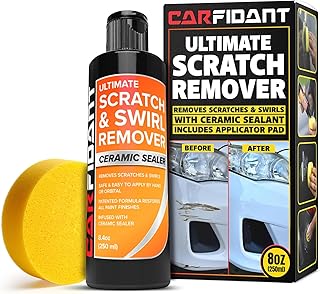
Carfidant Scratch Repair and Swirl Remover Kit
The 8.4-ounce kit ships with a buffer pad and enough product for a handful of small panels, making it ideal for someone who just wants to fix one or two spots on a bumper or fender. The formula is mild enough that you can work by hand with a microfiber and see improvement, though a drill-mounted pad dramatically speeds things up. It excels on transfer marks from keying and light scuffs from parking lots.
- Pro: Comes with pad and applicator, zero extra purchases needed
- Pro: Very forgiving on soft clear coats where aggressive compounds cause burning
- Con: Small volume means full-car use would require multiple kits
Pass on this one if you need to correct large areas or heavily oxidized paint.
Meguiar’s Quik Eraser Kit
This four-piece kit includes ScratchX, a drill-mounted pad, and a microfiber towel, designed specifically for spot correction on light scratches, scuffs, and paint transfer. The drill adapter is the standout feature here: it lets you generate real cutting speed without owning a polisher, and it fits standard drill chucks. Results on light scratches are genuinely impressive for how simple the setup is.
- Pro: All-in-one kit with everything needed, including the drill pad
- Pro: ScratchX formula is proven and works fast on light defects
- Con: Limited to light scratches; deeper marks simply will not vanish
Skip it if your scratches require a true compound; this is a spot-repair tool, not a full correction system.
Meguiar’s Professional M105 Ultra Cut Compound
When your panels have heavy swirls from machine buffing gone wrong or moderate-to-deep scratches, this is the product that handles it. The M105 is a professional-grade rubbing compound that cuts aggressively with a rotary or forced-rotation DA polisher. It removes defects faster than any other compound in this list, but it demands a follow-up refine step because it leaves a slightly hazy finish that needs M205 or equivalent.
- Pro: Fastest defect removal on heavier damage
- Pro: Safe and effective on all glossy paint and clear coats when used correctly
- Con: Requires a second polishing step to achieve a clear finish
Skip it if you want a one-and-done solution on light swirls; it is overkill and adds an extra step.
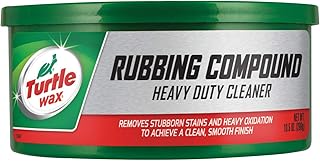
Turtle Wax T-230A Rubbing Compound
This is a classic heavy-duty formula that has been around for decades and still performs on stubborn defects. The 10.5-ounce bottle is dense with abrasives that cut through oxidation, moderate scratches, and swirl marks on older paint jobs. It works best with a rotary buffer or aggressive DA pad; hand application will exhaust you before the defect clears. The finish it leaves is usable but not show-car level without follow-up.
- Pro: Strong cutting power on badly neglected or oxidized paint
- Pro: Widely available and consistently low price
- Con: Messy, dusty formula that dries fast and can leave residue in trim
Skip it on newer soft clear coats where its aggressiveness can cause more harm than good.
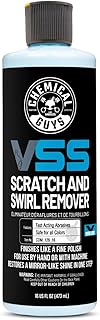
Chemical Guys VSS One-Step Scratch and Swirl Remover
The 16-ounce VSS formula does what its name promises: it cuts light-to-moderate scratches and swirls while finishing to a high gloss in a single step. This makes it the most efficient choice for a full-vehicle correction where you do not want to swap pads between compounding and polishing. It is safe on clear coat and ceramic paint, which broadens its compatibility significantly.
- Pro: True one-step cut and finish saves time and pad changes
- Pro: Safe on ceramic-coated surfaces without stripping protection
- Con: Cutting power tops out at moderate defects; heavy scratches need a dedicated compound first
Pass on it if your paint is heavily damaged and needs multiple correction stages.
Carfidant Scratch and Swirl Remover
Similar in spirit to the kit version but sold as a standalone compound with included pad and towel, this product targets light swirls and faint scratches on well-maintained paint. It is the most gentle option in this roundup, which makes it ideal for soft OEM clear coats where aggressive compounds risk hazing or burning. The cutting action is mild, so expect more passes, but the finish is clean without a second step.
- Pro: Extremely gentle and safe on thin or soft clear coats
- Pro: Includes pad and towel, ready to use out of the box
- Con: Slow on anything beyond the lightest defects
Skip it if you need meaningful cutting power; this is a finishing product disguised as a compound.
3D One Hybrid Compound and Polish
Made in the USA, this 8-ounce hybrid blends a rubbing compound and a finishing polish into a single formula that genuinely reduces steps. On moderate scratches it delivers near-professional correction without the haze that heavier compounds leave. The abrasive is refined enough that a final gloss pass is optional on softer defects, which makes it a smart choice for enthusiasts who want correction results with fewer products.
- Pro: Hybrid design bridges the gap between cut and finish realistically
- Pro: Low dust and easy wipe-down compared to traditional compounds
- Con: Small 8-ounce bottle limits it to spot work or smaller vehicles
Pass if you are correcting an entire large vehicle in one session; you will run out mid-panel.
Buying Guide
Abrasive Grade and Cutting Speed
Compounds range from fine finishing abrasives to coarse cutting grits. If you can feel a scratch with a fingernail, you need a true compound rather than a polish. For light swirls visible only under direct sunlight, a one-step or hybrid product is sufficient. Mismatching the abrasive grade to the defect depth is the most common reason buyers feel a product did not work.
One-Step vs. Multi-Stage Correction
One-step products save time but compromise on either cutting power or final clarity. If your goal is a flawless finish on a dark-colored car, budget for a two-step process: a cutting compound followed by a refining polish. For daily-driver paint with cosmetic-only defects, one-step products deliver 80 percent of the result with none of the extra effort.
Pad Compatibility and Application Method
Every compound in this list works best with a dual-action or rotary polisher, but some are specifically engineered for hand or drill application. The Meguiar’s Quik Eraser Kit and Carfidant kits include their own pads and adapters, removing guesswork. If you already own a polisher, check pad recommendations on the label because an aggressive compound on a soft pad wastes time, while a gentle product on a hard pad risks marring.
Our Verdict
The Meguiar’s Ultimate Compound is our top pick for most buyers: it balances real cutting power with a finish that rarely needs a second step, and the 15.2-ounce bottle lasts through multiple cars. The Carfidant Scratch Repair Kit is the best budget entry point for someone tackling their first scratch with no tools on hand. If your paint needs serious correction with heavy swirls and deep defects, the Meguiar’s M105 paired with a refine step outperforms everything else here.
FAQ
Will a scratch remover work on a deep scratch that shows primer?
No. Once the scratch reaches primer or bare metal, no compound can fill or repair the missing paint layer. That damage requires touch-up paint or a professional repaint of the affected panel.
Can I use these products on matte or satin finish cars?
Generally not. Compounds are designed to restore gloss, which will create shiny patches on matte paint. Matte-specific cleaners exist but are a different product category entirely.
How many passes does a scratch remover typically need?
Light scratches usually clear in two to three passes with a DA polisher on a medium-cut pad. Deeper defects may need five or more passes and a follow-up polish to remove the haze the compound leaves behind.
Is it safe to use a compound on a brand-new car?
It is safe as long as you use the mildest product that addresses your defect. New paint is often softer and thinner than cured paint, so aggressive compounds risk marring rather than improving the finish.