Key takeaways
- Verify group size, terminal orientation, height, venting, and hold-down before purchase.
- Clean corrosion from the terminals and cable ends; a poor connection can mimic a failed battery.
- Install the hold-down firmly without crushing the case.
- Use the correct charger mode. A conventional charger setting may be unsuitable for some AGM batteries.
- Do not repeatedly discharge a starting battery to run accessories.
- Have the charging system checked if the battery repeatedly goes flat. A new battery cannot compensate for a failing alternator, excessive parasitic draw, or loose ground cable.
- Use a battery maintainer when a vehicle is stored for more than several weeks, especially if an alarm, telematics module, or keyless-entry system remains active.
Best Car Batteries for Reliable Starting Power
The best car batteries are the ones that match your vehicle’s group size, meet or exceed its cold-cranking-amp requirement, and suit how the car is driven—not simply the battery with the largest advertised number.
For most everyday vehicles, a quality flooded lead-acid battery from a reputable manufacturer is the sensible value choice. Choose an AGM battery instead when the vehicle requires AGM, has start-stop technology, uses substantial electrical accessories, or regularly experiences vibration, heat, and short-trip driving. Before buying, confirm the exact fitment in the owner’s manual or a reputable vehicle-fitment catalog.
Our top picks
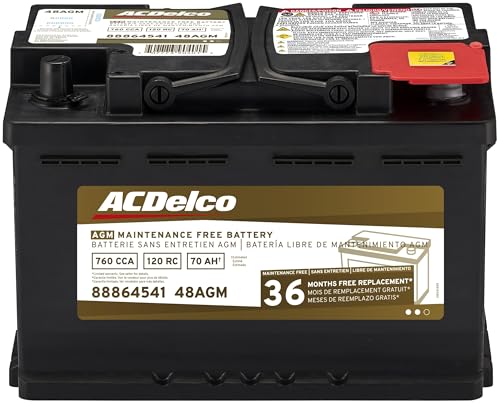


As an Amazon Associate we earn from qualifying purchases at no extra cost to you. Ratings are shown as listed on Amazon.
Quick picks by driving situation
| Situation | Best battery type | Useful target | Why it fits |
|---|---|---|---|
| Normal commuting and lowest ownership cost | Flooded lead-acid | OEM CCA or higher; 36–60 months of expected service | Lower purchase price and widely available replacement |
| Factory start-stop system | AGM, unless the manufacturer specifies EFB | Use the original technology and group size | Designed for repeated engine restarts and deeper cycling |
| Audio equipment, winch, lighting, or frequent accessory use | AGM | High reserve capacity plus adequate CCA | Better cycling tolerance and vibration resistance |
| Cold winters | Flooded or AGM with a strong CCA rating | At least the vehicle’s specified CCA; more margin for severe cold | Cold slows the chemical reaction and makes the engine harder to turn |
| Vehicle stored for weeks at a time | AGM with a maintainer, or a quality flooded battery with a maintainer | Reserve capacity is helpful, but maintenance matters more | Parasitic drain can discharge either design while parked |
Group size comes before brand
A battery group size describes the case dimensions, terminal arrangement, hold-down design, and often the general electrical capacity. Common automotive sizes include 24F, 35, 48/H6, 49/H8, 51R, 65, and 78. The “R” suffix commonly indicates reversed terminal positioning, so a 51 battery is not automatically interchangeable with a 51R.
Do not force a battery into the tray because its voltage is also 12 volts. A case that is too tall can contact the hood; incorrect terminals may not reach the cables; and a missing or incompatible hold-down can allow damaging movement. Start with the vehicle’s original group size. An alternative is acceptable only when the manufacturer or battery-fitment data confirms the dimensions, terminal orientation, venting, and restraint system.
Typical group-size comparison
| Group | Approximate case size (L × W × H) | Typical CCA range | Typical reserve capacity | Common applications |
|---|---|---|---|---|
| 35 | 9.1 × 6.9 × 8.9 in | 500–650 | 80–110 minutes | Many Japanese and compact vehicles |
| 48/H6 | 11.0 × 6.9 × 7.5 in | 600–760 | 100–140 minutes | European vehicles and many newer sedans |
| 49/H8 | 13.9 × 6.9 × 7.5 in | 800–950 | 130–180 minutes | Large vehicles and high-electrical-load applications |
| 51R | 9.4 × 5.1 × 8.8 in | 400–550 | 60–90 minutes | Smaller cars where reversed terminals are required |
| 65 | 12.1 × 7.5 × 7.6 in | 650–850 | 110–160 minutes | Trucks, SUVs, and larger engines |
These are representative ranges, not fitment rules. Dimensions and output vary by manufacturer and construction, so the label on a specific battery takes priority.
CCA and reserve capacity: what the numbers mean
Cold-cranking amps (CCA) indicate how much current a fully charged battery can deliver for 30 seconds at 0°F while maintaining the industry test voltage. CCA matters most when starting a large engine in cold weather. It does not measure total battery size, long-term durability, or how long accessories can run.
Reserve capacity (RC) measures how many minutes a fully charged battery can provide a 25-amp load before reaching a specified discharged voltage. RC is more relevant to running lights, a radio, or other electrical equipment after the alternator stops charging. If two correctly fitting batteries meet the vehicle’s CCA requirement, the one with higher RC can offer more accessory-running margin.
For a simple estimate, a 25-amp load on a battery rated at 120 minutes of RC represents approximately 50 amp-hours under the test condition: 25 amps × 2 hours = 50 amp-hours. Real-world runtime will be shorter or longer depending on temperature, battery age, load, and the voltage cutoff. Avoid using a starting battery as a deep-cycle power source.
AGM versus flooded: which construction should you buy?
Flooded lead-acid
Flooded batteries use liquid electrolyte and remain the standard choice in many vehicles. They usually cost less, offer adequate starting power, and are easy to replace. Their weaknesses are greater sensitivity to vibration and repeated deep discharge. Heat, low electrolyte level, corrosion, and chronic undercharging accelerate aging.
AGM
Absorbent Glass Mat batteries hold the electrolyte in glass-fiber separators. They are sealed against normal spillage, tolerate vibration well, and generally provide stronger cycling performance and higher reserve capacity for a comparable case size. They are often the right choice for start-stop vehicles and cars with heavy electrical demands.
AGM is not an automatic upgrade for every car. It costs more, and the vehicle’s charging system must be compatible. Some vehicles require battery registration or charging-system coding after replacement. Installing a flooded battery where AGM is specified can shorten battery life and interfere with start-stop operation.
Brands and product lines worth comparing
Established lines such as Interstate MT and MTX, DieHard Gold and Platinum, Duralast Gold and Platinum, Optima RedTop and YellowTop, and Odyssey Extreme are widely recognized examples of conventional and AGM choices. Availability and exact specifications vary by group size, so compare the individual battery label rather than assuming every model in a product family has the same CCA or warranty.
For a normal commuter, compare the lower-priced flooded options from reputable manufacturers on warranty length, recent production date, and local replacement support. For severe vibration or accessory use, compare AGM options such as Optima YellowTop, Odyssey Extreme, or equivalent AGM lines from Interstate and DieHard. Optima RedTop is primarily a starting battery; a YellowTop-type design is more appropriate when repeated accessory cycling is part of the use case.
Warranty, freshness, and total value
Automotive battery warranties commonly range from about 1 to 5 years, with some premium products offering longer limited coverage. A longer free-replacement period is more valuable than a prorated credit, which may cover only part of the replacement cost. Read the terms for exclusions involving commercial use, deep discharge, improper charging, and failure to return the old battery.
Battery age also matters. Look for the manufacturer’s date code or production label and prefer a recently manufactured unit. A battery that has sat discharged for months can lose capacity before installation. General market prices are roughly $100–$180 for many flooded replacement batteries and $180–$350 or more for premium AGM batteries, depending on group size and warranty.
Installation and maintenance mistakes that shorten battery life
- Verify group size, terminal orientation, height, venting, and hold-down before purchase.
- Clean corrosion from the terminals and cable ends; a poor connection can mimic a failed battery.
- Install the hold-down firmly without crushing the case.
- Use the correct charger mode. A conventional charger setting may be unsuitable for some AGM batteries.
- Do not repeatedly discharge a starting battery to run accessories.
- Have the charging system checked if the battery repeatedly goes flat. A new battery cannot compensate for a failing alternator, excessive parasitic draw, or loose ground cable.
- Use a battery maintainer when a vehicle is stored for more than several weeks, especially if an alarm, telematics module, or keyless-entry system remains active.
Bottom line
Choose the correct group size first, then meet the original CCA specification and compare reserve capacity, construction, warranty, freshness, and price. A flooded battery is usually the best value for ordinary driving. AGM is the better investment for factory start-stop systems, high electrical loads, severe vibration, and frequent short trips—provided the vehicle is designed for it. That approach produces more reliable starting power than choosing by brand name or the biggest CCA number alone.