Key takeaways
- Comes with installation wire kit, no extra parts needed
- Entry-level, budget-tier pick in this roundup
- Con: No published RMS rating, so actual sustained output is likely well below 800W peak
Underseat subwoofers used to be a compromise you made when you cared more about trunk space than bass. That changed. The best powered underseat car subwoofers now deliver genuinely physical low-end punch without requiring a separate amp rack or a trunk full of plywood. The category has matured to the point where a single compact unit can fill a mid-size SUV with chest-thumping bass, or tuck under a truck seat and still move enough air to keep a subwoofer on your playlist from sounding thin.
But not all underseat subs are built the same. The gap between a genuinely good one and a cheap knockoff is enormous. We are talking about the difference between a cast aluminum enclosure that sheds heat well and a thin plastic shell that can distort once you push past moderate volume. Power ratings on the sticker are marketing. What separates a good buy from a disappointing one is real RMS output, crossover quality, build materials, and how cleanly the unit integrates with your existing head unit or factory radio. We compared these options using published specifications across different vehicle sizes and wiring setups so you can skip the guesswork.
Our top picks
 10" 800W Under Seat Car Subwoofer and
- Seventour 10 inch Ultra Slim Under Seat Active…
- This is a car subwoofer audio that features…
- This car subwoofer includes wired bass volume remote…


As an Amazon Associate we earn from qualifying purchases at no extra cost to you.
Updated October 2026 — The best powered underseat car subwoofer for most drivers is the Kicker 46HS10 Hideaway: a 10-inch driver and 180-watt RMS Class D amp in a sealed box about 3-1/8 inches tall, with speaker-level inputs that work with factory radios. For tight cabins, the JBL BassPro SL2 (8-inch, 125 W RMS, 2-13/16 inches tall) fits under more seats. On a budget, the Rockville SS10P (10-inch, 200 W RMS, cast aluminum) is the value pick.
Measure the space under your seat first: most true underseat subs need about 3 to 3-1/2 inches of height and 14 inches of depth. Compare RMS ratings, not peak watts.
Quick Picks
| Product | Best For | Price |
|---|---|---|
| 10″ 800W Under Seat Car Subwoofer (Blue LED) | Lowest price with a complete install kit | Check price |
| Rockville SS10P | Solid all-around performance under the seat | Check price |
| 10″ 1200W Under Seat Sub with Class D Amp | Higher power output and better heat management | Check price |
| Rockville RWS12CA 12″ | Larger cone and more air movement from a slim profile | Check price |
| Rockville SS8P | Tight, punchy bass in smaller cars or trucks | Check price |
How We Compared
We evaluated each subwoofer on four criteria that actually matter in this category. First, real power delivery: RMS ratings published by the maker and checked against enclosure design and driver size, not just peak numbers on a box. Second, crossover and tuning quality: a good underseat sub needs a clean low-pass filter that does not muddy your midrange or leave a gap between the sub and your speakers. Third, build and thermal management: cast aluminum and thickened housings outperform thin stamped steel or plastic when the amp works hard in a confined underseat space. Fourth, installation practicality: high-level inputs, auto turn-on, and included wiring kits save real time and frustration.
The Best Powered Underseat Car Subwoofers in 2026
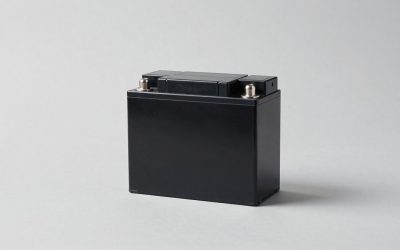
10″ 800W Under Seat Car Subwoofer with Blue LED and Install Kit
It is for the buyer who wants to add bass to a truck or daily driver without committing serious money. The 800W peak rating and built-in amp get the job done at moderate volumes, and the blue LED light is a nice touch for anyone who shows their install.
- Comes with installation wire kit, no extra parts needed
- Entry-level, budget-tier pick in this roundup
- Con: No published RMS rating, so actual sustained output is likely well below 800W peak
Skip this if you want clean bass at higher volumes or plan to run it in a vehicle with poor cabin acoustics. The build quality is the trade-off you make at the budget tier.
Rockville SS10P 10″ Slim Under-Seat Powered Subwoofer
This is the reference point for the budget category. The 200W RMS figure is the maker’s stated rating on a 10-inch driver in a cast aluminum enclosure, which helps with heat under a seat. The high and low level inputs make it easy to connect to a factory radio or an aftermarket head unit. The dash-mounted bass knob lets you dial output on the fly.
- Cast aluminum enclosure handles heat far better than plastic or thin metal
- Auto turn-on with high-level input means no remote wire to run
- Con: It costs more than the basic no-name options in this roundup
Skip this only if you need a wiring kit included or want more than a single 10-inch driver.
10″ 1200W Under Seat Subwoofer with Class D Power Amplifier
The thickened aluminum housing is a real advantage under a seat where airflow is limited and summer temperatures climb fast. It fits trucks, SUVs, Jeeps, and MPVs without clearance issues. For anyone who listens at higher volumes, the extra headroom here matters.
- Class D amplifier in a thickened aluminum housing designed for heat dissipation
- 1200W peak rating translates to more headroom before distortion kicks in
- Con: No published RMS figure, so the 1200W number is harder to contextualize
Skip this if you want a known brand with detailed spec sheets and dealer support.
Rockville RWS12CA 12″ Slim Powered Car Subwoofer
A 12-inch driver in a slim powered enclosure is a physically difficult thing to do well, and this one aims for it. The 300W RMS rating makes it the most powerful single-driver option here, and the built-in mono amp drives the cone with enough authority to move serious air. The dash bass knob and low-pass crossover work together cleanly. If your vehicle has the clearance for a 12-inch unit, this hits harder than any 10-inch on this list.
- 12-inch cone moves significantly more air than 10-inch alternatives, producing deeper perceived bass
- 300W RMS is the highest stated RMS rating in this comparison
- Con: Requires more underseat clearance than smaller units; will not fit tight cabin floors
Skip this if your vehicle has low-profile seats or limited space beneath the front floor.
Rockville SS8P 8″ Slim Under-Seat Powered Subwoofer
The 8-inch driver gives you punch instead of rumble. This is for buyers who want tighter, more defined bass that sits higher in the frequency range without the physical footprint of a 10 or 12. The 100W RMS rating fits this size, and the cast aluminum enclosure matches the build quality of its bigger siblings. It disappears under any seat, including tight coupe and sedan floors.
- An 8-inch driver tends to sound tighter than larger drivers, with less one-note thump
- Smallest footprint, fits vehicles where 10-inch and larger units will not
- Con: Will not reproduce sub-bass frequencies that larger drivers can reach
Skip this if your goal is deep, chest-filling bass rather than punch and clarity.
Name-Brand Powered Underseat Subwoofers Worth Paying More For
The picks above lean on budget brands. These four name-brand underseat subs publish full spec sheets (RMS power, height, frequency response) and include remote bass controls.
Kicker 46HS10 Hideaway — Best Overall Powered Underseat Subwoofer

- Driver: 10-inch in a sealed enclosure
- Amplifier: Class D, 180 W RMS
- Size: about 9-7/8 in. W x 3-1/8 in. H x 12-3/8 to 14 in. D (sources differ on depth)
- Frequency response: 25 to 120 Hz; KickEQ boost up to +6 dB at 40 Hz
- Inputs: speaker-level (accepts 0.25 to 40 V) and line-level; works with start/stop systems
- Includes: remote bass control and wiring harness with 17 ft power lead
The Kicker 46HS10 Hideaway gets a 10-inch driver into a box barely taller than most 8-inch underseat subs. That extra cone area is what you hear: deeper, fuller bass than 8-inch units at the same volume. The wide-range speaker-level input is its other strength. It accepts nearly any factory radio signal and turns on by DC offset or signal sensing, so you rarely need a line output converter or a remote wire.
Pros
- 10-inch output from a 3-1/8 inch tall box
- Very flexible factory-radio integration
- Full controls: crossover, phase, subsonic filter and bass EQ
Cons
- Premium-tier cost compared with Rockville’s 10-inch underseat sub
- Needs roughly 14 inches of floor depth
Skip it if: your seat leaves less than about 3-1/8 inches of height or roughly 14 inches of floor depth.
Alpine PWE-S8 — Best for Mounting Under or Behind the Seat
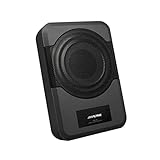
- Driver: 8-inch high-excursion, polypropylene/aluminum cone
- Amplifier: Class D, 120 W RMS (240 W max)
- Size: 13-7/16 x 9-1/16 x 2-13/16 in. (under 3 in. thick lying flat)
- Frequency response: 25 to 152 Hz (Alpine spec)
- Inputs: RCA and auto-sensing speaker-level; phase, gain and low-pass controls
- Includes: 13 ft wired remote bass knob; needs a 10-gauge wiring kit (sold separately)
The Alpine PWE-S8 is one of the thinnest powered subs from a major brand, at under 3 inches thick. It can lie flat under a front seat or stand upright behind the seat of a single-cab pickup. The sealed cast-aluminum enclosure helps it shed heat under a seat where airflow is poor.
Pros
- Under 3 inches thick
- Works under the seat or behind it
- Cast-aluminum enclosure
Cons
- 120 W RMS 8-inch output will not shake the mirrors
- Wiring kit not included
Skip it if: you want deep, loud bass in a large SUV; a 10-inch like the Kicker 46HS10 moves more air.
JBL BassPro SL2 — Best for Low Seat Clearance

- Driver: 8-inch shallow woofer in a sealed ABS enclosure
- Amplifier: Class D, 125 W RMS
- Size: 13-9/16 x 9-7/8 x 2-13/16 in. (71 mm tall)
- Frequency response: 35 to 120 Hz; bass boost 0 to +9 dB at 70 Hz
- Crossover: 50 to 120 Hz, 12 dB/octave
- Inputs: line-level and speaker-level; includes JBL wired remote bass control
At 71 mm (2-13/16 inches) tall, the JBL BassPro SL2 fits under seats that block the 3-inch-plus Kicker and Rockford Fosgate boxes. The 12-amp maximum draw is also light, so the stock electrical system in most cars handles it without upgrades. It is the sensible pick for compact cars and crossovers with low seat rails.
Pros
- One of the lowest-profile name-brand underseat subs
- Low current draw
- Bass boost and remote level control included
Cons
- Plastic enclosure rather than cast aluminum
- Bass rolls off below about 35 Hz
Skip it if: you have 3-1/2 inches of clearance; a 10-inch sub will hit harder.
Rockford Fosgate PS-8 Punch — Best for Classic Cars and Single-Cab Trucks

- Driver: Punch 8-inch in a sealed cast-aluminum enclosure with ABS backplate
- Amplifier: Class D, 150 W RMS (300 W peak), CEA-2006 compliant
- Size: about 14.4 x 9.4 x 3.3 in.
- Frequency response: 25 to 150 Hz; bass boost 0 to +12 dB at 45 Hz
- Inputs: RCA and summed speaker-level; remote, DC-offset or signal-sense turn-on
- Includes: remote bass level control
The Rockford Fosgate PS-8 Punch has a CEA-2006 compliant amp, which means its 150 W RMS rating follows an industry measurement standard rather than a marketing number. The short, wide box suits muscle cars, hot rods and single-cab pickups with little room behind the seat.
Pros
- CEA-2006 power rating you can compare fairly
- Cast-aluminum enclosure handles heat well
- Three turn-on modes for easy factory-radio installs
Cons
- Premium-tier cost for an 8-inch driver
- About 3.3 inches tall, taller than the JBL BassPro SL2
Skip it if: you have the depth for a 10-inch underseat sub; the Kicker 46HS10 gives you a 10-inch driver in a box of similar height.
| Subwoofer | Driver | RMS power | Height | Frequency response | Price tier |
|---|---|---|---|---|---|
| Kicker 46HS10 Hideaway | 10 in. | 180 W | 3-1/8 in. | 25-120 Hz | Premium |
| Rockford Fosgate PS-8 Punch | 8 in. | 150 W | 3.3 in. | 25-150 Hz | Premium |
| JBL BassPro SL2 | 8 in. | 125 W | 2-13/16 in. | 35-120 Hz | Upper-mid |
| Alpine PWE-S8 | 8 in. | 120 W | 2-13/16 in. | 25-152 Hz | Upper-mid |
| Rockville SS10P | 10 in. | 200 W | See maker page | Low-pass 50-180 Hz | Budget |
| Rockville SS8P | 8 in. | 100 W | See maker page | Not listed | Budget |
Also Consider
Kicker 51HS8 Hideaway

Best for smaller cars that still want Kicker tuning. 8-inch driver · 150 W RMS · 3-1/8 in. tall · 25 to 120 Hz. Trade-off: RCA input needs an optional adapter, and the 10-inch 46HS10 offers more cone area at the same listed height.
Infinity BassLink SM2

Best alternative to the JBL BassPro SL2. It is a Harman sibling with the same 8-inch, 125 W RMS, 71 mm-tall format and 35 to 120 Hz response. Trade-off: buy whichever is cheaper the day you shop, because the specs are nearly identical.
Kenwood KSC-PSW7EQ

Best for very shallow spaces. 8 x 5-1/2 in. oval driver · 160 W max (about 80 W RMS) · 2-3/4 in. tall · HEAVY/TIGHT/FLAT EQ presets. Trade-off: response starts at 40 Hz, so it fills in punch rather than deep rumble.
Pioneer TS-WX140DA

Best for a light bass lift on a factory system. 8 x 5-1/4 in. oval driver · 50 W RMS (170 W max) · 2-3/4 in. tall · DEEP/DYNAMIC/NATURAL bass modes. Trade-off: low output; skip it if you want to feel the bass.
Best Powered Underseat Subwoofers by Budget
One spec line per pick, grouped by budget tier. Check the current listing for pricing.
Budget Tier
- Rockville SS10P — 10 in. · 200 W RMS · cast aluminum · high- and low-level inputs
- Rockville SS8P — 8 in. · 100 W RMS · cast aluminum · auto turn-on
- Rockville RWS12CA — 12 in. · 300 W RMS · slim box, needs more height than true underseat units
What to expect at this tier:
- Decent RMS ratings, but thinner documentation (height and frequency response often missing)
- Generic no-name units list big peak watts with no RMS figure; treat those numbers with caution
- Wiring kits are sometimes bundled, which saves a separate purchase
Mid-Range Tier
- Alpine PWE-S8 — 8 in. · 120 W RMS · under 3 in. thick · 25-152 Hz
- Infinity BassLink SM2 — 8 in. · 125 W RMS · 71 mm tall · 35-120 Hz
- Kenwood KSC-PSW7EQ — 8 x 5.5 in. oval · about 80 W RMS · 2-3/4 in. tall
- Pioneer TS-WX140DA — 8 x 5.25 in. oval · 50 W RMS · 2-3/4 in. tall
- Kicker 51HS8 Hideaway — 8 in. · 150 W RMS · 3-1/8 in. tall
What to expect at this tier:
- Full spec sheets from major brands, with honest RMS ratings
- Remote bass knobs and better factory-radio inputs
- Mostly 8-inch or oval drivers: tight, clean bass rather than deep rumble
Premium Tier
- Kicker 46HS10 Hideaway — 10 in. · 180 W RMS · 3-1/8 in. tall · 25-120 Hz
- Rockford Fosgate PS-8 Punch — 8 in. · 150 W RMS (CEA-2006) · 3.3 in. tall
- JBL BassPro SL2 — 8 in. · 125 W RMS · 71 mm tall · bass boost to +9 dB
What to expect at this tier:
- 10-inch drivers in 3-inch boxes, or standards-rated amplifiers
- Start/stop-friendly inputs and multiple turn-on modes
- Better heat handling for long drives in hot climates
Summary: the Kicker 46HS10 Hideaway is the best overall powered underseat subwoofer, the JBL BassPro SL2 is the pick for low seats, and the Rockville SS10P is the best value.
Buying Guide
RMS vs. Peak: What the Numbers Actually Mean
Peak wattage tells you the absolute maximum the amp can push in a short burst before clipping. RMS tells you what it can sustain through a full song at volume. A 1200W peak sub with no published RMS is harder to compare against a 200W RMS unit than a 300W RMS model. Always anchor your decision on RMS. For a daily-driven vehicle, 150 to 300W RMS underseat is enough to fill a cabin. Going higher only helps in large trucks or SUVs with significant air volume.
Enclosure Material and Thermal Performance
Under a seat is a hostile environment. No airflow, floor heat, summer temperatures above 120 degrees. Cast aluminum and thickened housing designs dissipate heat from the amplifier stage far more effectively than stamped metal or plastic. Overheating is the primary cause of distortion and eventual failure in underseat subs. If you live in a hot climate or do long drives, this spec is more important than peak wattage.
Inputs and Integration with Your Existing System
High-level inputs let you tap into your factory speaker wires without replacing the radio, and auto turn-on eliminates the need for a separate remote wire run from the head unit. A variable low-pass crossover matters because every vehicle’s cabin acoustics differ, and the right filter point ensures the sub blends smoothly with your existing speakers rather than overlapping or creating a gap. If you have a factory system and want to keep it, prioritize units with both high-level inputs and adjustable crossover.
How to Measure Under-Seat Clearance
Slide the seat all the way back and measure from the carpet to the lowest point of the seat frame or rail, where the sub will sit. Repeat with the seat fully forward and at its lowest height setting, because power seats drop as they move. As a rule of thumb, leave at least 1/4 inch above the sub so the seat motor and springs never touch it. Typical heights:
- Under 2-7/8 in.: 71 mm-class units such as the JBL BassPro SL2, Infinity BassLink SM2, Kenwood KSC-PSW7EQ or Pioneer TS-WX140DA
- 3 to 3-1/2 in.: Kicker Hideaway HS8/HS10 or Rockford Fosgate PS-8 Punch
- Over 3-1/2 in. or behind the seat: Alpine PWE-S8 standing upright, or larger slim 10- and 12-inch boxes
Depth matters too. Most 10-inch underseat subs need 12 to 14-1/2 inches front to back, and seat-belt anchors, heater ducts and wiring looms often eat into that space.
Underseat vs Behind-Seat vs Trunk Subwoofer
A powered underseat sub trades output for space. Expect it to fill in the bottom octave a factory system is missing, not to match a 12-inch sub in a ported trunk box. Behind-seat slim boxes (common in pickups) allow bigger drivers and more power. A trunk enclosure gives the deepest, loudest bass, but uses cargo space. If you want daily-driver bass that stays hidden, choose underseat. If you want bass you can feel from outside the car, choose a trunk setup.
Wiring and Fusing Basics
- Use the wire gauge the maker specifies: 10-gauge for most 120 to 200 W RMS underseat subs, 8-gauge for larger units.
- Fit an inline fuse within about 18 inches of the battery, sized to the wire, plus the fuse on the sub itself.
- Ground to bare metal on the body or seat bolt, with the shortest wire you can manage.
- With a factory radio, use speaker-level inputs and signal-sense or DC-offset turn-on so you do not need a remote wire.
- Set the low-pass filter around 80 Hz to start, then adjust by ear so the sub blends with the door speakers.
Which Underseat Subwoofer Fits Your Vehicle?
- Compact car or crossover with low seats: JBL BassPro SL2 or Infinity BassLink SM2 (71 mm tall).
- Midsize sedan or SUV with a factory radio: Kicker 46HS10 Hideaway, for 10-inch bass and the widest factory-signal input range.
- Single-cab pickup or classic car: Rockford Fosgate PS-8 Punch under the seat, or the Alpine PWE-S8 standing behind it.
- Vehicle with start/stop: Kicker 46HS10, which Kicker lists as compatible with start/stop systems.
- Tight budget: Rockville SS10P for the most RMS power at a budget-tier cost, or Rockville SS8P if a 10-inch will not fit.
- Just want a little more bass from the stock system: Pioneer TS-WX140DA or Kenwood KSC-PSW7EQ.
Common mistakes: buying on peak watts, skipping the clearance check with the seat in its lowest position, and running the power wire without a fuse near the battery.
Our Verdict
Best value pick: Rockville SS10P (the Kicker 46HS10 Hideaway remains the best overall pick above). It has the best combination of stated RMS power, cast aluminum construction, practical inputs, and budget-tier cost for the widest range of vehicles. It does not win a single spec category by a huge margin, but it has no meaningful weakness either.
It will not match the others at volume, but it is an affordable path out of factory-radio flatness.
If you have the clearance and want the highest stated RMS rating here, the Rockville RWS12CA 12-inch is the one to look at, but it needs more height than a true underseat unit.
FAQ
Do powered underseat subwoofers need a separate amplifier?
No. The entire point of a powered underseat sub is that the amplifier is built into the enclosure. You connect it to your vehicle’s electrical system with a power wire and ground, then run speaker inputs from your head unit; units with high-level inputs and auto turn-on do not need a remote wire. No additional amp is required.
Can I install an underseat sub on a vehicle with a factory radio?
Yes, as long as the unit has high-level speaker inputs. You tap into the existing speaker wires under the seat or at the door, and the auto turn-on feature detects signal without a remote wire. The SS10P, RWS12CA, and SS8P all support this.
Will an underseat subwoofer drain my battery?
Not during normal operation. The amp draws power only when the radio is on and bass signal is present. A properly fused 4-gauge or 8-gauge wire with a fuse near the battery is standard, and the parasitic draw at idle is negligible compared to your vehicle’s electronics.
How much clearance do I need under my seat?
Most 8-inch and 10-inch units are designed to slide under seats with roughly 3 to 4 inches of floor clearance. The 12-inch models need more, often around 5 inches or higher depending on the enclosure height. Check your specific vehicle’s under-seat space before ordering anything larger than 10 inches.
Do underseat subwoofers sound good?
Yes, a good powered underseat subwoofer sounds clearly better than a factory system without one. Models like the Kicker 46HS10 or Rockford Fosgate PS-8 fill in bass down to about 25 Hz. They will not match a large trunk sub for volume, but they add depth to music at normal listening levels.
What is the best 8-inch underseat subwoofer?
The Rockford Fosgate PS-8 Punch is the strongest 8-inch underseat sub here, with 150 W RMS from a CEA-2006 rated amp. If your seat clearance is under 3 inches, choose the JBL BassPro SL2 or Alpine PWE-S8 instead; both are under 2-7/8 inches tall.
Is a 10-inch underseat sub better than an 8-inch?
A 10-inch underseat sub usually plays deeper and louder than an 8-inch at the same power, because the larger cone moves more air. The trade-off is footprint and price: the Kicker 46HS10 needs about 10 x 14 inches of floor space and costs more, while low-profile 8-inch units such as the JBL BassPro SL2 fit under seats only 2-7/8 inches tall.