Our Short List of 3

- Best for: A household that streams 4K on several screens at once and wants a clear 6 GHz lane for newer devices.

- Best for: A living room where streaming shares the network with gaming, and the wired side matters as much as the wireless side.

- Best for: A larger single-storey home where a stated coverage figure guides the choice and the router must reach far rooms without a mesh kit.
All 4 Picks at a Glance
| Product | Specs | Action |
|---|---|---|
| TP-Link Archer AXE75 — ASIN B0B3SQK74L |
| Check price on Amazon |
| ASUS RT-AX86U Pro — ASIN B0BQ417K47 |
| Check price on Amazon |
| NETGEAR Nighthawk RAX50 — ASIN B082X17B8P |
| Check price on Amazon |
 TP-Link Archer AX55 — ASIN B09G5W9R6R |
| Check price on Amazon |
Key takeaways
- Find the best wifi routers for streaming in 2026. Compare four WiFi 6 and WiFi 6E routers by band speed, ports, and coverage for smooth 4K streams at home.
The best WiFi router for streaming is the TP-Link Archer AXE75, because its tri-band WiFi 6E design gives 4K streams a clear 6 GHz lane while the rest of the household stays on the 5 GHz and 2.4 GHz bands. The ASUS RT-AX86U Pro is the runner-up, with a fast dual-band WiFi 6 radio, a 2.5 gigabit port, and a dedicated gaming port for a wired console or desktop. Both routers handle several simultaneous streams, so the choice comes down to whether you want the extra 6 GHz band or the stronger wired side.
Our top pick: TP-Link Archer AXE75. Runner-up: ASUS RT-AX86U Pro. This guide compares published specifications only: every speed, port count, and coverage figure below comes from the product listing or the manufacturer specification sheet, so you can compare the four routers on the same facts a buyer sees before ordering.
At a Glance
| Product | Best for | Key specification |
|---|---|---|
| TP-Link Archer AXE75 | A household that streams 4K on several screens at once | AXE5400 tri-band WiFi 6E, 2,402 Mbps on 6 GHz, 2.5 Gbps WAN port |
| ASUS RT-AX86U Pro | A living room where streaming shares the network with gaming | AX5700 dual-band WiFi 6, 2.0 GHz quad-core CPU, 1 GB RAM, 2.5G port |
| NETGEAR Nighthawk RAX50 | A larger floor plan where a stated coverage figure guides the choice | AX5400 dual-band WiFi 6, up to 5.4 Gbps, 2,500 sq. ft. coverage |
| TP-Link Archer AX55 | A smaller home that wants WiFi 6 streaming without a large unit | AX3000 dual-band WiFi 6, 2,402 Mbps on 5 GHz, 512 MB RAM |
How to Choose
1. Match the WiFi standard to your devices
WiFi 6 routers cover the 2.4 GHz and 5 GHz bands and suit most streaming households today, because almost every television, streaming stick, phone, and laptop sold in the last few years supports WiFi 6 or an earlier standard. WiFi 6E adds a 6 GHz band, which gives newer devices a separate lane with less traffic from older neighbours and older gadgets. If your streaming devices include a recent phone, laptop, or television with WiFi 6E support, a tri-band router makes a real difference during busy evenings. If none of your devices support 6 GHz yet, a strong WiFi 6 router delivers the same stream quality for less.
2. Count the streams, not just the speed
A single 4K stream needs a steady connection far more than it needs a headline speed figure, and the router has to serve every screen at the same time. Look at how many streams your household runs at peak hours: a television in the living room, a tablet in a bedroom, a phone, and a console downloading a game can all share the same router. Routers with OFDMA and MU-MIMO split airtime between many devices instead of serving them one by one, which keeps each stream smooth when the network is busy. A router with a faster processor and more memory also holds more device connections without slowing its interface.
3. Check the band layout
Tri-band routers carry three separate radios, so a 4K stream can sit on one band while phones and smart home devices use another. Dual-band routers carry two radios, which is enough for most homes, provided the 5 GHz band is not crowded by every device in the house. The band speeds in the listing tell you the ceiling for each radio: 2,402 Mbps on a 5 GHz or 6 GHz band leaves far more headroom than 1,200 Mbps when several streams run together. Channel width matters too, because 160 MHz channels on the 5 GHz and 6 GHz bands move more data per transmission than narrower channels.
4. Use the wired ports for the main screen
The television or streaming box that matters most should connect by Ethernet cable whenever the router sits close enough, because a wired link removes WiFi interference from the equation entirely. A router with a 2.5 gigabit WAN port accepts a faster internet plan later, and a 2.5 gigabit LAN port gives a wired console or desktop a faster link than a standard gigabit port. Count the gigabit LAN ports before you buy: four ports cover a television, a console, a desktop, and a network drive without an extra switch. A USB port adds shared storage or a shared printer to the network.
5. Measure coverage against your floor plan
A router in a central spot covers a small apartment easily, but a long house or a home with thick walls needs either a stronger radio set or a mesh expansion path. Some listings state a coverage figure, such as 2,500 square feet, which helps you match the router to the floor plan before ordering. Others state only antenna counts, so look for mesh support such as OneMesh, EasyMesh, or AiMesh, which lets you add a compatible node later without building a second network. Placing the router high and in the open, away from metal shelves and thick walls, does more for coverage than any single specification.
6. Look for traffic controls that protect streams
Quality of service controls let the router give video traffic priority over downloads and backups, which is what keeps a 4K stream from stuttering when a laptop starts a large download. Some routers include a dedicated gaming port that gives the connected device priority automatically, which also helps a console that streams and plays at the same time. A guest network keeps visitors on a separate network name, so their devices do not compete with the household streams. Parental controls and scheduled pauses help a family keep streaming hours under control.
7. Weigh security and software support
WPA3 is the current wireless security standard, and every router in this guide supports it. Built-in network security that blocks malicious sites adds a layer of protection for every device on the network, including televisions and streaming sticks that cannot run their own security software. Check whether the security suite needs a subscription after the first period, because some suites are free for life while others charge after a trial. Firmware updates matter for streaming too, because manufacturers fix bugs and add features through updates, so pick a brand with a clear update history.
8. Plan for the next internet upgrade
A router bought today should still fit the household in two or three years, so check the WAN port speed against the internet plan you expect to have. A gigabit WAN port caps a plan at gigabit speed, while a 2.5 gigabit WAN port leaves room for a faster plan later. WiFi 7 routers exist now, but WiFi 6 and WiFi 6E routers cover current streaming needs, and their listings state every specification you need to compare them. A two-year or three-year manufacturer warranty gives you a clear window if the hardware fails.
Our Picks
TP-Link Archer AXE75 — ASIN B0B3SQK74L
- Best for: A household that streams 4K on several screens at once and wants a clear 6 GHz lane for newer devices.
A household that streams 4K on several screens at once and wants a clear 6 GHz lane for newer devices.
The Archer AXE75 is a tri-band WiFi 6E router rated AXE5400, with band speeds of 2,402 Mbps on 6 GHz, 2,402 Mbps on 5 GHz, and 574 Mbps on 2.4 GHz. Its 1.7 GHz quad-core CPU and 512 MB of memory keep the router responsive when several streams run at once, and the 2.5 Gbps WAN port accepts a faster internet plan later. Six high-gain antennas with beamforming push the signal toward connected devices, and 160 MHz channels on the 5 GHz and 6 GHz bands move more data per transmission. The listing also names four gigabit LAN ports, a USB 3.0 port, OneMesh support for later expansion, VPN server and client support, WPA3 security, and a two-year manufacturer warranty.
Consideration: The unit is larger than a dual-band router, so measure the shelf depth before ordering, and none of your devices benefits from the 6 GHz band until it supports WiFi 6E.
ASUS RT-AX86U Pro — ASIN B0BQ417K47
- Best for: A living room where streaming shares the network with gaming, and the wired side matters as much as the wireless side.
A living room where streaming shares the network with gaming, and the wired side matters as much as the wireless side.
The RT-AX86U Pro is a dual-band WiFi 6 router rated AX5700, with band speeds of up to 4,804 Mbps on 5 GHz and 861 Mbps on 2.4 GHz. Its 2.0 GHz quad-core processor and 1 GB of RAM give it the muscle to hold many device connections at once, and the listing names a 2.5G port plus a dedicated gaming port that gives a wired console priority. Four gigabit LAN ports cover a television, a console, a desktop, and one more wired device, and AiMesh support lets the router join other ASUS routers into one mesh network later. The listing also names Mobile Game Mode for low-latency mobile play, port forwarding, VPN support, WPA3 security, and AiProtection Pro network security with no subscription, backed by a three-year manufacturer warranty.
Consideration: It has no 6 GHz band, so a household with WiFi 6E devices loses the separate lane that a tri-band router provides, and the gaming features need setup in the app before they take effect.
NETGEAR Nighthawk RAX50 — ASIN B082X17B8P
- Best for: A larger single-storey home where a stated coverage figure guides the choice and the router must reach far rooms without a mesh kit.
A larger single-storey home where a stated coverage figure guides the choice and the router must reach far rooms without a mesh kit.
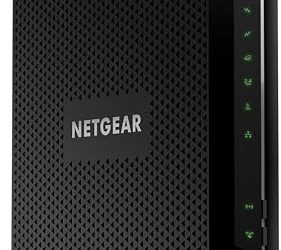
The Nighthawk RAX50 is a dual-band WiFi 6 router rated AX5400, with combined speeds of up to 5.4 Gbps across the 2.4 GHz and 5 GHz bands in a six-stream design. Its listing states coverage of up to 2,500 square feet for as many as 25 devices, which makes it the easiest pick in this guide to match against a floor plan. Four external antennas carry the signal through the house, and four gigabit LAN ports plus a USB 3.0 port cover wired devices and shared storage. The listing also names WPA3 security, NETGEAR Armor security, and the Nighthawk app for setup and control, and the model code on the listing is RAX50-100NAS.
Consideration: It has no multi-gigabit port and no 6 GHz band, so a faster internet plan or a WiFi 6E device gains nothing extra here, and the Armor security suite needs a subscription after its trial period.
TP-Link Archer AX55 — ASIN B09G5W9R6R
- Best for: A smaller home that wants WiFi 6 streaming without a large unit or a tri-band radio set.
A smaller home that wants WiFi 6 streaming without a large unit or a tri-band radio set.
The Archer AX55 is a dual-band WiFi 6 router rated AX3000, with band speeds of 2,402 Mbps on 5 GHz and 574 Mbps on 2.4 GHz. Its 512 MB of memory and OFDMA with MU-MIMO keep several streams and devices moving at once, and the listing names four gigabit LAN ports, a USB 3.0 port, and EasyMesh support for later expansion. The listing also names VPN clients and server, HomeShield security, and WPA3, with a two-year manufacturer warranty. Four external antennas carry the signal across a small to medium home, and the unit is compact enough to sit on a media console without dominating the shelf.
Consideration: Its gigabit WAN port caps a future internet plan at gigabit speed, and its combined speed rating sits below the other three routers here, so a household with many simultaneous 4K streams may outgrow it sooner.
Which One Is Right for You?
Choose the TP-Link Archer AXE75 when several screens stream 4K at the same time and at least one device supports WiFi 6E, because the 6 GHz band gives those streams a lane of their own. Choose the ASUS RT-AX86U Pro when the living room mixes streaming with gaming, because its dedicated gaming port and 2.5G port give the wired console or desktop priority that the other routers do not name. Choose the NETGEAR Nighthawk RAX50 when the floor plan is the deciding factor, because its stated coverage figure of up to 2,500 square feet makes it simple to match against the house. Choose the TP-Link Archer AX55 when the home is smaller and the budget for the router is tighter, because its WiFi 6 radio and gigabit ports cover everyday streaming without the extra bands and ports of the larger models.
Frequently Asked Questions
Do I need WiFi 6E for 4K streaming?
No. A single 4K stream runs well on a WiFi 6 or even a WiFi 5 router, because the stream needs a steady connection more than a high headline speed. WiFi 6E helps when several 4K streams run at once, because the 6 GHz band gives newer devices a separate lane away from older traffic.
How many 4K streams can one router handle?
It depends on the router and the household. A router with OFDMA, MU-MIMO, a fast processor, and enough memory handles several simultaneous streams better than a router with the same speed rating but weaker hardware. Wiring the main television by Ethernet also frees wireless capacity for the other screens.
Should the television connect by WiFi or by cable?
By cable whenever the router sits close enough, because a wired link removes WiFi interference and keeps the stream steady. When a cable is not practical, place the router in the open and use the 5 GHz band for the television, since it carries more data than the 2.4 GHz band.
What is the difference between a tri-band and a dual-band router?
A tri-band router carries three radios, such as 2.4 GHz, 5 GHz, and 6 GHz on a WiFi 6E model, while a dual-band router carries two radios, usually 2.4 GHz and 5 GHz. The extra band gives the router another lane to separate traffic, which helps most in a busy household with many devices.
Does a faster router improve streaming if my internet plan is slow?
No. The router cannot deliver more speed than the internet plan provides, so a slow plan caps every stream no matter which router you buy. A better router helps when the plan is fast enough and the bottleneck is the home network itself, such as a crowded band, a weak signal in a far room, or too many devices sharing one radio.
Bottom Line
For most streaming households, the TP-Link Archer AXE75 is the strongest choice, because its tri-band WiFi 6E design, 2.5 Gbps WAN port, and fast quad-core processor cover several simultaneous 4K streams with room to grow. The ASUS RT-AX86U Pro is the better pick when gaming shares the network, thanks to its dedicated gaming port, 2.5G port, and generous memory. The NETGEAR Nighthawk RAX50 suits a larger floor plan with its stated coverage figure, and the TP-Link Archer AX55 covers smaller homes that want WiFi 6 without the larger footprint. Match the router to the number of streams, the size of the home, and the devices you already own, and the streams will stay smooth through the busiest evenings.
Disclosure: As an Amazon Associate, this site earns from qualifying purchases.
FAQ
Which One Is Right for You?
Do I need WiFi 6E for 4K streaming?
How many 4K streams can one router handle?
Should the television connect by WiFi or by cable?
What is the difference between a tri-band and a dual-band router?
Does a faster router improve streaming if my internet plan is slow?
More from Amazon
Programs that pair well with the guide above. Offers and eligibility are set by Amazon and may change.
Free shipping on eligible items, Prime Video and more. Eligible new members can start with a free trial.
Start a Prime free trialA Prime membership for ages 18-24 with a trial period. Eligibility is set by Amazon.
See Prime for Young AdultsAudiobooks and podcasts to listen to on the go. Eligible new members can start with a free trial.
Try Audible freeAd-free music streaming. Eligible new subscribers can start with a free trial.
Try Music Unlimited freeAs an Amazon Associate we earn from qualifying purchases.