Our Short List of 3
All 4 Picks at a Glance
| Product | Specs | Action |
|---|---|---|
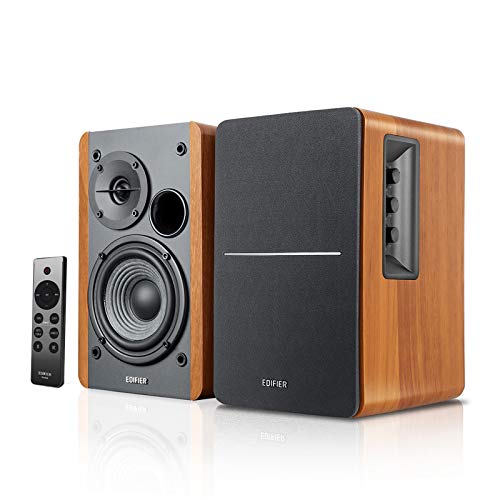 1. Edifier R1280DBs — Best All-Rounder for Everyday Listening | Check price on Amazon | |
 2. JBL 305P MkII — Best Studio Monitors for Mixing | Check price on Amazon | |
 3. KRK Rokit 5 G5 — Best for Producers Who Want Tuning Control | Check price on Amazon | |
 4. PreSonus Eris 3.5 — Best Compact Pair for Small Desks | Check price on Amazon |
Key takeaways
- Looking for the best active speakers for your desk, studio, or living room? Compare four powered pairs on sound quality, inputs, and room fit before you buy.
The best active speakers make buying a hi-fi setup far simpler than it used to be. Because each cabinet has its own amplifier built in, you do not need a separate receiver or power amp, a tangle of speaker wire, or a rack of matching components. You connect a source, plug the speakers into wall power, and you are listening. That simplicity is why active speakers now show up everywhere: on mixing desks, on office desks, beside turntables, and flanking televisions in living rooms.
Active speakers are not one narrow product. The category covers compact desktop monitors for music production, Bluetooth bookshelf pairs for everyday listening, and larger studio monitors that can fill a room. What they share is a built-in amplifier matched to the drivers inside the cabinet, plus a crossover that splits the signal between the woofer and the tweeter.
This guide explains what active speakers are, how to choose a pair for your room and your sources, and compares four powered pairs that suit different budgets and uses. Every pick below is a genuine active speaker pair sold on Amazon, with its amplifier, drivers, and connections taken from the product listing.
What Are Active Speakers?
An active speaker, also called a powered speaker, has an amplifier inside the cabinet. In most two-way designs, each driver gets its own amplifier channel: one for the woofer that handles bass and midrange, and one for the tweeter that handles treble. An electronic crossover sits before the amplifiers and sends each frequency band to the right driver.
That is different from a passive speaker, which has no amplifier at all and relies on an external amp or receiver. It is also different from a soundbar or a smart speaker, which may be powered but is built around a single cabinet and a very different listening goal.
Active speakers appeal to three groups in particular. Music producers and podcasters use nearfield studio monitors, which are designed to sound neutral at arm’s length so that a mix translates well to other systems. Desk workers and gamers want compact powered speakers that sound far better than laptop speakers without taking over the desk. Living-room listeners want bookshelf pairs that connect to a television, a turntable, or a phone over Bluetooth and simply play music well.
How to Choose the Best Active Speakers
Match the speaker to the room
Room size matters more than almost any other factor. A compact 3.5-inch pair is plenty for a desk in a small bedroom, but it will sound thin trying to fill an open-plan living room. A 5-inch woofer moves noticeably more air and reaches lower, which makes it a better fit for a medium room or a home studio where bass detail matters. Measure your desk or shelf space too: active speakers are deeper than they look in photos, and rear ports need a few inches of clearance from the wall.
Check the inputs against your sources
List everything you plan to connect before you buy. A turntable with a built-in phono stage, a television, a computer, and an audio interface all use different connections. The most useful inputs are RCA for unbalanced sources, balanced XLR or TRS for audio interfaces and mixers, optical or coaxial digital inputs for televisions, and Bluetooth for phones and tablets. If your main source is a phone, Bluetooth and a remote control matter a lot. If your main source is an audio interface, balanced inputs matter more, because they reject the hum and buzz that unbalanced cables can pick up near a computer.
Understand woofer size and bass
Woofer size is the simplest predictor of low-end reach. A 3.5-inch woofer is compact and tidy on a desk but rolls off well above the deepest bass notes. A 4-inch woofer adds a useful amount of low end for music and films, and a 5-inch woofer reaches lower still and suits mixing, where hearing the bass matters. If you want deeper bass than your pair can reach, look for a subwoofer output on the active cabinet, which lets you add a powered subwoofer later.
Consider tone controls and room tuning
Small rooms exaggerate bass, especially when speakers sit close to a wall or in a corner. That is why many active speakers include bass and treble knobs, boundary EQ switches, or high-frequency trim controls. These are not gimmicks: a small cut in the low end can clean up a boomy desk setup dramatically. Studio monitors often go further, with switches that compensate for placement near a wall or on a desk surface. If your room is untreated and your speakers will sit against a wall, these controls are worth having.
Think about how you will control volume
Some active speakers put volume, bass, and treble knobs on the front or side of the active cabinet, which is handy on a desk. Others rely on a remote control, which is better in a living room. A few studio monitors expect you to set the level once and control volume from your audio interface or computer. Decide which arrangement fits how you actually listen, because reaching behind a speaker to change the volume gets old fast.
Buy a pair, not a single
Several studio monitors are sold one cabinet at a time, while most bookshelf pairs are sold as a set of two. Check the listing carefully before ordering. If a monitor is sold singly, you need two of them for stereo sound, and the per-pair cost is double the listed single-speaker figure. The picks below state clearly whether each listing is a pair or a single.
Top Picks
1. Edifier R1280DBs — Best All-Rounder for Everyday Listening
The Edifier R1280DBs is the most versatile pair in this roundup, and the easiest to recommend to someone who simply wants better sound at a desk or in a small room. Each cabinet holds a 4-inch woofer and a silk dome tweeter, driven by a total of 42 watts RMS, with a frequency response listed as 51 Hz to 20 kHz. The classic wood-grain MDF enclosure looks at home in a living room or a study, and the removable mesh grilles let you choose between a tidy covered look and exposed drivers.
Connectivity is where this pair earns its place. It offers dual RCA inputs, optical and coaxial digital inputs, and Bluetooth 5.0, so it connects to a television, a computer, a turntable with a built-in phono stage, and a phone without swapping cables. A subwoofer output lets you add a powered subwoofer later if you want deeper bass for films. Side-mounted dials control volume, bass, and treble, and a wireless remote covers volume, mute, input switching, and Bluetooth pairing from the sofa.
This is the pick for listeners who want one pair of speakers to handle music, video, and casual television sound without fuss. It is not a studio reference monitor, and it does not pretend to be one, but for everyday listening its balance of inputs, controls, and warm bookshelf sound is hard to beat.
View the Edifier R1280DBs on Amazon
2. JBL 305P MkII — Best Studio Monitors for Mixing
The JBL 305P MkII is a proper nearfield studio monitor, and it is the pick for anyone mixing music, editing podcasts, or producing video at a desk. The pair listing ships as two matched cabinets, each with a 5-inch woofer and a 1-inch tweeter driven by dual 41-watt Class-D amplifiers, for 82 watts per cabinet. The listed frequency range runs from 43 Hz to 24 kHz, with a peak output of 108 dB, which gives these monitors enough headroom to stay clean at realistic listening levels.
The standout feature is JBL’s Image Control Waveguide, a shaped guide around the tweeter that widens the sweet spot. In practice that means the stereo image holds together even when you lean back, shift in your chair, or work slightly off centre, which matters during long sessions. Boundary EQ and a high-frequency trim switch on the rear panel let you tune the monitors for placement near a wall or on a desk surface.
Inputs are balanced XLR and TRS, so these monitors connect directly to an audio interface or mixer. There is no Bluetooth and no remote, which is the right call for a monitor built for accuracy rather than convenience. If your goal is honest sound you can trust while mixing, this is the pair to buy.
View the JBL 305P MkII Pair on Amazon
3. KRK Rokit 5 G5 — Best for Producers Who Want Tuning Control
The KRK Rokit 5 G5 is the current generation of one of the most popular studio monitors ever made, and it is the most adjustable pair in this guide. Each cabinet carries a 5-inch woven Kevlar woofer and a 1-inch silk dome tweeter, bi-amplified with 55 watts of Class-D power per speaker. The listed frequency response is 54 Hz to 30 kHz, with a maximum output of 104 dB.
What sets the G5 apart is its onboard DSP. Three voicing modes let one pair serve different jobs: a flat Mix mode for critical listening, a Focus mode that highlights the midrange for checking vocal and instrument balance, and a Create mode with a more energetic curve for writing and casual listening. Twenty-five boundary and tuning EQ combinations, adjusted through an LCD menu on the rear panel and a companion app, let you adapt the monitors to your room without extra hardware. Foam isolation pads are included in the box.
These monitors are sold as a pair, with balanced TRS and XLR inputs for an audio interface or mixer. They suit electronic and hip-hop producers who want a monitor that can switch between a flat reference and a more inspiring sound at the touch of a button, and anyone whose room needs more tuning help than a simple bass knob can provide.
View the KRK Rokit 5 G5 Pair on Amazon
4. PreSonus Eris 3.5 — Best Compact Pair for Small Desks
The PreSonus Eris 3.5 is the smallest pair in this roundup, and the best choice when desk space is tight. Each pair combines a 3.5-inch woven composite woofer with a 1-inch silk dome tweeter, in a cabinet small enough to fit beside a laptop or a compact keyboard. Despite the size, these are genuine active media reference monitors, with front-panel volume control, a headphone output for late-night listening, and an auxiliary input on the front for a phone or media player.
Rear-panel bass and treble controls let you adjust the tone by up to 6 dB in either direction, which is genuinely useful when the speakers sit against a bedroom wall or in a corner. Inputs cover balanced TRS and unbalanced RCA, so the pair connects to an audio interface, a computer, or a small mixer. The box includes the cables needed to get started, including a stereo cable and an adapter cable for connecting to a computer or phone.
This is the pick for a first home studio, a student desk, or a gaming setup where space is limited and budget matters. The 3.5-inch woofers will not produce deep sub-bass on their own, so bass-heavy producers may eventually add a subwoofer, but for nearfield listening at a desk they deliver clear, balanced sound in a footprint almost nothing else in this guide can match.
View the PreSonus Eris 3.5 Pair on Amazon
Comparison Table
| Speaker | Woofer | Power per Speaker | Key Inputs | Best For |
|---|---|---|---|---|
| Edifier R1280DBs | 4 inch | 21 watts RMS per channel | Bluetooth, optical, coaxial, dual RCA | Everyday listening, TV and desk |
| JBL 305P MkII | 5 inch | 82 watts | Balanced XLR, TRS | Mixing and critical listening |
| KRK Rokit 5 G5 | 5 inch | 55 watts | Balanced XLR, TRS | Producers who want DSP tuning |
| PreSonus Eris 3.5 | 3.5 inch | Class AB amplification | Balanced TRS, RCA, front aux | Small desks and first studios |
How to Set Up Active Speakers
Placement matters as much as the speakers themselves. Start with the two cabinets at ear height, angled slightly inward so the tweeters point at your listening position, and form a rough triangle with your head. Keep the speakers away from the wall if you can; even a few inches of space behind a rear-ported cabinet reduces boomy bass. If they must sit against the wall, use the bass control or boundary EQ to compensate.
Use the right cables. Balanced XLR or TRS cables between an audio interface and studio monitors reject interference, so use them when both ends support them. For a television or a turntable, a digital optical connection avoids ground-loop hum that analogue cables sometimes pick up. Keep power cables and audio cables separated where practical.
Set levels once, then leave them. On studio monitors, set the rear volume controls to a matched position and control the overall level from your interface or computer. On bookshelf pairs, set the bass and treble knobs to the middle, listen for a few days, and only then adjust. Small changes make a big difference.
Frequently Asked Questions
Are active speakers better than passive speakers?
Neither type is better in every situation. Active speakers are simpler, because the amplifier is built in and matched to the drivers, and they need no separate amp or receiver. Passive speakers offer more flexibility, because you can change the amplifier later and drive several pairs from one system. For a desk or a simple living-room setup, active speakers are usually the easier choice. For a large multi-room system, passive speakers with a central amplifier may make more sense.
Do active speakers need an amplifier or receiver?
No. Each active speaker has its own amplifier inside the cabinet, so you connect a source directly and plug the speakers into wall power. You still need a source with a volume control, such as a computer, an audio interface, a television, or a phone, but you do not need a separate power amplifier or AV receiver.
Can I connect active speakers to a turntable?
Yes, in most cases. If your turntable has a built-in phono preamp, connect it to the RCA inputs on the active speaker. If it does not, you need a separate phono preamp between the turntable and the speakers. The Edifier R1280DBs in this guide is a good match for a turntable because it has dual RCA inputs and Bluetooth for other sources.
Can I use studio monitors as regular speakers?
Yes. Studio monitors are active speakers designed for accurate sound, and they play music, films, and games well. The trade-off is convenience: most studio monitors have no Bluetooth or remote control, and they expect balanced inputs from an audio interface. If you mainly listen for pleasure and want easy connections, a bookshelf pair like the Edifier is a better fit. If you mix or edit audio, monitors like the JBL or KRK are the right tool.
Conclusion
The best active speakers are the ones that fit your room, your sources, and the way you listen. For most people, the Edifier R1280DBs is the smartest all-round buy: it connects to almost anything, sounds warm and balanced, and includes a remote and a subwoofer output for later upgrades. If you mix music or edit audio, the JBL 305P MkII pair is the more accurate tool, with a wide sweet spot and the headroom to stay clean at working levels. Producers who want to tune their monitors to the room should look at the KRK Rokit 5 G5, whose voicing modes and DSP EQ cover situations a simple tone knob cannot. And if your desk is small and your budget is tight, the PreSonus Eris 3.5 delivers genuine monitor sound in the smallest footprint here.
Whichever pair you choose, check the inputs against your sources, leave space behind the cabinets, and give yourself a week to get used to the sound before judging it. A well-matched pair of active speakers is one of the simplest upgrades you can make to a desk or a living room, and it is one you will notice every time you press play.
Disclosure: As an Amazon Associate, we earn from qualifying purchases.
FAQ
What Are Active Speakers?
Are active speakers better than passive speakers?
Do active speakers need an amplifier or receiver?
Can I connect active speakers to a turntable?
Can I use studio monitors as regular speakers?
More from Amazon
Programs that pair well with the guide above. Offers and eligibility are set by Amazon and may change.
Free shipping on eligible items, Prime Video and more. Eligible new members can start with a free trial.
Start a Prime free trialA Prime membership for ages 18-24 with a trial period. Eligibility is set by Amazon.
See Prime for Young AdultsAudiobooks and podcasts to listen to on the go. Eligible new members can start with a free trial.
Try Audible freeAd-free music streaming. Eligible new subscribers can start with a free trial.
Try Music Unlimited freeAs an Amazon Associate we earn from qualifying purchases.