Our Short List of 3

All 4 Picks at a Glance
| Product | Specs | Action |
|---|---|---|
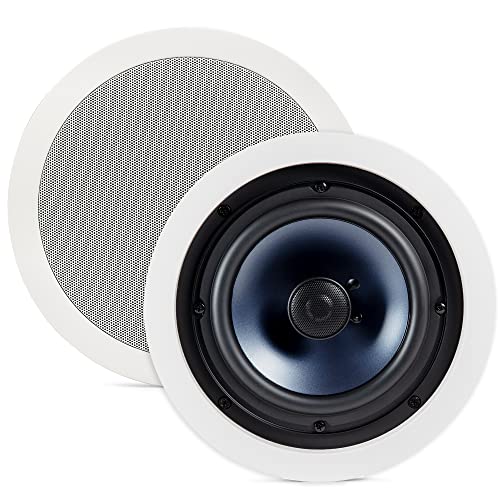 1. Polk Audio RC80i — Best Overall for Most Atmos Rooms | Check price on Amazon | |
| 2. Klipsch CDT-5650-C II — Best for Precise, Dynamic Height Effects | Check price on Amazon | |
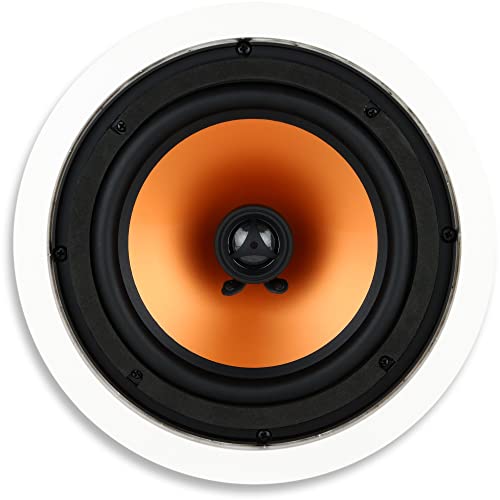 3. Micca M-8C — Best Value for Budget Atmos Builds | Check price on Amazon | |
 4. Yamaha NS-IC800 — Best for High-Power Receivers | Check price on Amazon |
Key takeaways
- Find the best ceiling speakers for Atmos: placement, dispersion, power handling, and four in-ceiling picks that bring height effects to your home theater.
Introduction
The best ceiling speakers for Atmos turn an ordinary surround system into a three-dimensional soundstage, placing rain, aircraft, and crowd noise above the listening position instead of only around it. Dolby Atmos height channels work best when the sound comes from directly overhead, and in-ceiling speakers deliver that effect more convincingly than upward-firing modules that bounce sound off the ceiling. A well-chosen pair of in-ceiling speakers disappears into the room visually while adding a layer of immersion that floor-standing speakers alone cannot reproduce.
Choosing the right ceiling speakers for Atmos is not the same as choosing background music speakers for a kitchen. Height channels carry discrete effects, so dispersion, aimable tweeters, and clean power handling matter far more than they do for casual listening. The wrong speaker can sound thin, beam sound straight down onto one seat, or distort when an action scene peaks. The right speaker blends with the front soundstage, covers the whole seating area, and stays composed at theater volume.
This guide explains how to choose in-ceiling speakers for a Dolby Atmos setup, compares four proven models, and answers the placement and receiver questions that come up most often. Every pick below is a passive in-ceiling speaker designed to run from an AV receiver, and every one fits the same basic job: a round or near-round flush-mount speaker that mounts in a ceiling cutout and fires sound down toward the seats.
How to Choose Ceiling Speakers for Atmos
Match the speaker to the Atmos layout
Dolby Atmos layouts are named by their channel count, and the last number tells you how many height speakers the layout uses. A 5.1.2 system uses two ceiling speakers, while a 5.1.4 or 7.1.4 system uses four. Two height speakers belong above and slightly in front of the main seating position, roughly in line with the left and right front speakers. Four height speakers form two pairs, one in front of the seating position and one behind it. Before buying, count how many height channels the AV receiver can power. Many mid-range receivers support two height channels, while larger models support four. Buying four speakers for a receiver that only powers two leaves half the system silent.
Choose the right woofer size
Eight-inch woofers are the standard choice for Atmos height channels in living rooms and dedicated theaters. They move enough air to reproduce effects with body and weight, and they cross over cleanly to a subwoofer. A 6.5-inch woofer suits smaller rooms, lower ceilings, and systems where the subwoofer handles more of the low end. Smaller drivers can sound thin on large effects, while larger drivers need deeper ceiling cavities and bigger cutouts. For most rooms, an 8-inch two-way design is the safe starting point, with 6.5-inch models reserved for compact spaces or secondary zones.
Look for an aimable tweeter
An aimable or pivoting tweeter is one of the most useful features on a ceiling speaker for Atmos. Ceiling speakers often sit slightly off-axis from the seats, especially in rooms where joists or lights force a compromise on placement. A tweeter that pivots toward the listening position keeps high-frequency effects clear and focused instead of scattering them across the room. Fixed tweeters work when the speaker sits almost directly above the seats, but an aimable tweeter gives the installer far more flexibility and usually produces a more precise soundstage.
Check dispersion and sensitivity
Wide dispersion matters because height effects should reach every seat, not just the center of the sofa. Speakers with a broad, even off-axis response keep the overhead image stable when listeners sit off-center. Sensitivity, measured in decibels, tells you how loud a speaker plays from a given amount of amplifier power. Higher sensitivity speakers need less power from the receiver to reach theater volume, which helps in systems where the receiver drives many channels at once. A sensitivity rating around 89 decibels or higher is a good target for Atmos height channels.
Confirm power handling and impedance
Almost all in-ceiling Atmos speakers are 8-ohm passive designs rated for the power output of a typical AV receiver. Check that the speaker’s recommended amplifier power range overlaps with the receiver’s per-channel output, and avoid speakers rated far below what the receiver can deliver if the system will be played loudly. Most receivers handle 8-ohm speakers without difficulty, but mixing 4-ohm and 8-ohm speakers across channels can complicate setup, so keeping the whole system at 8 ohms is the simpler path.
Measure the ceiling before buying
Every in-ceiling speaker needs a cutout of a specific diameter and a minimum mounting depth behind the drywall. Measure joist spacing, check for pipes, ductwork, and wiring above the ceiling, and confirm that the mounting depth fits the cavity. Some speakers need only a shallow cavity, while larger 8-inch models need several inches of clearance. A paintable magnetic grille helps the speaker blend into the ceiling, and moisture-resistant construction matters in bathrooms, kitchens, and covered outdoor areas. Always confirm the cutout size in the product specifications before cutting, because cutouts vary between models even when the woofer size is the same.
Do not skip the subwoofer
In-ceiling speakers are not full-range speakers, and none of them replaces a subwoofer. Atmos height channels are crossed over to the subwoofer at the receiver, usually around 80 hertz, so deep bass comes from the subwoofer while the ceiling speakers handle everything above that point. A system without a subwoofer will sound thin no matter how good the ceiling speakers are. Budget for the subwoofer as part of the Atmos upgrade, not as an afterthought.
Top Picks
1. Polk Audio RC80i — Best Overall for Most Atmos Rooms
The Polk Audio RC80i is a long-running favorite for Atmos height channels, and it earns that position by combining a full-size 8-inch driver with installation-friendly design. The 8-inch polypropylene woofer delivers effects with real weight, while the pivoting tweeter can be aimed at the seating position for a focused overhead image. Its moisture-resistant construction suits damp rooms as well as theaters, and the paintable grille lets it disappear into a white ceiling.
Power handling covers the output range of most AV receivers, with a sensitivity rating that keeps it efficient enough for multi-channel systems. The one-cut drop-in mounting system uses rotating cams that grip the drywall from behind, so installation needs no extra bracketry in a standard ceiling. The cutout measures about 9 and 3/8 inches round, with a mounting depth of about 3 and 1/8 inches, which fits most residential ceilings.
The RC80i is sold as a pair, which matches a 5.1.2 layout exactly, and two pairs cover a 5.1.4 layout. For a first Atmos build in a small to medium room, this is the safest starting point among the picks in this guide.
Key specifications: 8-inch polypropylene woofer, pivoting tweeter, 8-ohm impedance, moisture-resistant build, paintable grille, sold as a pair.
2. Klipsch CDT-5650-C II — Best for Precise, Dynamic Height Effects
The Klipsch CDT-5650-C II is the pick for listeners who want overhead effects with extra snap and projection. Its 6.5-inch woofer pairs with a 1-inch titanium tweeter mounted in a Tractrix horn, a design that controls dispersion and keeps high-frequency effects focused on the seats. The tweeter pivots, and the speaker includes treble and bass attenuation switches, so the installer can fine-tune the balance after the speaker is in the ceiling.
This is a single-speaker purchase, sold individually, which suits buyers who need an exact number of height channels rather than a fixed pair. Two units cover a 5.1.2 layout, and four cover a 5.1.4 layout. The 8-ohm design works with standard AV receivers, and the slim, paintable grille keeps the installed look discreet.
The CDT-5650-C II suits medium to large rooms where the listener wants height effects to cut through a powerful front soundstage. Its horn-loaded tweeter gives it a more forward, detailed character than the softer-sounding silk-dome designs, which many home theater listeners prefer for effects-heavy soundtracks.
Key specifications: 6.5-inch woofer, 1-inch titanium horn-loaded pivoting tweeter, treble and bass attenuation switches, 8-ohm impedance, sold individually.
3. Micca M-8C — Best Value for Budget Atmos Builds
The Micca M-8C proves that an Atmos height channel does not need a large budget. This 8-inch two-way in-ceiling speaker pairs a poly woofer with a 1-inch pivoting silk-dome tweeter, giving it the same basic formula as speakers costing several times more. The frequency response extends from 40 hertz to 20 kilohertz, and the speaker handles up to 100 watts, which is ample for height-channel duty.
The M-8C is sold individually, so a buyer can purchase exactly two or four units to match the Atmos layout. The cutout measures 9.4 inches in diameter, and the paintable grille blends into the ceiling. The pivoting tweeter is the feature that matters most here, since it lets the installer aim high-frequency effects at the seats even when the speaker position is a compromise.
For a budget 5.1.2 build, or for filling out a 5.1.4 system without overspending on height channels, the M-8C is the value pick. It is also a sensible choice for a first Atmos experiment, where the listener wants to hear what overhead channels add before investing in a premium set.
Key specifications: 8-inch poly woofer, 1-inch pivoting silk-dome tweeter, 40 hertz to 20 kilohertz response, 100-watt power handling, 8-ohm impedance, sold individually.
4. Yamaha NS-IC800 — Best for High-Power Receivers
The Yamaha NS-IC800 stands out for power handling. Rated for up to 140 watts maximum input with a 50-watt nominal rating, it offers more headroom than most in-ceiling speakers in its class, which helps when an action scene pushes the height channels hard. The 8-inch blue-cone woofer pairs with a swivel tweeter, and the speaker is sold as a pair.
The NS-IC800 fits naturally in Yamaha-based systems, but its 8-ohm impedance and standard speaker terminals make it compatible with any AV receiver. The sealed back design resists dust and moisture, and the paintable grille keeps the installed appearance clean. The cutout and mounting depth are comparable to other 8-inch models, so it fits standard residential ceilings.
This is the pick for larger rooms and louder systems, where the height channels need to keep up with powerful front speakers and a strong subwoofer. It is also a good match for receivers with generous per-channel output, since the extra power handling turns that output into clean headroom rather than distortion.
Key specifications: 8-inch woofer, swivel tweeter, 140-watt maximum power handling, 50-watt nominal rating, 8-ohm impedance, sold as a pair.
Comparison Table
| Speaker | Woofer | Tweeter | Power Handling | Sold As | Best For |
|---|---|---|---|---|---|
| Polk Audio RC80i | 8-inch polypropylene | Pivoting | Up to 100 watts | Pair | Most Atmos rooms |
| Klipsch CDT-5650-C II | 6.5-inch | 1-inch titanium horn-loaded, pivoting | Receiver-dependent | Each | Precise, dynamic effects |
| Micca M-8C | 8-inch poly | 1-inch silk dome, pivoting | Up to 100 watts | Each | Budget Atmos builds |
| Yamaha NS-IC800 | 8-inch | Swivel | Up to 140 watts max | Pair | High-power receivers |
Frequently Asked Questions
How many ceiling speakers do I need for Dolby Atmos?
A 5.1.2 system needs two ceiling speakers, while a 5.1.4 or 7.1.4 system needs four. The number depends on the receiver, since the receiver must have enough powered height channels. Check the receiver’s channel count before buying, and buy speakers in the exact quantity the layout requires.
Where should ceiling speakers go in an Atmos setup?
Two height speakers go above and slightly in front of the main seating position, roughly in line with the left and right front speakers. Four height speakers form two pairs, one pair in front of the seats and one pair behind them. Dolby recommends keeping the speakers at an angle of roughly 30 to 55 degrees from the listening position, measured from the ear level. Avoid placing them directly above the seats, where the sound can feel too localized, and avoid pushing them too far forward, where they blend into the front soundstage.
Do ceiling speakers for Atmos need a special receiver?
Yes, the AV receiver must support Dolby Atmos decoding and have powered height channels. A standard 5.1 receiver without Atmos support cannot drive height speakers as discrete channels. Many Atmos-capable receivers support two height channels, while larger models support four. The receiver also handles the crossover, sending low frequencies to the subwoofer and the rest to the ceiling speakers.
Are upward-firing Atmos modules as good as in-ceiling speakers?
In-ceiling speakers generally produce a more convincing overhead effect, because the sound comes directly from above rather than bouncing off the ceiling. Upward-firing modules depend on the ceiling height, material, and angle, and they lose precision on textured or vaulted ceilings. Modules are a reasonable compromise for renters or rooms where cutting into the ceiling is not possible, but in-ceiling speakers are the stronger choice when installation is an option.
Can I use ceiling speakers for music as well as Atmos?
Yes. The same in-ceiling speakers that serve as Atmos height channels can play music in a multi-room or whole-house setup when the receiver supports it. For music, wide dispersion and a balanced tonal character matter more than pinpoint effects placement, so the same aimable-tweeter models that work well for Atmos also work well for music. A system used heavily for music may benefit from larger woofers and a lower crossover point.
Conclusion
The best ceiling speakers for Atmos are the ones that match the room, the receiver, and the layout. The Polk Audio RC80i is the strongest all-around choice for most rooms, combining an 8-inch woofer, an aimable tweeter, and straightforward installation in a pair that fits a 5.1.2 system exactly. The Klipsch CDT-5650-C II suits listeners who want sharper, more dynamic height effects and the flexibility of buying speakers one at a time. The Micca M-8C keeps a budget Atmos build within reach without giving up the pivoting tweeter that makes placement forgiving. The Yamaha NS-IC800 brings the most power headroom, making it the right pick for larger rooms and stronger receivers.
Whichever model fits the system, the fundamentals stay the same: count the receiver’s height channels first, measure the ceiling cavity before cutting, aim the tweeters at the seats, and pair the speakers with a capable subwoofer. Get those four things right, and the ceiling speakers will deliver the overhead dimension that makes Dolby Atmos worth the effort.
Disclosure: As an Amazon Associate, we earn from qualifying purchases.
FAQ
How many ceiling speakers do I need for Dolby Atmos?
Where should ceiling speakers go in an Atmos setup?
Do ceiling speakers for Atmos need a special receiver?
Are upward-firing Atmos modules as good as in-ceiling speakers?
Can I use ceiling speakers for music as well as Atmos?
More from Amazon
Programs that pair well with the guide above. Offers and eligibility are set by Amazon and may change.
Free shipping on eligible items, Prime Video and more. Eligible new members can start with a free trial.
Start a Prime free trialA Prime membership for ages 18-24 with a trial period. Eligibility is set by Amazon.
See Prime for Young AdultsAudiobooks and podcasts to listen to on the go. Eligible new members can start with a free trial.
Try Audible freeAd-free music streaming. Eligible new subscribers can start with a free trial.
Try Music Unlimited freeAs an Amazon Associate we earn from qualifying purchases.