Our Short List of 3

- Best for: Weddings, reunions and parties where several guests share cameras.
- Film: 35mm color film, ISO 400
- Exposures: 27 per camera, 2 cameras per pack
- Flash: built-in, range up to 10 ft, continuous flash switch
- Lens: fixed focus, 32 mm
- Best for: Everyday snapshots, first film cameras and single-trip use.
- Film: 35mm Kodak MAX color film
- Exposures: 27
- Flash: built-in
- Exposure control: automatic

- Best for: Parties, evening events and indoor shooting without daylight.
- Film: 35mm Kodak MAX 800 color film, ISO 800
- Exposures: 27
- Flash: automatic, auto-recharging, range 4 to 14.5 ft
- Focus: fixed focus
All 5 Picks at a Glance
| Product | Specs | Action |
|---|---|---|
| Fujifilm QuickSnap Flash 400 2-Pack |
| Check price on Amazon |
| Kodak FunSaver 35mm Single Use Camera |
| Check price on Amazon |
| Kodak Power Flash Single Use Camera |
| Check price on Amazon |
 Fujifilm QuickSnap Waterproof |
| Check price on Amazon |
 Ilford XP2 Super Single Use Camera |
| Check price on Amazon |
Key takeaways
- Compare the best disposable cameras for weddings, trips and parties, covering film speed, flash range, exposure counts and a waterproof pick.
Picking a disposable camera looks simple until the photos come back. The real decision is matching the film and flash to the light you will shoot in: a camera loaded with slower film and a modest flash turns a dim reception hall into a roll of dark, grainy frames, while that same camera at a sunny beach party produces bright, forgiving snapshots. Exposures per camera, pack size and how the finished film gets developed matter almost as much as the camera itself.
Buyers split into a few clear groups. Wedding and party hosts need several cameras that any guest can operate without instructions. Travelers want one light camera that asks nothing of them and risks little if it is lost. Beach and pool users need a sealed body, and film fans may want black and white instead of color. The five cameras below are the single-use models from Fujifilm, Kodak and Ilford still sold on Amazon US, compared on the film, flash and exposure figures in their listings.
Quick Picks
As an Amazon Associate we earn from qualifying purchases.
| Product | Best for | Key spec from title |
|---|---|---|
| Fujifilm QuickSnap Flash 400 2-Pack | Weddings and group events | ISO 400 film, built-in flash, 2 cameras |
| Kodak FunSaver 35mm Single Use Camera | Everyday snapshots | 27 exposures, built-in flash |
| Kodak Power Flash Single Use Camera | Parties and low light | ISO 800 film, auto-recharge flash |
| Fujifilm QuickSnap Waterproof | Beach and pool days | Waterproof to 35 ft, ISO 800 film |
| Ilford XP2 Super Single Use Camera | Black and white photos | XP2 Super film, C-41 processing |
How to Choose
Match the film speed to your light
Film speed, printed as an ISO number, decides how a disposable camera copes away from bright daylight. ISO 400 film is the all-rounder: it handles sunny days, shade and typical indoor light when the flash is used, and it keeps grain moderate. ISO 800 film gathers more light, so it suits evening events, restaurants and underwater shooting where no flash can help, at the cost of slightly more visible grain. Because the film is sealed inside the camera at the factory, this choice is made at purchase, not on the day. Buy the speed that fits your worst expected light, not your best.
Check the flash, not just its presence
Nearly every disposable camera lists a built-in flash, but the details separate a useful one from a token one. Flash range is the first figure to check: a flash rated to about ten feet covers a posed group across a table, while a longer range reaching fourteen feet or more gives you room at parties. The second detail is how the flash fires. A manual flash must be switched or charged before each shot, which guests often forget. An auto-recharging flash recycles itself after every frame, so the camera is ready again in seconds and fewer indoor photos come back underexposed.
Count exposures and check the expiry date
Most single-use cameras hold 27 exposures, and that number is fixed: there is no reloading and no second roll. For a single traveler, 27 frames across a weekend is usually enough. For a wedding or reunion, do the guest math first and buy multipacks, because one camera per table disappears quickly. Film also expires. Every listing and box carries a process-before date, and fresh stock matters more with disposables than with roll film, since you cannot swap in a new roll. Order close to the event, store the cameras somewhere cool and dry, and avoid stock that will pass its date before the pictures are taken.
Know how the film gets developed
Every camera here shoots standard 35mm film, so any photo lab or mail-in service that still processes 35mm can handle it. You hand over the whole camera, not a roll: the lab opens it, processes the film and returns prints, scans or both, and the empty body is recycled rather than returned. One exception to learn is the Ilford XP2 below. Its black and white film is chromogenic, meaning it develops in the same C-41 chemistry as ordinary color film, so a lab that only offers color processing can still take it. Confirm turnaround time before an event if you need prints by a set date.
The 5 Best Options
Fujifilm QuickSnap Flash 400 2-Pack
- Best for: Weddings, reunions and parties where several guests share cameras.
- Film: 35mm color film, ISO 400
- Exposures: 27 per camera, 2 cameras per pack
- Flash: built-in, range up to 10 ft, continuous flash switch
- Lens: fixed focus, 32 mm
Weddings, reunions and parties where several guests share cameras.
The flash reaches only about ten feet, so group shots need to stay close.
The QuickSnap Flash 400 is the default event camera, and this listing pairs two of them for 54 exposures in total. Each camera is pre-loaded with ISO 400 color film, a forgiving speed for mixed indoor and outdoor light, and carries a built-in flash with a range of about ten feet plus a continuous flash switch that keeps the flash ready instead of asking guests to charge it before every frame. The fixed-focus 32mm lens and automatic exposure mean there is nothing to set: wind the wheel, point and press. For hosts putting a camera on every table, the two-pack format keeps the per-camera juggling simple.
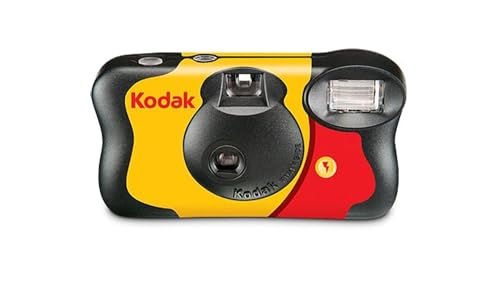
Kodak FunSaver 35mm Single Use Camera
- Best for: Everyday snapshots, first film cameras and single-trip use.
- Film: 35mm Kodak MAX color film
- Exposures: 27
- Flash: built-in
- Exposure control: automatic
Everyday snapshots, first film cameras and single-trip use.
One camera and 27 frames go quickly at a full-day event.
The FunSaver is the single-use camera most people picture first: a yellow Kodak body, 27 exposures and nothing to learn. It runs standard 35mm color film with automatic exposure control, so the camera picks the settings and the photographer just winds on and shoots. A built-in flash covers indoor moments, birthdays and restaurant tables where daylight runs out. Sold as a single camera, it suits one person rather than a whole event: a traveler who wants a pocketable backup, a parent handing a child a first camera, or anyone who wants the classic disposable look without buying a multipack first.
Kodak Power Flash Single Use Camera
- Best for: Parties, evening events and indoor shooting without daylight.
- Film: 35mm Kodak MAX 800 color film, ISO 800
- Exposures: 27
- Flash: automatic, auto-recharging, range 4 to 14.5 ft
- Focus: fixed focus
Parties, evening events and indoor shooting without daylight.
The listing notes packaging may vary, so confirm the 27-exposure version when ordering.
The Power Flash is Kodak’s low-light specialist. It is loaded with Kodak MAX 800 film, the fastest film in this roundup, which keeps evening and indoor shots usable where ISO 400 cameras start to struggle. Its flash is the other half of the package: it fires automatically and recharges itself after each shot, with a listed range of four to fourteen and a half feet, the longest here. That combination makes it the natural pick for parties, concerts and nighttime street scenes. The body stays as simple as any disposable, with fixed focus and a manual wind-on wheel, so the extra capability costs nothing in complexity.
Fujifilm QuickSnap Waterproof
- Best for: Beach trips, pool parties, snorkeling and rainy-day hikes.
- Film: 35mm color film, ISO 800
- Exposures: 27
- Waterproof: sealed housing rated to 35 ft (10 m)
- Flash: none
Beach trips, pool parties, snorkeling and rainy-day hikes.
With no flash, underwater and evening shots need bright ambient light.
The QuickSnap Waterproof trades the flash for a sealed, clear housing rated to 35 feet, which makes it the only camera here that can go in the pool or the sea. Fujifilm loads it with 800-speed color film, and that fast film is doing real work: with no flash on board, the extra sensitivity is what keeps snorkeling and surf shots from coming back too dark. The controls are sized for wet hands, with an oversized shutter lever and a large wind-on wheel, and the fixed-focus lens is set for the distances people actually shoot at in the water. It is a single camera with 27 exposures.
Ilford XP2 Super Single Use Camera
- Best for: Black and white portraits, street photography and a film-first experiment.
- Film: Ilford XP2 Super black and white film, ISO 400
- Processing: C-41 color chemistry
- Exposures: 27
- Flash: built-in
Black and white portraits, street photography and a film-first experiment.
Every frame is monochrome, and scans or prints cost the same as color.
The Ilford XP2 Super is the black and white option, and it is more practical than it first sounds. The camera is pre-loaded with Ilford XP2 Super film, a chromogenic black and white stock rated at ISO 400 that develops in standard C-41 color chemistry, so any lab that processes ordinary color film can process it. You get 27 exposures and a built-in flash for indoor work. The results are true monochrome with smooth tones, which flatters portraits and street scenes and gives weddings a documentary feel. For a first experiment with black and white film, it removes the usual obstacle of finding a specialist lab.
Which One Fits Your Situation
You are hosting a wedding or a big party
Buy for the guest count, not the photo count. The QuickSnap Flash 400 2-Pack gives two cameras per purchase and a flash that stays ready, suiting tables of guests who will not read instructions. Add a Kodak Power Flash for the evening, when light drops and its faster film and auto-recharging flash earn their place. Order close to the date so the film is fresh, and add a table sign asking guests to use the flash indoors.
You want a camera for travel without screens
Take the Kodak FunSaver. It is light, cheap to lose and needs no charging, cables or settings, which makes it a genuine break from a phone rather than another gadget to manage. Twenty-seven exposures also change how you shoot: instead of dozens of near-identical frames, you pick moments. Keep it in hand luggage rather than checked bags, and ask for a hand inspection at security if you want to be careful with the film.
You are shooting at the beach or in the pool
The Fujifilm QuickSnap Waterproof is the only pick that can be submerged, rated to 35 feet in its sealed housing. Its 800-speed film compensates for the missing flash in bright water, and the big shutter lever is easy to work with wet hands. Rinse the housing in fresh water after a beach day, keep it shaded rather than baking on a towel, and never open the housing yourself: the lab opens it when the film is processed.
You want to try black and white film
Start with the Ilford XP2 Super. Because its film develops in the same C-41 chemistry as color film, the lab you already use can process it, and the ISO 400 speed with a built-in flash keeps it usable indoors and out. Black and white rewards texture, contrast and expression over color, so it suits portraits, architecture and street scenes. Shoot the whole camera on one subject or day trip so the finished set feels like a deliberate series.
Common Mistakes
- Buying old stock: film inside a disposable camera expires like any other, so check the process-before date in the listing and skip cameras that will expire before your event.
- Forgetting the flash indoors: most disposable cameras default to no flash, and indoor frames without it come back dark and grainy, so switch it on whenever you step inside.
- Standing too far back: a built-in flash reaches ten to fourteen feet at best, and the fixed-focus lens favors subjects a few feet away, so move closer instead of zooming with your feet planted.
- Expecting the camera back from the lab: processing means handing over the whole camera, which is opened and recycled, so ask upfront about prints, scans and negatives if you want files as well as paper.
- Submerging a regular camera: only the waterproof model is sealed, and even it must stay within its 35-foot rating with the housing closed, or water ends the roll and the camera together.
Frequently Asked Questions
How many photos does a disposable camera take?
Almost every current single-use camera, including all five above, holds 27 exposures. That count is fixed at the factory and the camera cannot be reloaded, so plan purchases around it: one camera per person for a trip, or several per table at an event. A few variant models hold 39 exposures, which is why checking the count in the listing before ordering is worth a moment.
Can disposable camera film still be developed?
Yes. Every camera here uses standard 35mm film, and labs, drugstore counters and mail-in services that process 35mm can develop it. You hand in the camera, the lab extracts and processes the film, and you receive prints, digital scans or both depending on the service. Turnaround ranges from days to a couple of weeks by mail, so send cameras promptly after an event rather than leaving them in a drawer.
Do disposable cameras expire?
The film inside does. Each camera carries a process-before date, and film shot long after it can shift colors and lose sensitivity. Current stock usually shows a date comfortably ahead, but check on arrival and return anything short-dated. Store unshot cameras somewhere cool and dry, out of direct sun and away from heat like a car dashboard, and shoot before the printed date for the most predictable results.
Can I take a disposable camera on a plane?
Yes, and hand luggage is the better place for it. Checked-bag X-ray scanners are stronger and can fog film, so keep unshot cameras in your carry-on. Checkpoint scanners are considered low risk for a single pass, but ISO 800 film, like the Power Flash and QuickSnap Waterproof loads, is more sensitive, so frequent flyers often ask security for a hand inspection instead. Never put a finished camera in checked luggage.
FAQ
How many photos does a disposable camera take?
Can disposable camera film still be developed?
Do disposable cameras expire?
Can I take a disposable camera on a plane?
More from Amazon
Programs that pair well with the guide above. Offers and eligibility are set by Amazon and may change.
Free shipping on eligible items, Prime Video and more. Eligible new members can start with a free trial.
Start a Prime free trialA Prime membership for ages 18-24 with a trial period. Eligibility is set by Amazon.
See Prime for Young AdultsAudiobooks and podcasts to listen to on the go. Eligible new members can start with a free trial.
Try Audible freeAd-free music streaming. Eligible new subscribers can start with a free trial.
Try Music Unlimited freeAs an Amazon Associate we earn from qualifying purchases.