Our Short List of 3

- Best for: Hunters who want one dependable camera per stand or trail, with no subscription and no app to manage.
- Photo resolution: 48MP
- Video resolution: 1296p H.264 HD video
- Night vision: 100ft no-glow infrared
- Trigger speed: 0.1s
- Best for: Hunters who crop and zoom into still photos to identify individual bucks across a season.
- Photo resolution: 64MP
- Video resolution: 1296P HD video
- Night vision: 100ft no-glow infrared
- Trigger speed: 0.1s

- Best for: Video-first scouting on scrapes and trails, and buyers who prefer an established hunting brand’s flagship card camera.
- Photo resolution: 32MP images
- Video resolution: 4K video
- Sensor design: dual sensors, one for day and one for night
- Flash: no-glow infrared
All 4 Picks at a Glance
| Product | Specs | Action |
|---|---|---|
| GardePro A3 |
| Check price on Amazon |
| GardePro A3S |
| Check price on Amazon |
| Bushnell Core DS-4K No Glow |
| Check price on Amazon |
 Meidase P80 Pro |
| Check price on Amazon |
Key takeaways
- Compare four game cameras for deer scouting and wildlife, with fast triggers, no-glow night vision and 4K video, using specs from each Amazon listing.
A game camera has one job: be awake and ready in the exact second an animal crosses its sensor, then prove it with a photo or clip you can actually read. The real buying decision is which trade-offs fit your ground. A camera watching a feeder behind the barn needs different strengths from one hung on a scrape line an hour from home, and a fast trigger matters more on a narrow trail than a wide detection angle does.
The four cameras below cover the main buyer groups: hunters who want a simple card-based camera that just works, scouting-focused buyers who read night images closely, video-first users who want the sharpest clips, and backyard watchers who like pulling photos over WiFi. Every pick is a non-cellular trail camera, and every specification comes from the name and details on its Amazon product page.
Quick Picks
As an Amazon Associate we earn from qualifying purchases.
| Product | Best for | Key spec from title |
|---|---|---|
| GardePro A3 | All-round deer scouting | 48MP photos, 1296p video |
| GardePro A3S | Maximum still-image detail | 64MP photos, 1296p video |
| Bushnell Core DS-4K No Glow | Sharpest video clips | 4K video, 32MP images |
| Meidase P80 Pro | Checking photos near home | WiFi and Bluetooth, 48MP photos |
How to Choose
Trigger Speed Decides What Ends Up in Frame
A trail camera that wakes slowly photographs tails and empty trails. Trigger speed is the delay between the sensor detecting movement and the camera recording, and on a crossing trail an animal can clear the frame in well under a second. The fastest models here fire in a tenth of a second, while slower cameras suit feeders and mineral sites where animals stop and linger. Match the trigger to the setup: tight trails and funnels reward speed, stationary attractants forgive a slower wake-up, and burst modes can rescue a marginal trigger by firing several frames per event.
Flash Type Controls How Invisible the Camera Is
Night illumination comes in three broad flavors. No-glow infrared uses 940nm-style emitters that produce no visible light, which keeps a camera discreet around pressured deer and near houses or trails used by people. Low-glow infrared shows a faint red tint when it fires, usually in exchange for brighter night images. White flash gives full-color night photos but announces the camera to everything in front of it. All four picks here use no-glow infrared, so the choice between them turns on range and image quality rather than visibility.
Resolution Numbers Need a Second Look
Megapixel counts on game cameras often describe an interpolated file size rather than the native sensor output, so a bigger number does not guarantee a sharper photo. Video resolution is easier to compare directly: 1296p and 1080p clips are plenty for identifying individual animals at a feeder, while 4K video holds up better when you crop into a frame or watch on a large screen. Judge a camera by the combination of its listed photo resolution, its video resolution, and its lens and sensor hardware rather than by the headline megapixel figure alone.
Card, WiFi, or Cellular: Pick Your Retrieval Style
Every camera in this guide stores images on a memory card, which is the simplest and cheapest way to run a trail camera: walk in, swap the card, walk out. WiFi and Bluetooth models add short-range wireless transfer, useful when the camera hangs near a house, barn, or a stand you visit often, but the connection only works when you are standing close to the camera. Cellular cameras send photos to a phone from anywhere, at the cost of a data plan. This guide stays with card and WiFi models, so there is no subscription to manage.
The 4 Best Options
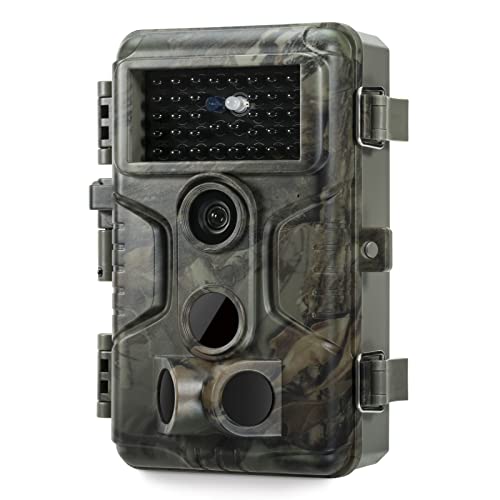
GardePro A3
- Best for: Hunters who want one dependable camera per stand or trail, with no subscription and no app to manage.
- Photo resolution: 48MP
- Video resolution: 1296p H.264 HD video
- Night vision: 100ft no-glow infrared
- Trigger speed: 0.1s
Hunters who want one dependable camera per stand or trail, with no subscription and no app to manage.
There is no wireless transfer at all, so every check is a card swap, and the 48MP figure follows the category’s usual interpolated rating style.
The GardePro A3 is the straightforward recommendation for most deer hunters: a card-based camera with a very fast trigger, high listed photo resolution, and no app, account, or plan standing between you and your pictures. Its 0.1-second trigger speed suits trail crossings where animals do not stop, and the 100ft no-glow infrared range covers feeders and scrapes after dark without visible flash. Because it is non-cellular and non-WiFi, checking it means a walk to the tree, which many hunters prefer anyway for scent control and battery checks on the same trip.
Watch out for: There is no wireless transfer at all, so every check is a card swap, and the 48MP figure follows the category’s usual interpolated rating style.
GardePro A3S
- Best for: Hunters who crop and zoom into still photos to identify individual bucks across a season.
- Photo resolution: 64MP
- Video resolution: 1296P HD video
- Night vision: 100ft no-glow infrared
- Trigger speed: 0.1s
Hunters who crop and zoom into still photos to identify individual bucks across a season.
Video tops out at 1296P like the cheaper A3, and the 64MP rating is an interpolated figure, so judge night sharpness by the infrared range and sensor rather than the headline number.
The A3S is GardePro’s step-up stills camera, raising the listed photo resolution to 64MP while keeping the same 0.1-second trigger and 100ft no-glow infrared setup as the A3. That extra resolution is aimed at readers who zoom into images to read antler points, ear tags, or turkey beards at a distance. It remains a deliberately simple machine: no cellular radio, no WiFi, just a memory card and a fast sensor. Buyers who mostly shoot video will not gain much here, but stills-focused scouting is exactly what this model is built around.
Watch out for: Video tops out at 1296P like the cheaper A3, and the 64MP rating is an interpolated figure, so judge night sharpness by the infrared range and sensor rather than the headline number.
Bushnell Core DS-4K No Glow
- Best for: Video-first scouting on scrapes and trails, and buyers who prefer an established hunting brand’s flagship card camera.
- Photo resolution: 32MP images
- Video resolution: 4K video
- Sensor design: dual sensors, one for day and one for night
- Flash: no-glow infrared
Video-first scouting on scrapes and trails, and buyers who prefer an established hunting brand’s flagship card camera.
It is a card-only camera with no wireless option, and current Amazon availability runs through third-party sellers rather than a direct Amazon offer, so check the seller before ordering.
Bushnell’s Core DS-4K takes a different approach from the GardePro pair: it uses two separate sensors, one optimized for daytime and one for night, instead of asking a single sensor to do both jobs. The payoff is 4K video, the highest video resolution in this guide, paired with 32MP stills and no-glow night illumination. For buyers who identify animals from video behavior, watch a scrape for rub and licking-branch activity, or simply want clips that hold up on a television, this is the strongest specification set here from a long-established trail camera brand.
Watch out for: It is a card-only camera with no wireless option, and current Amazon availability runs through third-party sellers rather than a direct Amazon offer, so check the seller before ordering.
Meidase P80 Pro
- Best for: Backyard wildlife watching and feeder cameras close to home, where short-range wireless checks save opening the housing.
- Photo resolution: 48MP
- Video resolution: 1296p with sound
- Connectivity: WiFi and Bluetooth, non-cellular, app control
- View angle: 120 degrees
Backyard wildlife watching and feeder cameras close to home, where short-range wireless checks save opening the housing.
WiFi range is short by design, so it will not send photos from a remote lease, and Amazon availability is through third-party sellers rather than Amazon itself.
The Meidase P80 Pro is the convenience pick. It pairs WiFi and Bluetooth with a phone app, so a camera mounted by the garden, feeder, or barn can be checked from a few steps away instead of being opened up in the cold. Imaging is still serious on paper: 48MP stills, 1296p video with sound, a wide 120-degree view angle, and a Sony Starvis image sensor feeding no-glow night vision. It stays non-cellular, so there is no plan to pay for; the trade is that wireless checks only work when you are physically near the camera.
Watch out for: WiFi range is short by design, so it will not send photos from a remote lease, and Amazon availability is through third-party sellers rather than Amazon itself.
Which One Fits Your Situation
You Scout a Lease You Visit Every Weekend
Choose the GardePro A3. A weekly card swap fits the rhythm of a lease you already walk for stand work and sign checks, the fast trigger covers the trails between bedding and food, and there is no plan or app adding cost or friction. If you run several cameras across the property, the A3’s simple setup keeps every unit configured the same way, which makes reviewing a stack of cards at home noticeably faster.
You Read Night Photos to Track Individual Bucks
Choose the GardePro A3S for stills or the Bushnell Core DS-4K for video. The A3S puts its budget into listed photo resolution, which helps when you zoom in to compare antler characteristics between weeks. The Bushnell answers a different question: its dedicated night sensor and 4K clips show how a buck works a scrape, not just that he visited. Pick based on whether your decisions come from photographs or from behavior on video.
Your Camera Watches a Feeder or Garden Near the House
Choose the Meidase P80 Pro. When the camera is a short walk from the door, WiFi and Bluetooth checks are genuinely useful: pull the latest turkey or raccoon photos from the porch without unstrapping the unit or disturbing the spot. The wide 120-degree view angle also suits close-range setups where animals appear suddenly at the edge of frame, and no-glow flash keeps the camera discreet near the house at night.
You Want a First Camera and an Easy Learning Curve
Choose the GardePro A3. A first trail camera should teach placement, angle, and card discipline without extra systems to configure, and the A3 is the most direct expression of that formula here: mount it, set the clock, walk away. Its trigger speed forgives imperfect placement on trails, and when you later add a second camera, the same model keeps batteries, cards, and settings consistent across your small fleet.
Common Mistakes
- Buying a cellular camera for ground with no reliable signal, then paying for a plan the camera cannot use; every pick in this guide works without any signal at all.
- Trusting the megapixel headline without checking whether the figure is interpolated, and ignoring trigger speed, which decides whether the animal is in the frame at all.
- Mounting the camera facing east or west, so sunrise and sunset trigger empty photos and wash out real ones; a north-facing setup avoids most false triggers.
- Hanging the camera at head height aimed straight ahead, which crops deer at close range; knee-to-waist height with a slight downward angle covers the detection zone better.
- Skipping the timestamp and date setup on day one, which makes a season of photos far harder to pattern when you review the cards later.
Frequently Asked Questions
Do game cameras require a monthly subscription?
Only cellular models do, because they use a network to send photos to your phone. None of the four cameras in this guide is cellular: the GardePro and Bushnell models record to a memory card, and the Meidase adds WiFi and Bluetooth for nearby checks. If a listing mentions a data plan, cloud storage fees, or a carrier name, you are looking at a cellular model, not a card-based one.
What does no-glow flash mean on a trail camera?
No-glow infrared illuminators emit light outside the range animals and people can see, so the camera produces no visible flash or red tint when it fires at night. The trade-off is that no-glow night images can be slightly dimmer at long range than low-glow equivalents. For pressured deer, cameras near trails and houses, and any spot where discretion matters, no-glow is usually the right default choice.
How long will the batteries last in a game camera?
Battery life depends on how many photos and videos the camera records, how much of that happens at night with infrared lit, and how cold the weather gets. Makers state their figures on each product page, so compare the listed battery type and the maker’s runtime notes before buying. Lithium AA cells are commonly recommended for winter because they hold voltage better in cold than alkaline cells.
Can a game camera work where there is no cell service or WiFi?
Yes. A card-based game camera is fully self-contained: it detects motion, records photos and video to its memory card, and waits for you to collect the card. That is exactly how the GardePro A3, A3S, and Bushnell Core DS-4K in this guide operate. Lack of signal only rules out cellular photo delivery and remote app access; it does not limit the camera’s ability to scout a property.
FAQ
Do game cameras require a monthly subscription?
What does no-glow flash mean on a trail camera?
How long will the batteries last in a game camera?
Can a game camera work where there is no cell service or WiFi?
More from Amazon
Programs that pair well with the guide above. Offers and eligibility are set by Amazon and may change.
Free shipping on eligible items, Prime Video and more. Eligible new members can start with a free trial.
Start a Prime free trialA Prime membership for ages 18-24 with a trial period. Eligibility is set by Amazon.
See Prime for Young AdultsAudiobooks and podcasts to listen to on the go. Eligible new members can start with a free trial.
Try Audible freeAd-free music streaming. Eligible new subscribers can start with a free trial.
Try Music Unlimited freeAs an Amazon Associate we earn from qualifying purchases.