Key takeaways
- Handle height: A taller handle suits users who press with the palm and fingers. A shorter handle can feel more controlled for a compact, vertical tamp.
- Diameter: A broad handle spreads pressure across the hand. Narrow handles may suit smaller hands but can create a concentrated pressure point during repeated use.
- Grip surface: Anodized aluminum, textured polymer, wood, and stainless steel all work, but smooth metal can become slippery when wet or oily.
- Weight: A heavy handle feels stable, but weight alone does not improve extraction. It can make the tool more tiring if the workflow involves many shots.
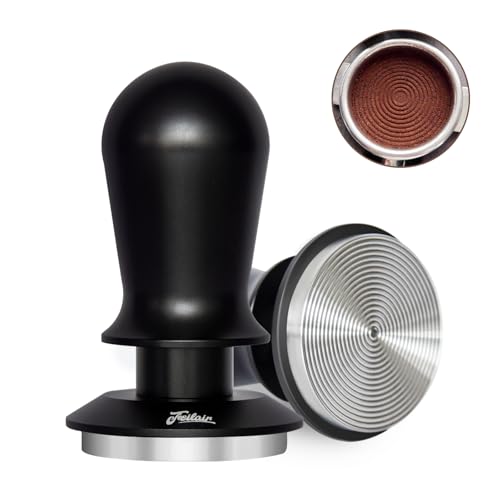
- Base material: Stainless steel is durable, corrosion-resistant, and easy to wipe clean. Aluminum is light and can be precisely machined, but it can show scratches and should not be treated as indestructible. Coated bases need careful cleaning to avoid damaging the finish.
- Base geometry: A flat base is easy to understand and clean. Convex bases can change how grounds move toward the edge and are less forgiving when distribution is inconsistent.
The best calibrated espresso tampers are the Normcore V4 for most home baristas, the Force Tamper for premium repeatability, and an automated Puqpress model for busy cafés; the right choice depends on basket diameter, spring consistency, ergonomics, and how often you make espresso.
Our top picks


As an Amazon Associate we earn from qualifying purchases at no extra cost to you. Ratings are shown as listed on Amazon.
Best calibrated espresso tampers by situation
| Best for | Recommended type or example | Typical size | Typical force or setting | Why it suits the situation |
|---|---|---|---|---|
| Budget-conscious home use | Spring-loaded calibrated tamper such as Normcore V4 | 58.5 mm or 53.3 mm | Usually 15, 25, or 30 lb springs | Interchangeable springs and a level-guiding design provide repeatability without café-level cost |
| Experienced home barista | Precision spring tamper such as Force Tamper | Commonly 58.5 mm | Adjustable or model-dependent calibrated range | Consistent depth, premium machining, and a compact distribution profile |
| Small commercial bar | Heavy-duty calibrated manual tamper | 58.4–58.5 mm | 25–30 lb is common | Fast workflow while retaining manual control and low electrical complexity |
| High-volume café | Automated tamper such as Puqpress | Model-specific, often 58.0–58.5 mm | Programmable force, commonly expressed in kilograms | Reduces repetitive hand pressure and gives every portafilter the same tamping cycle |
| Nonstandard or narrow basket | Size-matched calibrated tamper | 49, 51, 53.3, 54, or 57.3 mm | Usually 15–30 lb | Correct edge coverage matters more than buying the most expensive mechanism |
What calibration actually changes
A calibrated tamper uses a spring, clutch, stop, or electronic motor to limit the applied force or tamping depth. The mechanism does not make poor coffee automatically. It makes one variable easier to repeat, which is valuable when different people prepare the same espresso recipe.
Force is only part of the result. Grind size, dose, distribution, basket geometry, and puck moisture have a greater influence on extraction. Once those are reasonably consistent, calibration helps prevent large differences between shots. It is especially useful when a barista tends to tamp lightly on the first shot and heavily later in a session.
Do not treat a higher force rating as better. After the grounds are compressed and the puck is level, additional pressure generally has little practical benefit. A moderate setting around 15–25 lb is sufficient for many home workflows. The important characteristics are a level tamp, complete edge coverage, and the same endpoint every time.
Head-to-head: the main calibrated tamper designs
Spring-loaded manual tampers
Spring-loaded models are the most sensible starting point for home users. Pressing the handle compresses a spring until a stop is reached, giving tactile feedback and a repeatable endpoint. The Normcore V4 is a well-known example of this design and is commonly sold with multiple spring options, including 15, 25, and 30 lb versions depending on the package.
The advantages are modest cost, no batteries, easy storage, and simple operation. The limitations are equally important: the spring does not correct uneven distribution, and the mechanism can become sticky if coffee particles enter the shaft. A spring-loaded tamper should be lifted straight up rather than twisted aggressively in the basket.
Precision adjustable tampers
Premium manual tampers such as Force Tamper focus on machining, guided movement, and adjustable or tightly controlled tamping depth. They can feel more stable than inexpensive spring models, particularly when the base fits the basket closely.
This design makes sense for someone who has already standardized dose and distribution and wants a refined, durable tool. Its cost is harder to justify if the grinder produces inconsistent particles or if the basket is not the correct size. Calibration cannot compensate for a 58 mm tamper being used in a basket that needs a 58.5 mm base.
Automated tampers
Automated systems such as Puqpress use a motor to tamp at a selected force or pressure. They are designed for speed, staff consistency, and reduced repetitive hand movement. In a busy café, saving a few seconds per drink can matter more than the purchase price.
For occasional home use, an automated tamper is usually excessive. It occupies counter space, requires electrical power, and adds another machine to clean and maintain. It becomes more rational when several baristas share one machine, when dozens or hundreds of shots are prepared daily, or when standardized workflow is more important than tactile control.
Choose the correct tamper diameter first
Measure the internal diameter of the basket or check its manufacturer specification before buying. Common sizes include 58.0, 58.4, 58.5, 57.3, 54, 53.3, 51, and 49 mm. The portafilter’s nominal diameter is not always the exact size required by the basket.
A larger base can reduce the exposed ring around the puck, but too large a base may bind against the basket wall or fail to enter once the grounds are distributed. A smaller base enters easily but may leave a perimeter of loose coffee that can encourage uneven water flow.
For example, suppose a basket measures 58.6 mm internally and a chosen tamper is 58.0 mm. The diameter difference is 0.6 mm, creating approximately a 0.3 mm radial gap on each side. That may be acceptable in one basket and excessive in another because basket walls taper and manufacturing tolerances vary. A 58.4–58.5 mm base is often a closer fit for modern 58 mm commercial-style baskets, but fit should be verified rather than assumed.
Handle design and base material matter more than decoration
- Handle height: A taller handle suits users who press with the palm and fingers. A shorter handle can feel more controlled for a compact, vertical tamp.
- Diameter: A broad handle spreads pressure across the hand. Narrow handles may suit smaller hands but can create a concentrated pressure point during repeated use.
- Grip surface: Anodized aluminum, textured polymer, wood, and stainless steel all work, but smooth metal can become slippery when wet or oily.
- Weight: A heavy handle feels stable, but weight alone does not improve extraction. It can make the tool more tiring if the workflow involves many shots.
- Base material: Stainless steel is durable, corrosion-resistant, and easy to wipe clean. Aluminum is light and can be precisely machined, but it can show scratches and should not be treated as indestructible. Coated bases need careful cleaning to avoid damaging the finish.
- Base geometry: A flat base is easy to understand and clean. Convex bases can change how grounds move toward the edge and are less forgiving when distribution is inconsistent.
A repeatable setup that makes calibration useful
- Confirm the basket and tamper fit. Insert the clean tamper without coffee. It should move freely without scraping or wedging.
- Set one spring or force level. Start at approximately 15–25 lb for a manual spring tamper, or a comparable moderate setting on an automated model. Keep it unchanged while dialing in.
- Distribute before tamping. Break up visible clumps with a distribution tool or careful stirring, then level the grounds. A calibrated tamper can repeat a bad mound perfectly.
- Tamp vertically once. Lower the tamper squarely until the mechanism stops. Avoid rocking, polishing, or repeated tamping, which can disturb the puck surface.
- Lock in the recipe. Record dose, beverage mass, and extraction time. Adjust grind size for taste and flow rather than changing tamp pressure every shot.
As a practical example, a 18 g dose yielding 36 g of espresso is a 1:2 brew ratio. If one shot runs in 22 seconds and another in 34 seconds despite the same dose and yield, investigate distribution, grinder retention, and grind setting before blaming a small difference in tamp force.
Ownership, cleaning, and likely wear
Coffee oils and fine particles are the main enemies of calibrated mechanisms. Wipe the base after each session, brush the spring or guide area when particles appear, and follow the manufacturer’s instructions before using water near an adjustable mechanism. Do not immerse a tamper containing a spring, bearing, or electronic components unless it is explicitly designed for that treatment.
The first parts likely to show wear are the spring, guide surfaces, adjustment threads, or the coating on an aluminum base. Springs can lose consistency over a long period of heavy use, while automated tampers may eventually require service for their motor, sensor, or drive components. Keep replacement springs and manufacturer-specific parts available before buying a proprietary system.
Common mistakes include forcing an oversized tamper into the basket, allowing coffee to enter the shaft, changing force and grind size simultaneously, and assuming a calibrated tamper eliminates the need for even distribution. A well-fitted 58.5 mm stainless-steel spring tamper is often the best value for a standard commercial basket; choose a premium adjustable manual model when machining and long-term feel matter, and choose automation only when throughput justifies the added cost and maintenance.
Final buying recommendation
For most home users, choose a spring-loaded calibrated tamper with the correct basket diameter, a replaceable spring, a comfortable handle, and a stainless-steel base. The Normcore V4 is a practical reference point in this category. Step up to a Force Tamper when you want premium adjustment and construction. For a café producing high volumes, compare an automated Puqpress with a durable manual alternative using labor savings, counter space, cleaning, and service requirements—not tamp pressure alone.