Key takeaways
- Confusing thread diameter with wrench size. A 5/16-inch side-terminal bolt description does not guarantee every nearby nut or accessory fastener is 5/16 inch.
- Using an adjustable wrench on a corroded nut. Adjustable jaws can slip under high force. A six-point socket or correctly sized box end gives better contact.
- Forcing SAE tools onto metric hardware. A 3/8-inch wrench is close to 10 mm but is not an accurate replacement.
- Buying only a terminal wrench. Battery replacement also commonly requires a 10 mm or 13 mm tool for the hold-down bracket.
- Ignoring tool thickness. The correct 10 mm wrench can still be unusable if its head cannot fit between the cable, cover, and battery case.
- Overtightening the clamp. The clamp should be secure and unable to rotate by hand, but excessive force can strip threads, distort the clamp, or damage the terminal.
What's inside
The Short Answer
For most passenger-car battery work, start with a 10 mm wrench or socket. It is the most common size for the hex nut on a top-post battery terminal clamp. If your vehicle has side-mounted battery terminals, a 5/16-inch battery terminal wrench is often the right choice for the terminal bolt. A compact ratcheting battery wrench with a 10 mm end and a 5/16-inch end covers many common setups.
The important detail is that a battery’s post or bolt description is not always the same as the wrench’s hex size. For example, a “3/8-inch top-post terminal” may describe the terminal hardware or stud, while the nut you turn can still require a 10 mm wrench. Always measure the flats of the nut or test-fit the tool before applying force.
As an Amazon Associate we earn from qualifying purchases at no extra cost to you. Product prices and availability are accurate as of the date shown and are subject to change.


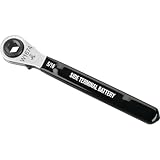

For a basic 2026 household garage kit, keep a 10 mm combination wrench, a 5/16-inch side-terminal wrench, and a 3/8-inch-drive socket set with 8 mm through 13 mm sockets. That range also handles many battery hold-down brackets, retaining bars, and nearby accessory fasteners.
Standard Sizes
| Battery Component or Fastener | Common Wrench/Socket Size | Inches | Centimeters | Where You’ll Usually Find It |
|---|---|---|---|---|
| Top-post terminal clamp nut | 10 mm | 0.394 in. | 1.00 cm | Most conventional top-post automotive batteries |
| Side-terminal battery bolt | 5/16 in. | 0.313 in. | 0.79 cm | Many GM-style and other side-terminal battery installations |
| Smaller terminal or accessory clamp fastener | 8 mm | 0.315 in. | 0.80 cm | Some compact cars, accessory leads, and fuse-block connections |
| Battery hold-down bolt | 10 mm or 13 mm | 0.394 or 0.512 in. | 1.00 or 1.30 cm | Lower retaining clamp, crossbar, or tray bracket |
| Battery tray or larger hold-down hardware | 13 mm | 0.512 in. | 1.30 cm | Tray removal and some European vehicle battery brackets |
| Older or larger clamp hardware | 1/2 in. | 0.500 in. | 1.27 cm | Some older domestic vehicles and aftermarket hardware |
A 10 mm wrench has jaws spaced 10 mm apart across the flat sides of the nut. Do not substitute a 3/8-inch wrench simply because it looks close: 3/8 inch equals 9.525 mm, leaving about 0.475 mm of difference. That small gap can round soft or corroded battery-terminal hardware.
Likewise, a 5/16-inch wrench measures 0.3125 inch, or about 7.94 mm, across its jaws. A dedicated side-terminal wrench is usually slim, offset, and sometimes insulated, making it easier to reach recessed side bolts without contacting adjacent metal parts.
How to Measure Your Space
- Turn the vehicle off and remove the key or key fob from the work area. Open the hood, trunk, or battery compartment fully. If the battery is inside the vehicle, make sure there is adequate light and room to work without pulling on surrounding trim.
- Identify the terminal style. Top-post batteries have tapered lead posts on the upper surface. Side-terminal batteries have threaded connections on the battery’s side. Some vehicles have a top post plus a side connection or a distribution block that changes the access angle.
- Measure the nut across its flats. Use a caliper if available, placing the jaws on two opposite flat sides of the hex nut—not on the corners. A reading close to 10.0 mm calls for a 10 mm tool; a reading near 7.9 mm calls for a 5/16-inch tool.
- Check vertical and side clearance. A standard combination wrench typically needs roughly 5 to 7 inches (12.7 to 17.8 cm) of swing room. In a cramped engine bay, a ratcheting wrench may need only a few degrees of movement, but its head can be 1 inch (2.5 cm) or more wide.
- Measure recess depth. If the nut sits below a plastic cover or behind a cable bundle, measure from the opening to the fastener. A deep socket may need 2 to 3 inches (5.1 to 7.6 cm) of clear depth, while a thin battery wrench can reach into narrower spaces.
- Inspect the hold-down separately. The terminal wrench may not fit the battery retaining bracket. Check that fastener too; 10 mm and 13 mm are the most useful metric sizes to have ready.
- Test-fit before turning. The correct wrench should slide over the nut without forcing and should have very little side-to-side play. If it rocks on the nut, use the next appropriate size rather than risking rounded corners.
By Room or Use Case
Home Garage Workbench
For routine battery cleaning, terminal tightening, or seasonal checks, a small metric wrench set is the most versatile choice. Keep 8 mm, 10 mm, 12 mm, and 13 mm combination wrenches in a labeled drawer, plus a 5/16-inch side-terminal wrench. A 10 mm ratcheting wrench is especially useful because battery-clamp nuts often allow only short turns between the cable and the battery case.
A compact tool roll measuring about 12 by 8 inches (30.5 by 20.3 cm) can hold the essentials: wrenches, terminal brush, gloves, dielectric grease, and a small wire brush. Dedicated 10 mm battery wrenches commonly cost about $10 to $18, while basic side-terminal wrenches generally fall around $8 to $15. A multi-piece battery service kit with pliers, a terminal puller, cleaners, and brushes can range from roughly $30 to $55.
Driveway or Apartment Parking Area
When working outdoors, choose a simple, portable setup rather than a large socket case. A double-ended battery wrench with 10 mm and 5/16-inch ends handles the most likely terminal hardware in one tool. Select a model with an insulated or coated handle if possible, but remember that insulation is not a substitute for safe procedure.
Bring a flashlight, a rag, and a small container for removed hardware. Avoid placing metal tools on top of the battery. Disconnect the negative terminal first and reconnect it last; this reduces the chance of accidentally creating a short circuit between a positive connection and grounded vehicle metal.
Tight Engine Bays
Modern compact cars can place the battery under a cowl panel, behind an intake duct, or beside a fuse box. In these spaces, tool head thickness matters as much as wrench size. Look for a narrow 10 mm ratcheting head, often about 0.4 to 0.6 inch (1.0 to 1.5 cm) thick, or use a 1/4-inch-drive socket and short extension.
A flex-head ratchet can help when the terminal nut is angled, but do not use a universal joint if it causes the socket to sit crookedly on the nut. Full engagement is more important than speed. If a plastic terminal cover blocks access, remove only the cover or nearby component specified by the vehicle’s service instructions.
RV, Boat, and Auxiliary-Battery Systems
RV and auxiliary-battery installations often add ring terminals, fuse holders, disconnect switches, and larger cables. The battery terminal may still use a 10 mm clamp nut, but added accessory hardware can use 8 mm, 10 mm, 13 mm, or 1/2-inch fasteners. Carry a broader set and inspect every connection before choosing a wrench.
For high-capacity batteries, keep a terminal puller available instead of prying a tight clamp off the post with a screwdriver. A puller applies force evenly and is less likely to crack a battery case, damage the cable end, or deform the lead terminal.
Common Sizing Mistakes
- Confusing thread diameter with wrench size. A 5/16-inch side-terminal bolt description does not guarantee every nearby nut or accessory fastener is 5/16 inch.
- Using an adjustable wrench on a corroded nut. Adjustable jaws can slip under high force. A six-point socket or correctly sized box end gives better contact.
- Forcing SAE tools onto metric hardware. A 3/8-inch wrench is close to 10 mm but is not an accurate replacement.
- Buying only a terminal wrench. Battery replacement also commonly requires a 10 mm or 13 mm tool for the hold-down bracket.
- Ignoring tool thickness. The correct 10 mm wrench can still be unusable if its head cannot fit between the cable, cover, and battery case.
- Overtightening the clamp. The clamp should be secure and unable to rotate by hand, but excessive force can strip threads, distort the clamp, or damage the terminal.
FAQ
What size wrench do I need for a standard car battery terminal?
Most top-post battery terminal clamp nuts use a 10 mm wrench or socket. Check the nut directly, because some vehicles use 8 mm hardware or nonstandard replacement terminals.
Is 3/8 inch the same as 10 mm for a battery wrench?
No. A 3/8-inch wrench is 9.525 mm, while a 10 mm wrench is 10.0 mm. The difference is enough to create looseness and potentially round the nut. Use a true 10 mm wrench on a 10 mm hex.
What size is a side-terminal battery wrench?
Many side-terminal battery bolts use a 5/16-inch wrench, equal to approximately 7.94 mm. A slim dedicated 5/16-inch side-terminal wrench is useful because these bolts are often recessed and difficult to reach with a bulky socket.
What tools should I have to replace a car battery?
At minimum, have a 10 mm wrench, a 5/16-inch side-terminal wrench if your vehicle uses side posts, and 10 mm and 13 mm sockets for the hold-down. Add gloves, eye protection, a terminal brush, a battery terminal puller, and a flashlight for a practical battery-service kit.