Key takeaways
- Pro: Anti-tipping shutoff adds a real safety margin on uneven surfaces.
- Pro: Steel wand and 5-nozzle set make it feel like a more expensive unit.
- Con: 1.76 GPM means it will not blast through deeply embedded stains on large driveways quickly.
If you own a car you actually wash, a driveway that has gone from “concrete gray” to “moss green,” or a fence that makes you wince every time you pull into your garage, you have probably looked at pressure washers and felt overwhelmed. The spec sheets all start to blur together after a while. What separates a genuinely useful machine from one that collects dust is not peak PSI — it is how consistently the unit delivers cleaning power, how much water it actually moves, and whether the design choices (anti-tipping, induction motors, onboard soap tanks) solve the problems you will encounter on a Saturday morning or just add price.
Westinghouse has built a wide lineup that covers electric entry-level units through commercial-leaning gas machines, and the differences between them are more meaningful than most people realize. A 2100 PSI electric washer will not clean your driveway the same way a 4400 PSI gas unit will, and the gap between a $109 and a $250 electric model is not just brand markup. This roundup puts the best westinghouse pressure washers side by side based on real-world cleaning tasks, build quality, and whether the features justify the price tag in 2026.
Our top picks




As an Amazon Associate we earn from qualifying purchases at no extra cost to you.
Quick Picks
| Product | Best for | Price |
|---|---|---|
| ePX3500 Electric | Best overall electric for most homeowners | $169 |
| WPX3000e Electric | Heavier home cleaning with an induction motor | $242.49 |
| WPX3400 Gas | Driveways and large areas on a gas budget | $349 |
| ePX3100v Electric | Best value electric with foam cannon included | $129 |
| ePX3100 Electric | Compact cleaning with anti-tipping safety | $139 |
| ePX3050 Electric | Tightest budget that still works | $109 |
| WPX4400 Gas | Large properties and stubborn built-up grime | $1033.75 |
| PWSC12 Surface Cleaner | Flat concrete and driveway attachments | $26.09 |
How We Picked
We evaluated each unit on four criteria: cleaning effectiveness relative to its stated PSI and GPM, durability of the pump and motor construction, practical usability (weight, storage, setup complexity), and whether the included accessories add real value or just inflate the box. A washer that scores well on PSI but frustrates you with a flimsy wand or a soap tank that leaks within a season is not a recommendation, regardless of how the numbers look on paper.
The 8 Best Westinghouse Pressure Washers in 2026
1. Westinghouse ePX3500 Electric Pressure Washer
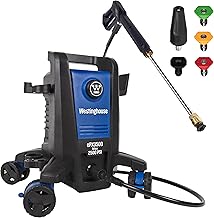
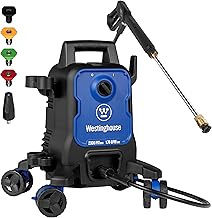
This is the model most homeowners should start with if they want one machine that handles cars, fences, patio furniture, and a section of driveway without leaving obvious streaks. The 2500 Max PSI paired with 1.76 Max GPM gives it enough bite for caked-on mud without the noise and maintenance of gas. The anti-tipping technology is not a gimmick — if the unit rocks on uneven pavers it shuts off rather than spraying your shins. The onboard soap tank is easy to refill and the pro-style steel wand feels genuinely more durable than plastic alternatives in this price range. The 5-nozzle set covers rinse through detergent without needing to buy add-ons.
- Pro: Anti-tipping shutoff adds a real safety margin on uneven surfaces.
- Pro: Steel wand and 5-nozzle set make it feel like a more expensive unit.
- Con: 1.76 GPM means it will not blast through deeply embedded stains on large driveways quickly.
Skip it if your primary job is a long driveway or a barn wall; you will want the water volume of a gas model instead.
2. Westinghouse WPX3000e Electric Pressure Washer
The induction motor is the headline here. Compared to universal motors in cheaper electrics, it runs cooler, lasts longer under extended use, and handles the occasional 30-minute session without tripping a thermal cutoff. The 3000 Max PSI puts it close to gas territory for cleaning power while keeping the noise level reasonable for a residential Sunday. GPM stays at 1.76, which means it is strong at breaking up grime but not fast at rinsing it away on wide surfaces. The spray gun and wand setup is straightforward, and the 5-nozzle kit covers every standard angle you will need. The onboard soap tank works well for detergent applications on siding and fences.
- Pro: Induction motor is noticeably more durable for regular use.
- Pro: 3000 PSI handles most home cleaning tasks that an electric can theoretically do.
- Con: At $242.49 it approaches the price floor where you start considering a gas unit for raw power.
Skip it if you only pressure wash a car twice a year and want the lowest price that still does the job.
3. Westinghouse WPX3400 Gas Pressure Washer
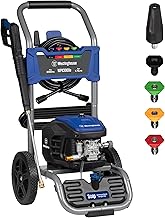
For anyone whose driveway, fence, and patio together take more than 45 minutes to clean, the jump to gas makes sense. The 3400 PSI and 2.6 GPM combination is the real difference-maker: that water volume strips away years of oxidation and algae from concrete in noticeably fewer passes. The onboard soap tank lets you apply detergent for dwell time without switching machines. Weight and noise are the trade-offs — this is not something you store on a small balcony or run at 7 AM without waking neighbors. The 5-nozzle set is standard and functional.
- Pro: 2.6 GPM rinses surfaces far faster than any electric model here.
- Pro: 3400 PSI handles stubborn stains and textured surfaces with ease.
- Con: Requires fuel, oil changes, and seasonal storage prep that electric models skip entirely.
Skip it if your space is limited, you want zero maintenance, or your cleaning targets are a car and a small patio.
4. Westinghouse ePX3100v Electric Pressure Washer
This unit earns the value rating because it includes a detachable foam cannon at $129 — a feature that on its own would cost extra. The 2100 Max PSI is adequate for cars, furniture, and light fence work. The built-in carry handle is a small but genuinely useful touch for moving it between a garage and a driveway. The steel wand and 3-nozzle set cover the basics. It does not have anti-tipping, so you need to set it on level ground carefully. The foam cannon makes it particularly appealing if you wash vehicles regularly, since the pre-soak step does most of the heavy lifting before you even pull the trigger.
- Pro: Detachable foam cannon included saves money versus buying it separately.
- Pro: Carry handle and compact footprint make storage easy in a small garage.
- Con: 3-nozzle set and no soap tank limit versatility for non-car tasks.
Skip it if you need detergent application beyond foam or want the broadest nozzle selection.
5. Westinghouse ePX3100 Electric Pressure Washer
Essentially the ePX3500’s smaller sibling, this unit keeps the anti-tipping technology and the 5-nozzle set while dropping peak pressure from 2500 to 2300 PSI. For most homeowner tasks the difference is marginal — you will notice it on a caked-on mud patch but not on a dusty car or a grimy patio. The onboard soap tank, steel wand, and compact body make it easy to live with. At $139 it sits just above the ePX3100v in price but adds the safety feature and the extra two nozzles, which is a reasonable trade if those features matter to you. GPM matches every other electric here at 1.76.
- Pro: Anti-tipping at $139 is the cheapest entry point for that safety feature.
- Pro: 5-nozzle set gives good range for varied surfaces without adapters.
- Con: 2300 PSI sits in a middle ground where you pay slightly more than the ePX3100v without a big power jump.
Skip it if the foam cannon on the ePX3100v is more useful to you than the extra nozzles here.
6. Westinghouse ePX3050 Electric Pressure Washer
The absolute floor of the Westinghouse electric lineup at $109. It delivers 2100 Max PSI with the same 1.76 GPM as the other electrics, so the cleaning power difference versus the ePX3100v is essentially zero in most scenarios. The turbo nozzle helps on spots that need concentrated force, and the foam cannon is a welcome inclusion at this price. What you give up is the larger nozzle kit, the steel wand (not specified here the same way), and the safety or storage features found on pricier models. It is the pick for someone who needs to wash a car and a small deck and wants to spend the minimum.
- Pro: Foam cannon and turbo nozzle included at the lowest price in the lineup.
- Pro: Light and simple to set up for occasional users who will not learn a complex system.
- Con: Fewer nozzles and no anti-tipping means you need to be more careful about placement and task variety.
Skip it if you will use the washer weekly across many surfaces; the next tier up adds real versatility.
7. Westinghouse WPX4400 Gas Pressure Washer
This is the heavy hitter. 4400 PSI and 4.2 GPM put it in a different category from everything else on this list. For a quarter-acre of cracked driveway with decade-old oil stains, or a barn and fence line that has gone essentially black with mildew, this is the machine that finishes the job in one pass instead of three. The 5-nozzle set and spray gun are commercial-leaning in feel. The $1033.75 price tag reflects that positioning, and the 4.0 rating suggests some owners find it overkill or difficult to store. It is loud, it is heavy, and it demands fuel and engine care.
- Pro: 4.2 GPM is more than 50% higher than any other unit here, dramatically cutting rinse time.
- Pro: Handles commercial-scale messes that leave the WPX3400 struggling.
- Con: Overkill for anything smaller than a full driveway plus house sides.
Skip it unless you have large flat surfaces, heavy built-up grime, or need this for a business or rental property.
8. Westinghouse PWSC12 12″ Pressure Washer Surface Cleaner Attachment
Not a washer, but the right pairing matters. At $26.09 this 12-inch surface cleaner connects to any Westinghouse unit rated up to 3000 Max PSI via a standard quarter-inch connector. On flat concrete it removes the streaking that a wand alone creates, and it covers a swath wide enough to make a mid-size driveway feel manageable. The 4.4 rating reflects consistent satisfaction for the price. It will not help on vertical surfaces or textured stone, and it adds weight and bulk that some users find awkward on uneven ground.
- Pro: Eliminates wand streaking on flat concrete, producing an evenly clean surface.
- Pro: Inexpensive add-on that transforms driveway cleaning speed on compatible units.
- Con: Rated only to 3000 PSI, so it does not pair with the WPX4400.
Skip it if your concrete is rough-textured or if your primary targets are cars and fences rather than flat slabs.
Buying Guide
PSI vs GPM: Which Number Actually Matters
PSI determines how forcefully water hits a surface; GPM determines how much water flows to carry away the loosened dirt. A high-PSI, low-GPM unit breaks up grime effectively but leaves you doing multiple rinse passes. The electric models here cluster at 1.76 GPM, which is adequate for cars and furniture but slow on large flat areas. The gas models at 2.6 and 4.2 GPM solve that bottleneck. If your priority is speed on a driveway, GPM is the number to weigh most heavily.
Induction Motor vs Universal Motor in Electrics
Most electric pressure washers under $200 use a universal motor: cheaper to build, lighter, but it generates more heat and wears out faster under sustained use. The WPX3000e uses an induction motor, which is heavier but runs cooler and lasts significantly longer if you clean regularly. For occasional users, the difference may not justify the price gap. For someone washing weekly or doing long sessions, the induction motor is a durability investment that pays off over several seasons.
Safety and Convenience Features Worth Paying For
Anti-tipping technology on the ePX3500 and ePX3100 automatically shuts off pressure if the unit tilts, preventing a sudden spray toward your body or the machine tipping onto a nozzle. Onboard soap tanks save you from constantly refilling a separate container mid-task. A pro-style steel wand resists the cracking and bending that plastic wands develop after a year of cold storage and rough handling. These features individually add cost, but together they reduce frustration and extend the usable life of the unit.
Our Verdict
The top pick is the Westinghouse ePX3500. It balances cleaning power, safety features, and accessory completeness at a price that will not make you hesitate for a week before ordering. For the tightest budget that still includes useful extras, the ePX3100v at $129 is the clear winner thanks to its included foam cannon. If your primary target is a large driveway or property with heavy buildup, the WPX3400 at $349 wins over any electric option because the water volume and pressure put it in a different class of capability.
FAQ
Can any electric Westinghouse pressure washer clean a car safely?
Yes. All the electric models here use nozzle tips rated for gentle enough spray patterns to avoid damaging paint or trim when used at proper distance. The 2300 and 2500 PSI units are the sweet spot — enough force to break up road film without risk of etching clear coat the way some older high-pressure machines could.
Do I need a gas pressure washer or will an electric handle my driveway?
An electric at 1.76 GPM will clean a driveway, but slowly. If you have under 400 square feet of concrete with light staining, an electric works fine. For anything larger or with years of buildup, the 2.6 GPM of the WPX3400 cuts the job in half and the surface cleaner attachment helps further.
Is the 4400 PSI gas model overkill for a homeowner?
For most people, yes. Unless you maintain a rental property, a farm, or a very large paved area, you will never need 4400 PSI and 4.2 GPM. The WPX3400 at 3400 PSI and 2.6 GPM covers the same tasks faster than any electric while costing roughly a third as much.
How often should I maintain a Westinghouse gas pressure washer?
Check the oil before each use and change it per the owner’s manual interval. Run fuel stabilizer through the carburetor if the unit sits for more than a month. Winter storage requires draining the pump to prevent freeze damage. Electric models need none of this, which is a legitimate advantage for casual users.