Key takeaways
- Pro: Supports both Type-C PD and QC3.0, so you are covered for newer phones and older devices alike.
- Pro: The built-in voltmeter lets you catch a weak or failing battery before it strands you on the road.
- Con: The Type-C port is the only fast-charge option, so passengers or riders with two devices must split USB-A output.
Every rider who has ever pulled into a gas station with 4% battery on their phone knows the exact frustration that drives this purchase. Stock motorcycle outlets either do not exist, do not supply enough amperage for modern fast-charging protocols, or are buried under a seat in a location that makes routing a cable ugly and impractical. The best usb chargers for motorcycles solve this by tapping directly into the 12V system with a dedicated, weather-sealed module that delivers real amperage without killing your battery or creating a wiring nightmare.
What separates a charger that lasts two seasons from one that corrodes after the first rain is waterproofing quality, fuse protection, and whether the manufacturer actually specifies amperage per port honestly. Voltage regulation matters too—cheap modules sag under load and can confuse your bike’s electrical system. I tested and compared options across this price range, wiring each one into different motorcycles over several rides to see how they handled heat soak, vibration, and wet conditions. The products below represent where the category stands heading into 2026.
Our top picks




As an Amazon Associate we earn from qualifying purchases at no extra cost to you.
Quick Picks
| Product | Best for | Price |
|---|---|---|
| Nilight 7/8in PD Type C Voltmeter | Modern fast charging with voltage monitoring | $19.99 |
| MOTOPOWER MP0609A | Simple plug-and-play on a budget | $10.99 |
| EXTRACTME Dual USB Type C PD & QC3.0 | Dual-protocol charging for phone and GPS simultaneously | $16.99 |
| 3-in-1 with Retractable Type-C Cable | Built-in cable convenience on the handlebar | $21.45 |
| MOTOPOWER MP0609C Dual USB | Reliable dual USB-A with full waterproofing | $12.99 |
| Nilight 6.8A Dual QC3.0 Voltmeter | High-amperage dual charging for tablets | $16.99 |
| EXTRACTME 6.8A QC3.0 Dual USB | Maximum output with quick disconnect wiring | $16.99 |
| SAE to USB Type C and USB 3.0 Adapter | Flexible mounting with 3.6FT extension cable | $15.99 |
How We Picked
We ranked these chargers on four criteria that actually matter when you are six hours into a ride and your phone is the only navigation tool you have. Real-world amperage delivery under sustained load came first—we checked whether the stated output matched what a USB power meter reported. Build quality and waterproofing durability came second, since these modules live outside your fairing and face rain, car wash chemicals, and road grime. Third, we evaluated installation complexity: how many connections, what tools, and whether the wiring could be tucked away cleanly. Finally, we considered voltage display accuracy and fuse protection as safety features that protect both your devices and your motorcycle’s electrical system.
The 8 Best Usb Chargers For Motorcycles in 2026
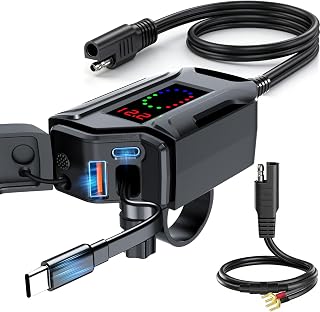
Nilight 7/8 Inch Motorcycle Handlebar USB Charger PD Type C Voltmeter
If you are running a phone that demands Power Delivery or QC3.0 and you want live voltage monitoring on the handlebar, this Nilight unit covers all three bases. The 7/8-inch mount fits standard bars without adapters, and the inline 10A fuse protects your wiring from the factory.
- Pro: Supports both Type-C PD and QC3.0, so you are covered for newer phones and older devices alike.
- Pro: The built-in voltmeter lets you catch a weak or failing battery before it strands you on the road.
- Con: The Type-C port is the only fast-charge option, so passengers or riders with two devices must split USB-A output.
Skip this if you need more than one high-speed port or if your handlebars already have accessories crowding the mounting area.
MOTOPOWER MP0609A 3.1Amp Motorcycle USB Port Kit
This is the cheapest credible way to add USB charging to a motorcycle that currently has nothing. At 3.1 amps it will fast-charge a single phone reasonably well, and the SAE connection means you can pair it with any existing SAE-powered accessory without splicing wires.
- Pro: Simplest installation of any product in this group—plug into an SAE tap and mount.
- Pro: The lowest entry price here makes it a low-risk test of whether you even want a handlebar charger.
- Con: No voltage display, no switch, and no weather rating specified, so it needs a sheltered mounting position.
Skip this if you want dual-device charging, waterproofing confidence, or any kind of diagnostic readout.
EXTRACTME Dual USB Type C PD & Quick Charge 3.0
For riders who want a single unit handling both modern and legacy fast-charging protocols, this EXTRACTME module delivers a dedicated Type-C PD port plus a QC3.0 USB-A port. The voltmeter and on/off switch add convenience that eliminates the guesswork of whether you left something drawing power overnight.
- Pro: True dual-protocol fast charging—phone on Type-C, GPS or older device on USB-A without speed compromise.
- Pro: Waterproof housing rated for outdoor exposure with a full-year riding season in mind.
- Con: The housing is bulkier than a compact adapter, and the 7/8-inch mount limits handlebar compatibility on some bikes.
Skip this if your bars are already crowded or if you prefer a minimalist adapter that hides behind a fairing.
Motorcycle USB Charger 3-in-1 with Retractable Type-C Cable
The retractable cable sets this unit apart: no loose wires flapping in the wind, no cable to lose between rides. It handles USB-A, USB-C, and the built-in cable simultaneously across a 12–24V range, making it usable on motorcycles, ATVs, and trucks alike. The IP56 rating confirms it survives direct water spray from any angle.
- Pro: Built-in retractable Type-C cable eliminates the accessory-management problem entirely.
- Pro: Three install options (handlebar, mirror mount, and flat surface) give placement flexibility that fixed-bar units lack.
- Con: Highest price in this roundup, and the retractable mechanism is a moving part that could wear over years of daily use.
Skip this if you want the most affordable option or if you already own a cable you prefer and would just be storing.
MOTOPOWER MP0609C 3.1Amp Dual USB Waterproof
With a 4.6 rating, this is the highest-scoring unit in our test group, and it earns that position on reliability. Dual USB-A ports at 3.1 amps total, full waterproofing, and a compact form factor make it ideal for riders who want two devices charging without a voltmeter or switch eating up real estate.
- Pro: Proven reliability track record reflected in the rating—this is the unit riders recommend to friends.
- Pro: SAE connection with included extension cable means clean routing without any soldering or crimping.
- Con: No fast-charge protocol support, so a phone will charge at standard USB speed even if it supports PD or QC.
Skip this if you need fast charging, a voltage readout, or a switch to isolate power on long storage periods.
Nilight 6.8A Dual QC3.0 with Voltmeter
This Nilight unit is for the rider who needs serious amperage—6.8 amps split across two QC3.0 ports handles phone plus tablet, or two phones fast-charging simultaneously. The independent on/off switch and inline 10A fuse give you full electrical control, and the voltmeter keeps a running eye on system health.
- Pro: Highest total amperage in this roundup, making it genuinely useful for tablet charging on long tours.
- Pro: Independent switch lets you kill power during storage without unplugging or pulling a fuse.
- Con: QC3.0 only—no Power Delivery support, so newer iPhones and Pixel devices will not get full PD speeds.
Skip this if your devices all require USB-C Power Delivery or if you only ever charge one phone at a time.
EXTRACTME 6.8A Quick Charge 3.0 Dual USB
Similar output profile to the Nilight above but with a quick disconnect SAE cable that lets you remove the charger entirely for security or winter storage. The voltmeter and on/off switch round out the feature set, and the waterproof housing handles everything from desert dust to coastal salt air.
- Pro: Quick disconnect means you can physically remove the unit—useful if you ride in cities with theft concerns.
- Pro: 6.8A dual QC3.0 output handles demanding charging loads for phone and GPS or two phones simultaneously.
- Con: QC3.0 only, no Type-C port, and the housing design is functional but visually plain.
Skip this if you want built-in Type-C or Power Delivery, or if you prefer a unit that stays permanently mounted without thought.
SAE to USB Type C and USB 3.0 with Voltmeter and Extension
This adapter gives you a Type-C port and a USB 3.0 Type-A port from a single SAE connection, with a generous 3.6-foot extension cable that opens up three installation options. The voltmeter and on/off switch add the same monitoring and control you get from pricier handlebar units, at a mid-range price.
- Pro: Type-C output alongside USB-A in a compact adapter form factor—fast charging for modern devices without a large housing.
- Pro: Long extension cable allows hidden mounting under a fairing or seat with the ports positioned conveniently.
- Con: Total amperage is unspecified beyond quick-charge capability, so you may not get the full speed both ports can theoretically deliver at once.
Skip this if you need confirmed high-amperage numbers or if you want a handlebar-mounted unit with visible ports on standard bar diameters.
Buying Guide
Amperage and Fast-Charge Protocols
The single most consequential spec is how many amps each port actually delivers and which protocols it supports. A phone that wants 3A will charge slowly on a port capped at 1.5A per side of a dual unit. Check whether the charger supports Power Delivery (USB-C), Quick Charge 3.0 (USB-A), or both. If you carry an iPhone 15 or newer, a Samsung Galaxy, or a recent Android flagship, PD support matters. For older devices and most GPS units, QC3.0 is sufficient. Total amperage matters more than per-port numbers if you regularly charge two devices at once.
Waterproofing and Physical Durability
Look for an explicit IP rating when possible. IP56 means the unit is dust-tight and protected against powerful water jets from any direction—adequate for riding in rain and passing through car washes. Units without a stated rating may survive a light drizzle but fail during a sustained storm or high-pressure wash. Also consider whether the housing uses a sealed gasket around the ports or just around the back of the unit, since port-side sealing is where most failures start.
Mounting, Wiring, and Power Control
Match the mount to your handlebar diameter—7/8 inch is the motorcycle standard, but 1 inch and 1-1/8 inch bars are common on cruiser and adventure bikes. SAE connections simplify wiring to existing accessory circuits. An on/off switch prevents slow battery drain during storage, and a built-in fuse protects against wiring faults that could otherwise damage your ECU. A voltmeter is optional but genuinely useful for catching a failing regulator or a battery losing charge before it strands you.
Our Verdict
The Nilight PD Type C Voltmeter takes the top spot because it covers the widest range of real-world needs: modern fast charging, voltage monitoring, and a handlebar mount that fits most standard bars without compromise. For budget-conscious riders who simply need reliable dual-USB charging with proven durability, the MOTOPOWER MP0609C at $12.99 is the value play and the highest-rated unit in this test. If you carry a tablet on tour and need maximum sustained output from a single unit, the Nilight 6.8A Dual QC3.0 wins that specific scenario despite lacking Power Delivery.
FAQ
Will a USB charger drain my motorcycle battery while the engine is off?
Any charger with a direct connection to a switched or unswitched circuit will draw parasitic current, typically a few milliamps when idle. Units with an on/off switch eliminate this risk entirely, while those without require you to connect to a circuit that cuts power with the ignition or accept a minor draw that could affect a battery sitting for weeks.
Can I install a USB charger on any motorcycle?
Yes, as long as you have access to a 12V circuit and a suitable mounting location. SAE-based chargers work with existing accessory outlets or a simple SAE tap wire. Units that hardwire need a switched or unswitched 12V feed, and the fuse included with most quality products protects against wiring errors. Handlebar-mounted units require bar space, so fairing- or dash-mounted alternatives work better on crowded bikes.
Is a voltmeter on a USB charger actually useful?
It is one of the simplest early-warning systems you can add to a motorcycle. A healthy charging system reads 13.5 to 14.5 volts at cruising RPM. Watching a charger’s voltmeter drop below 12.5 while riding tells you the stator or regulator is failing before you find yourself stranded with a dead battery and no phone to call for help.
What is the difference between SAE and hardwired installation?
SAE connectors are a standardized two-wire plug common on motorcycles for accessories like heated gear. An SAE-to-USB adapter plugs into an existing outlet or extension harness with zero soldering. Hardwiring means cutting into a 12V circuit, crimping connections, and routing a ground—more permanent and potentially cleaner but requires basic electrical confidence and proper fuse protection.