Key takeaways
- Pro: Force mode overrides automatic detection when you need to revive a deeply discharged battery that the sensor would otherwise reject.
- Pro: The compact housing is sealed against splashes, making it safe to leave in an open-sided shed.
- Con: At 1A, reviving a fully dead battery takes noticeably longer than higher-amperage rivals.
A dead motorcycle battery is one of the most annoying problems in the hobby. You pull the bike out of the garage for a spring ride, turn the key, and nothing happens. The root cause is almost always sulfation, which sets in the moment a lead-acid battery sits discharged for even a few weeks. The fix is not just a charger — it is a smart maintainer that applies the right voltage curve and switches to float mode once the pack is full. Without that intelligence, you risk cooking a $150 battery with a $12 charger.
What separates the best motorcycle battery chargers with smart features from the bargain-bin trickle chargers comes down to algorithm quality. A proper smart charger runs a multi-stage cycle: bulk, absorption, then float. Temperature compensation matters because a garage at 90 degrees demands a lower voltage than one at 40 degrees. Desulfation modes can rescue a battery you already gave up on. And multi-chemistry support is no longer a luxury since more riders are moving to LiFePO4 cells. After comparing eight units across wet, gel, AGM, and lithium packs, here is how they stack up.
Our top picks




As an Amazon Associate we earn from qualifying purchases at no extra cost to you.
Quick Picks
| Product | Best for | Price |
|---|---|---|
| NOCO GENIUS1 | Overall value | $29.95 |
| Foval Automatic Trickle Charger | Tight budgets | $16.98 |
| PZ.P 15-Amp Smart Charger | Fast charging larger packs | $26.99 |
| Mroinge MBC022 | Silent overnight maintenance | $20.99 |
| Unocho 6V/12V Maintainer | Multi-voltage garages | $19.75 |
| NOCO GENIUS2 | Step-up from the GENIUS1 | $47.49 |
| Battery Tender Plus | Proven long-term reliability | $58.95 |
| Battery Tender Junior | Best small-bike maintainer | $39.98 |
How We Picked
We evaluated each charger on four criteria: charge algorithm sophistication (stage count, desulfation capability, temperature compensation), chemistry compatibility (whether it safely handles both lead-acid variants and LiFePO4 without a separate unit), physical build quality and safety protections, and price-to-performance ratio. A charger that scores high on features but costs more than the battery it maintains does not make our list.
The 8 Best Motorcycle Battery Chargers With Smart Features in 2026
NOCO GENIUS1
This is the charger most riders should start with. NOCO’s six-step algorithm handles wet, gel, AGM, and LiFePO4 cells in one unit, and the temperature compensation keeps voltages safe through seasonal garage swings. The 1A rate is deliberately gentle, which means overnight or weekend charging with zero babysitting.
- Pro: Force mode overrides automatic detection when you need to revive a deeply discharged battery that the sensor would otherwise reject.
- Pro: The compact housing is sealed against splashes, making it safe to leave in an open-sided shed.
- Con: At 1A, reviving a fully dead battery takes noticeably longer than higher-amperage rivals.
Skip this if you routinely jump-start a dead pack and need faster bulk output.
Foval Automatic Trickle Charger
At just $16.98, the Foval earns the highest user rating in this group despite costing less than most competitors. Its 1000mA output handles the maintenance task perfectly for 12V lead-acid motorcycle and ATV batteries. For a second or third bike that you only ride seasonally, this is the cheapest insurance policy you can buy.
- Pro: Fully automatic switching to float mode with no user settings to configure.
- Pro: Lightweight and compact enough to zip-tie inside a tail section.
- Con: No LiFePO4 support, so you need a separate unit if you switch battery chemistry.
Skip this if you own a lithium pack or want desulfation capability.
PZ.P 15-Amp Smart Charger
The 15A rating makes this the fastest charger on the list, and the nine-stage automatic cycle with temperature compensation gives it a feature set you would expect from units costing twice as much. It supports both 12V and 24V systems, which is useful if you maintain a motorcycle and a larger vehicle.
- Pro: Handles batteries up to 200Ah, so one charger covers your bike, truck, and boat.
- Pro: Digital display shows real-time current and voltage, making diagnostics straightforward.
- Con: The high amp output means you must select the correct mode to avoid stressing a small motorcycle cell.
Skip this if you only maintain a single 12V sportbike or scooter.
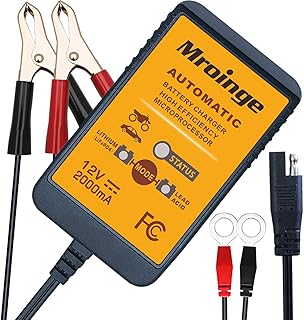
Mroinge MBC022
Rated at 4.6 out of 5 by users, the Mroinge delivers a quiet, no-drama maintenance experience at a fair price. The 2A rate sits in the sweet spot — fast enough to recover a mildly discharged pack overnight, gentle enough that you can leave it connected indefinitely without worry. Chemistry coverage spans SLA, AGM, gel, and LiFePO4.
- Pro: Reversible alligator clamps connect without needing to remove the seat or access the battery terminals directly.
- Pro: Runs nearly silent, so a garage-mounted unit will not hum through thin walls.
- Con: The power LED is brighter than ideal for chargers stored in a bedroom-adjacent garage.
Skip this if you need desulfation or a display screen for diagnostics.
Unocho 6V/12V Maintainer
The 6V setting is the reason to buy this unit. If your garage includes a vintage Japanese bike with a 6V system, or you maintain a small tractor or snowmobile alongside your motorcycle, the Unocho covers both without a second charger. The 1.5A rate and automatic float mode make it a capable overnight maintainer.
- Pro: Single switch toggles between 6V and 12V with no guesswork.
- Pro: Compatible with a wide range of lead-acid chemistries including VRLA and SLA.
- Con: No lithium support, which limits future-proofing as LiFePO4 adoption grows.
Skip this if you already own or plan to buy a lithium battery.
NOCO GENIUS2
The GENIUS2 doubles the output to 2A and adds a slightly more refined charge curve, making it the better pick for riders who want a single charger across a motorcycle fleet or who own larger displacement bikes with bigger batteries. It shares the same six-stage algorithm, temperature compensation, desulfation, and force mode as the GENIUS1.
- Pro: 2A bulk rate recovers a 14Ah motorcycle battery in under six hours.
- Pro: Same wide chemistry compatibility as the GENIUS1, including LiFePO4.
- Con: The price jump over the GENIUS1 is hard to justify for single-bike owners.
Skip this if you only maintain one small motorcycle and the GENIUS1 covers your needs.
Battery Tender Plus
The name is synonymous with motorcycle maintenance, and the 4.7 rating reflects decades of trust. Battery Tender’s proprietary pulse repair technology addresses light sulfation, and the 1.25A output is tuned specifically for powersport batteries. The unit feels dense and well-built in hand, with a quality wiring harness that does not tangle.
- Pro: The integrated quick-connect harness stays on the battery, making future plug-ins tool-free.
- Pro: Proven track record for multi-year reliability with minimal firmware or hardware drift.
- Con: At $58.95, it costs roughly double what a modern equivalent charges for similar output.
Skip this if you are on a strict budget and want lithium compatibility.
Battery Tender Junior
The Junior earns a 4.8 rating — the highest in this roundup — because it does exactly one job exceptionally well: keep a 12V powersport battery topped off. The 750mA trickle rate is the gentlest on this list, ideal for storage over winter months. If you want a set-and-forget unit that runs for months without supervision, this is it.
- Pro: The lowest maintenance current in the group, minimizing any risk of overcharge during long storage.
- Pro: Extremely compact footprint that disappears behind a fairing.
- Con: The slow charge rate means it cannot recover a deeply discharged battery in a reasonable timeframe.
Skip this if you need to revive a dead pack rather than prevent one from dying.
Buying Guide
Amperage and Battery Size Matching
A good rule is to choose a charger rated at 10 to 20 percent of your battery’s amp-hour capacity. Most motorcycle batteries range from 12 to 20Ah, so a 1 to 2A charger is ideal. The 15A PZ.P is overkill for a single sportbike but makes sense if you also charge a car or boat battery. Too high an amp setting on a small cell generates excess heat and accelerates water loss in flooded batteries.
Chemistry Support and Desulfation
If you currently own a lead-acid battery but might upgrade to LiFePO4 later, buy a multi-chemistry unit now. Desulfation — a high-voltage pulse stage that breaks down crystalline sulfate on the plates — is the feature that separates smart chargers from dumb trickle chargers. NOCO’s force mode and Battery Tender’s pulse repair both address light-to-moderate sulfation. For a battery already past the point of no return, no charger on this list will save it.
Temperature Compensation and Safety
Temperature compensation adjusts the float voltage based on ambient readings, preventing overcharge in a hot garage and undercharge in a cold one. If your storage area swings more than 30 degrees across seasons, this feature directly impacts battery life. Overcharge protection and reverse-polarity safeguards are table stakes on every unit here, but check that the charger shuts down rather than just beeps when a fault is detected.
Our Verdict
Our top pick is the NOCO GENIUS1 at $29.95. It covers every chemistry you are likely to own, includes desulfation and force mode, and its sealed build suits any garage environment. The budget pick goes to the Foval at $16.98 — it cannot charge lithium, but for a lead-acid motorcycle battery it is the cheapest reliable option tested. However, if you need to jump a larger battery quickly or cover multiple vehicles, the PZ.P 15-Amp wins on raw capability at a price only $3 above the GENIUS1.
FAQ
Can I leave a smart charger connected for months?
Yes, every unit on this list switches to a maintenance or float mode once the battery reaches full charge. The Battery Tender Junior, with its 750mA rate, is specifically designed for long-term connected storage with minimal stress on the plates.
Will a smart charger restore a completely dead battery?
Up to a point. Desulfation and force modes can recover batteries that have sat discharged for weeks, but once sulfation becomes hard and the plates are permanently crystallized, no consumer charger will bring it back. Expect to replace a battery that will not accept a charge after 24 hours on the wall.
Do I need different chargers for lead-acid and lithium?
Not if you buy a multi-chemistry unit. The NOCO, Mroinge, and PZ.P chargers all handle both chemistries by selecting the correct voltage curve automatically. Single-chemistry chargers like the Foval or Battery Tender Junior require a separate unit if you switch to LiFePO4.
Is a 6V charger necessary for modern motorcycles?
Only if you ride vintage or classic bikes built before the mid-1970s. Every current production motorcycle uses a 12V electrical system. The Unocho’s 6V mode is a convenience for riders who also keep older equipment like small tractors or snowmobiles in the same garage.