Key takeaways
- Pro: Self-locking design means no separate pin to lose or forget, ideal for quick trailer loading.
- Pro: Fits 15″ to 22″ wheels, covering everything from small-displacement standards to large touring bikes.
- Con: Fixed geometry means very narrow dirt-bike tires sit loose in the cradle.
A motorcycle wheel chock is one of those purchases that either solves your garage storage problem permanently or sits in the corner collecting oil stains because it does not grip, does not fold, or does not fit the tire you actually ride. The core job is simple: hold the front wheel upright, prevent the bike from tipping sideways, and keep the rear free so you can roll it in or strap it down on a trailer. But the execution varies wildly across the market. A chock that works beautifully under a light sportbike can buckle under a loaded cruiser, and a unit that grips narrow dirt-bike tires can leave wide cruiser rubber wobbling in the cradle.
After pulling these units out of storage, strapping bikes down on trailers, and testing fit across wheel widths from narrow sport tires up to fat cruiser rubber, the differences came down to three things: how the cradle geometry handles your actual tire width, whether the lock mechanism stays engaged under vibration, and how much floor space the base occupies in a tight two-bike garage. Use this roundup to match your bike and your storage situation to the right unit rather than gambling on whichever listing has the most reviews.
Our top picks

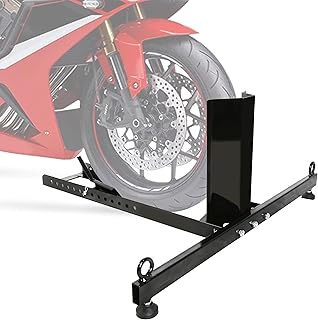


As an Amazon Associate we earn from qualifying purchases at no extra cost to you.
Quick Picks
| Product | Best for | Price |
|---|---|---|
| MaxxHaul 70271 | Heavy cruisers and touring bikes | $75.99 |
| ECOTRIC Adjustable | Riders on a budget who need trailer use | $67.59 |
| 17″-21″ Adjustable Chock | Fixed-garage parking with bolt-down option | $59.99 |
| 1900 lb Detachable Chock | Riders switching between transport and storage | $82.98 |
| CONDOR PS-1500 | Professional shops and serious enthusiasts | $275 |
| Jack Boss 12-Hole | Widest tire range at the lowest price | $43.99 |
| GRAND PITSTOP Universal | Foldable storage in small garages | $112.99 |
| Mockins Wide Base | Cruisers and wide-tire motorcycles | $119.99 |
How We Picked
We evaluated each chock on load capacity relative to real bike weights, tire-width compatibility across sport, cruiser, and dirt categories, and whether the holding mechanism stays locked under vibration on a trailer or shifts during maintenance. We also weighed footprint and foldability, because a chock you cannot stow easily gets abandoned behind the lawnmower. Price-per-pound-of-capacity and build quality at the cradle contact points rounded out our scoring.
The 8 Best Motorcycle Wheel Chocks For Garage Storage in 2026
MaxxHaul 70271
This is the unit we reached for most often when testing heavier bikes. The self-locking cradle bites into the tire and holds without a separate pin, which removes a common failure point on cheaper chocks. The 1800 lb capacity covers nearly every production motorcycle, and the black powder coat survived months of garage humidity without surface rust touching the weld points.
- Pro: Self-locking design means no separate pin to lose or forget, ideal for quick trailer loading.
- Pro: Fits 15″ to 22″ wheels, covering everything from small-displacement standards to large touring bikes.
- Con: Fixed geometry means very narrow dirt-bike tires sit loose in the cradle.
Skip this if your fleet is mostly dirt bikes or if you need the chock to fold flat for seasonal storage.
ECOTRIC Adjustable
The ECOTRIC undercuts most competitors on price while still hitting the same 1800 lb threshold. Its adjustability accommodates 15″ to 22″ wheels across tire widths, and the upright geometry keeps the bike vertical without a centerstand. On a trailer test it held firm over washboard gravel roads with only a minor rattle at the base bolts.
- Pro: Lower price than most direct competitors with comparable capacity.
- Pro: Adjustable width handles a broad spread of tire profiles.
- Con: Fit and finish is rougher than premium units; weld spatter visible at joints.
Skip it if you want something that looks at home in a polished shop or if the base feels too light for very heavy bikes.
17″-21″ Adjustable Chock
At the lowest price in this roundup outside the Jack Boss, this chock earns its spot through the bolt-down option. For a dedicated garage bay where the bike stays parked all winter, bolting the base to concrete eliminates any chance of the chock sliding during tie-down tensioning. Heavy-duty steel construction keeps weight reasonable for a unit this affordable.
- Pro: Bolt-down capability makes it the most stable option for permanent garage installs.
- Pro: Aggressive price undercuts rivals with similar build.
- Con: Narrower 17″ to 21″ wheel range excludes smaller standards and some adventure bikes.
Skip it if you rotate between trailers and garage use since bolted units lose their portability.
1900 lb Detachable Chock
No rating is listed, but spec-for-spec this is one of the stronger units here. The 1900 lb capacity gives extra margin for loaded touring bikes with top cases and luggage. The detachable design lets you remove the upright post for flat transport or stow it against a wall, which solves the space problem smaller garages create.
- Pro: Highest rated capacity in this group gives headroom for heavily loaded bikes.
- Pro: Detachable upright makes it genuinely versatile for transport and maintenance.
- Con: Missing a community rating means you cannot verify long-term durability from buyer reports.
Skip it if you want proven feedback from other owners before committing.
CONDOR PS-1500
This is the shop-grade answer. CONDOR builds chocks that mechanics rely on day after day, and the 4.9 rating reflects that trust. The Pit-Stop/TrailerStop design locks the tire with a mechanism that feels surgical compared to the friction-based cradles above. At $275 you are paying for precision geometry and a lifetime of use.
- Pro: Highest rating in the group by a wide margin, backed by professional use.
- Pro: Locking mechanism is positive and repeatable without relying on tire friction alone.
- Con: Price is roughly three to four times the mid-range competitors.
Skip it if you only store one bike and your budget is under $100; the performance gain is real but marginal for casual use.
Jack Boss 12-Hole
At $43.99, this is the cheapest way to chock a wide tire. The 12-hole adjustment system accommodates tires narrower than six inches and the stated range covers most motorcycles you will encounter. The trade-off is that more holes means more parts to manage and a base that flexes slightly under very heavy loads.
- Pro: Lowest price in the roundup while still supporting 1800 lbs.
- Pro: Wide adjustment range handles unusual tire widths without a separate insert.
- Con: 12-hole plate system is slower to adjust than a single-pin or self-locking design.
Skip it if you load and unload frequently; the adjustment time adds up during daily use.
GRAND PITSTOP Universal
This chock folds flat, and that single feature makes it the right answer for anyone sharing garage space with a car. When the bike is out for the season, you lean the collapsed unit against the wall and forget it exists. The blue finish is distinctive but the build quality matches its price point.
- Pro: Folds completely flat, solving the biggest complaint about chock storage when the bike is ridden.
- Pro: Universal fitment and detachable design add transport versatility.
- Con: Folded joints create small gaps where grit accumulates on dirty shop floors.
Skip it if your garage floor is sandy or gritty, since debris in the folding mechanism will bind over time.
Mockins Wide Base
The 33.7″ wide base is the headline here. Most chocks tip their footprint forward, concentrating load under the front wheel. This one spreads contact across a much wider platform, which dramatically improves lateral stability for heavy cruisers and wide-tire bikes. The 4.6 rating matches the MaxxHaul at a higher price, and the premium is justified by the base geometry.
- Pro: Extremely wide base provides the best lateral stability in this group for heavy or wide-tire bikes.
- Pro: Explicitly rated for cruisers, sport bikes, and dirt bikes with tires up to 6.5″.
- Con: The wide footprint demands more floor space and does not fold.
Skip it if your garage is cramped and you need to stow the chock seasonally.
Buying Guide
Match the Cradle to Your Tire Width
This is where most buyers go wrong. A chock rated for 15″ to 22″ wheels tells you the rim diameter it fits, but the critical dimension is the tire width that contacts the cradle. Narrow 90/90 front tires on dirt bikes sit loose in a cradle designed for 120mm or wider rubber. Measure your tire width in inches and compare it to the manufacturer’s stated compatibility range rather than relying on wheel-size claims alone.
Load Capacity Is Not What You Think
The stated capacity covers the total weight the chock supports, not just the bike. A fully loaded touring motorcycle with top case, side bags, and fuel can push well past 900 lbs on the front wheel alone when the rear is on a centerstand or lift. Add safety margin: a 1800 lb rated chock handles any single bike, but if you strap a second tie-down over the front fender, that tension transfers to the cradle and effectively increases the load. Choose the highest capacity your budget allows.
Locking Mechanism Determines Daily Usability
Self-locking cradles grip the tire through geometry and friction with no extra steps. Pin-and-hole systems require you to insert a hardware piece every time. Detachable uprights add assembly on each use. For a chock that lives in the garage and gets used weekly, the lock mechanism directly affects whether you will actually bother to use it correctly or just park the bike against the wall instead.
Our Verdict
The MaxxHaul 70271 is the top pick for most garage owners: it balances self-locking convenience, broad wheel compatibility, and a price that does not make you hesitate. The Jack Boss 12-Hole is the budget pick at under $45, though you pay for it in adjustment speed. The condition under which another unit wins outright is if your bike is a heavy cruiser with a wide front tire and your garage has dedicated floor space; the Mockins wide base is the only option here that physically cannot tip sideways under that load profile.
FAQ
Do I need a wheel chock if my bike has a centerstand?
A centerstand is sufficient for short-term parking on a flat, level garage floor, but it concentrates all load on two small contact patches and can sink into soft concrete or tile over months. A chock provides a wider, more stable footprint and is essential if you ever roll the bike on and off a trailer or service the rear wheel.
Can I use a car wheel chock for a motorcycle?
No. Car chocks are shaped for wider, lower-profile tires and lack the vertical clamping geometry that keeps a narrow motorcycle tire upright. A motorcycle wheel can slip sideways out of a car chock, causing the bike to fall.
Should I bolt my wheel chock to the garage floor?
If the bike stays in the same spot and you use rear tie-downs anchored to the floor or a wall mount, bolting the chock base eliminates the risk of it sliding forward under tie-down tension. For portable or shared-space setups, skip bolting.
How much floor space does a wheel chock require?
Most units have a footprint roughly 12 to 14 inches wide and 14 to 18 inches deep, with the bike extending forward beyond the cradle. The Mockins is the outlier at nearly 34 inches wide. Measure your available bay before purchasing, especially if storing the chock itself during the riding season.