Key takeaways
- Typing with long nails is easier on flat, low-profile chiclet keys with short travel. We break down the key design that matters and one verified full-size pick.
Typing with long nails changes the geometry of every keystroke. Instead of pressing a key with the flat pad of your fingertip, the nail reaches the key first, and on a tall, sculpted keycap that usually means one of three things: the nail slides off the edge of the cap, it catches on the raised rim of the neighboring key, or it strikes two keys at once. The result is a stream of typos, broken rhythm, and — for anyone who types for a living — sore fingertips by the end of the day. The fix is not a special “nail keyboard.” No major manufacturer markets a keyboard specifically for long nails, and you should be skeptical of any listing that claims otherwise. The fix is key design: flat, low-profile chiclet keys with short travel sit low in the frame, present a wide, level landing surface, and need only a shallow press to register. That combination is what this guide is built around.
Below, we explain exactly which published specifications matter for nail-friendly typing, then walk through one full-size wireless keyboard whose manufacturer-published key design matches that profile: low-profile chiclet keys with 2.5 mm of key travel. We are careful throughout to separate what the product page actually states from the reasoning we apply to it. The key-design argument is ours, based on the published specifications; the manufacturer does not claim this keyboard is made for long nails, and neither do we claim it does on their behalf.
As an Amazon Associate, we earn from qualifying purchases.
Quick answer
If you type with long nails, look for a keyboard whose product page publishes low-profile chiclet keys and short key travel — flat, widely spaced caps that sit close to the frame and register with a shallow press. The verified pick in this guide is the HP 230 Wireless Keyboard, a full-size board with low-profile chiclet keys, 2.5 mm key travel per the manufacturer’s comparison data, 105 keys including a number pad, and 2.4 GHz wireless with up to 16 months of battery life. It is a single-product recommendation because it is the only keyboard in this round of verification whose opened product page published the low-profile chiclet design this keyword depends on.
Key takeaways
- Key shape matters more than switch type for nail typists: flat chiclet caps give the nail a level surface instead of a curved, dished one.
- Short travel (around 2.5 mm) means the key registers before your fingertip has to press deep between raised key rims.
- Low-profile keys sit closer to the keyboard frame, so nails are less likely to catch on the edge of the row above.
- The HP 230’s page publishes low-profile chiclet keys and quiet keystrokes, but it makes no long-nails claim — the fit argument here rests on the published key design, not on marketing.
- Full-size layout still matters: the HP 230 keeps 105 keys, a number pad, and a full F1–F12 row, so you do not trade layout for comfort.
- Wireless range is published at up to 32.8 ft (10 m) via a USB-A receiver, and the two required AAA batteries are included in the box.
The pick
HP 230 Wireless Keyboard (B09W2SV2JD)
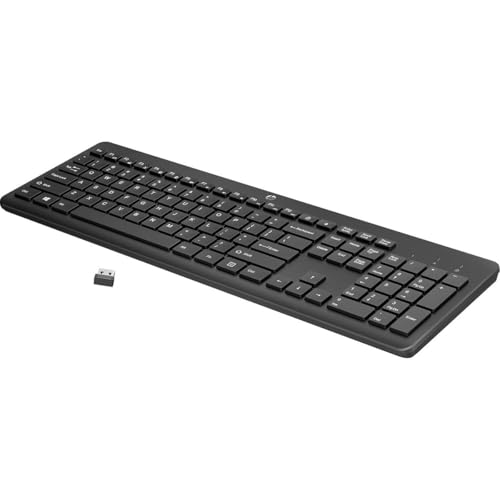
The HP 230 Wireless Keyboard is a full-size wireless board built around low-profile chiclet keys — the flat, separated, island-style keys familiar from laptop keyboards. The manufacturer’s description describes “full-sized, low-profile chiclet keys” designed to type “without the distracting keystroke clicks,” and the model’s comparison data lists key travel at 2.5 mm. For a typist with long nails, that published design is the relevant part of the specification sheet. A flat chiclet cap does not have the tall, sculpted walls of a traditional desktop keycap, so a nail landing slightly off-center meets a level surface rather than a curved slope that pushes it toward the gap between keys. The shallow 2.5 mm travel also means the keystroke completes with a short press, so your fingertip does not have to drive down into the well between keys — the motion that most often ends with a nail striking the edge of the adjacent cap.
The rest of the published specification describes a straightforward, full-size office keyboard. It carries 105 keys with an integrated number pad and a full row of F1–F12 shortcut keys, so spreadsheet work, data entry, and shortcut-heavy applications lose nothing compared with a standard desktop board. It connects over 2.4 GHz wireless through a USB-A receiver with a published range of up to 32.8 ft (10 m), runs on two AAA batteries that are included in the box, and is rated by the manufacturer for up to 16 months of battery life. It is compatible with both Windows and Mac systems and weighs 1.1 lb, light enough to move between a desk and a laptop bag without feeling flimsy on the desk. To be clear about the framing once more: HP publishes the low-profile chiclet design and the quiet keystrokes; the conclusion that this design suits long nails is an inference from those published facts, drawn because flat caps and short travel directly address the ways nails interfere with typing.
Specs
- Key design: low-profile chiclet keys, full-size layout
- Key travel: 2.5 mm (per manufacturer comparison data)
- Keys: 105, with integrated number pad and full F1–F12 shortcut row
- Connection: 2.4 GHz wireless via USB-A receiver
- Wireless range: up to 32.8 ft (10 m)
- Battery: 2 × AAA (included); up to 16 months of battery life
- Compatibility: Windows and Mac
- Weight: 1.1 lb
- Model: 3L1E7AA#ABA
- In the box: keyboard, receiver, 2 × AAA batteries, quick start guide, warranty card
See the HP 230 Wireless Keyboard on Amazon
How to choose a keyboard when you type with long nails
Start with keycap shape. Chiclet keys — flat, separated, island-style caps — are the single most helpful design feature. Traditional desktop keycaps are tall and often sculpted or dished, which guides a fingertip into the center of the cap but gives a long nail nothing stable to land on. A flat chiclet cap accepts the nail at almost any angle. When you read a product page, look for the words “low-profile” and “chiclet” in the manufacturer’s own description, not in a headline written by a third-party seller.
Check key travel. Travel is the distance a key moves before the keystroke registers. Short travel — around 2 to 2.5 mm — means the press finishes quickly, with your fingertip staying high above the frame. Tall mechanical switches with 4 mm of travel ask for a deeper press, which is exactly when nails start clipping neighboring caps. If a page does not publish travel at all, treat the nail-friendliness of that board as unknown rather than assumed.
Mind the height of the key profile. Low-profile keys sit closer to the deck, reducing the “wall” your nail has to clear when reaching for the row above. This is also why many nail typists get along well with laptop keyboards and struggle when they move to a tall desktop board: the laptop’s keys are nearly flush with the surface around them.
Consider spacing and layout. Full-size chiclet boards space their flat caps with small, even gaps, and the key tops are wide relative to those gaps, which lowers the chance of a nail slipping between two keys. If you do heavy numeric entry, keep the number pad — comfort changes should not cost you layout features you use daily, and the pick in this guide keeps all 105 keys.
Decide on connection and power honestly. Wireless boards trade a receiver or Bluetooth pairing for a clean desk; check the published range and battery arrangement. A board that runs for months on a pair of AAA batteries, with the batteries included, is simpler to live with than one that needs frequent recharging — but confirm the battery type and count from the specification field, since comparison tables and headlines sometimes disagree with the detailed specs.
Be skeptical of “for long nails” marketing. No verified product page in our research for this guide claimed a keyboard was designed for long nails. When a listing leans on that phrase without publishing low-profile keys, chiclet caps, or short travel, the claim is decoration. Buy the published design, not the slogan.
Who should skip this pick
Skip the HP 230 if you want a mechanical keyboard. Its chiclet keys are a membrane-style laptop-type design, and typists who specifically want tactile mechanical switches, swappable keycaps, or per-key backlighting will not find them here. Skip it if you need Bluetooth: the published connection is 2.4 GHz through a USB-A receiver, so devices without a free USB-A port — many thin tablets and some modern laptops — are not a natural fit. Skip it if you type in the dark and need illuminated keys, since no backlighting is published for this model. And skip it if your nails are short and you simply prefer tall, sculpted keycaps: the flat, shallow typing feel that helps nail typists can feel imprecise to someone used to deep, contoured keys. Finally, if you want a keyboard and mouse set, note that this listing is keyboard-only — the box contents list the keyboard, receiver, batteries, quick start guide, and warranty card, with no mouse included.
FAQ
Does HP market the 230 Wireless Keyboard for long nails?
No. The product page publishes low-profile chiclet keys, 2.5 mm key travel, and quiet keystrokes, but it makes no claim about long nails. This guide recommends it because that published key design — flat caps and short travel — addresses the specific problems long nails cause on tall, sculpted keycaps. The reasoning is ours; the specifications are the manufacturer’s.
Why do flat chiclet keys help with long nails?
A long nail reaches the key before the fingertip pad does. On a tall, dished keycap, the nail lands on a slope and tends to slide toward the edge or catch the rim of the next key. A flat chiclet cap gives the nail a level surface, and short travel means the keystroke registers with a shallow press, so the fingertip never has to push down between raised caps. Wider, evenly spaced flat caps also reduce the chance of pressing two keys at once.
Is the HP 230 a keyboard-and-mouse combo?
No. Although the listing sits under a family heading that mentions a mouse and keyboard combo, this model’s own box contents are keyboard-only: the keyboard, the USB-A receiver, two AAA batteries, a quick start guide, and a warranty card. If you need a mouse, you will have to add one separately.
How long does the battery last, and what does it use?
The manufacturer rates the keyboard for up to 16 months of battery life. It runs on two AAA batteries, and both are included in the box according to the specification field and the contents list. Battery life in practice depends on how heavily you type, but the published figure means battery changes should be a rare chore rather than a routine one.
Final verdict
For typing with long nails, the specifications that matter are published key design, not marketing language: flat, low-profile chiclet caps and short travel. The HP 230 Wireless Keyboard is the one keyboard in this verification round whose opened product page publishes exactly that design — low-profile chiclet keys with 2.5 mm travel — while keeping a full 105-key layout, a number pad, 2.4 GHz wireless out to 32.8 ft, and up to 16 months of battery life from the included AAA pair. It is not a mechanical board, it is not backlit, and it is not sold as a combo, so readers who need those features should look elsewhere. But if your daily frustration is nails sliding off tall keycaps and clipping the row above, a full-size board built on flat, shallow keys is the right shape of solution, and this is the verified option that fits it.
Product and ASIN Reference
| Product | ASIN | Key design | Connection | Battery |
|---|---|---|---|---|
| HP 230 Wireless Keyboard | B09W2SV2JD | Low-profile chiclet, 2.5 mm travel | 2.4 GHz via USB-A receiver | 2 × AAA (included), up to 16 months |
More from Amazon
Programs that pair well with the guide above. Offers and eligibility are set by Amazon and may change.
Free shipping on eligible items, Prime Video and more. Eligible new members can start with a free trial.
Start a Prime free trialA Prime membership for ages 18-24 with a trial period. Eligibility is set by Amazon.
See Prime for Young AdultsAudiobooks and podcasts to listen to on the go. Eligible new members can start with a free trial.
Try Audible freeAd-free music streaming. Eligible new subscribers can start with a free trial.
Try Music Unlimited freeAs an Amazon Associate we earn from qualifying purchases.