Key takeaways
- For a small room or rental: Choose a door-hanging organizer if the door is sturdy and its hinges can support the added load. Confirm the over-door brackets won’t prevent the door from closing. If hanging necklaces is the priority, choose hooks over pockets; pockets are more useful for small accessories.
- For a modest everyday collection: A compact freestanding cabinet is a balanced choice. Favor a layout with ring slots, divided shallow drawers, and a handful of necklace hooks rather than paying for unused height.
- For mixed jewelry and a full-length mirror: Consider a mirror armoire with adjustable shelves or removable dividers. Check that the mirror is glass or clearly identified as another material, and inspect the hinge and frame construction; the mirror adds weight and puts extra strain on the door.
- For a growing or extensive collection: A wider chest with several drawer depths is generally more useful than a tall cabinet filled with identical shallow drawers. Leave some capacity spare so new pieces do not end up piled together.
- For higher-value pieces: Look for a keyed lock, a rigid cabinet body, reinforced hinges, and a stable mounting or anchoring option. Treat a jewelry armoire lock as a deterrent against casual access, not as a safe; it does not make the cabinet theft-proof.
Best Jewelry Armoires for Storage and Organization
The best jewelry armoires match your collection’s size and shape, give frequently worn pieces easy access, and have drawers and hardware sturdy enough for daily use. For most bedrooms, a freestanding wooden armoire with a locking upper cabinet, divided drawers, and a stable base is the most versatile choice; a door-hanging model suits a tight budget or small room, while a larger chest is better for extensive collections.
Choose by collection and room—not by drawer count alone
Capacity claims can be hard to compare: one maker may count ring slots, while another emphasizes drawers or hooks. Before shopping, sort your jewelry into practical groups: rings and studs, necklaces, bracelets and watches, and larger or delicate pieces. Measure the longest necklaces and the deepest jewelry box you own. Then check the interior dimensions and layout, not just the exterior height.
Our top picks


As an Amazon Associate we earn from qualifying purchases at no extra cost to you. Ratings are shown as listed on Amazon.
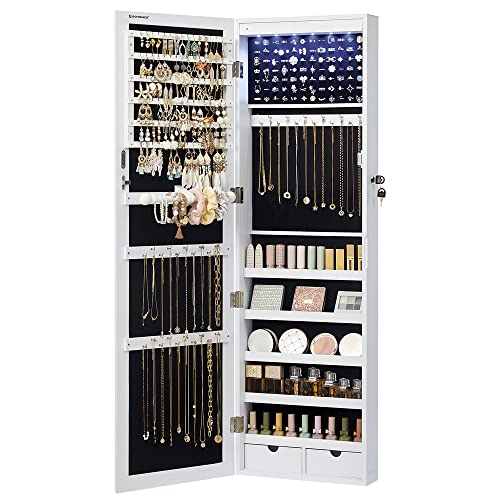
Necklace hooks help prevent chains from tangling, but only if they have enough spacing and hang freely when the cabinet door closes. A shallow divided drawer is useful for earrings and rings; an open, undivided drawer can swallow small pieces unless you add trays. For bulky bangles, watches, or statement jewelry, look for at least one deeper drawer or an open compartment.
What to look for: a practical comparison
The figures below are useful shopping ranges for common armoire formats, not specifications for a single product. Individual models vary, so verify dimensions, materials, and lock details before buying.
| Armoire type | Typical exterior size (H × W × D) | Typical weight | Storage layout | Best fit |
|---|---|---|---|---|
| Door-hanging organizer | About 30–45 × 14–20 × 3–5 in. | About 8–20 lb. | Hooks, small pockets or shallow trays; little room for bulky items | Small collections and rooms with limited floor space |
| Compact freestanding cabinet | About 36–48 × 14–20 × 10–16 in. | About 20–45 lb. | Several drawers, ring storage, and necklace hooks | Everyday jewelry in a bedroom or dressing area |
| Full-length mirror armoire | About 55–65 × 14–20 × 14–18 in. | About 35–70 lb. | Mirror door, hooks, trays, and multiple drawers | Medium-to-large collections where a mirror is useful |
| Large jewelry chest | About 40–55 × 24–36 × 14–20 in. | About 50–100 lb. | More and deeper drawers, with space for larger pieces | Extensive collections and a dedicated dressing space |
These dimensions describe the cabinet, not the clearance it needs. A door-mounted organizer needs room to swing without hitting a wall, and a hinged mirror cabinet needs space to open fully. Measure the route into the room, too: a large, heavy chest may be difficult to maneuver upstairs or through a narrow doorway.
Best picks by situation
- For a small room or rental: Choose a door-hanging organizer if the door is sturdy and its hinges can support the added load. Confirm the over-door brackets won’t prevent the door from closing. If hanging necklaces is the priority, choose hooks over pockets; pockets are more useful for small accessories.
- For a modest everyday collection: A compact freestanding cabinet is a balanced choice. Favor a layout with ring slots, divided shallow drawers, and a handful of necklace hooks rather than paying for unused height.
- For mixed jewelry and a full-length mirror: Consider a mirror armoire with adjustable shelves or removable dividers. Check that the mirror is glass or clearly identified as another material, and inspect the hinge and frame construction; the mirror adds weight and puts extra strain on the door.
- For a growing or extensive collection: A wider chest with several drawer depths is generally more useful than a tall cabinet filled with identical shallow drawers. Leave some capacity spare so new pieces do not end up piled together.
- For higher-value pieces: Look for a keyed lock, a rigid cabinet body, reinforced hinges, and a stable mounting or anchoring option. Treat a jewelry armoire lock as a deterrent against casual access, not as a safe; it does not make the cabinet theft-proof.
Security, finishes, and construction that hold up
Know what a lock can—and cannot—do
Some armoires lock only the main door; others include a locking drawer or compartment. Check which areas are secured and whether keys are included. A simple cam lock can discourage children or casual browsing, but a light cabinet can still be moved, and the lock may offer little resistance to forced entry. For valuables you could not easily replace, use a properly secured safe or another suitable storage option rather than relying on a furniture lock.
If an armoire will stand near a door, in a home with children, or in an earthquake-prone area, follow the manufacturer’s anchoring instructions. A tall, top-heavy cabinet can tip, especially when its door is open or several drawers are pulled out at once.
Finish durability depends on use and care
Wood veneer, solid wood, and engineered wood with a printed or painted finish can all work well as furniture. The practical differences are often at the edges and moving parts: veneer and decorative coatings can chip or lift after repeated impacts, while solid wood can dent or change slightly with swings in humidity. MDF and particleboard are susceptible to swelling if water reaches an unsealed edge. Ask what the frame, doors, and drawer bottoms are made from; “wood finish” alone does not establish that a cabinet is solid wood.
Look for smooth drawer runners, secure handle attachment, aligned doors, and finished interior surfaces that will not snag fabric or delicate chains. Soft lining helps reduce scratches, but it does not replace separate storage for pieces that tangle or abrade one another.
Keep the layout useful over time
Assign each drawer a job: rings and studs in divided trays, necklaces on individual hooks, and larger pieces in deeper compartments. Store pairs together, but avoid cramming hooks so tightly that chains overlap. For very fine chains, fasten the clasp before hanging; this can reduce tangling without putting stress on the chain. If the armoire lacks dividers, removable jewelry trays make it easier to reorganize without permanently altering the furniture.
Dust the exterior with a soft, dry cloth and follow the maker’s instructions for the specific finish. Avoid spraying cleaner directly onto wood, mirror edges, or lining: liquid can seep into joints or loosen adhesive. Keep the cabinet away from damp bathrooms and direct sunlight, which can damage some finishes and fade fabrics. Periodically check hinge screws, door alignment, and drawer runners; tightening a loose screw early can prevent the door from sagging or a drawer from binding.
Bottom line
For a compact, everyday collection, start with a compact freestanding armoire that combines divided drawers with necklace hooks. Choose a door-hanging organizer when floor space is the constraint, a mirror cabinet when the mirror and storage will both be used, and a wider chest for bulky or extensive collections. Before deciding, compare the internal layout, verify the cabinet’s dimensions and anchoring needs, and treat its lock as a privacy feature rather than high-security protection.