Key takeaways
- One verified floor jack publishes a full 24-inch maximum lift: the Sunex 6602LP 2-ton low-profile service jack, with a 2.75-inch minimum height and dual pumps.
Maximum lift height is the specification that decides whether a floor jack actually finishes the job. A jack that runs out of travel two inches short leaves a lifted truck’s frame rail below the top of your jack stands, and no amount of extra pumping fixes a saddle that has simply reached the end of its stroke. That is why a specific group of buyers — owners of lifted trucks and SUVs, and anyone who does suspension work that needs real clearance underneath — shops by one number first: a maximum lift height of 24 inches.
This guide is deliberately narrow. It covers only floor jacks whose published specifications state a maximum lifting height of 24 inches, and it is built around the one model we could verify against that figure on its own product page: the Sunex Tools 6602LP, a 2-ton low-profile steel service jack that pairs its 24-inch maximum with an unusually low 2.75-inch minimum height. Rather than pad the page with jacks that publish 18, 20, or 21 inches of lift and call them close enough, the article explains what the 6602LP’s published numbers mean in practice, and how to judge whether a full 24 inches of lift is what your work actually requires.
One caution applies to the whole category: maximum lift height is only meaningful when it comes from the manufacturer’s own specification for that exact model. Retail listings round numbers, copy figures between variants, and sometimes quote the height of a different jack in the same product line. The 24 inches credited to the 6602LP here is the figure Sunex itself publishes in the model’s spec table and repeats in its product bullets — the same standard any jack should be held to before its lift height is trusted with a vehicle in the air.
As an Amazon Associate, we earn from qualifying purchases.
Quick answer
The Sunex Tools 6602LP is the pick for a 24-inch-lift floor jack: its published specifications state a maximum lifting height of exactly 24 inches and a minimum height of 2.75 inches, with a 2-ton capacity, a steel chassis, and rapid-rise dual pump pistons that reach full height in 6.5 pumps. It is a low-profile service jack, so the same tool that slides under a lowered car still has the stroke to raise a tall frame rail high enough for stands and suspension work.
Key takeaways
- The 6602LP’s maximum lifting height is published as 24 inches — the full figure this guide is scoped to, not a rounded-up approximation.
- Its 2.75-inch minimum height makes it a genuine low-profile jack, so it fits under low cars as well as tall trucks.
- Capacity is 2 tons; lift height and capacity are separate limits, and both have to suit the vehicle.
- Rapid-rise dual pump pistons reach maximum height in 6.5 pumps, and the low-profile chassis is shaped for reach beyond pinch welds.
The pick
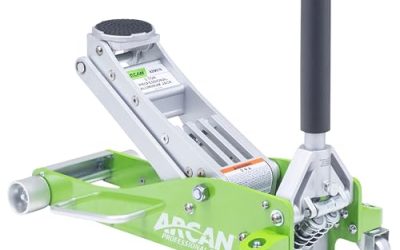
Sunex Tools 6602LP 2 Ton Low Rider Steel Service Jack
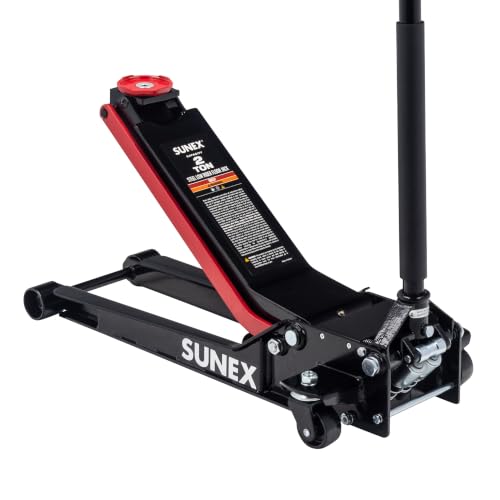
The 6602LP’s defining combination is range. At the bottom end, the saddle sits 2.75 inches off the floor, low enough to slide under the pinch welds and subframes of cars that a standard service jack cannot reach without first being driven onto boards. At the top end, the published maximum lifting height is 24 inches, which is the working room that matters when a vehicle sits tall to begin with: the higher the frame rail starts, the more stroke is left over for actually raising the vehicle once the saddle makes contact. A jack with a tall maximum but a tall minimum wastes part of its travel just reaching the lift point; the 6602LP’s published figures avoid that trap at both ends.
The rest of the published specification reads like a shop service jack rather than a lightweight occasional-use tool. The chassis is steel and the jack weighs 99 pounds, with dimensions of 36 x 15.75 x 7.5 inches, so it is built to live on a garage floor and be rolled into position rather than carried in a trunk. Sunex publishes an 18-inch throw and a low-profile chassis that keeps a consistent height along its length, a design aimed at reaching lift points set well inboard of the pinch welds. The rapid-rise system uses dual pump pistons and is published as reaching maximum height in 6.5 pumps, which shortens the slowest part of the job — the long, unloaded travel before the saddle meets the frame.
Specs
- Maximum lifting height: 24 in
- Minimum height: 2.75 in
- Load capacity: 2 tons
- Pump: rapid-rise dual pump pistons, max height in 6.5 pumps
- Throw: 18 in
- Material: steel
- Item weight: 99 lb
- Dimensions: 36 x 15.75 x 7.5 in
- Model: 6602LP
View the Sunex Tools 6602LP 2 Ton Low Rider Steel Service Jack on Amazon
How to choose
Start by doing the lift-height arithmetic for your own vehicle, because 24 inches is a means to an end, not an end in itself. Measure from the ground to the lift point you actually use — a frame rail, a subframe, or a crossmember — then add the working clearance the job needs: enough height to get jack stands under a solid support point and, for suspension work, enough droop room to unload a control arm or drop a strut. If that total approaches or passes the maximum height of a typical service jack, a published 24-inch maximum stops being a luxury and becomes the requirement. If your vehicles are stock-height sedans and the work is tire rotations and brake jobs, the extra stroke buys you little.
Check the minimum height with the same care. Lift height is measured from the saddle, so a jack that starts at 5 inches and lifts to 24 inches delivers less usable raising range at a low lift point than its headline figure suggests, and it may not fit under a lowered car at all. The 6602LP’s published 2.75-inch minimum is the figure to compare against your lowest vehicle’s pinch weld or subframe clearance, measured with the tires at their normal pressure and the car on level ground.
Treat capacity as a separate, non-negotiable limit. A floor jack lifts only part of a vehicle’s weight — one corner or one end — but the lifted share still has to sit comfortably inside the rating. The 6602LP is published at 2 tons, which suits cars, crossovers, and the individual ends of most light trucks; heavier trucks and loaded work vehicles call for a higher-rated jack regardless of lift height. Never let a tall maximum height talk you into lifting a load the jack is not rated for.
Plan the setup around the lift, too. A jack at full extension is at its least forgiving, so the work belongs on level concrete, never on gravel, soil, or a sloped driveway where the jack’s wheels cannot roll slightly as the load rises and the geometry shifts. Chock the wheels that stay on the ground, lift only on the vehicle maker’s specified points, and have the jack stands — rated for the load and tall enough to use the height the jack provides — positioned before the first pump. Tall stands matter here in a way they do not with a short-stroke jack: stands that top out below the raised frame rail waste exactly the clearance a 24-inch lift was bought to create.
Finally, weigh pump design and construction against how often you will use the tool. Dual-pump rapid-rise systems like the one published for the 6602LP cut the number of strokes spent on unloaded travel, which matters in a shop and barely matters twice a year at home. Steel construction and a 99-pound weight make for a stable, durable jack that is genuinely unpleasant to move between locations; if the jack has to travel to the vehicle rather than live beside it, that trade-off deserves honest thought before buying.
Who should skip
Skip the 24-inch class entirely if your vehicles are low and your work is routine: a shorter-stroke low-profile jack is lighter, easier to store, and gives up nothing on tire and brake jobs. Skip the 6602LP specifically if you need more than 2 tons of capacity — owners of heavy-duty trucks should shop by rating first and lift height second. And skip any floor jack, this one included, if you plan to work under a vehicle supported by the jack alone: a hydraulic jack is a lifting device, not a support device, and the 24 inches of lift only become useful once rated jack stands are carrying the load.
FAQ
Why does a floor jack’s maximum lift height matter so much for trucks and SUVs?
Because the saddle starts its stroke at the lift point, and on a tall vehicle that point is already high off the ground. A jack must first travel up to the frame rail and then keep going far enough to raise the vehicle onto stands with room to work. A published 24-inch maximum, like the 6602LP’s, preserves usable stroke after contact; a shorter jack can reach the rail and still run out of travel before the job is positioned.
Can a low-profile jack like the 6602LP really lift a tall vehicle?
Yes, within its 2-ton rating. Low profile describes the minimum height — 2.75 inches published for this jack — not the maximum. The 6602LP pairs that low starting point with a 24-inch maximum, which is precisely the combination that lets one jack serve a lowered car on Monday and a tall crossover or light truck on Tuesday.
How many pumps does the 6602LP take to reach full height?
Sunex publishes the rapid-rise dual pump system as reaching maximum height in 6.5 pumps. That figure describes the quick-rise travel that brings the saddle up fast; as with any service jack, the loaded portion of the lift still calls for controlled, deliberate strokes, and the load should be transferred to jack stands before anyone works underneath.
Is 2 tons of capacity enough for a pickup truck?
For lifting one end or one corner of most light-duty pickups, a 2-ton jack is working within its published rating, because the jack never carries the truck’s full weight. It is not the right tool for heavy-duty trucks, heavily loaded beds, or any lift where the raised share approaches the rating. Check the vehicle’s weight distribution, stay inside the 2-ton limit, and support the raised end on stands rated for the load.
Final verdict
Within the strict scope of this guide — a floor jack whose own published specifications state a 24-inch maximum lift — the Sunex Tools 6602LP stands as the verified pick. Its 24-inch maximum and 2.75-inch minimum give it an unusually wide working range, the dual-pump rapid-rise system reaches full height in a published 6.5 pumps, and the steel low-profile chassis is shaped for reach beyond pinch welds. If your vehicles sit tall, your stands need the height, and your loads stay within 2 tons, this is the jack whose numbers match the job. If your work never asks for more than ordinary lift height, a shorter, lighter jack will serve you just as well for less effort.
Product and ASIN Reference
| Product | ASIN | Lift focus |
|---|---|---|
| Sunex Tools 6602LP 2 Ton Low Rider Steel Service Jack | B00L1ZCN0I | Published 24 in maximum lift height, 2.75 in minimum height, 2-ton low-profile service jack |
FAQ
Why does a floor jack’s maximum lift height matter so much for trucks and SUVs?
Can a low-profile jack like the 6602LP really lift a tall vehicle?
How many pumps does the 6602LP take to reach full height?
Is 2 tons of capacity enough for a pickup truck?
More from Amazon
Programs that pair well with the guide above. Offers and eligibility are set by Amazon and may change.
Free shipping on eligible items, Prime Video and more. Eligible new members can start with a free trial.
Start a Prime free trialA Prime membership for ages 18-24 with a trial period. Eligibility is set by Amazon.
See Prime for Young AdultsAudiobooks and podcasts to listen to on the go. Eligible new members can start with a free trial.
Try Audible freeAd-free music streaming. Eligible new subscribers can start with a free trial.
Try Music Unlimited freeAs an Amazon Associate we earn from qualifying purchases.