Our Short List of 3
All 4 Picks at a Glance
| Product | Specs | Action |
|---|---|---|
 Epson WorkForce DS-970 (ASIN: B07PYYRG52) | Check price on Amazon | |
 Canon imageFORMULA DR-M260 (ASIN: B0765BMRG4) | Check price on Amazon | |
 Brother ADS-4900W (ASIN: B09TRX9JQ3) | Check price on Amazon | |
 Canon imageFORMULA DR-C240 (ASIN: B00WKW9FS4) | Check price on Amazon |
Key takeaways
- Compare the best departmental document scanners with ultrasonic double-feed detection for document digitization by scan speed, feeder capacity, daily volume and
As an Amazon Associate, we earn from qualifying purchases made through links on this page.
A digitization project fails quietly: two pages stick together, the scanner images them as one, and the missing page is discovered months later — if ever. Ultrasonic double-feed detection is the safeguard against that failure. A departmental scanner with an ultrasonic sensor listens to each sheet as it passes and stops the batch the moment two pages overlap, so the operator can re-feed the page while the stack is still on the desk. For a department converting filing cabinets into a searchable archive, that single feature protects the integrity of the whole project. This guide compares departmental models whose manufacturers publish ultrasonic detection, matched to the feeder capacity, daily volume and driver support a real digitization workflow needs.
What to Look For
- Published ultrasonic double-feed detection — verify the sensor in the manufacturer specification, not just a generic misfeed warning, because only the ultrasonic type reliably catches two thin pages stuck together.
- Feeder capacity of 80-100 sheets, so digitization batches run in meaningful stacks instead of constant reloading.
- Daily volume headroom above your cabinet-conversion pace; a project that scans 3,000 pages a day should not run on a scanner rated near that figure.
- TWAIN or ISIS drivers, so the scanner feeds your capture or document management software rather than locking you into a bundled app.
- Mixed-media handling for the real contents of filing cabinets: thin receipts, card stock, folded pages and long sheets.
The Picks
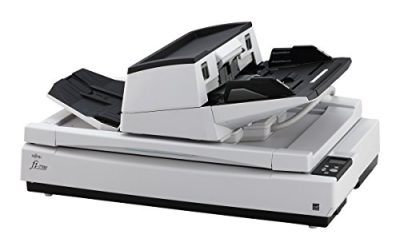
Fujitsu fi-8170 (Ricoh fi Series) (ASIN: B0BZZ9W6V1)
The fi-8170 is the departmental anchor of the Ricoh (formerly Fujitsu) fi Series: a 70 ppm sheet-fed scanner with both USB and wired LAN connections, so one unit can serve a whole workgroup through PaperStream networking or sit on a single high-volume desk. Its ultrasonic iMFF sensor watches every page for overlaps, and the straight, reliable paper path handles mixed batches of office paper, cards and long documents.
Key specifications:
– 70 ppm / 140 ipm single-pass duplex scanning
– 100-sheet automatic document feeder
– Manufacturer daily volume up to 10,000 sheets
– USB 3.2 and Gigabit Ethernet LAN connectivity
– Ultrasonic intelligent multi-feed function (iMFF) double-feed detection
– PaperStream IP TWAIN/ISIS drivers and PaperStream Capture software
– Clear Image Capture optics and automatic skew, crop and color detection
Limitations to know: Network deployment works best through the PaperStream software stack, so mixed-platform offices should confirm driver coverage for every operating system in use before standardizing on it.
Epson WorkForce DS-970 (ASIN: B07PYYRG52)
The DS-970 is Epson’s speed leader in this class: 85 ppm with a 100-sheet feeder and a daily duty cycle rated up to 9,000 pages, aimed at centralized scanning stations that process other people’s paper all day. Epson’s paper protection function slows or stops the feed when it senses a misaligned staple or a crumpling page, and the ultrasonic sensor flags double feeds before they become missing pages in a file.
Key specifications:
– 85 ppm / 170 ipm single-pass duplex scanning
– 100-sheet automatic document feeder
– Manufacturer daily duty cycle up to 9,000 pages
– SuperSpeed USB 3.0 connection, optional network interface unit
– Ultrasonic double-feed detection plus paper protection function
– TWAIN and ISIS drivers, 1.44-inch color LCD control panel
– Handles documents up to A3 through folio mode and long pages
Limitations to know: Networking is an add-on rather than built in, so a shared deployment needs the optional network interface unit or a permanently attached host PC.
Canon imageFORMULA DR-M260 (ASIN: B0765BMRG4)
The DR-M260 is Canon’s departmental speed option: 60 ppm driven by an onboard processor chip, so scan speed does not depend on the attached PC’s power. The five-line LCD makes status and job selection clear at the device, the double-feed release button lets operators re-feed a flagged page without restarting the batch, and the paper path accepts everything from receipts to folded A3 sheets.
Key specifications:
– 60 ppm / 120 ipm duplex scanning
– 80-sheet automatic document feeder
– Manufacturer daily volume up to 7,500 scans
– Ultrasonic double-feed detection with double-feed release function
– USB 3.1 connection and a five-line LCD operator panel
– Onboard DR chip image processing independent of PC speed
– Handles folded A3, long documents and passports up to 6 mm thick
Limitations to know: Like Canon’s other departmental models here it is USB-connected, so network sharing requires a host PC or Canon’s separate network adapters.
Brother ADS-4900W (ASIN: B09TRX9JQ3)
The ADS-4900W is Brother’s professional desktop flagship: a 60 ppm engine, every connection type in the class and a large touchscreen that stores per-user workflows for shared departments. It is positioned for busy workgroups that scan all day, with image processing compatibility (Kofax VRS) that larger organizations often standardize on, and an ultrasonic sensor guarding batch integrity.
Key specifications:
– 60 ppm / 120 ipm single-pass duplex scanning
– 100-sheet automatic document feeder
– Wi-Fi, Gigabit Ethernet and USB 3.0 connectivity
– 4.3-inch color touchscreen with customizable workflow shortcuts
– Ultrasonic multifeed detection sensor
– Kofax VRS Elite image processing compatibility and TWAIN/ISIS support
– Scan to network, SharePoint, FTP/SFTP, email server and cloud services
Limitations to know: Its feature set is aimed at administered workgroups; a single user with light volume pays for networking and workflow capacity they will not use.
Canon imageFORMULA DR-C240 (ASIN: B00WKW9FS4)
The DR-C240 is Canon’s compact departmental workhorse, long used in banks, clinics and government counters where mixed batches — forms, ID cards, even passports with the carrier method — are routine. Its ultrasonic double-feed detection and strong paper handling give it a reliability record in front-office capture, and the ISIS driver support connects it to serious document management systems.
Key specifications:
– 45 ppm / 90 ipm duplex scanning
– 60-sheet automatic document feeder
– Ultrasonic double-feed detection
– Manufacturer daily volume up to 4,000 scans
– USB 2.0 connection with TWAIN and ISIS drivers
– CaptureOnTouch and CapturePerfect software, Kofax VRS compatibility
– Handles passports, plastic cards and mixed document batches
Limitations to know: The connection is USB 2.0 and there is no network option, so it serves one workstation rather than a shared pool.
Quick Comparison
| Model | ASIN | Speed | Feeder | Connection |
|---|---|---|---|---|
| Fujitsu fi-8170 | B0BZZ9W6V1 | 70 ppm / 140 ipm | 100 sheets | USB, Ethernet |
| Epson DS-970 | B07PYYRG52 | 85 ppm / 170 ipm | 100 sheets | USB |
| Canon imageFORMULA DR-M260 | B0765BMRG4 | 60 ppm / 120 ipm | 80 sheets | USB |
| Brother ADS-4900W | B09TRX9JQ3 | 60 ppm / 120 ipm | 100 sheets | Wi-Fi, Ethernet, USB |
| Canon imageFORMULA DR-C240 | B00WKW9FS4 | 45 ppm / 90 ipm | 60 sheets | USB |
Frequently Asked Questions
Why does ultrasonic detection matter more for digitization than for everyday scanning?
Everyday scanning is checked by the person who sent it; archive scanning is not. Once a cabinet is shredded or stored off-site, a page skipped during digitization may be unrecoverable, so catching overlaps at scan time is the only reliable quality control.
What happens when the sensor flags a double feed?
The scanner pauses the batch and shows which page to check. The operator separates the sheets, re-feeds them and continues — a ten-second interruption instead of a missing page in the finished archive.
Can ultrasonic sensors handle labels and sticky notes?
Most models let you teach or temporarily bypass detection for pages with legitimate attachments, either through a pattern setting or a one-page override, so flagged items do not stall the whole batch.
How many pages a day can a departmental scanner digitize?
The models here carry manufacturer daily ratings from about 4,000 to 10,000 pages. A two-person project team typically works well inside that range with time left for indexing and quality checks.
Verdict
For a digitization project, start with the fi-8170 or DS-970 for the strongest combination of ultrasonic protection, feeder size and daily volume. Choose the DR-M260 when the attached PC is modest, since its onboard chip holds speed, and keep the DR-C240 in mind for smaller cabinets or front-counter capture stations.
FAQ
Why does ultrasonic detection matter more for digitization than for everyday scanning?
What happens when the sensor flags a double feed?
Can ultrasonic sensors handle labels and sticky notes?
How many pages a day can a departmental scanner digitize?
More from Amazon
Programs that pair well with the guide above. Offers and eligibility are set by Amazon and may change.
Free shipping on eligible items, Prime Video and more. Eligible new members can start with a free trial.
Start a Prime free trialA Prime membership for ages 18-24 with a trial period. Eligibility is set by Amazon.
See Prime for Young AdultsAudiobooks and podcasts to listen to on the go. Eligible new members can start with a free trial.
Try Audible freeAd-free music streaming. Eligible new subscribers can start with a free trial.
Try Music Unlimited freeAs an Amazon Associate we earn from qualifying purchases.