Key takeaways
- Compare the best bass speakers for home and portable use, from a powered 12-inch home subwoofer to a waterproof Bluetooth speaker with dual subwoofers.
As an Amazon Associate we earn from qualifying purchases.
Most speakers can play the notes in a song, but far fewer can reproduce the lowest part of it with real weight. Bass is the foundation that makes a kick drum feel physical, gives a film explosion its rumble, and stops dance, hip-hop, and electronic music from sounding thin. If your current setup leaves those low frequencies quiet, distant, or muddy, the problem is rarely the music itself. It is usually a speaker that was designed for convenience first and low-end output second, with a small driver, a small enclosure, and no dedicated hardware for moving air at low frequencies.
The best bass speakers solve that problem in different ways, and the right approach depends on where you listen. A powered home subwoofer adds a dedicated low-frequency channel to an existing stereo or home theater system, handling only the bass so your main speakers can concentrate on everything else. A large portable Bluetooth speaker takes the opposite approach, building subwoofers and passive radiators into a single box you can carry from room to room or out into the yard. Both routes are covered in this guide, because “bass speaker” means different things to a home theater owner and to someone who wants one speaker that travels.
This guide focuses on home and general listening. It is deliberately different from a car audio guide: nothing here is designed to be wired into a vehicle, and none of the picks below are car subwoofer enclosures or amplifiers. If your goal is stronger low end at home, at a desk, in a garage, or outdoors, the two speakers below represent the two main shapes that goal takes, and the buying advice that follows will help you decide which shape fits your space before you commit to either one.
Disclosure: This article contains affiliate links. If you buy through these links, we may earn a commission at no additional cost to you.
How to Choose a Bass Speaker
Decide between a dedicated subwoofer and an all-in-one speaker
The first decision is architectural. A dedicated powered subwoofer, like the Rockville model below, contains its own amplifier and one job: reproducing low frequencies. It connects to a receiver or to speakers you already own, and it only makes sense if you already have, or plan to buy, the rest of a system. An all-in-one bass speaker, like the W-KING model below, contains its own drivers for the full range, its own battery, and its own wireless connection. It needs nothing else to play music, but its bass output is limited by what can fit inside a portable cabinet. Neither approach is better in the abstract. A subwoofer goes deeper and plays the lowest notes with more authority, while an all-in-one speaker is usable in far more places with far less setup.
Look at driver size and how the bass is produced
Low frequencies require moving air, and moving air requires cone area or a helping mechanism. A 12-inch powered woofer moves a great deal of air on its own, which is why dedicated subwoofers use drivers of that size. Portable speakers cannot fit a driver that large, so they combine smaller subwoofers with passive bass radiators, which are unpowered diaphragms that resonate with the air inside the cabinet and reinforce the low end. When you compare specifications, note the woofer diameter, whether the design uses passive radiators, and whether the speaker lists a separate subwoofer driver at all. A single small full-range driver with a bass label in the marketing copy is not the same thing as a speaker with dedicated low-frequency hardware.
Check power ratings carefully, and compare like with like
Speaker power figures are easy to misread because manufacturers quote them in different ways. Peak power describes a short burst, while RMS power describes what the amplifier can sustain, and the RMS figure is the more useful one for comparing how a speaker will behave through a whole song or film. The Rockville subwoofer below, for example, is quoted at 800 watts peak and 400 watts RMS, and the RMS number is the one to weigh. Portable speakers add a second complication: pairing two identical units for stereo raises the combined figure, so check whether a headline number describes one speaker or two. Always compare RMS to RMS, and one speaker to one speaker.
Match the connections to your source
A bass speaker you cannot connect to your music is no use at all. Home subwoofers typically accept line-level RCA inputs from a receiver and high-level speaker-level inputs from an amplifier, and the better designs include outputs as well, so the signal can pass onward in the chain. Adjustable crossover and phase controls matter here too, because they let you set where the subwoofer takes over from your main speakers and keep the two in step. Portable speakers instead rely on Bluetooth for phones and tablets, with auxiliary inputs, memory card slots, and near-field pairing as useful fallbacks. List the devices you actually play music from, and check them against the input list before anything else.
Consider the room, the placement, and the neighbors
Bass behaves differently from the rest of the sound spectrum. It spreads in all directions, builds up in corners, and passes through walls more readily than treble does. A large powered subwoofer placed in a corner of a small room can overwhelm everything else, while the same unit in an open-plan space may sound balanced. Think about where the speaker will physically sit, how much floor or shelf space it needs, and how close other people are on the other side of the wall. Portability changes this calculation completely: a battery speaker can be moved away from a wall, taken outside where bass dissipates naturally, or turned down and brought closer, which makes it the more flexible option in shared or rented spaces.
Weigh size, weight, and durability honestly
A 12-inch powered subwoofer is a substantial piece of furniture. The Rockville below weighs 44.7 pounds and is built from medium-density fiberboard, so it is something you position once and leave in place. A portable bass speaker is designed around the opposite assumption, with a handle-friendly form, a rechargeable battery, and, in the case of the W-KING, an IPX6 waterproof rating that tolerates splashes and outdoor use. Be realistic about which life the speaker will actually live. Buying a fixed subwoofer for a listening habit that moves between rooms leads to a speaker that rarely gets used, and buying a portable for a dedicated home theater leaves the lowest film effects underpowered.
The Best Bass Speakers Compared
1. Rockville BASS Blaster 12 Powered Home Audio Subwoofer
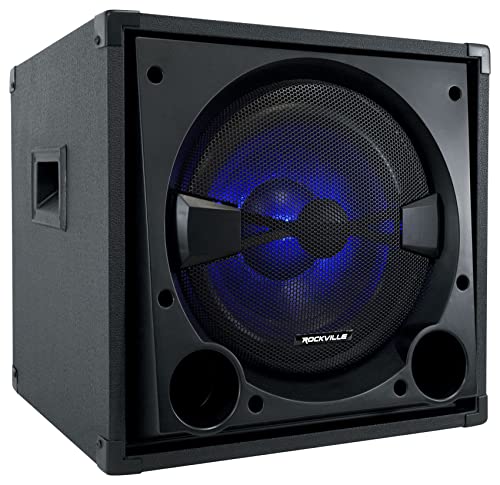
The Rockville BASS Blaster 12 is a powered home subwoofer built around a 12-inch high-grade woofer with a Y30 magnet and a four-layer voice coil, housed in a wood enclosure with a vinyl-style finish. Rockville quotes 800 watts of peak power and 400 watts RMS, and lists a frequency response range extending from 20 Hz at the low end, which is the region where film effects and the deepest electronic bass lines live. Because the amplifier is built in, the unit needs only a signal and mains power, and it is intended for home theater and music use rather than for a vehicle or a stage rig.
Connection flexibility is a strength of this design. The rear panel provides RCA inputs and outputs alongside high-level speaker inputs and outputs, so the subwoofer can be added to a receiver with a dedicated subwoofer output or inserted into a system that only has speaker-level connections. An adjustable crossover lets you choose the point where the subwoofer hands over to your main speakers, and phase control helps align its output with theirs. Included components are the powered subwoofer itself, a power cable, and a user manual. The cabinet measures roughly seventeen inches across in its product dimensions and weighs 44.7 pounds, with an impedance listing of 4 ohms and a signal-to-noise ratio of 85 dB.
This is the pick for a listener who already owns speakers or a receiver and feels that the system, rather than any single song, lacks low-end weight. It is also the pick for film viewing, where a dedicated subwoofer channel carries effects that a portable speaker cannot reproduce at the same depth. The trade-offs are the obvious ones: it is heavy, it stays where you put it, it has no battery and no wireless connection of its own, and it does nothing at all without a source and main speakers to partner with. Within a home system, though, it is the more complete answer to a bass problem.
- Speaker type: Powered subwoofer for home theater and music
- Woofer: 12-inch high-grade woofer, Y30 magnet, four-layer voice coil
- Power: 800 watts peak, 400 watts RMS
- Inputs and outputs: RCA and high-level speaker level, with adjustable crossover
- Weight: 44.7 pounds
- View on Amazon: https://www.amazon.com/dp/B0BBZP1V7K
2. W-KING D8 Bluetooth Speaker
The W-KING D8 takes the portable route to bass. It is a large Bluetooth boombox-style speaker built around four drivers: two 25-watt subwoofers and two 5-watt tweeters, supported by double passive bass radiators on the sides of the cabinet. W-KING quotes 90 watts peak and 50 watts RMS for a single unit, and notes that pairing two D8 speakers wirelessly creates a stereo pair with a combined 100 watts RMS. A digital signal processing chip manages the sound, and a built-in equalizer offers indoor and outdoor modes, so the balance can be adjusted for a room or for open air rather than left fixed.
Practical features fill out the design. The cabinet carries an IPX6 waterproof rating, the rechargeable battery is quoted at up to 40 hours of standby-oriented play time with shorter figures at higher volumes, and the speaker can also serve as a power bank for a phone. Connections include Bluetooth 5.0, an auxiliary input, a TF memory card slot, USB, and NFC pairing for compatible Android phones, and a built-in microphone supports hands-free calling. The speaker is listed with bass boost among its special features, and its product information classifies its speaker type as subwoofer, which reflects how heavily the design leans on its low-frequency hardware.
This is the pick for a listener who wants one speaker that can move: from kitchen to yard, from a workshop bench to a beach trip, without a receiver, cables, or a fixed listening position. Its bass comes from the combination of dual subwoofers and passive radiators rather than from a single large driver, so it delivers punchy, present low end for music at gatherings rather than the deepest home theater rumble. The trade-offs follow from the format: it cannot match a 12-inch powered subwoofer for depth, its headline power figures depend on whether one unit or a pair is playing, and its size makes it a large portable rather than a pocket speaker. For bass that travels, it is the more practical design.
- Speaker type: Portable Bluetooth speaker with subwoofers and passive bass radiators
- Drivers: Two 25-watt subwoofers and two 5-watt tweeters, four drivers in total
- Power: 90 watts peak, 50 watts RMS for one unit
- Water resistance: IPX6 waterproof rating
- Connections: Bluetooth 5.0, auxiliary, TF card, USB, and NFC
- View on Amazon: https://www.amazon.com/dp/B083K35R9D
Comparison Table
| Feature | Rockville BASS Blaster 12 | W-KING D8 |
|---|---|---|
| ASIN | B0BBZP1V7K | B083K35R9D |
| Form | Powered home subwoofer | Portable Bluetooth speaker |
| Main bass hardware | 12-inch powered woofer | Dual subwoofers plus passive radiators |
| Power quoted | 800 watts peak, 400 watts RMS | 90 watts peak, 50 watts RMS |
| Power source | Corded electric | Rechargeable battery |
| Main connections | RCA and speaker-level inputs and outputs | Bluetooth, auxiliary, TF card, USB, NFC |
| Water resistance | Not water resistant | IPX6 waterproof |
| Best setting | Home theater and fixed music systems | Rooms, yards, workshops, and travel |
Frequently Asked Questions
What makes a speaker good for bass?
Dedicated low-frequency hardware is the main factor: a large powered woofer in a subwoofer, or subwoofer drivers supported by passive radiators in a portable design. Amplifier power quoted as RMS, an enclosure with enough internal volume, and controls such as an adjustable crossover also contribute, because they determine how much air the speaker can move and how cleanly the bass blends with the rest of the music.
Do I need a separate subwoofer if my speakers already sound full?
Only if the lowest part of your music or films is missing or weak. A powered subwoofer such as the Rockville BASS Blaster 12 takes over the deepest frequencies entirely, which adds weight to effects and bass lines and relieves your main speakers of the hardest part of their job. If you listen mainly to speech, acoustic music, or background radio, the improvement may not justify the extra box and cabling.
Can a portable Bluetooth speaker deliver real bass?
It can deliver strong, punchy bass for its size, using designs like the W-KING D8, which combines two subwoofers with double passive bass radiators. What a portable cannot match is the depth of a large powered subwoofer with a 12-inch driver, especially in film soundtracks. Expect satisfying low end for music and gatherings from a portable, and the deepest rumble from a dedicated home subwoofer.
Where should a home subwoofer be placed?
Start with the subwoofer on the floor near your main speakers, then experiment. Placement close to a wall, and especially in a corner, reinforces bass output, which can help in a large room and overwhelm a small one. Use the crossover and phase controls after moving the unit, since small changes in position change how the subwoofer blends with the main speakers at your listening seat.
What does an adjustable crossover do?
A crossover sets the frequency where the subwoofer takes over from the main speakers. Set it too high and voices and instruments start coming from the subwoofer, which sounds unnatural. Set it too low and a gap can open between what the main speakers produce and where the subwoofer begins. The adjustable crossover on the Rockville model lets you tune that handover point to your own speakers and room instead of accepting a fixed compromise.
Is a waterproof bass speaker safe to use outdoors?
An IPX6 rating, such as the one listed for the W-KING D8, means the speaker is protected against powerful water jets and heavy splashing, so rain and poolside splashes are within its design limits. It does not mean the speaker should be submerged. Outdoor use also changes how bass sounds, because low frequencies dissipate without walls to reinforce them, which is one reason the D8 includes an outdoor equalizer mode.
Conclusion
The best bass speaker for you depends on whether your listening is fixed or mobile. Choose the Rockville BASS Blaster 12 if you already own a home system and want a dedicated powered subwoofer with a 12-inch driver, flexible RCA and speaker-level connections, and an adjustable crossover to anchor films and music with genuine low-end depth. Choose the W-KING D8 if you want bass that moves with you, in a waterproof Bluetooth speaker that pairs dual subwoofers and passive radiators with a long-running rechargeable battery and several wired and wireless ways to play music. Either way, judge a bass speaker by its low-frequency hardware, its RMS power, and how it connects to the music you already own, and it will improve on a speaker that treats bass as an afterthought.
FAQ
What makes a speaker good for bass?
Do I need a separate subwoofer if my speakers already sound full?
Can a portable Bluetooth speaker deliver real bass?
Where should a home subwoofer be placed?
What does an adjustable crossover do?
Is a waterproof bass speaker safe to use outdoors?
More from Amazon
Programs that pair well with the guide above. Offers and eligibility are set by Amazon and may change.
Free shipping on eligible items, Prime Video and more. Eligible new members can start with a free trial.
Start a Prime free trialA Prime membership for ages 18-24 with a trial period. Eligibility is set by Amazon.
See Prime for Young AdultsAudiobooks and podcasts to listen to on the go. Eligible new members can start with a free trial.
Try Audible freeAd-free music streaming. Eligible new subscribers can start with a free trial.
Try Music Unlimited freeAs an Amazon Associate we earn from qualifying purchases.