Our Short List of 3
All 4 Picks at a Glance
| Product | Specs | Action |
|---|---|---|
 1. Kanto YU4 — Best Overall | Check price on Amazon | |
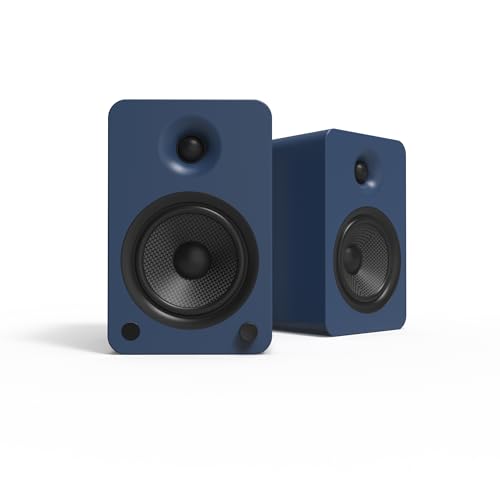 2. Kanto YU6 — Best for Larger Rooms | Check price on Amazon | |
 3. Klipsch R-51PM — Best Lively Sound | Check price on Amazon | |
 4. Edifier R1280T — Best Entry Point | Check price on Amazon |
Key takeaways
- Find the best stereo speakers for vinyl with our guide to four powered bookshelf pairs, phono inputs, room fit, and simple turntable setup tips today.
As an Amazon Associate I earn from qualifying purchases.
The Short Answer
The best stereo speakers for vinyl for most listeners are the Kanto YU4: a compact powered pair with a built-in phono preamp, so a turntable plugs straight in with no extra box in the chain. The 4-inch Kevlar woofers and 1-inch silk dome tweeters deliver a balanced sound that suits small and medium rooms, with Bluetooth and a subwoofer output for digital listening and future bass upgrades.
If your room is larger or you want more low-end weight without adding a subwoofer, the Kanto YU6 is the step up, with larger 5.25-inch drivers and a stronger amplifier in the same phono-ready design. If you want a livelier, more forward sound for rock and jazz, the Klipsch R-51PM brings horn-loaded treble and a built-in phono stage of its own. And if your turntable already has a built-in preamp and you want the simplest, most affordable route to good sound, the Edifier R1280T is the classic entry point — with one limitation: it has no phono input of its own.
The key decision in this category is not brand or wattage. It is where the phono preamp lives. A turntable cartridge produces a very quiet signal that must be amplified and equalized before a speaker can play it. That job can be done by the turntable, by the speaker, or by a separate phono box. Once you know which of your components handles it, the rest of the choice is about room size, driver size, and the inputs you need.
Our Top Picks
- Best overall: Kanto YU4 — Powered bookshelf pair with a built-in phono preamp, Bluetooth, and a remote. The simplest complete vinyl setup in this guide.
- Best for larger rooms: Kanto YU6 — Same phono-ready design as the YU4 with bigger 5.25-inch drivers and more amplifier power for living-room listening.
- Best lively sound: Klipsch R-51PM — Powered pair with a built-in phono preamp, horn-loaded tweeter, and the widest input selection here.
- Best entry point: Edifier R1280T — Affordable powered bookshelf pair for turntables that already have a built-in preamp.
Quick Comparison
| Speaker | Type | Phono preamp built in | Drivers | Inputs | Best for |
|---|---|---|---|---|---|
| Kanto YU4 | Powered bookshelf | Yes | 4-inch Kevlar woofer, 1-inch silk dome tweeter | RCA phono/line, 2x optical, 3.5mm aux, Bluetooth | Most vinyl setups |
| Kanto YU6 | Powered bookshelf | Yes | 5.25-inch Kevlar woofer, 1-inch silk dome tweeter | RCA phono/line, 2x optical, 3.5mm aux, Bluetooth | Larger rooms |
| Klipsch R-51PM | Powered bookshelf | Yes | 5.25-inch copper-spun woofer, horn-loaded tweeter | RCA phono/line, optical, USB, 3.5mm, Bluetooth | Lively, detailed sound |
| Edifier R1280T | Powered bookshelf | No | 4-inch woofer, 13mm silk dome tweeter | Dual RCA line-level | Turntables with a built-in preamp |
How to Choose
Start with the phono question
Every vinyl setup needs exactly one phono preamp in the signal chain. Check your turntable first: many modern decks include a switchable built-in preamp. If yours does, any powered speaker with a line-level RCA input will work, and the Edifier R1280T becomes a genuine option. If your turntable has no built-in preamp, you need a speaker with a built-in phono stage, such as the Kanto YU4, Kanto YU6, or Klipsch R-51PM, or a separate phono preamp box between the deck and the speakers.
Running two phono preamps at once is a common error: if your turntable’s preamp is switched on and the speaker also applies phono equalization, the sound comes out loud, distorted, and boomy. Set one to phono and the other to line. On the Kanto and Klipsch models, the RCA input has a phono/line switch on the back panel, and the Klipsch also provides a ground screw terminal for the turntable ground wire.
Powered versus passive
All four speakers in this guide are powered, which means the amplifier is built into one of the cabinets: turntable, cable, speakers, done. A passive speaker needs a separate stereo amplifier or receiver, which adds cost, cables, and shelf space, and only makes sense if you already own an amplifier you like. If you are starting from a turntable and a record collection, a powered pair gets you listening faster with fewer decisions.
Match the speaker to the room
Driver size is a useful shorthand for room fit. A 4-inch woofer, as on the Kanto YU4 and Edifier R1280T, is comfortable in a bedroom, study, or small living room, and it keeps the cabinet compact enough for a bookshelf or a media console. A 5.25-inch woofer, as on the Kanto YU6 and Klipsch R-51PM, moves more air and fills a medium or large living room with less strain, and it reaches lower into the bass before a subwoofer becomes necessary.
Placement matters as much as size. Give bookshelf speakers a few inches of space behind them, with the tweeters roughly at ear level from your listening seat. Keep the turntable and the speakers on separate surfaces where possible: a speaker cabinet vibrating on the same shelf as a turntable can feed low-frequency energy back into the stylus, which shows up as muddy sound on loud passages.
Inputs beyond the turntable
A vinyl setup rarely stays vinyl-only. The Kanto YU4 and YU6 both include two optical inputs, a 3.5mm aux input, and Bluetooth with aptX, so a television, a computer, or a phone can share the same speakers. The Klipsch R-51PM adds a USB digital input for a computer alongside optical, Bluetooth, and analog inputs. The Edifier R1280T is the outlier: dual RCA line-level inputs and no digital or wireless input, so it is a dedicated analog pair.
Subwoofer output and upgrades
Three of the four picks include a subwoofer output, the most useful upgrade path in a vinyl system. The Kanto YU4, Kanto YU6, and Klipsch R-51PM all let you add a powered subwoofer later without replacing the speakers: start with the pair, live with it for a few months, and only add bass if your room and your records actually demand it. The Edifier R1280T has no subwoofer output — it is the one pick here that cannot take a powered subwoofer later. A subwoofer is optional for most listeners.
The Picks in Detail
1. Kanto YU4 — Best Overall
The Kanto YU4 is the pair to buy if you want the shortest path from a turntable to music. It is a powered bookshelf pair with a built-in phono preamp, so any turntable plugs directly into the RCA input with the phono switch engaged and no extra box is required. The 4-inch Kevlar woofers and 1-inch silk dome tweeters are driven by a Class D amplifier listed at 140 watts peak power, or 70 watts total RMS, with a frequency response of 60 Hz to 20 kHz. Bluetooth 4.0 with aptX handles wireless streaming, two optical inputs cover a television or a digital source, a 3.5mm aux input takes anything else, and a subwoofer output leaves room to add bass later. A remote and automatic standby are included.
The YU4 suits small and medium rooms, desks, and bookshelves, and its compact cabinet disappears into a living room in a way larger speakers cannot. The 4-inch woofers will not shake a large open-plan room on their own; if your room is large, the YU6 below is the better Kanto.
Pros:
– Built-in phono preamp connects any turntable directly
– Bluetooth with aptX, two optical inputs, and a subwoofer output
– Remote, auto standby, and compact cabinets that fit real shelves
– Balanced, unfussy sound that flatters a wide range of records
Cons:
– 4-inch woofers have limited low-end weight in large rooms
– Bass lovers will eventually want a subwoofer
2. Kanto YU6 — Best for Larger Rooms
The Kanto YU6 is the YU4’s bigger sibling, and the upgrade is straightforward: larger 5.25-inch Kevlar drivers, a stronger amplifier listed at 200 watts peak power, or 100 watts total RMS, and a frequency response reaching down to 50 Hz. Everything else carries over, including the built-in phono preamp, Bluetooth 4.0 with aptX, two optical inputs, a 3.5mm aux input, a subwoofer output, a USB charge port, a remote, and automatic standby and startup.
In a medium or large living room, the YU6 sounds fuller and more relaxed than the YU4 at the same volume, and the extra bass extension means fewer recordings leave you wanting a subwoofer. It is still a two-box system with no receiver. The trade-off is size and the need for a sturdier shelf or stand.
Pros:
– Built-in phono preamp with the same direct turntable connection as the YU4
– Larger drivers and stronger amplifier for bigger rooms
– Full input set: optical, aux, Bluetooth, and a subwoofer output
– Remote and auto standby make daily use effortless
Cons:
– Larger cabinets need more shelf or stand space
– More speaker than a small room requires
3. Klipsch R-51PM — Best Lively Sound
The Klipsch R-51PM is the extrovert of this guide: a powered bookshelf pair with a built-in phono preamp, a 5.25-inch copper-spun woofer, and a horn-loaded tweeter built around Klipsch’s Tractrix horn geometry with Linear Travel Suspension. The horn design makes the speaker efficient and gives treble a forward, detailed character that suits rock, jazz, and anything with energy in the upper registers. Maximum output is listed at 120 watts total system power (140 watts peak), and the input set is the widest here: a switchable phono/line RCA input with a ground screw terminal, digital optical, USB digital for a computer, 3.5mm analog, and Bluetooth wireless, plus a remote.
The R-51PM is the pick for listeners who found other bookshelf speakers polite or restrained. It plays loud without strain and brings out detail in busy recordings. That forward character is a matter of taste; listeners who prefer a soft, warm presentation may find the Kanto models more relaxing over long sessions. Like the Kanto picks, it has a subwoofer output — a mono-sub RCA output on the back of the right speaker — so a powered subwoofer can be added later.
Pros:
– Built-in phono preamp with a ground terminal for hum-free connection
– Horn-loaded tweeter delivers lively, detailed treble
– Widest input selection in this guide, including USB digital
– Plays loud with ease in medium rooms
Cons:
– Forward treble character will not suit every listener
– Forward, bright treble is a matter of taste — not the pick for listeners who prefer a warm presentation
– Larger cabinets than the compact 4-inch models
4. Edifier R1280T — Best Entry Point
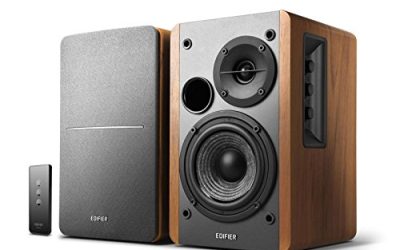
The Edifier R1280T is the long-running entry point to powered bookshelf speakers, and it earns its place here with one clear condition: your turntable must have a built-in preamp, or you must add a separate phono preamp between the deck and the speakers. The R1280T has no phono input of its own. What it does have is a simple, well-executed design: a 2.0 active near-field pair in a wooden enclosure, listed at 42 watts RMS, with dual RCA line-level inputs, bass and treble controls, and a remote.
For a listener whose turntable already handles the phono stage, the R1280T is the least expensive route to good sound in this guide, and its simplicity is genuine: two cables, two speakers, music. It will not stream from a phone, it has no optical input, and it will not fill a large room, but none of that matters if the speakers will only ever play records in a small space.
Pros:
– Simple, proven powered design at an accessible point in the range
– Dual RCA inputs and tone controls on the side panel
– Wooden cabinets that look at home beside a turntable
– Remote included
Cons:
– No built-in phono preamp, so the turntable must provide one
– No Bluetooth or digital inputs
– 42 watts RMS and 4-inch drivers suit small rooms best
Who Should Choose What
- Choose the Kanto YU4 if you want the simplest complete vinyl system for a small or medium room, with a built-in phono preamp and Bluetooth for everything else.
- Choose the Kanto YU6 if your room is larger, you listen at higher volumes, or you want fuller bass without adding a subwoofer right away.
- Choose the Klipsch R-51PM if you love a lively, detailed sound, listen to a lot of rock and jazz, and want USB input for a computer alongside the turntable.
- Choose the Edifier R1280T if your turntable already has a built-in preamp, your room is small, and you want the most affordable powered pair that still sounds genuinely good.
If you are unsure, answer the phono question first, then measure your room: a deck with no built-in preamp narrows the field to the three phono-ready picks, and a room under roughly 12 by 14 feet points to a 4-inch model.
Common Mistakes
Connecting a turntable with no preamp to a line-only speaker. This is the most frequent error in vinyl setups, and it produces sound so quiet that people assume something is broken. Match a preamp-less deck to a speaker with a built-in phono stage, or add a separate phono preamp.
Running two phono preamps at once. If the turntable’s preamp is switched on and the speaker’s phono input is also engaged, the signal gets equalized twice. Set one side to phono and the other to line, and check the switch on the back of the speaker before you listen.
Skipping the ground wire. A turntable ground wire connected to the speaker’s ground terminal, where one is provided, keeps hum out of quiet passages. The Klipsch R-51PM includes a ground screw terminal for exactly this purpose. If hum persists, check that the ground wire is secure at both ends.
Judging speakers before they are positioned. Bookshelf speakers placed hard against a wall or with tweeters firing at knee height will sound boomy and dull regardless of model. Pull them a few inches from the wall and aim the tweeters toward ear level at your listening seat before deciding whether the sound is right.
Buying passive speakers by accident. Every pick in this guide is powered, but many bookshelf speakers that look identical are passive and need a separate amplifier. Check the listing for a built-in amplifier and a power cord before ordering.
FAQ
Do I need a phono preamp to use stereo speakers with a turntable?
Yes, exactly one phono preamp must sit between the cartridge and the speakers. It can be built into the turntable, built into the speaker, or a separate box. The Kanto YU4, Kanto YU6, and Klipsch R-51PM here have one built in; the Edifier R1280T does not, so it needs a turntable with its own preamp or a separate phono box.
Can I connect any turntable to powered speakers?
Any turntable can connect to powered speakers as long as the phono question is handled. A deck with a built-in preamp connects to any line-level RCA input. A deck without one needs a speaker with a built-in phono input, such as the three phono-ready picks here, or a separate phono preamp between them.
Are powered speakers good enough for vinyl, or do I need a receiver?
Powered speakers are a complete solution for most vinyl listeners. The amplifier is matched to the drivers by the maker, and the system needs no receiver at all. A receiver only becomes useful if you want to run multiple passive speakers or a home theater setup through one central unit.
What size speakers do I need for vinyl in a small room?
A 4-inch bookshelf pair, such as the Kanto YU4 or Edifier R1280T, is comfortable in a bedroom, study, or small living room. A 5.25-inch pair, such as the Kanto YU6 or Klipsch R-51PM, suits medium and large rooms and delivers more bass without a subwoofer.
Do I need a subwoofer with bookshelf speakers for vinyl?
Most listeners do not. A well-chosen bookshelf pair handles the great majority of vinyl recordings convincingly on its own. A subwoofer is worth adding later if your room is large or you listen to bass-heavy records. The Kanto YU4, Kanto YU6, and Klipsch R-51PM all include a subwoofer output for that upgrade. The Edifier R1280T does not.
Can these speakers also play music from my phone or television?
The Kanto YU4, Kanto YU6, and Klipsch R-51PM all include Bluetooth, and the Kanto models add two optical inputs while the Klipsch adds optical and USB digital, so a phone, computer, or television can share the same pair. The Edifier R1280T has analog RCA inputs only.
Conclusion
The best stereo speakers for vinyl are the ones that solve the phono question cleanly and fit your room. For most listeners, that is the Kanto YU4: a compact powered pair with a built-in phono preamp, Bluetooth, and a remote, ready to play the moment a turntable is connected. The Kanto YU6 extends the same design to larger rooms, the Klipsch R-51PM adds a livelier character and the widest input selection, and the Edifier R1280T gives the simplest entry point for turntables with their own preamp.
Whichever pair you choose, confirm the phono switch positions, give the speakers a few inches of breathing room from the wall, and keep the turntable on a sturdy surface of its own.
FAQ
Do I need a phono preamp to use stereo speakers with a turntable?
Can I connect any turntable to powered speakers?
Are powered speakers good enough for vinyl, or do I need a receiver?
What size speakers do I need for vinyl in a small room?
Do I need a subwoofer with bookshelf speakers for vinyl?
Can these speakers also play music from my phone or television?
More from Amazon
Programs that pair well with the guide above. Offers and eligibility are set by Amazon and may change.
Free shipping on eligible items, Prime Video and more. Eligible new members can start with a free trial.
Start a Prime free trialA Prime membership for ages 18-24 with a trial period. Eligibility is set by Amazon.
See Prime for Young AdultsAudiobooks and podcasts to listen to on the go. Eligible new members can start with a free trial.
Try Audible freeAd-free music streaming. Eligible new subscribers can start with a free trial.
Try Music Unlimited freeAs an Amazon Associate we earn from qualifying purchases.