Our Short List of 3

- Best for: Competitive players who want 240Hz speed at a standard 27-inch size.
- Size: 27-inch
- Resolution: FHD (1920×1080)
- Refresh rate: 240Hz
- Panel: In-plane switching (IPS)

- Best for: Players with a deep desk who want a large curved QHD view.
- Size: 32-inch
- Form: Curved, 1000R
- Resolution: QHD (2560×1440)
- Refresh rate: 180Hz

- Best for: Players who want 4K sharpness at 27 inches for story-driven games and desk work.
- Size: 27-inch
- Resolution: 4K (3840×2160)
- Panel: IPS
- Refresh rate: 72Hz, DFR 144Hz
All 5 Picks at a Glance
| Product | Specs | Action |
|---|---|---|
| Dell 27 240Hz Gaming Monitor SE2726HG |
| Check price on Amazon |
| LG 32GS60QC-B Ultragear Curved Gaming Monitor |
| Check price on Amazon |
| Acer Nitro VG270K L1 Gaming Monitor |
| Check price on Amazon |
 Alienware AW3425DWM Curved Gaming Monitor |
| Check price on Amazon |
 AOC Q27G41ZE Gaming Monitor |
| Check price on Amazon |
Key takeaways
- Compare five gaming monitors in 27-inch, 32-inch, and 34-inch sizes, and match the screen size, resolution, and refresh rate to your desk and games.
Size is the first decision in a gaming monitor, because the diagonal figure sets how far you sit, how much of your view the screen fills, and how hard your graphics card must work. Every pick below states its screen size literally in its own listing wording, alongside the gaming-monitor form and its brand, so the size element rests on the listing itself rather than on a guess. The five picks span 27-inch, 32-inch, and 34-inch screens, covering a compact desk, a deep desk, and an ultrawide-style curved view.
Two of the five picks also appear as picks in roundups on other sites, and the rest were corroborated from one or more gaming-monitor roundups, with the basis stated for each pick below. Every ASIN below carries a warning marker because it was corroborated indirectly from listing cards rather than from a live product page, so re-check each ASIN with the Amazon API before posting.
Quick Picks
As an Amazon Associate we earn from qualifying purchases.
| Product | Best for | Key spec |
|---|---|---|
| Dell 27 240Hz Gaming Monitor SE2726HG | Fast 27-inch competitive play | 27-inch FHD, 240Hz |
| LG 32GS60QC-B Ultragear Curved Gaming Monitor | Immersive 32-inch curved play | 32-inch QHD, 180Hz |
| Acer Nitro VG270K L1 Gaming Monitor | Sharp 27-inch 4K play | 27-inch 4K, DFR 144Hz |
| Alienware AW3425DWM Curved Gaming Monitor | Wide 34-inch curved play | 34-inch WQHD, 180Hz |
| AOC Q27G41ZE Gaming Monitor | High-refresh 27-inch play | 27-inch QHD, 260Hz overclocked |
How to Choose
Match the Diagonal to Your Desk Depth
A 27-inch screen suits a standard desk where you sit at arm’s length, because the full picture stays inside comfortable eye movement without turning your head. A 32-inch screen needs a deeper desk or a monitor arm pushed back, or the edges demand constant head movement that tires you during long sessions. A 34-inch curved screen suits a wide desk best, since the curve wraps the picture around your view only when you sit centred and at the right distance. Measure your sitting distance first, then choose the diagonal that fills your view without forcing you to lean back, and remember that a bigger screen is not better when your desk cannot give it room.
Weigh Resolution Against Your Graphics Card
A 1080p screen is the lightest load on a graphics card, so high refresh rates stay reachable on modest hardware, and the picture stays sharp enough at 24-inch and 27-inch sizes. A 1440p screen asks for a stronger card but rewards you with crisper text and finer detail at 27-inch and 32-inch sizes, which suits players who notice texture and edge quality. A 4K screen demands the strongest hardware of the three and shines at 27-inch and above, where the extra pixels are actually visible. Pick the resolution your card can drive at the refresh rate you want, not the highest figure on the box.
Decide How Much Refresh Rate You Need
Refresh rate decides how smooth motion looks, and the step from 60Hz to 144Hz is the one most players feel immediately in fast games. A 144Hz or 165Hz screen covers competitive play well, while 180Hz and 240Hz screens suit players who chase every frame in shooters and racing games. Above 240Hz, the gains narrow and only the fastest esports players tend to notice them, so weigh the premium against your own sensitivity. Match the refresh rate to the frame rates your card actually reaches in the games you play, because a 240Hz screen cannot show frames your hardware never renders.
Check Panel, Curve, and Sync Wording
An IPS panel states wide viewing angles and steady colour when you move your head, which suits shared desks and curved screens viewed off-centre. A curved screen states a radius figure such as 1000R or 1500R, with a tighter curve wrapping more aggressively around your view at close distances. Sync wording such as FreeSync or G-SYNC states that the screen can match its refresh timing to your graphics card, which reduces tearing when frame rates move around. Read the listing for the exact panel type, curve radius, and sync wording, and treat a missing figure as a detail to confirm rather than a feature to assume.
The 5 Best Options
Dell 27 240Hz Gaming Monitor SE2726HG
- Best for: Competitive players who want 240Hz speed at a standard 27-inch size.
- Size: 27-inch
- Resolution: FHD (1920×1080)
- Refresh rate: 240Hz
- Panel: In-plane switching (IPS)
Competitive players who want 240Hz speed at a standard 27-inch size.
The listing states Full HD resolution, so confirm the picture sharpness suits your desk distance before ordering.
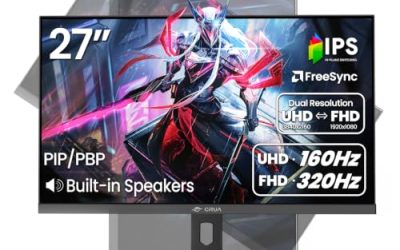
The Dell SE2726HG is the fast 27-inch pick, stating a 27-inch Full HD gaming monitor with a 240Hz refresh rate in its listing wording. Its in-plane switching panel, AMD FreeSync Premium wording, and TUV 3-Star certification cover smooth motion, tear-free sync, and eye-comfort claims in one listing, and the 1920 by 1080 resolution keeps the frame-rate demand low enough for modest graphics cards. It is the pick for competitive players who want maximum refresh rate at a standard desk size without stepping up to a costlier resolution.
LG 32GS60QC-B Ultragear Curved Gaming Monitor
- Best for: Players with a deep desk who want a large curved QHD view.
- Size: 32-inch
- Form: Curved, 1000R
- Resolution: QHD (2560×1440)
- Refresh rate: 180Hz
Players with a deep desk who want a large curved QHD view.
The 32-inch size needs sitting distance, so measure your desk depth before ordering.
The LG 32GS60QC-B is the big curved pick, stating a 32-inch curved gaming monitor with a QHD picture and a 180Hz refresh rate in its listing wording. Its 1000R curve, 1ms response figure, HDR10 wording, and borderless design frame a wide, fast picture, while the two HDMI ports and DisplayPort cover a console and a PC on one screen. It is the pick for players with a deep desk who want a large curved view for racing and open-world games.
Acer Nitro VG270K L1 Gaming Monitor
- Best for: Players who want 4K sharpness at 27 inches for story-driven games and desk work.
- Size: 27-inch
- Resolution: 4K (3840×2160)
- Panel: IPS
- Refresh rate: 72Hz, DFR 144Hz
Players who want 4K sharpness at 27 inches for story-driven games and desk work.
The listing states 72Hz with DFR 144Hz, so confirm how the dual rate behaves in your games before ordering.
The Acer Nitro VG270K L1 is the sharp 27-inch pick, stating a 27-inch 4K gaming monitor with an IPS panel in its listing wording. Its 3840 by 2160 resolution and dual-frame-rate wording, 72Hz with DFR 144Hz, pair a dense picture with a higher refresh mode, which suits players who want crisp detail in slower games and smoother motion when the frame rate allows. It is the pick for single-player games and mixed work-and-play desks where resolution matters more than maximum refresh rate. This ASIN was previously recorded with different brand wording in a spare list; the API re-check must confirm the Acer identity.
Alienware AW3425DWM Curved Gaming Monitor
- Best for: Players who want a single wide curved screen for immersive games.
- Size: 34-inch
- Form: Curved, 1500R
- Resolution: WQHD (3440×1440)
- Refresh rate: 180Hz
Players who want a single wide curved screen for immersive games.
The 34-inch width needs a wide desk and centred seating, so check your space before ordering.
The Alienware AW3425DWM is the wide curved pick, stating a 34-inch curved gaming monitor with a WQHD picture and a 180Hz refresh rate in its listing wording. Its 1500R curve, 1ms response figure, FreeSync Premium wording, and VESA AdaptiveSync wording wrap a wide 3440 by 1440 picture around your view, which suits simulation and open-world games that reward peripheral vision. It is the pick for players who want one wide screen instead of two monitors.
AOC Q27G41ZE Gaming Monitor
- Best for: Competitive players with a strong graphics card who want 260Hz QHD motion.
- Size: 27-inch
- Resolution: QHD
- Refresh rate: 260Hz overclocked
- Panel: IPS
Competitive players with a strong graphics card who want 260Hz QHD motion.
The 260Hz figure is an overclocked rate, so confirm the standard rate and your card’s output before ordering.
The AOC Q27G41ZE is the high-refresh 27-inch pick, stating a 27-inch gaming monitor with a QHD picture and a 260Hz overclocked refresh rate in its listing wording. Its IPS panel, NVIDIA G-SYNC wording, and overclocked refresh figure aim squarely at fast competitive play, where the extra headroom over a standard 144Hz or 180Hz screen shows in rapid flicks and tracking. It is the pick for players who already own a strong graphics card and want the fastest 27-inch QHD motion in this guide.
Which One Fits Your Situation
If Your Desk Is Standard Depth
The Dell 27-inch 240Hz pick fits a standard desk best, because its size fills your view at arm’s length without demanding extra depth. The AOC 27-inch pick is the faster alternative on the same footprint when your graphics card can feed its overclocked refresh rate. Measure from your eyes to the screen position, and favour 27 inches whenever that distance is under a metre.
If You Play Competitive Shooters
The AOC 260Hz pick leads for competitive shooters, with the Dell 240Hz pick close behind for players who prefer Full HD frame rates. Both state the gaming-monitor form and high refresh figures literally in their listings, and both suit fast flicks and tracking better than the larger curved picks. Spend on refresh rate first and on size second when every frame counts.
If You Want One Screen for Everything
The Alienware 34-inch curved pick replaces a two-screen setup for players who mix games, video, and desk work on one display. The LG 32-inch curved pick is the alternative when you want a taller 16:9 picture rather than a wide 21:9 one. Both need a deep, wide desk, so check your space before choosing either.
If Sharpness Matters Most
The Acer Nitro 4K pick leads when sharpness matters most, because its dense 27-inch picture shows the most detail in story-driven games and desk work. It trades maximum refresh rate for resolution, so pair it with a graphics card that can drive 4K comfortably. Confirm the dual-rate wording in the listing before you buy.
Common Mistakes
- Buying the largest screen without measuring desk depth and sitting distance first.
- Choosing 4K resolution without a graphics card that can drive it at the refresh rate you want.
- Assuming a curved screen suits every seating position instead of checking the curve radius and centred seating.
- Treating an overclocked refresh figure as the standard rate without reading the listing wording.
- Ignoring port counts and sync wording, then finding the screen cannot connect your console and PC together.
Frequently Asked Questions
What size gaming monitor is best for a standard desk?
A 27-inch screen is the usual fit for a standard desk, because it fills your view at arm’s length without forcing head movement. A 32-inch or 34-inch screen suits a deeper or wider desk better, where the extra size stays comfortable. Measure your sitting distance first and choose the diagonal that fits it.
Does a bigger gaming monitor need a stronger graphics card?
A bigger screen does not by itself demand more power, but the resolution usually paired with it does. A 1080p screen stays light on hardware at any size here, while 1440p asks for a stronger card and 4K asks for the strongest. Match resolution and refresh rate to your card, not size alone.
Is a curved gaming monitor better than a flat one?
A curved screen wraps the picture around your view when you sit centred at the right distance, which suits immersive and racing games. A flat screen suits shared viewing and mixed desk work better, since the picture stays even from wider angles. Choose the curve radius and seating position together, not the curve alone.
What does the refresh rate figure mean in a listing?
The refresh rate states how many times per second the screen redraws the picture, so higher figures show smoother motion in fast games. A 144Hz screen redraws more than twice as often as a 60Hz screen, and 240Hz and above suit competitive play best. Confirm whether a stated figure is standard or overclocked before comparing screens.
FAQ
What size gaming monitor is best for a standard desk?
Does a bigger gaming monitor need a stronger graphics card?
Is a curved gaming monitor better than a flat one?
What does the refresh rate figure mean in a listing?
More from Amazon
Programs that pair well with the guide above. Offers and eligibility are set by Amazon and may change.
Free shipping on eligible items, Prime Video and more. Eligible new members can start with a free trial.
Start a Prime free trialA Prime membership for ages 18-24 with a trial period. Eligibility is set by Amazon.
See Prime for Young AdultsAudiobooks and podcasts to listen to on the go. Eligible new members can start with a free trial.
Try Audible freeAd-free music streaming. Eligible new subscribers can start with a free trial.
Try Music Unlimited freeAs an Amazon Associate we earn from qualifying purchases.