
Our Short List of 3

- Best for: Hobbyists who want one simple mains-powered charger for 2S to 4S packs.
- Specs:
- 65W maximum charging power
- 0.1 to 6.0 A charging current
- 10W maximum discharge power

- Best for: Beginners who want one charger for many battery types with automatic settings.
- Specs:
- 50W maximum charging power
- 0.1 to 5.0 A charging current, 0.1 to 1.0 A discharge current
- DC 10.5 to 18.0 V input
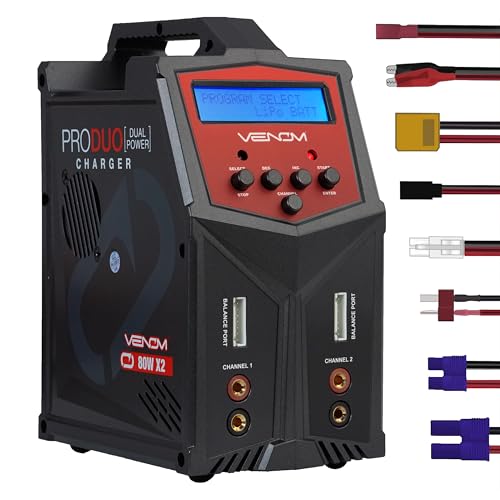
- Best for: Drivers with two cars or two pack types who want both charging at once.
- Specs:
- Two independent 80W charging circuits, 160W total
- 7A maximum output
- 1S to 6S LiPo, LiHV, Li-ion, LiFe, NiMH, NiCd and Pb
All 3 Picks at a Glance
| Product | Specs | Action |
|---|---|---|
| SkyRC S65 |
| Check price on Amazon |
| Tenergy TB6-B |
| Check price on Amazon |
| Venom Pro Duo |
| Check price on Amazon |
Key takeaways
- Our guide to the best rc lipo chargers compares charge power, cell counts and safety cutoffs so you can charge RC packs quickly without risking damage.
An RC LiPo charger does more than fill a battery, because it balances every cell in the pack and that balance decides how long the pack lasts and how safely it charges. A charger that skips balancing lets one cell drift high while another stays low, and that drift shortens the pack’s life and raises the risk of damage. The chargers in this guide all balance charge, and they differ in power, port count and size, so the right pick depends on how many packs you run and where you charge them.
This guide is for RC car drivers, drone pilots and boat racers who charge LiPo packs every week, and for beginners buying a first proper charger. Every charger below was selected from the name and specifications shown on its Amazon page.
Quick Picks
As an Amazon Associate we earn from qualifying purchases
| Product | Best for | Key spec from title |
|---|---|---|
| SkyRC S65 | Simple single-pack charging | 65W balance charging |
| ISDT Q6 Nano | Pocket-sized field charging | 200W balance charging |
| Tenergy TB6-B | Beginner multi-chemistry charging | 50W balance charging |
| Venom Pro Duo | Charging two packs at once | Dual 80W balance charging |
How to Choose
Charge power and charge rate
Charge power sets how fast a pack fills, and the chargers here range from 50 watts to 200 watts, with the dual-channel Venom Pro Duo offering two independent 80-watt circuits. A higher wattage charges large packs faster, while a lower wattage suits small 2S and 3S packs that need only a modest current. Match the charger to the largest pack you own, and remember that charging at 1C, where the current in amps equals the pack capacity in amp-hours, is the standard pace for pack health. A charger that lists its maximum current and wattage clearly makes that match easy to judge.
Cell count and battery chemistry
Cell count decides which packs a charger can handle, and all four chargers here cover 1S to 6S LiPo packs, which spans the small drone packs and the large car packs most hobbyists run. Chemistry support matters too, because a charger that also handles LiHV, Li-ion, LiFe, NiMH, NiCd and lead-acid batteries covers a whole collection rather than one pack type. Check the listed cell range against your largest pack before buying, and favour a charger that lists the chemistries you actually own rather than the longest list on the page.
Balance charging and safety features
Balance charging is the safety feature that matters most, because it keeps every cell in a pack at the same voltage and stops one cell from overcharging while the others catch up. All four chargers here balance charge through a dedicated balance port, and several add further protection: the Venom Pro Duo monitors its internal temperature and shuts down automatically if it gets too hot, while the SkyRC S65 protects against reversed polarity on its built-in XT60 connector. The Tenergy TB6-B adds an AUTO function that sets the feeding current and the cell count by itself, which helps prevent over-charging when a setting is entered wrong.
Portability and power input
Portability decides where you can charge, and the chargers here split into mains-powered models and DC-only models that need a separate power supply. The SkyRC S65, the Tenergy TB6-B and the Venom Pro Duo all run from a household mains socket, so they suit a bench at home. The ISDT Q6 Nano runs on DC input only, which makes it the field pick when paired with a car battery or a portable power supply. Size matters too, since the Q6 Nano fits a pocket while the Pro Duo needs bench space, so match the charger to the place you charge most often.
The 4 Best Options
SkyRC S65
- Best for: Hobbyists who want one simple mains-powered charger for 2S to 4S packs.
- Specs:
- 65W maximum charging power
- 0.1 to 6.0 A charging current
- 10W maximum discharge power
Hobbyists who want one simple mains-powered charger for 2S to 4S packs.
The 4S ceiling rules out larger 6S packs, and the single port charges one pack at a time.
The SkyRC S65 is the straightforward single-pack charger, delivering 65 watts through a built-in XT60 connector with reverse polarity protection. It handles 2S to 4S LiPo, LiHV, Li-ion and LiFe packs, plus NiMH, NiCd and lead-acid batteries, so one charger covers a mixed collection. Ten profile memories store your common pack settings, and the backlit LCD display shows the battery voltage to three decimal places while charging. A temperature-controlled fan keeps the charger cool, and the integrated balancer works at up to 200 mA to keep cells even. At 315 grams, it sits neatly on a bench without taking over the workspace.
Watch out for: The 4S ceiling rules out larger 6S packs, and the single port charges one pack at a time.
ISDT Q6 Nano
The ISDT Q6 Nano is the pocket charger, packing 200 watts and an 8-amp maximum current into a body barely larger than a matchbox. Its 2.4-inch IPS LCD screen shows charging data clearly, and the XT60 output plus a balance port for 2S to 6S packs covers everything from small drone packs to large car packs. The charger runs on DC input from 10 to 30 volts, so it pairs with a car battery or a portable power supply at the field, and the 119-gram body slips into a flight bag. Balance current reaches 0.5 amps per cell, which keeps multi-cell packs even during fast charges.
- Specs:
- 200W maximum charging power
- 8A maximum charging current
- DC 10 to 30 V input
- 1S to 6S LiPo, LiHV, Li-ion and LiFe
- 2.4-inch 320 by 240 IPS LCD display
- Balance current 0.5 A per cell
- 80 by 80 by 33.5 mm, 119 grams
- XT60 output and balance port for 2S to 6S
Best for: Pilots and drivers who charge at the field and need maximum power in a pocket-sized body.
Watch out for: DC input only, so it needs a separate power supply or battery, and the small screen can be hard to read in bright sunlight.
Tenergy TB6-B
- Best for: Beginners who want one charger for many battery types with automatic settings.
- Specs:
- 50W maximum charging power
- 0.1 to 5.0 A charging current, 0.1 to 1.0 A discharge current
- DC 10.5 to 18.0 V input
Beginners who want one charger for many battery types with automatic settings.
The 50-watt ceiling charges large packs slowly, and the DC input needs a power supply for bench use.
The Tenergy TB6-B is the beginner-friendly pick, a multi-chemistry balance charger that handles LiPo, Li-ion, LiFe, NiMH, NiCd and lead-acid packs in one unit. Its AUTO function sets the feeding current and the cell count by itself, which prevents over-charging when a setting is entered wrong, and the individual-cell balancer works without a separate balancer board. The blue backlight LCD shows charging status clearly, and the included multi-connector harness covers Tamiya, JST, EC3, HiTec and Deans plugs. A lipo bag comes in the box for safer charging and storage, and the 12-month warranty backs the charger for a full year.
Watch out for: The 50-watt ceiling charges large packs slowly, and the DC input needs a power supply for bench use.
Venom Pro Duo
- Best for: Drivers with two cars or two pack types who want both charging at once.
- Specs:
- Two independent 80W charging circuits, 160W total
- 7A maximum output
- 1S to 6S LiPo, LiHV, Li-ion, LiFe, NiMH, NiCd and Pb
Drivers with two cars or two pack types who want both charging at once.
The eight lead types come as one set, so two identical packs need a second lead, and the unit needs bench space.
The Venom Pro Duo is the two-pack charger, with two independent 80-watt circuits that charge two different batteries at the same time without sharing power. Each channel handles 1S to 6S LiPo packs plus LiHV, Li-ion, LiFe, NiMH, NiCd and lead-acid batteries, and the LCD screen shows settings and status for both channels. Eight charging lead adapters come in the box, covering alligator, Deans, EC3, EC5, JST, receiver, Tamiya and XT60 connectors, along with two balance blocks. An internal temperature monitoring system shuts the charger down automatically if it reaches a preset temperature, and the limited lifetime warranty backs the unit.
Watch out for: The eight lead types come as one set, so two identical packs need a second lead, and the unit needs bench space.
Which One Fits Your Situation
RC car drivers with two packs
If you run two cars or two pack types, the Venom Pro Duo is the pick, because its two independent 80-watt channels charge both packs at once without splitting the power. Set each channel separately and both packs finish together, which keeps race days moving. The SkyRC S65 suits the same driver if you charge one pack at a time and prefer a simpler bench setup.
Drone pilots charging at the field
If you charge between flights at the field, the ISDT Q6 Nano is the clear pick, because its 200-watt output and pocket-sized body pair with a car battery or a portable power supply. Its balance current keeps multi-cell packs even during fast top-ups, and the bright screen shows cell voltages at a glance. Pack a power supply with a DC output, since the Nano has no mains input.
Beginners buying a first charger
If this is your first proper charger, the Tenergy TB6-B is the safest start, because its AUTO function sets the current and cell count for you and its multi-chemistry support covers whatever packs you buy next. The included lipo bag adds a layer of safety for charging and storage, and the 12-month warranty covers the learning period. Move to a faster charger later once you know your pack sizes.
Mixed collections with many chemistries
If your shelf holds LiPo, NiMH and lead-acid packs, the Venom Pro Duo or the SkyRC S65 cover the widest chemistry range in this guide. The Pro Duo suits the larger collection with its two channels and eight lead types, while the S65 suits a smaller shelf with its compact bench footprint and ten profile memories. Either one replaces several single-chemistry chargers.
Common Mistakes
- Charging a LiPo pack without the balance lead connected, which lets cells drift apart over time.
- Setting the wrong cell count and overcharging a pack because the charger trusted the setting.
- Charging a swollen or damaged pack instead of retiring it safely.
- Leaving packs charging unattended in a closed room with no one nearby to act.
- Buying a charger that tops out at 4S and then discovering your next car runs a 6S pack.
Frequently Asked Questions
What does balance charging do for a LiPo pack?
Balance charging keeps every cell in a pack at the same voltage by charging each cell through the balance lead as well as the main lead. Without balancing, one cell can drift high while another stays low, which shortens the pack’s life and raises the risk of damage. Use the balance mode for every LiPo charge.
How do I pick the right charge current for a LiPo pack?
The pace is 1C, where the current in amps matches the pack capacity in amp-hours, so a 5000 mAh pack charges at 5 amps. Higher rates fill the pack faster but add heat and wear, while lower rates treat the pack gently. Check the pack label for its charge rate, and never exceed it.
Can I charge a LiPo pack with a regular phone charger?
No, a phone charger cannot balance charge a LiPo pack, because it has no balance lead and no way to monitor individual cell voltages. LiPo packs need a dedicated balance charger that watches every cell and stops at the correct voltage. Using the wrong charger risks overcharging a cell, which can damage the pack.
Why does my charger need a separate power supply?
Some chargers, such as the ISDT Q6 Nano, run on DC input only and need a power supply or a car battery to work, which keeps the charger light for field use. Mains-powered chargers include the power supply inside the unit, so they plug into a wall socket but weigh more. Pick the DC-only model for field use.
FAQ
What does balance charging do for a LiPo pack?
How do I pick the right charge current for a LiPo pack?
Can I charge a LiPo pack with a regular phone charger?
Why does my charger need a separate power supply?
More from Amazon
Programs that pair well with the guide above. Offers and eligibility are set by Amazon and may change.
Free shipping on eligible items, Prime Video and more. Eligible new members can start with a free trial.
Start a Prime free trialA Prime membership for ages 18-24 with a trial period. Eligibility is set by Amazon.
See Prime for Young AdultsAudiobooks and podcasts to listen to on the go. Eligible new members can start with a free trial.
Try Audible freeAd-free music streaming. Eligible new subscribers can start with a free trial.
Try Music Unlimited freeAs an Amazon Associate we earn from qualifying purchases.









