Our Short List of 3
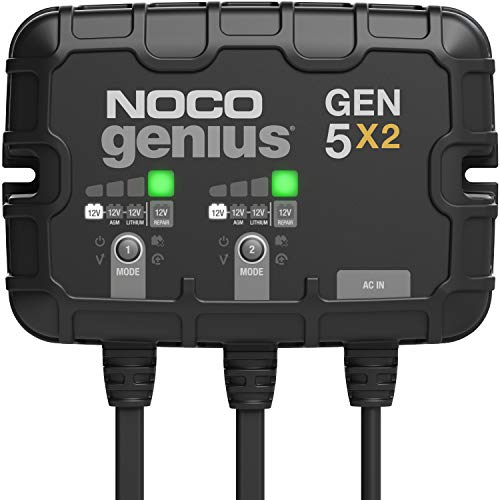
- Best for: Compact two-bank onboard charging for boats that charge overnight.
- 2-bank onboard charger, 5A per bank, 10A total
- 12V output
- Selectable 12V, AGM, lithium and repair modes
- IP68 waterproof

- Best for: Faster two-bank onboard charging for hard-working trolling batteries.
- 2-bank onboard charger, 10A per bank, 20A total
- 12V output
- Selectable 12V, AGM, lithium and repair modes
- Waterproof onboard housing

- Best for: Single-battery charging and upkeep for stored boats.
- 10-amp output for 6V and 12V batteries
- Fully automatic multi-stage charging
- Temperature compensation
- Force mode charges batteries as low as 0 volts
All 4 Picks at a Glance
| Product | Specs | Action |
|---|---|---|
| NOCO Genius GEN5X2 |
| Check price on Amazon |
| NOCO Genius GENPRO10X2 |
| Check price on Amazon |
| NOCO Genius10 |
| Check price on Amazon |
 Schumacher SC1281 |
| Check price on Amazon |
Our Top Picks
- NOCO GEN5X2 12V 10A 2-Bank OnBoard Marine Battery10A (5A per Bank)9.15 x 7.2 x 5.39 inches4.17 PoundsCheck on Amazon
- NOCO GENPRO10X2 12V 20A 2-Bank OnBoard Marine Battery20A (10A per Bank)10.28 x 9.25 x 6.06 inchesCheck on Amazon

A boat battery charger has one job that matters: making sure the starter battery turns the engine over and the trolling batteries last the whole day on the water. The best ones mount onboard, charge each battery on its own bank, match the battery chemistry, and survive spray, vibration and damp storage. The real choice is not the brand on the case but the bank count, the output per bank, and whether the charger handles the battery types already sitting in your boat.
This guide is written for boat owners who want an onboard or portable charger for starter, deep-cycle and trolling batteries. Each charger below was picked from the details shown on its own Amazon listing, with bank count, output, battery compatibility and waterproof rating checked against the page.
Quick Picks
As an Amazon Associate we earn from qualifying purchases
| Product | Best for | Key spec from title |
|---|---|---|
| NOCO Genius GEN5X2 | Compact two-bank onboard charging | 2-bank, 5A per bank |
| NOCO Genius GENPRO10X2 | Faster two-bank onboard charging | 2-bank, 10A per bank |
| NOCO Genius10 | Single-battery charging and upkeep | 10A, 6V and 12V |
| Schumacher SC1281 | Charging plus engine-start assist | 6A charge, 100A engine start |
How to Choose
Bank Count and Battery Layout
Bank count decides how many batteries a charger serves at once, so count your batteries first. A two-bank charger covers a starter battery plus one trolling or house battery, which suits most small and mid-size boats, while a three-bank charger serves boats with two trolling batteries and a starter. Each bank should charge its battery independently, so a weak battery does not drag down the others. Check the wiring in your boat, confirm how many 12V batteries you run, and pick a charger with at least one bank per battery. Extra banks also leave room for a future house battery.
Output Per Bank and Charging Speed
Output per bank decides how quickly a drained battery recovers, and the number on the box deserves a careful read. A 5-amp bank tops up a battery slowly overnight, which suits boats that sit plugged in at the dock, while a 10-amp bank refills a deeply drained trolling battery in far less time. Total output can mislead, since a 20-amp charger split across two banks delivers 10 amps to each, not 20 amps to one. Match the per-bank output to how deeply your batteries drain and how long you have between trips. Higher per-bank output also shortens the wait between back-to-back trips.
Battery Types and Charging Modes
Battery types decide which charging modes you need, since flooded, AGM, gel and lithium batteries charge differently. Look for a charger with selectable modes for each bank, so a lithium trolling battery and a flooded starter battery can charge correctly side by side. A repair or desulfation mode helps recover a battery that sat unused through winter, though it cannot revive a battery with a dead cell. Check the battery labels in your boat, confirm the charger lists each type, and set each bank to match its battery before the first charge. Label each bank once set, so a helper cannot change it by mistake.
Waterproofing and Mounting
Waterproofing and mounting decide whether a charger survives life on a boat. An onboard charger should carry a waterproof rating such as IP68, which protects against spray and brief immersion, and a sealed case that resists corrosion from salt air. Measure the mounting space before ordering, since onboard chargers need room for cables and airflow around the case. A portable charger suits owners who charge batteries at home, yet it needs a dry storage spot and a plan for moving it between the garage and the boat. Stainless fasteners resist rust where the charger meets a damp locker wall.
The 4 Best Options
NOCO Genius GEN5X2
- Best for: Compact two-bank onboard charging for boats that charge overnight.
- 2-bank onboard charger, 5A per bank, 10A total
- 12V output
- Selectable 12V, AGM, lithium and repair modes
- IP68 waterproof
Compact two-bank onboard charging for boats that charge overnight.
The 5-amp banks charge slowly, so deeply drained batteries need a full night.
The NOCO Genius GEN5X2 is the compact onboard pick for boats with two 12V batteries. Its two independent banks deliver 5 amps each, for 10 amps total, which suits overnight charging at the dock. Selectable modes cover 12V, AGM, lithium and repair settings, so each bank can match its battery type. The IP68 waterproof housing stands up to spray and damp storage, and the compact 7.2 by 9.15 by 5.39 inch body fits tight compartments. A 3-year limited warranty backs the unit for long-term onboard use.
Watch out for: The 5-amp banks charge slowly, so deeply drained batteries need a full night.
NOCO Genius GENPRO10X2
- Best for: Faster two-bank onboard charging for hard-working trolling batteries.
- 2-bank onboard charger, 10A per bank, 20A total
- 12V output
- Selectable 12V, AGM, lithium and repair modes
- Waterproof onboard housing
Faster two-bank onboard charging for hard-working trolling batteries.
It needs more mounting space than the compact GEN5X2, so measure first.
The NOCO Genius GENPRO10X2 is the faster two-bank onboard option for boats whose trolling batteries drain hard each trip. Its two independent banks deliver 10 amps each, for 20 amps total, which refills a deeply drained battery in far less time than a 5-amp bank. Selectable modes cover 12V, AGM, lithium and repair settings for each bank, so mixed battery types charge correctly side by side. The waterproof onboard housing is built for harsh marine conditions, and the unit is 19 percent smaller than the earlier GEN2 design for easier mounting.
Watch out for: It needs more mounting space than the compact GEN5X2, so measure first.
NOCO Genius10
- Best for: Single-battery charging and upkeep for stored boats.
- 10-amp output for 6V and 12V batteries
- Fully automatic multi-stage charging
- Temperature compensation
- Force mode charges batteries as low as 0 volts
Single-battery charging and upkeep for stored boats.
It serves one battery at a time, so multi-battery boats need a multi-bank model.
The NOCO Genius10 is the single-battery choice for owners who charge one starter or house battery at a time. Its 10-amp output covers both 6V and 12V batteries, and fully automatic multi-stage charging adjusts as the battery fills. Temperature compensation adapts to hot and cold weather, and a force mode charges batteries as low as 0 volts, which helps after a long winter in storage. The unit works with lead-acid and lithium batteries, and its portable size suits owners who charge batteries in the garage rather than onboard.
Watch out for: It serves one battery at a time, so multi-battery boats need a multi-bank model.
Schumacher SC1281
- Best for: Charging plus engine-start assist for a flat battery.
- 6A charge, 2A to 6A microprocessor-controlled
- 30-amp boost, 100-amp engine start
- 6V and 12V battery support
- 5-in-1: start, charge, maintain, test and restore
Charging plus engine-start assist for a flat battery.
It is a portable bench-style unit, not a permanently mounted onboard charger.
The Schumacher SC1281 is the multi-purpose pick for owners who want charging, maintenance, testing and engine-start assist in one box. Its 6-amp charge, with a 2-amp to 6-amp range, tops up 6V and 12V batteries, while a 30-amp boost and a 100-amp engine start help a flat battery turn an engine over. Automatic desulfation mode works to restore batteries that sat unused, and reverse hook-up protection guards against reversed clamps. The 5-in-1 design starts, charges, maintains, tests and reconditions batteries for cars, boats and power sport vehicles.
Watch out for: It is a portable bench-style unit, not a permanently mounted onboard charger.
Which One Fits Your Situation
Two-battery boats at the dock
Boats with a starter battery and one trolling battery should choose the NOCO Genius GEN5X2, which mounts onboard and charges both banks overnight at the dock. Plug in when you tie up, set each bank to match its battery type, and let the charger maintain both batteries until the next trip. A compact onboard unit keeps the setup simple, and the waterproof housing handles spray without a second thought.
Hard-working trolling batteries
Boats whose trolling batteries drain deeply each trip should pick the NOCO Genius GENPRO10X2, since its 10 amps per bank refills a drained battery far faster than a 5-amp bank. Mount it where cables reach both batteries easily, confirm the mounting space fits its larger body, and set each bank for its battery chemistry. Faster charging matters most when you fish two days in a row and the dock time between trips is short.
One battery in storage
Owners with a single battery in a stored boat should choose the NOCO Genius10, which charges and maintains one 6V or 12V battery in the garage. Connect it before winter, let temperature compensation adjust through the cold months, and use force mode if the battery reads very low after months idle. A portable charger is easy to move between the boat, the garage and a second vehicle when needed.
Flat battery and engine start
Owners who face a flat battery at the ramp should pick the Schumacher SC1281, which pairs charging with a 100-amp engine start and a 30-amp boost. Connect the clamps correctly, use the boost to help the engine turn over, then let the charger top up the battery once the engine runs. Keep the unit in the tow vehicle or garage rather than mounted onboard, and check the clamps and cables before each season.
Common Mistakes
- Buying a one-bank charger for a boat that runs two or three batteries.
- Reading total output as per-bank output and expecting faster charging than the charger delivers.
- Setting every bank to the same mode when the batteries use different chemistries.
- Mounting an onboard charger where cables cannot reach or air cannot move.
- Leaving a battery uncharged all winter, then expecting a charger to revive a dead cell.
Frequently Asked Questions
How many banks do I need on a boat battery charger?
You need one bank per 12V battery in your boat, so a starter battery plus one trolling battery needs a two-bank charger. Count every battery the charger must serve, then pick a charger with at least that many independent banks. Fewer banks force you to rotate connections, which leaves one battery uncharged each night.
Can one charger handle lithium and lead-acid batteries together?
Yes, a charger with selectable modes per bank can handle a lithium trolling battery and a lead-acid starter battery at the same time. Set each bank to match its battery type before charging, since the wrong mode can undercharge or stress a battery. The NOCO models here offer selectable modes for each bank, which covers mixed setups.
Is an onboard charger better than a portable one?
An onboard charger suits boats that stay plugged in at the dock, since it mounts once and charges every battery without moving cables. A portable charger suits owners who charge batteries at home or share one charger between vehicles. Choose onboard for convenience and portable for flexibility, and match the choice to where your boat spends most of its time.
How long does a boat battery take to charge?
Charging time depends on how deeply the battery drained and the output per bank. A lightly used battery on a 10-amp bank refills in a few hours, while a deeply drained one on a 5-amp bank needs overnight. Give the charger a full night when the battery ran low, and use maintenance mode to keep it connected safely once full.
FAQ
How many banks do I need on a boat battery charger?
Can one charger handle lithium and lead-acid batteries together?
Is an onboard charger better than a portable one?
How long does a boat battery take to charge?
More from Amazon
Programs that pair well with the guide above. Offers and eligibility are set by Amazon and may change.
Free shipping on eligible items, Prime Video and more. Eligible new members can start with a free trial.
Start a Prime free trialA Prime membership for ages 18-24 with a trial period. Eligibility is set by Amazon.
See Prime for Young AdultsAudiobooks and podcasts to listen to on the go. Eligible new members can start with a free trial.
Try Audible freeAd-free music streaming. Eligible new subscribers can start with a free trial.
Try Music Unlimited freeAs an Amazon Associate we earn from qualifying purchases.