Key takeaways
- Compare USCaster mower tire and wheel assemblies for riding mower fronts, with sizes, hub types, ply and load figures taken from the product listings.
Front tires decide how a riding mower steers, and they fail in ways that sneak up on you: sidewalls that crack over winter storage, beads that leak a little more air every week, and tread that has worn smooth enough to push wide on damp turns. Because the front pair also carries the deck end of the machine, a worn set makes the whole mower feel vague. The real decision is not which tire looks toughest, but which assembly repeats your current size, hub style and bushing bore exactly, in a construction built to last.

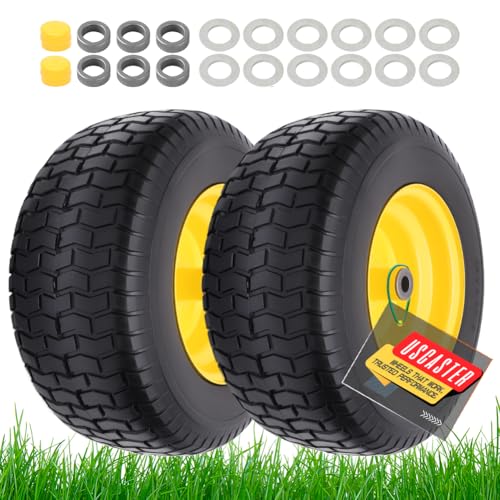
This guide is for owners of riding mowers and lawn tractors whose front tires are cracked, leaking or worn, and who would rather swap a complete assembly than wrestle a bare tire onto an old rim. Both USCaster assemblies below are sold as two-packs for the front axle, and every size, hub measurement and load figure quoted here comes from the Amazon listing data for each product.
Quick Picks
As an Amazon Associate we earn from qualifying purchases
| Product | Best for | Key spec from title |
|---|---|---|
| USCaster 15×6.00-6 Lawn Mower Tire and Wheel, Gray, 2 Pack | Riding mower fronts that need an air-filled replacement assembly | 4-ply tubeless, 3-inch centered hub |
| USCaster 16×6.50-8 Flat Free Lawn Mower Tire and Wheel, 2 Pack | Owners who want to stop fixing front flats for good | Solid flat-free tire, 3-inch offset hub |
How to Choose
Match the sidewall size before anything else
A front mower tire size such as 15×6.00-6 or 16×6.50-8 packs three separate fitments into one string: overall diameter, section width and rim diameter. All three have to match the tire coming off your mower, because the deck, steering linkage and fender clearance were arranged around those exact dimensions. A 16×6.50-8 assembly will not squeeze onto a machine built for 15×6.00-6, even though both are common front sizes. Read the numbers molded into the old sidewall, write them down, and treat any assembly that does not repeat them as the wrong part, however similar it looks in a photograph.
Decide between pneumatic and flat-free construction
The USCaster line splits cleanly on this choice. A pneumatic tubeless tire rides on a cushion of air, which softens the jolt from ruts, roots and driveway edges and keeps steering feel close to what the mower had when new. A solid flat-free tire gives up that air cushion in exchange for never leaking, never needing a pressure check and never stranding the mower mid-job with a thorn puncture. On smooth, finished lawns the pneumatic assembly is the gentler option; on rough ground littered with thorns, stubble or construction debris, the flat-free assembly removes the most common front-tire failure entirely.
Check the hub style and bushing bore
A tire and wheel assembly only fits if the hub matches your axle arrangement, and this is where otherwise correct orders go wrong. The 15×6.00-6 USCaster assembly uses a 3-inch centered hub, while the 16×6.50-8 flat-free assembly uses a 3-inch offset hub, and those two geometries place the wheel differently on the axle, so they are not interchangeable. Both listings state a 3/4-inch bushing bore. Before ordering, measure the hub length and position on your current wheel, confirm the axle diameter it slides onto, and check whether your setup uses spacers or washers that the new assembly must accommodate.
Weigh the load figure against how the mower works
Each front assembly carries a stated maximum load, 570 pounds for the 15×6.00-6 pair and 400 pounds for the 16×6.50-8 flat-free pair, and that figure should clear the weight your front axle actually bears with the deck fitted and the operator aboard. Most residential riding mowers sit comfortably inside either number, but a heavy cast-iron front axle, a mounted snow blade or a front weight kit all push the figure upward. Treat the listing’s load number as a ceiling to stay under rather than a target, and remember that a one-piece welded rim, which both of these assemblies use, is the part that keeps that capacity honest over seasons of impacts.
The 2 Best Options
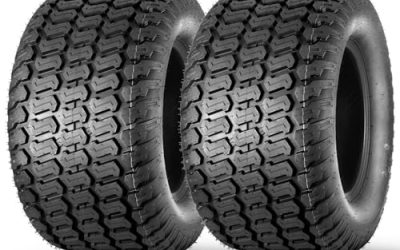
USCaster 15×6.00-6 Lawn Mower Tire and Wheel, Gray, 2 Pack
This is the like-for-like front replacement for the long list of riding mowers and lawn tractors that left the factory on 15×6.00-6 fronts. The listing names John Deere, Craftsman and Husqvarna machines among its fitments, and the assembly arrives as a tire already mounted on a reinforced one-piece welded rim, so the swap is an axle-off, axle-on job rather than a tire-iron fight. The 4-ply tubeless casing keeps the air-cushioned ride these mowers were tuned for, and the stated 570-pound maximum load leaves sensible headroom for a residential tractor with its deck fitted.
Specs
- Size: 15×6.00-6
- Tire type: Tubeless pneumatic
- Ply rating: 4-ply
- Rim: Reinforced one-piece welded rim, included
- Hub: 3-inch centered hub
- Bushing bore: 3/4 inch
- Maximum load capacity: 570 pounds
- Unit count: 2
- Fitment examples from listing: John Deere, Craftsman, Husqvarna riding mowers
Best for: Owners replacing worn or leaking 15×6.00-6 fronts on riding mowers and lawn tractors who want the original air-filled ride.
Watch out for: The centered hub must match your existing wheel; if your mower uses an offset hub, this assembly will sit wrong on the axle even though the tire size matches.
ASIN: B0FBX38H2S
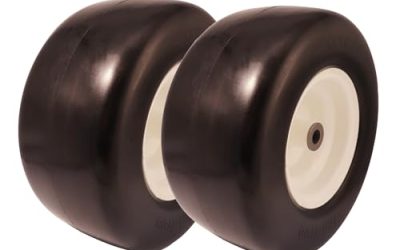
USCaster 16×6.50-8 Flat Free Lawn Mower Tire and Wheel, 2 Pack
The 16×6.50-8 assembly takes the opposite approach to durability: the tire is solid, so there is no air to lose and no puncture that can end a mowing session early. The listing identifies it for front-wheel use and names John Deere and Craftsman mower ranges as fitment examples, with a stated maximum load capacity of 400 pounds carried on the same style of reinforced one-piece welded rim as its pneumatic stablemate. Choose it for a mower that works rough, thorny or debris-strewn ground where front flats have been a recurring chore rather than a rare annoyance.
Specs
- Size: 16×6.50-8
- Tire type: Solid flat-free
- Rim: Reinforced one-piece welded rim, included
- Hub: 3-inch offset hub
- Bushing bore: 3/4 inch
- Maximum load capacity: 400 pounds
- Unit count: 2
- Position: Front wheel only, per listing
- Fitment examples from listing: John Deere and Craftsman mower ranges
Best for: Mower owners whose front tires keep puncturing on rough or debris-covered ground and who want a fit-and-forget front pair.
Watch out for: The listing rules out rear-wheel use, and the solid tire rides firmer than a pneumatic one, so expect more vibration through the steering on hard, uneven surfaces.
ASIN: B0FBWSGYVB
Which One Fits Your Situation
Your fronts lose air between mowings
Slow leaks at the bead or through a weather-checked sidewall are the classic sign that a pneumatic front has reached the end of its life. If your mower runs 15×6.00-6 fronts with a centered hub, the USCaster 15×6.00-6 assembly replaces tire and rim together, which removes both the tired casing and a possibly corroded bead seat from the equation in a single swap, and restores the steering feel the mower had when its tires held pressure properly.
Thorns and debris keep flattening your fronts
Repeated punctures are a ground problem, not bad luck, and patching or tubing a front tire only resets the clock until the next thorn. If your machine takes 16×6.50-8 fronts on an offset hub, the flat-free USCaster assembly ends that cycle outright, because a solid tire cannot deflate. The trade is a firmer ride, which matters little at mower speeds on the kind of rough ground that causes the punctures in the first place.
You are replacing a bent or rusted front wheel
A rim bent at the bead or rusted through will defeat any new tire mounted on it, tubeless especially, because the seal depends on a clean, true seat. Both assemblies here include a reinforced one-piece welded rim, so either solves a wheel problem and a tire problem together. Pick by size and hub: 15×6.00-6 centered for the pneumatic assembly, 16×6.50-8 offset for the flat-free one, and confirm the 3/4-inch bushing bore first.
Your mower steers a front blade or heavy deck
Front-mounted weight, whether a snow blade, a weight kit or a heavy fabricated deck, loads the front tires harder than ordinary mowing and punishes under-rated assemblies. The 15×6.00-6 USCaster pair carries the higher stated figure of the two at 570 pounds, making it the safer starting point when the front axle works for a living, provided its size and centered hub match your machine. Keep the stated maximum in view and do not exceed it.
Common Mistakes
- Ordering by diameter alone, so a 16×6.50-8 assembly arrives for a mower built around 15×6.00-6 fronts and cannot be used at all.
- Ignoring hub geometry: a centered-hub assembly and an offset-hub assembly with the same bushing bore still position the wheel differently, and forcing the wrong one on can bind the steering or leave the wheel loose on the axle.
- Assuming a flat-free tire fits anywhere a pneumatic one did, when the 16×6.50-8 listing limits that assembly to front-wheel use only.
- Replacing only the visibly damaged front, which leaves one new tire steering against one worn tire and makes the mower track unevenly on slopes and turns.
- Skipping the bushing check: both listings state a 3/4-inch bore, and an axle that needs a different bore or extra spacers will not be fixed by tightening the retaining hardware harder.
Frequently Asked Questions
How do I read the size on my current front mower tire?
Look for a string such as 15×6.00-6 molded into the sidewall. The first number is the approximate overall diameter in inches, the second is the section width, and the number after the dash is the rim diameter. All three must match the replacement assembly exactly, and the mower manual or deck plate usually repeats the size if the sidewall lettering has worn away.
Are these USCaster assemblies sold as pairs?
Yes. Both listings in this guide are two-packs, so one order replaces both front tires at once. That matters because front tires steer as a pair: matching age, tread and construction on both sides keeps the mower tracking straight and turning evenly, instead of pulling toward the older, softer or more worn side on every pass across the lawn.
Can the flat-free 16×6.50-8 assembly go on the rear axle?
No. The listing for the USCaster 16×6.50-8 identifies it as a front-wheel assembly and rules out rear-wheel applications. Rear fitments carry the drive load and use different sizes and hub arrangements, so a front assembly should never be moved to the back. Match the rear size from its own sidewall and choose an assembly listed for that position instead.
Do I need to inflate the pneumatic 15×6.00-6 assembly?
Yes. It is a tubeless pneumatic tire, so it needs air at the pressure your mower maker specifies for the front axle, checked with the tire cold. The flat-free 16×6.50-8 assembly needs no inflation at all, which is its main convenience. For the pneumatic pair, recheck pressure after the first few mowings, because a fresh bead seat can settle and lose a little air early on.
FAQ
How do I read the size on my current front mower tire?
Are these USCaster assemblies sold as pairs?
Can the flat-free 16×6.50-8 assembly go on the rear axle?
Do I need to inflate the pneumatic 15×6.00-6 assembly?
More from Amazon
Programs that pair well with the guide above. Offers and eligibility are set by Amazon and may change.
Free shipping on eligible items, Prime Video and more. Eligible new members can start with a free trial.
Start a Prime free trialA Prime membership for ages 18-24 with a trial period. Eligibility is set by Amazon.
See Prime for Young AdultsAudiobooks and podcasts to listen to on the go. Eligible new members can start with a free trial.
Try Audible freeAd-free music streaming. Eligible new subscribers can start with a free trial.
Try Music Unlimited freeAs an Amazon Associate we earn from qualifying purchases.