Key takeaways
- Best overall for heavy-duty recovery: 13,500 lb Recovery Winch with 1/2” Synthetic Rope — A high-capacity 12V winch with synthetic rope, two wireless remotes, and an IP68-rated all-metal housing.
- Best portable kit for lighter vehicles: VEVOR 3500 lbs Portable Winch — A box-style 12V kit that includes synthetic rope, wireless and wired remotes, a fairlead, clevis hook, and strap.
- Best 4,500-pound utility option: RUGCEL 4500lb Portable Winch — Combines a steel mounting plate, integrated hawse fairlead, synthetic rope, and infrared remote control.
- Best mid-capacity kit: VEVOR 4500 lbs Portable Winch — Provides a box-style recovery setup with dual wireless and wired remotes and included recovery hardware.
- Best lightweight backup: Portable Drill Winch of 1000 Lbs — A handheld drill winch with 40 feet of synthetic rope and a 360-degree rotating hook for lighter pulling tasks.
- Best high-capacity alternative: Winch13500lbs 12V Waterproof Electric Winch — A 13,500-pound 12V electric winch with synthetic rope and remote control for trucks, SUVs, trailers, and off-road vehicles.
- Best for dual control and water resistance: SINOKING PRO Series 13500 lb Electric Winch — Offers synthetic rope, a 2-in-1 wired/wireless remote, IP67 waterproofing, and a 7 HP motor.
- Best 4,000-pound portable option: Warrior Winches Trojan 12V Portable Winch — A 4,000-pound 12V portable winch with synthetic rope for users seeking a middle-capacity design.
The best portable winch depends on the vehicle, the recovery load, and how much portability matters. The products in this guide range from a 1,000-pound drill winch for light pulling and backup duties to 13,500-pound 12V electric winches intended for larger trucks, SUVs, trailers, and demanding recovery situations. Synthetic rope appears across the listed options, while the designs vary from handheld tools to box-style recovery kits and conventional electric winches.
For serious vehicle recovery, start by matching the winch’s stated capacity to the vehicle and recovery conditions rather than choosing the highest number automatically. A larger rating may be appropriate for a full-size truck, but a compact ATV or UTV may benefit more from a manageable portable kit with a fairlead, hook, strap, and flexible control options. Also verify the mounting method, battery connection, remote-control arrangement, rope specifications, and water-resistance details before buying.
Top picks at a glance
- Best overall for heavy-duty recovery: 13,500 lb Recovery Winch with 1/2” Synthetic Rope — A high-capacity 12V winch with synthetic rope, two wireless remotes, and an IP68-rated all-metal housing.
- Best portable kit for lighter vehicles: VEVOR 3500 lbs Portable Winch — A box-style 12V kit that includes synthetic rope, wireless and wired remotes, a fairlead, clevis hook, and strap.
- Best 4,500-pound utility option: RUGCEL 4500lb Portable Winch — Combines a steel mounting plate, integrated hawse fairlead, synthetic rope, and infrared remote control.
- Best mid-capacity kit: VEVOR 4500 lbs Portable Winch — Provides a box-style recovery setup with dual wireless and wired remotes and included recovery hardware.
- Best lightweight backup: Portable Drill Winch of 1000 Lbs — A handheld drill winch with 40 feet of synthetic rope and a 360-degree rotating hook for lighter pulling tasks.
- Best high-capacity alternative: Winch13500lbs 12V Waterproof Electric Winch — A 13,500-pound 12V electric winch with synthetic rope and remote control for trucks, SUVs, trailers, and off-road vehicles.
- Best for dual control and water resistance: SINOKING PRO Series 13500 lb Electric Winch — Offers synthetic rope, a 2-in-1 wired/wireless remote, IP67 waterproofing, and a 7 HP motor.
- Best 4,000-pound portable option: Warrior Winches Trojan 12V Portable Winch — A 4,000-pound 12V portable winch with synthetic rope for users seeking a middle-capacity design.
Our top picks




As an Amazon Associate we earn from qualifying purchases at no extra cost to you.
How We Compared This Guide
This guide is based on the product information available for each listing, including stated pulling capacity, voltage, rope material, control method, portability features, included recovery hardware, and water-resistance claims where provided. The comparison also considers how each design fits common use cases: full-size truck recovery, SUV and trailer use, ATV and UTV pulling, and light-duty backup work.
Because complete specifications were not available for every product, this guide does not assume details such as motor power, line speed, duty cycle, battery draw, mounting dimensions, rope length, gear ratio, or included accessories unless the product information states them. Before purchasing, confirm those details on the current product page and in the manufacturer’s instructions. In particular, a product described as portable may still require a specific mounting plate, hitch arrangement, anchor strap, battery connection, or compatible power drill.
How to Choose a Portable Winch for Off-Road Recovery
1. Match pulling capacity to the vehicle and recovery situation
Rated pulling capacity is the first specification to compare, but it should not be treated as a simple ranking. The products listed here span 1,000, 3,500, 4,000, 4,500, and 13,500 pounds. That broad range reflects very different jobs. A 1,000-pound drill winch is aimed at lighter lifting and dragging tasks, while a 13,500-pound electric winch is positioned for truck, SUV, trailer, and serious off-road applications.
Start with the vehicle’s actual weight, including passengers, equipment, fuel, cargo, and modifications. Then consider the recovery surface. A vehicle stuck on level, firm ground presents a different load from one buried in mud, pointed uphill, or obstructed by rocks. The winch may also need to overcome rolling resistance, suction from mud, and the angle created by the recovery line.
A useful selection approach is to choose a rated capacity comfortably above the vehicle’s expected recovery load rather than selecting a unit that only matches the vehicle’s curb weight. If the vehicle is heavily equipped or routinely used in deep mud, steep terrain, or remote conditions, a higher-capacity unit may provide more margin. Do not assume that the listed capacity applies equally through every layer of rope on the drum; check the manufacturer’s load chart and operating instructions.
Mistake to avoid: choosing a winch solely because its headline capacity is high. A large winch can add bulk, demand more electrical capacity, and require a stronger mounting system. Conversely, using a small utility winch for a vehicle recovery can exceed its intended duty and create an unsafe situation.
2. Decide what “portable” needs to mean for your setup
Portable winches use several different approaches. Box-style kits are designed around a self-contained recovery package and may include a fairlead, clevis hook, strap, and more than one control method. The VEVOR 3500-pound and 4,500-pound products both use this style. A handheld drill winch is more compact in concept and is intended for lighter jobs, while conventional 12V electric winches may be better suited to larger vehicles but still require a suitable temporary mounting or anchoring arrangement.
Think about how the winch will travel and where it will be stored. A kit that includes recovery hardware can reduce the number of separate pieces to gather, but it may also occupy more space than a bare winch. A drill-powered model may be convenient as an emergency tool, but it depends on having a compatible drill and should not be treated as a substitute for a vehicle-recovery winch unless its rating and instructions support that use.
Before buying, confirm whether the portable design uses a receiver mount, mounting plate, anchor strap, ground anchor, or another attachment method. Verify that the mounting hardware is rated for the intended load and that the vehicle has a suitable structural recovery point. A winch cannot compensate for a weak anchor or an improvised attachment point.
3. Compare synthetic rope, diameter, length, and condition requirements
Every product in this list is described with synthetic rope, including the 13,500-pound recovery winches, the VEVOR kits, the RUGCEL model, the drill winch, and the Warrior Winches model. Synthetic rope is generally easier to carry than steel cable and avoids the sharp broken strands that can develop in damaged wire rope. It is also a natural fit for portable equipment because reducing line weight makes storage and setup more manageable.
Material alone does not tell you whether the rope suits a particular recovery. Check the rope diameter, length, rated strength, abrasion protection, and termination method. The Portable Drill Winch listing specifically states that it includes 40 feet of synthetic rope; the other listings do not provide rope length, so that information should be confirmed before ordering.
Synthetic rope needs careful inspection. Look for cuts, melted sections, severe fuzzing, flattening, contamination, and abrasion after use. Pay special attention to places where the line contacts a fairlead, rocks, vehicle edges, or tree-protection equipment. Keep the rope clean and dry according to the manufacturer’s instructions, and use a rated tree strap rather than wrapping a bare line around a tree.
Mistake to avoid: assuming synthetic rope is maintenance-free. It can be damaged by heat, sharp edges, ultraviolet exposure, chemicals, and poor spooling. A rope that looks questionable should not be used until its condition and replacement requirements have been evaluated.
4. Treat waterproof ratings as useful information, not a complete guarantee
Water exposure is common in off-road recovery, but the listed products make different water-resistance claims. The first 13,500-pound recovery winch is described as having an IP68 waterproof all-metal housing. The SINOKING PRO Series model is listed with IP67 waterproofing. The other listings do not provide an IP rating, so buyers should not infer a specific level of protection from the word “portable,” “outdoor,” or “waterproof” appearing in a title.
IP ratings describe protection under defined test conditions; they do not mean a winch can be submerged indefinitely, operated without maintenance, or exposed to contaminated water without consequences. Confirm what parts of the system the rating applies to, including the motor, solenoid, controls, connectors, and remote. The instructions should also explain post-exposure care.
After wet or muddy use, inspect the rope, fairlead, hook, electrical connections, and mounting points. Mud and grit can affect moving components, while moisture at battery connections can contribute to corrosion. Follow the manufacturer’s cleaning, drying, lubrication, and inspection guidance rather than relying on an IP label alone.
5. Choose wired, wireless, or dual controls deliberately
Control flexibility matters when the winch operator needs to stand clear of the line or cannot remain beside the vehicle. The first 13,500-pound recovery winch lists two wireless remotes. Both VEVOR kits list wireless and wired remotes, and the SINOKING PRO Series model lists a 2-in-1 wired/wireless remote. The RUGCEL model specifies an infrared remote control, while the other listings identify remote control without providing the full control arrangement.
Wireless operation can make positioning more convenient, but it depends on remote batteries, signal conditions, and a usable control range. A wired remote provides a direct alternative and may be valuable if the wireless remote is lost, uncharged, obstructed, or otherwise unavailable. If a product includes only one control type, check whether a backup control is available and whether the connection is weather-protected.
Read the remote instructions before a recovery. Confirm how the controls operate forward and reverse, whether the winch has a separate clutch or freespool procedure, and how the remote is stored when not in use. Keep bystanders away from the line and maintain a position that provides a clear view of the vehicle, anchor, rope, and hook.
6. Verify the 12V power requirements
Most of the electric winches in this list are described as 12V DC models. That does not mean every 12V vehicle installation will power every winch equally well. Motor size, current demand, cable length, battery condition, alternator output, duty cycle, and connection quality all affect real-world operation. The SINOKING listing additionally states a 7 HP motor, but the listings do not provide comparable motor information for every model.
Check the manufacturer’s required battery type, recommended cable gauge, fuse or circuit protection, grounding method, and maximum current draw. A portable winch may connect directly to a battery, but the connection must be properly protected and kept clear of moving parts, hot exhaust components, and sharp edges. Long or undersized cables can cause voltage drop and heat.
Do not assume that a vehicle’s accessory socket can power a high-capacity winch. Many recovery winches require direct battery connections and heavy-duty connectors. If you plan to move the winch between vehicles, consider whether each vehicle has compatible connection points and sufficient electrical capacity.
7. Check the mounting system, fairlead, and recovery hardware
A winch’s rated capacity is useful only when the entire recovery system can handle the load. Inspect the mounting plate, receiver, anchor point, fairlead, hook, shackle, straps, and vehicle attachment points as one system. The RUGCEL product is described with a steel mounting plate and integrated hawse fairlead. The VEVOR products are described as box-style kits with a fairlead, clevis hook, and strap. These details can simplify setup, but they do not eliminate the need to confirm compatibility and ratings.
A fairlead helps guide the rope onto and off the drum, while a mounting plate or receiver arrangement determines how the winch transfers force into the vehicle or anchor. Confirm dimensions, bolt patterns, receiver size, line path, and clearance. A product may be called portable but still require a specific plate or adapter that is not included.
Use rated recovery hardware with compatible working-load limits. Do not substitute tow balls, tie-down points, luggage straps, or unknown hardware for recovery-rated equipment. Keep the rope as straight as practical, use a pulley or snatch block only when it is properly rated, and follow the winch maker’s instructions for line routing.
8. Understand duty cycle, heat, storage, and maintenance
Headline capacity does not describe how long a winch can run continuously. Electric winches generate heat, and pulling speed and load can change as the rope layers build on the drum. These listings do not provide comparable duty-cycle, line-speed, motor-temperature, or thermal-protection specifications, so those details should be checked before purchase, especially for repeated recoveries or commercial use.
Allow the winch to cool when the instructions call for a rest period. Avoid repeatedly stalling the motor, and monitor the battery and cables for excessive heat. Keep the rope evenly spooled under suitable tension, inspect the hook and attachment points, and replace damaged components with parts approved for the model.
Storage is also part of portability. Protect the winch and remote from unnecessary moisture, secure loose hardware, and keep the rope away from chemicals and sharp objects. A box-style kit may be easier to organize because its main recovery pieces are grouped together, while a bare winch may require a separate storage plan for the remote, strap, hook accessories, and electrical leads.
Portable winch buying checklist
- Confirm the vehicle’s loaded weight and choose a capacity with appropriate recovery margin.
- Verify whether the winch is intended for truck, SUV, trailer, ATV, UTV, lifting, dragging, or backup use.
- Check the mounting method, attachment points, fairlead position, and included hardware.
- Confirm synthetic-rope diameter, length, rated strength, and inspection requirements.
- Compare wired, wireless, infrared, and dual-control arrangements.
- Verify 12V electrical requirements, cable recommendations, current draw, and battery connections.
- Look for a stated IP rating, but also read the instructions for cleaning and water exposure.
- Confirm duty-cycle limits, replacement parts, storage requirements, and manufacturer support.
Detailed product breakdowns
1. 13,500 lb Recovery Winch with 1/2” Synthetic Rope
This 13,500-pound recovery winch is positioned for demanding vehicle-recovery work, particularly where a Jeep, SUV, truck, or trailer may need substantial pulling capacity. Its product description combines a 12-volt electric design with synthetic rope, an all-metal housing, an IP68 waterproof rating, and two wireless remotes. Those details make it a potentially useful choice for owners who want a high-capacity winch that can be moved or installed for off-road and trailer-related recovery tasks.
Key specifications from the listing:
- 13,500-pound stated capacity
- 12V electric operation
- 1/2-inch synthetic rope
- IP68 waterproof rating
- All-metal housing
- Two wireless remotes
- Product applications include Jeeps, SUVs, trucks, trailers, and off-road recovery
Strengths: The stated capacity is the highest among several vehicle-focused options in this guide, which may give this model a useful margin for larger vehicles and difficult recovery conditions. Synthetic rope is generally easier to handle than steel cable and avoids the sharp broken strands associated with damaged wire rope. The all-metal housing may appeal to buyers who prioritize a robust exterior, while the IP68 designation is a notable specification for people who expect exposure to water, mud, or heavy rain. Two wireless remotes could also be convenient when more than one operator needs a control or when a spare remote is useful.
Trade-offs: A high-capacity winch may be more equipment than needed for a small ATV or UTV. The listing does not identify the motor output, line speed, duty cycle, mounting pattern, fairlead type, hook rating, battery requirements, or whether a wired backup controller is included. Buyers should also confirm the actual rope construction and the meaning of the listed 1/2-inch dimension, since product listings can describe rope size differently. An IP rating does not eliminate the need to protect electrical connections and inspect synthetic rope after abrasion, contamination, or prolonged sunlight.
Best for: Owners of larger Jeeps, SUVs, trucks, or trailers who want a high-rated electric winch with synthetic rope and strong water-resistance specifications.
Skip it if: You only need light pulling for an ATV, utility work, or gear movement, or if your vehicle and mounting system cannot safely support a winch of this class.
Check the current product listing for specifications and fitment details
2. VEVOR Portable Winch, 3,500 lbs 12V DC Electric Winch
The VEVOR 3,500-pound portable winch is described as a box-style recovery kit for ATV and UTV use. Rather than presenting only a winch body, the listing identifies a synthetic rope, wireless and wired remotes, a fairlead, a clevis hook, and a strap. That combination may be attractive to recreational riders who want a transportable recovery setup with several core accessories included in one package.
Key specifications from the listing:
- 3,500-pound stated capacity
- 12V DC electric operation
- Synthetic rope
- Wireless and wired remotes
- Box-style recovery kit
- Fairlead, clevis hook, and strap included according to the product description
- Designed for ATV and UTV off-road and outdoor pulling tasks
Strengths: The box-style design is relevant for users who do not want to commit to a permanent vehicle-mounted installation, although the actual mounting method still needs to be confirmed. The inclusion of both wired and wireless controls provides flexibility: a wireless controller may be convenient during a straightforward pull, while a wired controller can be useful if wireless range, battery condition, or interference becomes a concern. The fairlead, clevis hook, and strap may reduce the number of separate components a buyer needs to source, and the synthetic rope keeps the kit oriented toward lighter, manageable off-road recovery.
Trade-offs: A 3,500-pound rating is aimed more at ATV and UTV duties than at heavy full-size truck recovery. Capacity should not be treated as a guarantee that the winch can extract every vehicle at that weight; slope, mud, tire resistance, anchor arrangement, line layers, and the vehicle’s actual loaded weight all matter. The available data does not state the rope length, motor specifications, gearbox, duty cycle, battery connection method, mounting hardware, or waterproof rating. Buyers should verify whether the included strap is intended as an anchor strap, a tree saver, or another purpose, and should confirm that the fairlead and mounting arrangement match the intended recovery setup.
Best for: ATV and UTV owners seeking a portable electric kit with synthetic rope and both wireless and wired control options.
Skip it if: You need a permanently mounted truck winch, require a capacity substantially above the stated rating, or want documented water-resistance and heavy-duty construction specifications that are not provided here.
Check the current product listing for specifications and fitment details
3. RUGCEL 4,500 lb Portable 12V DC Electric Utility Winch
The RUGCEL portable utility winch has a stated single-line pull of 4,500 pounds and is described for ATV and UTV use. Its listed configuration includes a steel mounting plate, integrated hawse fairlead, synthetic rope, and infrared remote control. This combination gives it a more defined mounting and control profile than a basic handheld pulling tool, while keeping the stated capacity in the light-to-midrange portable category.
Key specifications from the listing:
- 4,500-pound or 2,041-kilogram stated single-line pull
- 12V DC electric operation
- Portable utility-winch design
- Steel mounting plate
- Integrated hawse fairlead
- Synthetic rope
- Infrared remote control
- Listed for ATV and UTV applications
Strengths: The stated 4,500-pound single-line pull places this model above the two smaller-capacity options in this guide while remaining targeted at ATV and UTV work. A steel mounting plate may help buyers who need a defined base for temporary or semi-portable installation. The integrated hawse fairlead is suited to synthetic rope and may simplify the front-of-winch layout compared with sourcing a separate fairlead. An infrared remote can provide remote operation without requiring the operator to remain directly beside the winch, assuming the control path remains available in the intended environment.
Trade-offs: Infrared control can require a usable line of sight, so buyers should verify its operating range and whether a wired control is included. The product information does not specify a wireless radio remote, wired override, rope length, motor rating, waterproof classification, mounting dimensions, battery leads, hook details, or duty cycle. The 4,500-pound figure is a single-line rating, not a promise of the same performance under every line angle or recovery condition. Owners should compare the mounting plate dimensions and bolt pattern with their vehicle or recovery platform before purchase. The synthetic rope should also be protected from sharp edges, abrasion, and heat during use.
Best for: ATV and UTV owners who want a portable 12V utility winch with a steel mounting plate, integrated hawse fairlead, and a stated 4,500-pound single-line rating.
Skip it if: You specifically need a wireless or wired backup controller, a documented waterproof rating, or a capacity intended for large trucks and heavy vehicle recovery.
Check the current product listing for specifications and fitment details
4. VEVOR Portable Winch, 4,500 lbs 12V DC Electric Winch
This VEVOR model is a 4,500-pound box-style portable recovery kit for ATV and UTV outdoor pulling tasks. It shares the kit-oriented format of the smaller VEVOR option but lists a higher pulling capacity. The product description identifies synthetic rope, wireless and wired remotes, a fairlead, a clevis hook, and a strap, making it a candidate for riders who want a portable package rather than a winch body alone.
Key specifications from the listing:
- 4,500-pound stated capacity
- 12V DC electric operation
- Synthetic rope
- Wireless and wired remotes
- Box-style recovery kit
- Fairlead, clevis hook, and strap included according to the product description
- Designed for ATV and UTV off-road and outdoor pulling tasks
Strengths: The higher stated capacity gives this model more room than the 3,500-pound VEVOR kit for appropriately sized ATV and UTV recovery work. Its box-style format is potentially useful for owners who move equipment between vehicles or want to store the winch and accessories together. Wireless and wired controls offer two operating methods, which is a practical advantage when a remote battery is depleted or when the operator prefers a direct connection. The included fairlead, hook, and strap also suggest a more complete starting package than a bare winch.
Trade-offs: The 4,500-pound rating should be matched to the loaded vehicle, terrain, recovery angle, and anchoring arrangement rather than used as a simple vehicle-weight limit. The listing does not describe the kit’s mounting hardware, rope length, motor power, line speed, duty cycle, gearbox, waterproof rating, or electrical connector arrangement. Buyers should determine whether the box-style unit is compatible with their preferred hitch, receiver, anchor, or temporary mounting system. It is also important to confirm the included strap’s intended use and working load limit rather than assuming that every component shares the winch’s headline rating.
Best for: ATV and UTV users who want a portable kit with a 4,500-pound stated capacity, synthetic rope, included recovery accessories, and both wireless and wired controls.
Skip it if: You need a permanent front-mounted winch, a documented IP waterproof rating, or a model specifically sized for full-size truck recovery.
Check the current product listing for specifications and fitment details
5. Portable Drill Winch, 1,000 Lbs
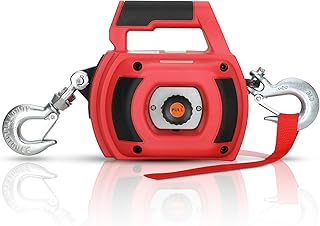
This compact red handheld winch is designed around a different use case from the 12V vehicle winches in this guide. The product description identifies a 1,000-pound capacity, 40 feet of synthetic rope, and a hook that rotates 360 degrees. It is intended for lifting and dragging and is powered through a drill-based handheld format. That makes it more suitable as a light-duty utility tool or backup than as the primary recovery winch for a heavy Jeep, truck, or SUV.
Key specifications from the listing:
- 1,000-pound stated capacity
- Handheld drill-winch design
- 40 feet of synthetic rope
- 360-degree rotating hook
- Red finish
- Listed uses include lifting and dragging
Strengths: The compact format may be easier to store than a conventional electric recovery winch. A 40-foot rope length can provide useful reach for certain light-duty pulling or positioning tasks, though the appropriate working distance depends on the anchor and the task. The rotating hook may help with alignment when the load or anchor point changes direction, and synthetic rope is generally easier to handle than steel cable. Because it is described as a drill winch rather than a permanently installed vehicle winch, it may appeal to users who need occasional utility assistance, equipment movement, or a secondary tool.
Trade-offs: The 1,000-pound rating is substantially lower than the vehicle-focused models in this guide, so it should not be assumed to be suitable for extracting a stuck truck, SUV, or heavily loaded off-road vehicle. The listing does not identify the compatible drill requirements, recommended drill torque or battery platform, line speed, duty cycle, brake design, rope diameter, hook rating, or anchoring method. Buyers should verify whether the stated capacity applies to lifting, dragging, or a particular line layer, since those conditions can differ. Any lifting application also requires special attention to load control and overhead safety.
Best for: Light lifting, dragging, equipment positioning, and emergency utility use where a compact drill-powered tool is more convenient than a full-size winch.
Skip it if: Your primary goal is off-road vehicle recovery, especially for a truck, SUV, Jeep, or loaded trailer, or if you do not already have a compatible drill and secure anchor arrangement.
Check the current product listing for specifications and fitment details
6. 13,500 lb 12V Waterproof Electric Winch with Synthetic Rope
This black electric winch is listed with a 13,500-pound capacity and is marketed for truck, SUV, trailer, boat, towing, and four-wheel-drive off-road applications. The description identifies a 12V system, waterproof construction, synthetic rope, and a remote control. It is therefore oriented toward high-capacity vehicle recovery rather than the smaller portable kits intended primarily for ATVs and UTVs.
Key specifications from the listing:
- 13,500-pound stated capacity
- 12V electric operation
- Synthetic rope
- Waterproof electric-winch description
- Remote control included according to the product description
- Listed with 3/8-inch synthetic rope
- Applications include trucks, SUVs, trailers, boats, towing, and four-wheel-drive off-road vehicles
Strengths: The 13,500-pound headline capacity makes this model relevant to owners considering heavy-duty vehicle recovery. Its listed 12V operation aligns with the electrical systems commonly associated with many trucks and off-road vehicles, although compatibility must still be confirmed. Synthetic rope can reduce handling weight compared with steel cable and is consistent with the needs of portable or recovery-oriented equipment. The stated waterproof design may be valuable for outdoor use, while the remote control allows the operator to stand away from the winch during operation.
Trade-offs: The listing does not provide an IP rating, so buyers should not assume a specific level of protection from water or dust. It also does not state whether the remote is wireless, wired, or both. The product title contains several application categories, including boats and trailers, but those uses may require different mounting arrangements and electrical protection than a truck installation. Buyers should verify mounting dimensions, fairlead type, rope length, hook and shackle details, motor output, line speed, battery-cable length, and whether a recovery strap or mounting plate is included. A 3/8-inch rope specification should also be checked against the intended load and replacement-rope availability.
Best for: Truck, SUV, trailer, and four-wheel-drive owners seeking a high-capacity 12V electric winch with synthetic rope and a remote control.
Skip it if: You need a clearly documented IP rating, dual control methods, or a compact box-style kit that includes mounting and recovery accessories.
Check the current product listing for specifications and fitment details
7. SINOKING PRO Series 13,500 lb Electric Winch
The SINOKING PRO Series winch is a 13,500-pound 12V towing winch with synthetic rope. Its description adds a 2-in-1 wired and wireless remote system, an IP67 waterproof rating, and a 7 HP motor. It is listed for Jeeps, SUVs, trucks, and trailers, placing it firmly in the high-capacity vehicle-recovery category. Buyers who value control redundancy and a stated ingress-protection rating may find its specifications particularly relevant.
Key specifications from the listing:
- 13,500-pound stated capacity
- 12V towing-winch design
- Synthetic rope
- 2-in-1 wired and wireless remote
- IP67 waterproof rating
- 7 HP motor
- Listed for Jeeps, SUVs, trucks, and trailers
Strengths: The combined wired and wireless control arrangement offers flexibility and a potential fallback if one control method cannot be used. The IP67 rating is a specific water- and dust-resistance specification, giving buyers more information than a general “waterproof” description alone. Its 13,500-pound stated capacity and 7 HP motor place it among the more heavy-duty options in this lineup. Synthetic rope is also consistent with buyers who prefer a lighter, more manageable recovery line for off-road use.
Trade-offs: IP67 does not mean the winch is suitable for unlimited submersion or that every external connection remains protected without proper installation. Buyers should inspect the manufacturer’s explanation of the rating and follow the electrical and maintenance instructions. The listing does not state rope diameter or length, fairlead type, mounting pattern, hook details, line speed, duty cycle, battery-cable specifications, or package contents beyond the listed controls. The 7 HP motor figure should not be treated as a direct indication of actual pulling performance without information about gearing, current draw, and line layer. Installation should also be checked against the vehicle’s bumper, mounting plate, battery, and recovery points.
Best for: Jeep, SUV, truck, and trailer owners seeking high capacity, a synthetic rope, a specified IP67 rating, and both wired and wireless control.
Skip it if: You need a small, easily hand-carried ATV winch or a complete box-style recovery kit with a clearly listed strap, hook, and fairlead package.
Check the current product listing for specifications and fitment details
8. Warrior Winches Trojan 12V Portable Winch with Synthetic Rope
The Warrior Winches Trojan is described as a portable 12V winch with synthetic rope and a 4,000-pound capacity. Its product information is concise, but those core details position it between the smaller 1,000-pound drill winch and the higher-capacity 4,500-pound ATV and UTV options. The portable design may appeal to users who need a transportable recovery tool rather than a permanently installed winch.
Key specifications from the listing:
- 4,000-pound stated capacity
- 12V operation
- Portable winch format
- Synthetic rope
- Warrior Winches Trojan model designation
Strengths: A 4,000-pound rating gives this model a useful position for lighter vehicle recovery and general outdoor pulling, subject to the actual load and recovery conditions. The 12V format may be convenient for use with a suitable vehicle battery or portable power arrangement. Synthetic rope can be easier to handle and carry than steel cable, which matters when the winch is transported between locations. The portable design is also potentially helpful for users who operate more than one vehicle or want to avoid a permanent installation.
Trade-offs: The listing does not specify whether the unit includes a mounting plate, fairlead, hook, strap, remote, or connection cables. It also does not identify the rope length or diameter, waterproof or dust-resistance rating, motor output, line speed, duty cycle, mounting method, or control type. Those omissions are important because “portable” can describe several different arrangements, from a box-style kit to a winch that still requires a specific receiver or anchor plate. Buyers should confirm how the Trojan connects to the vehicle, whether the stated capacity is a single-line rating, and whether the intended vehicle’s loaded weight and recovery conditions fall within a safe operating range.
Best for: Buyers looking for a portable 12V synthetic-rope winch with a stated 4,000-pound capacity for appropriately sized light-duty recovery and outdoor pulling.
Skip it if: You need documented waterproof protection, wireless controls, a complete accessory kit, or the higher capacity generally sought for full-size truck recovery.
Check the current product listing for specifications and fitment details
Portable Winch Comparison
The right portable winch depends on more than the headline pulling rating. Vehicle size, recovery method, power source, rope material, controls, mounting hardware, and weather exposure all affect whether a model fits your use. The table below compares the information identified in each product listing. Where the listing does not specify a detail, the safest approach is to check the current listing and owner documentation before buying.
| Product | Listed pulling capacity | Power | Rope or cable | Controls | Water-resistance information | Portable-use details | Best fit |
|---|---|---|---|---|---|---|---|
| 13,500 lb Recovery Winch with 1/2” Synthetic Rope | 13,500 lb | 12V electric | 1/2-inch synthetic rope | Two wireless remotes | IP68; all-metal housing | Portable design is indicated; mounting method and included recovery hardware: check listing | Heavy-duty Jeep, SUV, truck, or trailer recovery |
| VEVOR 3500 lbs 12V DC Electric Winch | 3,500 lb | 12V DC electric | Synthetic rope | Wireless and wired remotes | Check listing | Box-style recovery kit with fairlead, clevis hook, and strap | ATV and UTV pulling or lighter outdoor tasks |
| RUGCEL 4500lb Portable Utility Winch | 4,500 lb / 2,041 kg single-line pull | 12V DC electric | Synthetic rope | Infrared remote control | Check listing | Steel mounting plate and integrated hawse fairlead | ATV, UTV, and general utility pulling |
| VEVOR 4500 lbs 12V DC Electric Winch | 4,500 lb | 12V DC electric | Synthetic rope | Wireless and wired remotes | Check listing | Box-style recovery kit with fairlead, clevis hook, and strap | Mid-range ATV, UTV, and outdoor pulling |
| Portable Drill Winch of 1000 Lbs | 1,000 lb | Drill-powered; compatible drill requirements: check listing | 40-foot synthetic rope | Check listing | Check listing | Handheld design; hook rotates 360 degrees | Light lifting, dragging, and backup duties |
| 13,500 lb Waterproof Electric Winch | 13,500 lb | 12V electric | 3/8-inch synthetic rope | Remote control | Waterproof designation in product title; specific rating: check listing | Truck, towing, boat, trailer, SUV, and four-wheel-drive applications are identified | High-capacity vehicle recovery |
| SINOKING PRO Series 13500 lb Electric Winch | 13,500 lb | 12V electric; 7 HP motor | Synthetic rope | 2-in-1 wired and wireless remote | IP67 | Listed for Jeep, SUV, truck, and trailer use | Heavy-duty recovery with flexible control options |
| Warrior Winches Trojan 12V Portable Winch | 4,000 lb | 12V; further electrical details: check listing | Synthetic rope | Check listing | Check listing | Portable winch design | General-purpose portable recovery and pulling |
Best Pick by Need
Best for maximum listed capacity
The 13,500 lb Recovery Winch with 1/2-inch Synthetic Rope, 13,500 lb Waterproof Electric Winch, and SINOKING PRO Series share the highest listed capacity in this group. They are the models to investigate first for larger Jeeps, SUVs, trucks, and trailers. Capacity alone does not confirm compatibility, however. Check the mounting arrangement, battery and wiring requirements, line rating, and the manufacturer’s instructions for the intended vehicle.
Best for an ATV or UTV recovery kit
The VEVOR 3500 lbs Portable Winch is presented as a box-style recovery kit with a fairlead, clevis hook, strap, synthetic rope, and both wireless and wired remotes. That combination may reduce the need to source basic accessories separately. Its 3,500-pound rating is lower than the 4,000- and 4,500-pound options, so buyers should match it to the ATV, UTV, load, terrain, and recovery plan rather than assuming the kit suits every vehicle.
Best for a 4,500-pound portable setup
Two listings offer a 4,500-pound rating. The RUGCEL Portable Utility Winch identifies a steel mounting plate, integrated hawse fairlead, synthetic rope, and infrared remote control. The VEVOR 4500 lbs Portable Winch identifies a box-style kit, fairlead, clevis hook, strap, and wired and wireless remotes. Choose between them based on whether an integrated plate and infrared control or an accessory-oriented kit better matches your setup.
Best for light lifting or dragging
The Portable Drill Winch of 1000 Lbs is the most specialized option. It lists a 1,000-pound capacity, 40-foot synthetic rope, handheld form, and a hook that rotates 360 degrees. Its drill-powered design makes it potentially useful for light-duty lifting, dragging, or as a compact backup. It should not automatically be treated as a substitute for a vehicle-recovery winch; verify the required drill, duty cycle, anchor method, and operating instructions first.
Best for flexible remote operation
The SINOKING PRO Series lists both wired and wireless controls, as do the two VEVOR box-style models. A wired control can be useful when wireless operation is unsuitable or unavailable, while a wireless remote can let the operator stand away from the line and winch. Before purchase, confirm the remote range, battery type, storage method, and whether both controls are included in the box.
Best when water exposure is a priority
The first 13,500-pound model lists IP68 protection and an all-metal housing. The SINOKING model lists IP67, and another 13,500-pound model is described as waterproof without a specific rating in the listing. These designations are useful comparison points, but they do not eliminate the need for correct installation and maintenance. Check what parts the rating covers, the conditions used for the rating, and the manufacturer’s instructions after immersion, mud, or saltwater exposure.
Portable Winch Setup and Care Tips
- Confirm the recovery load before connecting. Consider the vehicle’s actual weight, cargo, incline, mud, snow, and whether the load is stuck. A headline capacity is not a guarantee that the winch can safely perform every recovery.
- Check the anchor point. A portable winch is only as secure as the receiver, mounting plate, recovery point, tree strap, or other anchor supporting it. Use an attachment point designed for recovery loads, not a decorative tie-down or an unverified bumper component.
- Inspect synthetic rope before use. Look for cuts, melted sections, abrasion, flattened areas, contamination, and unusual stiffness. Follow the rope manufacturer’s replacement and retirement guidance, particularly after a severe pull.
- Keep the line aligned. A fairlead helps guide the rope, but it does not make extreme side pulls safe. Position the winch and anchor so the line pays out as straight as practical, and keep hands, feet, clothing, and bystanders away from the line path.
- Use compatible recovery accessories. Check the working load limits of shackles, straps, hooks, tree protectors, snatch blocks, and mounting hardware. The weakest component controls the system’s practical limit.
- Plan the electrical connection. For 12V electric models, verify cable size, terminals, fuse or circuit protection, battery condition, grounding, and connector placement. Do not assume a vehicle outlet is suitable for a high-current winch.
- Use the control method correctly. Test wired and wireless controls without a load before a trip. Store wireless remotes where they will not be lost or activated accidentally, and keep the wired controller’s connector protected from dirt and moisture.
- Respect duty-cycle limits. Electric winches generate heat. Use short pulls and cooling periods according to the manual rather than holding the motor continuously. A drill winch also depends on the drill’s battery, torque, and operating limits.
- Clean and dry after recovery. Remove mud, grit, and standing water, then inspect the rope, hook, fairlead, terminals, and housing. Waterproof or IP-rated equipment still requires care after repeated exposure.
- Store the rope properly. A synthetic line should be rewound evenly and under appropriate tension so it does not bunch, cross-load, or become trapped beneath later wraps. Follow the product manual for storage and UV protection.
Portable Winch FAQ
How much winch capacity do I need for my vehicle?
Start with the vehicle’s actual recovery weight rather than relying only on its empty curb weight. Add passengers, cargo, accessories, and relevant equipment, then account for mud, an incline, and other resistance. The winch’s advertised rating is only one part of the calculation. Confirm the manufacturer’s capacity guidance and select compatible recovery hardware with suitable working load limits.
Is a 3,500-pound winch suitable for a full-size truck?
These listings position the 3,500-pound VEVOR model toward ATV, UTV, and lighter outdoor pulling tasks. That does not establish suitability for a full-size truck. A truck buyer should check the vehicle’s recovery weight, expected terrain, line-pull requirements, mounting system, and manufacturer guidance before choosing a model at that capacity.
Are 4,000- and 4,500-pound winches interchangeable?
They are not automatically interchangeable for every job. The listed ratings are different, and the models also differ in included equipment, controls, mounting details, and design. Compare the complete recovery system, not just the headline number. The 4,500-pound VEVOR includes a box-style kit with a fairlead, clevis hook, and strap, while the RUGCEL listing identifies a steel mounting plate and integrated hawse fairlead.
What is the difference between wired and wireless winch controls?
A wireless remote can provide operating flexibility and may let the user stand away from the winch. A wired remote does not depend on wireless communication or a remote battery, but it requires a physical connection. Models with both options offer more flexibility, though buyers should confirm range, battery details, connector protection, and included accessories in the listing.
Is synthetic rope better than steel cable for portable recovery?
Synthetic rope is identified on all eight listings, including the drill winch and the high-capacity models. It is generally easier to handle and can reduce the weight of a portable system, but it still needs inspection for abrasion, cuts, heat, contamination, and UV damage. Follow the specific rope-care instructions and never assume that synthetic rope is maintenance-free.
Can I use a portable winch without permanently mounting it?
Several products are explicitly described as portable, and the VEVOR models are identified as box-style recovery kits. The exact temporary mounting method differs by product. Check whether the kit uses a mounting plate, receiver, strap, anchor, or another system, and verify that the anchor point is rated for the intended load before beginning a pull.
Does an IP67 or IP68 rating make a winch safe to submerge?
An IP rating provides useful information about resistance to solids and water under defined test conditions, but it is not permission to ignore installation or maintenance requirements. The first 13,500-pound model lists IP68, while the SINOKING model lists IP67. Check the manufacturer’s explanation of the rating, protect electrical connections, and inspect and dry the winch after water or mud exposure.
What should I check before buying a portable winch online?
Check the rated capacity, rope diameter and length, power requirements, control type, mounting hardware, fairlead, hook, strap, waterproof information, dimensions, weight, warranty, replacement parts, and duty-cycle instructions. Also confirm whether the product is intended for vehicle recovery, utility pulling, lifting, or backup use. The drill winch, for example, lists a 1,000-pound capacity and 40-foot rope but has a different power source and use profile from the 12V electric models.
Final Verdict
The 13,500 lb Recovery Winch with 1/2-inch Synthetic Rope is the leading choice based on its specifications for buyers prioritizing high capacity, synthetic rope, two wireless remotes, IP68 protection, and an all-metal housing. The SINOKING PRO Series is another strong high-capacity option, particularly for shoppers who want both wired and wireless controls and an IP67 designation.
For ATV and UTV owners, the VEVOR 3500 lbs kit emphasizes a complete box-style package, while the VEVOR 4500 lbs kit provides a higher listed capacity with the same general kit-oriented approach. The RUGCEL 4500lb model is worth considering when its steel mounting plate, integrated hawse fairlead, and infrared remote better match the planned setup.
The 1000-pound drill winch occupies a different category: it is a compact light-duty tool and backup, not a direct replacement for a high-capacity vehicle-recovery winch. The Warrior Winches Trojan offers a 4,000-pound portable format with synthetic rope, but buyers should check its controls, electrical specifications, mounting arrangement, and weather protection before deciding.
Ultimately, match the winch to the vehicle and recovery scenario first. Then verify the anchor, power system, accessories, rope condition requirements, control options, and duty cycle. A portable winch is most useful when the entire recovery system—not just the winch rating—is suitable for the load.
FAQ
How much winch capacity do I need for my vehicle?
Is a 3,500-pound winch suitable for a full-size truck?
Are 4,000- and 4,500-pound winches interchangeable?
What is the difference between wired and wireless winch controls?
Is synthetic rope better than steel cable for portable recovery?
Can I use a portable winch without permanently mounting it?
Does an IP67 or IP68 rating make a winch safe to submerge?
What should I check before buying a portable winch online?
More from Amazon
Programs that pair well with the guide above. Offers and eligibility are set by Amazon and may change.
Free shipping on eligible items, Prime Video and more. Eligible new members can start with a free trial.
Start a Prime free trialA Prime membership for ages 18-24 with a trial period. Eligibility is set by Amazon.
See Prime for Young AdultsAudiobooks and podcasts to listen to on the go. Eligible new members can start with a free trial.
Try Audible freeAd-free music streaming. Eligible new subscribers can start with a free trial.
Try Music Unlimited freeAs an Amazon Associate we earn from qualifying purchases.