Key takeaways
- Compare five suspension seatposts that soften bumps and ease saddle discomfort, with travel, fit, and rider weight limits explained before you buy.
Introduction
A rigid seatpost passes every crack, root, and pothole straight through the saddle and into your spine. For riders who deal with back pain, that constant jarring can turn a pleasant ride into a countdown to the next rest stop. A suspension seatpost adds a small amount of controlled movement between the frame and the saddle, taking the sharp edge off impacts before they reach your lower back.
Be clear about what these posts can and cannot do. None of the five below is marketed as a medical device, and none is sold specifically as a treatment for back pain. They are comfort posts described by their makers in terms of vibration damping and bump absorption. If your back pain is persistent or severe, see a clinician or a professional bike fitter first.
The picks below cover the main approaches: coil-spring parallelogram posts, an elastomer parallelogram post, and a carbon leaf-spring post. The right choice depends on your weight, your frame’s seat tube diameter, and the kind of riding you do.
As an Amazon Associate, I earn from qualifying purchases.
How to Choose a Suspension Seatpost for Back Pain
Travel
Travel is the distance the post can compress. Short-travel posts in the 25 to 35 mm range smooth out road buzz, small cracks, and gravel chatter. Posts with around 50 mm of travel handle bigger hits from potholes, roots, and broken pavement. Too much soft travel can feel bouncy under pedalling. For paved riding, 30 to 40 mm is usually enough; for rough gravel or light trails, 50 mm makes more sense.
Mechanism
Most suspension posts use one of three designs. A parallelogram linkage mounts the saddle on a small pivoting arm, so the saddle moves down and slightly back as it compresses, keeping leg extension close to constant. A telescopic post slides straight down inside the seat tube. A leaf-spring post uses flexible carbon blades that bend under load. Parallelogram posts suit comfort riding best, since the arc feels natural and the spring rate can be tuned. Leaf-spring posts are lighter and simpler, but they offer less travel and less adjustment.
Spring rate and rider weight
A suspension post only works when its spring matches your weight. A spring that is too soft will sit compressed all the time and bottom out on every bump. A spring that is too firm will barely move at all. Good posts solve this with interchangeable springs or elastomers sold by rider weight band, or with a preload adjustment that changes how much force is needed to start the travel. Check the weight range for the exact size you are buying. A post rated to 320 lb is a very different product from one with a 220 lb limit, even when the two look alike.
Diameter, length, and setback
Measure your current seatpost before ordering. The diameter must match your frame’s seat tube exactly; common sizes are 27.2, 30.9, and 31.6 mm, and a post that is even slightly off will either slip or refuse to fit. Length matters too: the post needs enough insertion depth to be safe.
Comparison Table
| Seatpost | Travel | Diameter | Rider weight | Mechanism |
|---|---|---|---|---|
| Cirrus Cycles Kinekt 2.1 | 35 mm | 30.9 mm | 65-95 kg | Coil spring parallelogram |
| Cirrus Cycles Kinekt 2.1 XL2 | 35 mm | 27.2 mm | 240-320 lb | Coil spring parallelogram |
| SR Suntour SP12 NCX | 50 mm | 27.2 mm | Up to 120 kg | Coil spring parallelogram |
| Cane Creek Thudbuster ST | 33 mm | 25.4 mm | Elastomer bands | Elastomer parallelogram |
| Ergon CF3 Pro Carbon | 25-30 mm | 27.2 mm | Up to 220 lb | Carbon leaf spring |
Cirrus Cycles Kinekt 2.1

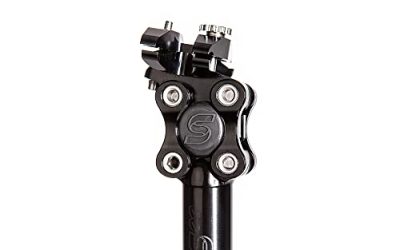
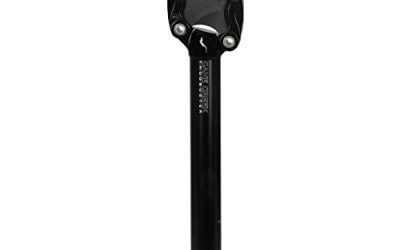
The Kinekt 2.1 is the benchmark coil-spring parallelogram post. This listing covers the mid-size version in a 30.9 mm diameter with a 350 mm length, fitted with the medium spring for riders between 65 and 95 kg. Its 35 mm of travel takes the sting out of potholes and gravel without making the saddle feel disconnected, and the parallelogram arc keeps leg extension close to constant. The coil spring can be swapped for softer or firmer springs, and a preload adjustment fine-tunes how readily the post begins to move. The post is built from 6061 aluminium, with 35 degrees of saddle angle adjustment. The trade-off is weight and bulk: it is noticeably heavier than a rigid post, and the taller linkage head may mean lowering the post slightly to keep your saddle height.
- Specs:
- Diameter: 30.9 mm
- Length: 350 mm
- Travel: 35 mm
- Spring: coil, size M for 65-95 kg riders, swappable
- Material: 6061 aluminium
- Saddle angle adjustment: 35 degrees
Cirrus Cycles Kinekt 2.1 XL2

The XL2 is the same Kinekt 2.1 platform built for heavier riders, and it earns its place here because rider weight is the most common reason a suspension post disappoints. This listing is the 27.2 mm diameter version in a 350 mm length, set up for riders from 240 to 320 lb, with the same 35 mm of coil-spring parallelogram travel but a spring rate matched to a much higher weight band, so the post actually moves under a heavier rider instead of sitting solid. The 27.2 mm diameter suits older steel and aluminium frames, many hybrids, and most gravel bikes. Check the listed weight band before ordering, because the wrong spring rating will feel either dead or bottomless.
- Specs:
- Diameter: 27.2 mm
- Length: 350 mm
- Travel: 35 mm
- Spring: coil, XL2 rating for 240-320 lb riders, swappable
- Material: 6061 aluminium
- Saddle angle adjustment: 35 degrees
SR Suntour SP12 NCX

The SR Suntour SP12 NCX is the value pick, with the longest travel of the five at 50 mm. This listing is the 27.2 mm diameter version in a 400 mm length, which suits taller riders and frames with a lot of exposed post. The parallelogram linkage runs on a preload-adjustable internal coil spring, with three interchangeable spring rates by rider weight: soft up to 75 kg, medium 70 to 95 kg, and hard 90 to 120 kg. Suntour’s setup check is simple: with a helper holding the bike, the post should sit about one third compressed when you are seated. A protective cover keeps dirt and spray out of the linkage. For a rider who wants the most travel for the least money on rough surfaces, it is hard to argue against.
- Specs:
- Diameter: 27.2 mm
- Length: 400 mm
- Travel: 50 mm
- Spring: internal coil, preload adjustable, three rates up to 120 kg
- Mechanism: parallelogram linkage with protective cover
- Setup: about one third compressed when seated
Cane Creek Thudbuster ST

The Thudbuster ST is the longest-running name in suspension seatposts, and the ST is its short-travel version, built for road and light cross-country use. This listing is the earlier ST version in a 25.4 mm diameter with a 350 mm length, a size that fits many older steel frames, hybrids, and folding bikes that modern posts no longer serve. The parallelogram linkage uses interchangeable elastomers instead of a coil spring, sold in bands by rider weight from soft through extra firm. Travel on this generation is 33 mm, aimed at taking the edge off road buzz and expansion joints rather than absorbing big trail hits. The current ST is listed with 50 mm of travel, so check the travel figure on the product page before ordering.
- Specs:
- Diameter: 25.4 mm
- Length: 350 mm
- Travel: 33 mm
- Spring: interchangeable elastomers by rider weight band
- Mechanism: parallelogram linkage
- Use: road and light cross-country
Ergon CF3 Pro Carbon

The Ergon CF3 Pro Carbon is the outlier here, and the lightest and simplest comfort post on the list. Instead of a coil spring or elastomers, it uses two carbon leaf springs that flex rearward and slightly down when the rear wheel hits a bump, giving 25 to 30 mm of movement. The design keeps the saddle angle steady, and at 220 grams it weighs less than many rigid aluminium posts. Ergon lists a 220 lb rider weight limit, a 27.2 mm diameter, and a 330 mm length, with versions for round and oval saddle rails, so check your saddle’s rail size before ordering. There is nothing to adjust: no preload knob, no interchangeable springs, and no pivots to service. It is a flex post for road use, not a coil-suspension post for rough trails, and Ergon does not suggest it for mountain bike use.
- Specs:
- Diameter: 27.2 mm
- Length: 330 mm
- Travel: 25-30 mm of leaf-spring flex
- Material: carbon fibre leaf springs
- Weight: 220 grams
- Rider weight limit: 220 lb
- Use: road only, not suggested for mountain biking
Which Suspension Seatpost Should You Pick?
Start with your frame: measure your seat tube diameter and your current post length, then eliminate every option that does not fit. Next, match the spring to your weight using the maker’s weight band, not a guess; a post with the wrong spring is worse than a rigid post, because it either bottoms out or does nothing at all.
For most riders with back pain on mixed paved and gravel roads, the standard Kinekt 2.1 is the safest all-round choice. Heavier riders should take the XL2 version instead. Riders on a tighter budget, or those who ride rough gravel and want the most travel available, should look at the SR Suntour SP12 NCX. Owners of older 25.4 mm frames have one clear answer in the Thudbuster ST, while weight-conscious road riders should consider the Ergon CF3, keeping its road-only limit in mind.
Set it up properly: sit on the bike with a helper holding it steady and check that the post compresses about a third of its travel under your weight. If it bobs on flat ground, the spring is too soft; if it never moves, it is too firm.
Frequently Asked Questions
Do suspension seatposts actually help with back pain?
A suspension seatpost can reduce the sharp impacts and vibration that reach your lower back, making long rides more comfortable. It is not a medical treatment, and it will not fix pain caused by poor bike fit, a saddle that does not suit you, or an underlying health issue. Treat it as one part of a comfort setup, alongside correct saddle height and riding position.
How much travel do I need on a suspension seatpost?
For paved roads and light gravel, 25 to 35 mm of travel is usually enough to smooth out cracks, joints, and small stones. For rough gravel, potholes, and light trails, 50 mm gives more margin before the post bottoms out. More travel is not always better: a very soft long-travel post can bob under pedalling and tire your core.
How do I know which diameter suspension seatpost fits my bike?
Measure the diameter printed on your current seatpost. Common sizes are 27.2, 30.9, and 31.6 mm, plus 25.4 mm on many older frames. The new post must match exactly; a post that is too small will slip and a post that is too large will not fit.
Do suspension seatposts need maintenance?
Yes, though the amount depends on the design. Parallelogram posts have pivot bushings that wear and should be cleaned and checked periodically, and coil-spring posts let you swap springs as your weight or preference changes. Elastomer posts may need softer elastomers in cold weather, since the material firms up when cold. Leaf-spring carbon posts need the least maintenance, but they cannot be tuned.
Conclusion
The best suspension seatpost for back pain is the one that fits your frame, matches your weight, and suits the surfaces you actually ride. The Kinekt 2.1 is the most versatile pick for most riders, the XL2 version serves heavier riders properly, the SR Suntour SP12 NCX offers the most travel for the money, the Thudbuster ST keeps older 25.4 mm frames comfortable, and the Ergon CF3 gives road riders the lightest path to a smoother ride. None of them is a cure for back pain, and all of them work best alongside a good bike fit and a saddle that suits you. Get the fit right, and the miles should feel noticeably kinder on your back.
FAQ
Which Suspension Seatpost Should You Pick?
Do suspension seatposts actually help with back pain?
How much travel do I need on a suspension seatpost?
How do I know which diameter suspension seatpost fits my bike?
Do suspension seatposts need maintenance?
More from Amazon
Programs that pair well with the guide above. Offers and eligibility are set by Amazon and may change.
Free shipping on eligible items, Prime Video and more. Eligible new members can start with a free trial.
Start a Prime free trialA Prime membership for ages 18-24 with a trial period. Eligibility is set by Amazon.
See Prime for Young AdultsAudiobooks and podcasts to listen to on the go. Eligible new members can start with a free trial.
Try Audible freeAd-free music streaming. Eligible new subscribers can start with a free trial.
Try Music Unlimited freeAs an Amazon Associate we earn from qualifying purchases.