Our Short List of 3
All 3 Picks at a Glance
| Product | Specs | Action |
|---|---|---|
 Epson WorkForce DS-970 (ASIN: B07PYYRG52) | Check price on Amazon | |
 Canon imageFORMULA DR-M260 (ASIN: B0765BMRG4) | Check price on Amazon | |
 Fujitsu fi-8270 (Ricoh fi Series) (ASIN: B0B39PQ5HH) | Check price on Amazon |
Key takeaways
- Compare the best production document scanners with ultrasonic double-feed detection for document digitization by scan speed, feeder capacity, daily volume and c
As an Amazon Associate, we earn from qualifying purchases made through links on this page.
High-volume digitization has an unforgiving quality standard: the digital archive becomes the record, so a page lost to a double feed is a page lost from history. Production scanners with ultrasonic double-feed detection address exactly that risk — an acoustic sensor verifies that each sheet traveling the paper path is a single sheet, and halts the batch instantly when two pages overlap. Combined with 60-85 ppm engines and daily ratings up to 10,000 pages, the models here are built for conversion projects where both speed and completeness are audited. This guide explains what to verify in the specification and which models publish genuine ultrasonic detection.
What to Look For
- Ultrasonic detection named in the manufacturer specification — acoustic sensing, not just length checks, because two same-size pages stuck together defeat length-only systems.
- A recovery workflow that makes detection useful: the scanner should pause, identify the page and let the operator re-feed without restarting the batch.
- Production throughput: 60 ppm or faster duplex with a 100-sheet feeder and a daily rating near 10,000 pages for project schedules.
- Image processing that flags quality problems beyond feeding — skew, blank pages and folded corners — since digitization QC is about the whole page.
- Driver support for the capture platform running the project, usually TWAIN or ISIS.
The Picks
Epson WorkForce DS-970 (ASIN: B07PYYRG52)
The DS-970 is Epson’s speed leader in this class: 85 ppm with a 100-sheet feeder and a daily duty cycle rated up to 9,000 pages, aimed at centralized scanning stations that process other people’s paper all day. Epson’s paper protection function slows or stops the feed when it senses a misaligned staple or a crumpling page, and the ultrasonic sensor flags double feeds before they become missing pages in a file.
Key specifications:
– 85 ppm / 170 ipm single-pass duplex scanning
– 100-sheet automatic document feeder
– Manufacturer daily duty cycle up to 9,000 pages
– SuperSpeed USB 3.0 connection, optional network interface unit
– Ultrasonic double-feed detection plus paper protection function
– TWAIN and ISIS drivers, 1.44-inch color LCD control panel
– Handles documents up to A3 through folio mode and long pages
Limitations to know: Networking is an add-on rather than built in, so a shared deployment needs the optional network interface unit or a permanently attached host PC.
Fujitsu fi-8170 (Ricoh fi Series) (ASIN: B0BZZ9W6V1)
The fi-8170 is the departmental anchor of the Ricoh (formerly Fujitsu) fi Series: a 70 ppm sheet-fed scanner with both USB and wired LAN connections, so one unit can serve a whole workgroup through PaperStream networking or sit on a single high-volume desk. Its ultrasonic iMFF sensor watches every page for overlaps, and the straight, reliable paper path handles mixed batches of office paper, cards and long documents.
Key specifications:
– 70 ppm / 140 ipm single-pass duplex scanning
– 100-sheet automatic document feeder
– Manufacturer daily volume up to 10,000 sheets
– USB 3.2 and Gigabit Ethernet LAN connectivity
– Ultrasonic intelligent multi-feed function (iMFF) double-feed detection
– PaperStream IP TWAIN/ISIS drivers and PaperStream Capture software
– Clear Image Capture optics and automatic skew, crop and color detection
Limitations to know: Network deployment works best through the PaperStream software stack, so mixed-platform offices should confirm driver coverage for every operating system in use before standardizing on it.
Canon imageFORMULA DR-M260 (ASIN: B0765BMRG4)
The DR-M260 is Canon’s departmental speed option: 60 ppm driven by an onboard processor chip, so scan speed does not depend on the attached PC’s power. The five-line LCD makes status and job selection clear at the device, the double-feed release button lets operators re-feed a flagged page without restarting the batch, and the paper path accepts everything from receipts to folded A3 sheets.
Key specifications:
– 60 ppm / 120 ipm duplex scanning
– 80-sheet automatic document feeder
– Manufacturer daily volume up to 7,500 scans
– Ultrasonic double-feed detection with double-feed release function
– USB 3.1 connection and a five-line LCD operator panel
– Onboard DR chip image processing independent of PC speed
– Handles folded A3, long documents and passports up to 6 mm thick
Limitations to know: Like Canon’s other departmental models here it is USB-connected, so network sharing requires a host PC or Canon’s separate network adapters.
Fujitsu fi-8270 (Ricoh fi Series) (ASIN: B0B39PQ5HH)
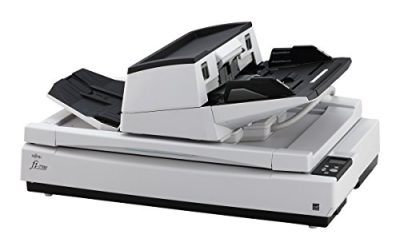
The fi-8270 pairs the same 70 ppm ADF engine as the fi-8170 with a built-in flatbed, which makes it the flexible departmental option when most work is batch scanning but bound, fragile or thick items appear regularly. It keeps the LAN connection, the ultrasonic overlap detection and the PaperStream capture workflow of the fi Series, adding a glass surface for the exceptions an ADF cannot take.
Key specifications:
– 70 ppm / 140 ipm single-pass duplex scanning
– 100-sheet ADF plus an integrated flatbed for books, passports and fragile pages
– Manufacturer daily volume up to 10,000 sheets
– USB 3.2 and Gigabit Ethernet LAN connectivity
– Ultrasonic multi-feed detection with PaperStream image processing
– TWAIN and ISIS driver support for document management systems
Limitations to know: The flatbed makes the footprint and weight noticeably larger than ADF-only models, so measure the desk or cabinet space before choosing it over the fi-8170.
Quick Comparison
| Model | ASIN | Speed | Feeder | Connection |
|---|---|---|---|---|
| Epson DS-970 | B07PYYRG52 | 85 ppm / 170 ipm | 100 sheets | USB |
| Fujitsu fi-8170 | B0BZZ9W6V1 | 70 ppm / 140 ipm | 100 sheets | USB, Ethernet |
| Canon imageFORMULA DR-M260 | B0765BMRG4 | 60 ppm / 120 ipm | 80 sheets | USB |
| Fujitsu fi-8270 | B0B39PQ5HH | 70 ppm / 140 ipm | 100 sheets + flatbed | USB, Ethernet |
Frequently Asked Questions
How does ultrasonic double-feed detection actually work?
The scanner sends an ultrasonic signal through the paper as it feeds. A single sheet attenuates the signal by a known amount; two overlapping sheets attenuate it far more, and the scanner stops so the operator can separate and re-feed them.
Can the detection be adjusted for documents with photos or labels attached?
Yes. These models allow sensitivity settings, learned patterns or single-page overrides, so a page with a legitimately attached photo or label does not halt every batch.
Does detection slow down a production batch?
No meaningful slowdown occurs during normal feeding — the sensor works in real time. It only stops the machine when it finds an overlap, which is precisely when a stop saves rework.
What else protects a digitization project besides the sensor?
Batch discipline: page counts per folder reconciled against scan counts, separator sheets between documents and a QC sampling routine. The sensor prevents losses; the process proves none happened.
Verdict
The DS-970 pairs the fastest engine here with Epson’s protection features, while the fi-8170 and fi-8270 bring Fujitsu’s mature iMFF implementation and networking. The DR-M260’s double-feed release function is the most operator-friendly recovery workflow of the group.
FAQ
How does ultrasonic double-feed detection actually work?
Can the detection be adjusted for documents with photos or labels attached?
Does detection slow down a production batch?
What else protects a digitization project besides the sensor?
More from Amazon
Programs that pair well with the guide above. Offers and eligibility are set by Amazon and may change.
Free shipping on eligible items, Prime Video and more. Eligible new members can start with a free trial.
Start a Prime free trialA Prime membership for ages 18-24 with a trial period. Eligibility is set by Amazon.
See Prime for Young AdultsAudiobooks and podcasts to listen to on the go. Eligible new members can start with a free trial.
Try Audible freeAd-free music streaming. Eligible new subscribers can start with a free trial.
Try Music Unlimited freeAs an Amazon Associate we earn from qualifying purchases.