Key takeaways
- Compare the best gaming mouse for laptop use, with portable wireless picks, Bluetooth and dongle options, battery life, weight and sensor advice.
A laptop changes what a good gaming mouse needs to do. At a fixed desk, size, cable routing, and charging docks are minor details. With a laptop, the mouse has to travel in a bag, connect quickly in different places, work on unfamiliar tables, and keep running without turning every session into a search for a charger or a spare port. The best gaming mouse for laptop use is therefore not simply the fastest mouse overall. It is the mouse that balances low-latency wireless performance with portability, sensible battery life, and a shape that still feels controlled during long play.
As an Amazon Associate we earn from qualifying purchases
This guide focuses on four wireless gaming mice that suit laptop play for different reasons. One is built specifically as a mobile mouse, with Bluetooth and a low-latency dongle in the same compact body. One stores its receiver inside the shell and runs for a long time on a single replaceable battery. One adds an ergonomic shape and many controls for players who use the same laptop for games and everyday work. One is a lightweight esports-style option for players who want a higher-end sensor and do not mind relying on a dongle. All four are gaming mice, all four are listed on Amazon US, and all four avoid the cable drag that makes laptop gaming on a small desk or a kitchen table harder than it needs to be.
What laptop gamers should prioritise
Portability without giving up control
A travel-friendly mouse should be small enough to slip into a laptop sleeve pocket or a small pouch, but not so small that aiming becomes tense and cramped. Weight matters here in two ways. A lighter mouse is easier to carry and easier to flick during play, but shape matters just as much as the number on a specification sheet. A compact mouse with a secure grip can feel more stable than a larger, lighter shell that forces your fingers into an awkward claw.
Look closely at how the receiver is handled. Models that store the dongle inside the body reduce the chance of losing the one part that enables the fastest connection. If a mouse has no internal storage, a small case or a dedicated pouch pocket becomes much more important. For students, remote workers, and anyone who games in more than one room, that small detail decides whether the mouse is genuinely portable or only portable in theory.
Bluetooth, dongle, or both
Connection choice is the defining laptop decision. Bluetooth is convenient because most modern laptops have it built in, so no port is used and no receiver can be lost. It is well suited to turn-based games, strategy, casual play, and everyday work. For fast shooters and other reaction-heavy games, a 2.4 GHz dongle connection from Logitech LIGHTSPEED, Razer HyperSpeed, or a similar gaming wireless system is usually the safer choice because those systems are designed for low-latency gaming use.
Dual-mode mice solve the dilemma neatly. Use Bluetooth for work, browsing, and lighter games, then switch to the dongle when latency matters most. Single-mode dongle mice can still be excellent for a gaming laptop, especially if that laptop has a USB-A port or you already carry a hub, but they ask for more planning. On a thin laptop with only USB-C ports, check the receiver type before buying. A USB-A receiver will need an adapter or hub, and that adapter becomes another item to carry and to keep stable during play.
Battery strategy for travel
There are two sensible battery approaches. Rechargeable mice reduce waste and can be topped up from the laptop, but they need a cable when the charge runs low. Mice powered by a single AA or AAA battery trade that convenience for very long runtimes and instant swaps. For laptop use, the replaceable-battery approach has a practical advantage: a spare battery in a bag weighs very little, and there is no waiting for a charge before a session can start.
Published battery figures always depend on the connection mode. Bluetooth figures are usually far longer than dongle figures, and figures quoted with a lithium battery can differ from those with an alkaline battery. Read the mode attached to any battery claim before comparing models. A mouse rated for hundreds of hours on Bluetooth and a shorter, still generous period on its gaming connection is not being inconsistent; it is reflecting how much more power a low-latency link uses.
Sensor, buttons, and surfaces
Modern gaming sensors from major brands track far beyond what most laptop displays and most players require. Differences in maximum DPI are less important than consistent tracking, a shape you can hold without slipping, and buttons that are placed where your thumb naturally rests. For laptop play, also think about surfaces. Hotel desks, library tables, and glossy kitchen worktops can challenge any optical sensor, so carrying a thin travel mouse pad often improves consistency more than chasing a higher headline DPI number.
Programmable buttons matter most if you play games with many commands. Six buttons cover the essentials for most shooters, while nine controls suit players who want extra bindings for abilities or work shortcuts. Onboard memory also helps when moving between machines.
The picks at a glance
The Razer Orochi V2 is the clearest laptop-first design in this group, combining Bluetooth and HyperSpeed wireless in a body listed at under 60 grams before its battery is fitted. The Logitech G305 LIGHTSPEED is the simple, durable all-rounder, with receiver storage inside the shell and a long runtime from one AA battery. The Razer Basilisk V3 X HyperSpeed is the comfort and controls option, with an ergonomic right-handed shape and nine programmable controls. The Razer Viper V3 HyperSpeed is the performance-focused option, with an 82 gram design and a 30K optical sensor for players who prioritise competitive play over Bluetooth convenience.
1. Razer Orochi V2 Mobile Wireless Gaming Mouse

The Orochi V2 was designed around the exact problem this guide addresses. Razer describes it as a mobile wireless gaming mouse, and the listing details support that positioning: a compact, ultra-lightweight body at under 60 grams excluding the battery, two wireless modes, and a sensor and switches chosen for gaming rather than basic office use. For a laptop bag, that combination is hard to beat.
Connectivity is its strongest argument. Bluetooth covers everyday use and lighter gaming without occupying a port, while Razer HyperSpeed Wireless covers demanding play through the included receiver. Battery life is listed at up to 950 hours on Bluetooth and up to 425 hours on HyperSpeed, and the mouse runs on a single AA or AAA battery through a hybrid battery slot. That flexibility helps while travelling, because either battery size can keep the mouse running. The receiver can be stored under the removable top cover, which reduces the loose-parts problem that affects many small wireless mice.
Inside, the listing specifies a Razer 5G Advanced optical sensor with up to 18,000 DPI, tracking at 450 IPS, and second-generation Razer mechanical mouse switches rated for up to 60 million clicks. There are six programmable buttons, which is enough for core game actions and a small number of extra bindings without crowding a compact shell.
Choose the Orochi V2 if portability is the first priority and your hand suits a small, symmetrical shape. Players with larger hands, or players who prefer a pronounced ergonomic curve and a thumb rest, may find it compact during very long sessions. It also has no wired fallback in the listing, so keeping a spare battery available is a sensible habit. For most laptop gamers who move between places, those trade-offs are reasonable in exchange for its size, weight, and dual-mode flexibility.
View on Amazon: https://www.amazon.com/dp/B0916N2LPZ
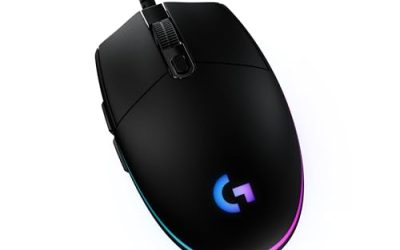
2. Logitech G305 LIGHTSPEED Wireless Gaming Mouse

The G305 LIGHTSPEED takes a simpler approach: one fast wireless connection, done well, in a compact body with practical travel details. Logitech lists the mouse at 99 grams, with a HERO sensor offering up to 12,000 DPI, a 1 millisecond report rate through LIGHTSPEED wireless, and six programmable buttons. It is an established design that suits laptop play because it is small, has no cable to manage, and stores its USB receiver inside the body.
Battery life is a major strength. The listing states up to 250 hours of continuous gameplay on a single AA battery in performance mode, with an endurance mode available through Logitech G HUB software that extends battery life further for non-gaming use. For a laptop user, that means the mouse can stay in a bag for extended periods without a charging routine. When the battery does run out, a replacement AA restores full use immediately.
The shape is a safe, symmetrical design that works for a range of grip styles, and onboard memory means DPI and button settings can travel with the mouse. Logitech G HUB is used to adjust DPI, configure buttons, and create macros, according to the listing description.
The limitation to understand is connectivity. The G305 connects through its USB receiver and does not offer Bluetooth in its listing. On a laptop with only USB-C ports, an adapter or hub is required, and the receiver needs to stay connected for gaming. There is also no rechargeable battery, which some buyers will see as a drawback and others will see as the reason the runtime is so long. If your gaming laptop has an available USB-A port, or your hub is already part of your setup, the G305 remains one of the most straightforward laptop gaming mice to live with.
View on Amazon: https://www.amazon.com/dp/B07CMS5Q6P
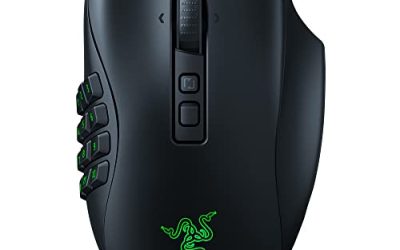
3. Razer Basilisk V3 X HyperSpeed Wireless Gaming Mouse

The Basilisk V3 X HyperSpeed is the option for laptop gamers who want a fuller ergonomic shape and more controls, and who are willing to carry a larger mouse to get them. Its right-handed form includes a thumb rest and textured grip areas, and the listing highlights nine programmable controls, including a multi-function trigger. For games with many abilities, or for a laptop that doubles as a work machine, those extra inputs can be genuinely useful rather than decorative.
Like the Orochi V2, it offers two wireless modes: Razer HyperSpeed Wireless for gaming and Bluetooth for everyday use and longer battery life. Razer lists up to 285 hours on HyperSpeed and up to 535 hours on Bluetooth from a single AA battery. That split makes mode choice practical. Keep the mouse on Bluetooth during a workday or a long trip, then switch to HyperSpeed when a game demands the gaming connection.
The sensor is Razer 5G Advanced 18K optical, listed with up to 18,000 DPI and 99.4 percent tracking accuracy in retailer and listing summaries of the product. Second-generation mechanical switches and Razer Chroma RGB are also part of the listing. The lighting can be adjusted or reduced through Razer software, which is worth doing on a laptop setup where battery conservation matters.
Size is the main compromise. This is a full ergonomic mouse rather than a minimal travel mouse, so it takes more room in a bag and suits right-handed users only. It also runs on a replaceable AA battery rather than a built-in rechargeable cell, and it has no wired mode in its listing. Choose it if comfort during long sessions and extra buttons matter more than the smallest possible carry, especially if the same laptop is used at a desk for extended play.
View on Amazon: https://www.amazon.com/dp/B0BXBC26X8
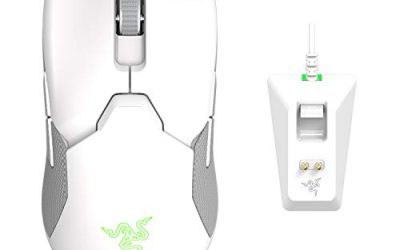
4. Razer Viper V3 HyperSpeed Wireless Esports Gaming Mouse

The Viper V3 HyperSpeed is aimed at competitive players who use a laptop as their main gaming machine and want an esports-style mouse without moving to a premium flagship. It is listed at 82 grams, with a Razer Focus Pro 30K optical sensor offering up to 30,000 DPI, second-generation mechanical switches, and up to 280 hours of battery life from a single AA battery. Its symmetrical shape is described by Razer as optimised for claw and fingertip grip styles, which suits fast, low-sensitivity aiming and frequent lifting.
For laptop use, its appeal is focus rather than versatility. There is no Bluetooth mode in the core listing proposition; the connection is Razer HyperSpeed Wireless through its receiver. That keeps the product centred on low-latency play, but it means a USB port or adapter is always part of the setup, and the mouse is less convenient for quick work sessions on a second device. Buyers who regularly switch between a gaming laptop and a tablet or work laptop without a dongle should choose one of the dual-mode models above instead.
Within its narrower brief, the specifications are strong. Eight programmable controls are listed for the Classic Black version in retailer summaries, giving more binding options than the six-button mice while keeping a familiar Viper layout. The AA battery approach again allows instant replacement, and the long rated runtime reduces how often that is needed during travel.
Choose the Viper V3 HyperSpeed if competitive shooters and similar games are the main use, your laptop setup can accommodate the receiver full time, and you prefer a lightweight symmetrical shell over Bluetooth convenience. It is less of a general travel mouse than the Orochi V2, but for a dedicated gaming laptop bag, that specialisation can be exactly the point.
View on Amazon: https://www.amazon.com/dp/B0CF4DJM7F
How to choose among these four
Start with connection, because it affects every session. If you want one mouse for work and play on the same laptop, and you value the option to leave the receiver behind, choose a dual-mode model: the Orochi V2 for maximum portability or the Basilisk V3 X HyperSpeed for ergonomic comfort and more controls. If your laptop is primarily a gaming machine and the receiver can stay plugged in, the G305 and the Viper V3 HyperSpeed become stronger candidates.
Next, match shape to hand and grip rather than to headline specifications. Small and medium hands using claw or fingertip grips will usually find the Orochi V2 and Viper shapes easier to manage. Palm grip players and anyone who dislikes a compact shell should look more closely at the Basilisk V3 X. The G305 sits in the middle as a compact but familiar shape that many players already know from earlier Logitech designs.
Then decide on power. All four mice here use replaceable batteries, which removes charging downtime but means carrying a spare on long trips. If a built-in rechargeable battery is essential, none of these four is the right answer.
Finally, check your ports. A thin ultrabook with only USB-C needs Bluetooth for dongle-free sessions or a reliable adapter for dongle play. Keep the receiver in its storage slot while moving, and carry a thin mouse pad for reflective tables.
Frequently asked questions
Is Bluetooth good enough for gaming on a laptop?
For many games, yes. Strategy, simulation, role-playing, and casual games tolerate Bluetooth well, and the convenience is real. For competitive shooters and other games where reaction time and consistent low latency are central, a gaming dongle connection is the safer choice. That is why dual-mode mice are so useful for laptops: they do not force a single answer for every kind of session.
Does a higher DPI number mean a better laptop mouse?
Not by itself. Most players use a far narrower DPI range than the maximum figures in listings. Consistent tracking, a comfortable shape, stable wireless performance, and buttons that suit your games matter more in practice. Use DPI as a check that a sensor meets modern gaming expectations, then make the decision on connection, size, weight, and battery approach.
Should a laptop gaming mouse be as light as possible?
Lighter helps with travel and fast movements, but it is not automatically the most comfortable. A very small shell can feel tiring for larger hands, so fit should come before chasing the lowest number.
What else belongs in a laptop gaming mouse kit?
A small protective pouch, a spare battery for the mice listed here, a thin travel mouse pad, and any USB adapter your laptop needs for a receiver. Those few items solve most of the problems that appear away from a home desk: lost receivers, flat batteries, poor tracking surfaces, and missing ports.
Conclusion
The best gaming mouse for laptop use depends on how the laptop is actually used. The Razer Orochi V2 is the strongest all-round travel pick because it combines a genuinely mobile size with Bluetooth, HyperSpeed wireless, and long rated battery life. The Logitech G305 LIGHTSPEED is the dependable receiver-based option with internal dongle storage and a simple, proven layout. The Razer Basilisk V3 X HyperSpeed serves players who want ergonomic support and nine controls from the same mouse they carry. The Razer Viper V3 HyperSpeed is the focused competitive choice for a gaming laptop where the dongle can stay in place. Decide first on connection and shape, confirm the port situation on your own laptop, and the right choice from these four becomes clear.
FAQ
Is Bluetooth good enough for gaming on a laptop?
Does a higher DPI number mean a better laptop mouse?
Should a laptop gaming mouse be as light as possible?
What else belongs in a laptop gaming mouse kit?
More from Amazon
Programs that pair well with the guide above. Offers and eligibility are set by Amazon and may change.
Free shipping on eligible items, Prime Video and more. Eligible new members can start with a free trial.
Start a Prime free trialA Prime membership for ages 18-24 with a trial period. Eligibility is set by Amazon.
See Prime for Young AdultsAudiobooks and podcasts to listen to on the go. Eligible new members can start with a free trial.
Try Audible freeAd-free music streaming. Eligible new subscribers can start with a free trial.
Try Music Unlimited freeAs an Amazon Associate we earn from qualifying purchases.