Key takeaways
- Long-range barcode scanners for shipping stations compared, from a 433 MHz industrial imager to data collectors, on link reach, storage and bench fit.
As an Amazon Associate we earn from qualifying purchases.
A shipping station has its own geography. The bench is fixed, but the work is not: cartons stack up in staging lanes, pallets wait several metres from the desk, and the operator walks between bench, racking and dock door all day. The best long-range barcode scanners for shipping stations keep that operator connected to the shipping system across the whole area, through a long reach wireless link, a scanner that stores codes when the link drops, or a collector that keeps the shipping data on the device itself. As in the stockroom guide, this article separates optical range from transmission range and favours the second, because at a shipping station the code is usually close and the computer is what ends up far away. The four models below cover a 433 MHz industrial imager with an exceptional link distance, a data collector with its own screen, a mini dock based scanner for the bench, and a display equipped cordless model for supervised dispatch work.
Disclosure: This article contains affiliate links. If you buy through these links, we may earn a commission at no additional cost to you.
How to Choose
Start with the scan engine. A 1D laser reads printed linear codes quickly and at longer distances, but it cannot read QR codes, Data Matrix or codes shown on a screen. A 2D area imager reads 1D and 2D codes on paper and on screens, handles damaged or poorly printed labels better, and is the safer long term choice for mixed label stock. Next, separate two distances that are often confused: scanning range is how far the scanner sits from the code, while transmission range is how far the operator can walk from the host computer or cradle. A receiving dock may need neither in extreme form, while a stockroom may need one or both. Connectivity follows the workflow: corded USB is simple and never needs charging, 2.4 GHz links to a receiver or cradle, and Bluetooth pairs with phones, tablets and computers. Finally, match the housing to the floor. Sealed housings described with codes such as IP65 or IP67 resist dust and water, and drop resistance to concrete matters anywhere pallets, forklifts and ladders are in daily use. Check the symbology list against your labels too, including Code 128, Interleaved 2 of 5 and any GS1 formats your suppliers use.
At a shipping station, map the walk before choosing. Pace out the staging lanes and note where the operator scans: at the bench, at the pallet, at the dock door. The link must cover that whole triangle with racking and stacked cartons in the way, which is why makers’ obstructed distance figures matter more than open air ones. A scanner with storage mode forgives the dead spots that remain. Then think about confirmation: shipping errors are expensive, so a scanner that shows battery, connection or even the scanned data on a small screen reduces the walk back to the monitor to check a code landed. Finally, decide the bench arrangement, because a charging cradle or stand at the bench keeps the scanner located, charged and ready for the next operator.
The Picks in Detail
1. Alacrity Upgraded 2D Industrial Barcode Scanner

ASIN: B0CM3C17NC
Amazon US: https://www.amazon.com/dp/B0CM3C17NC
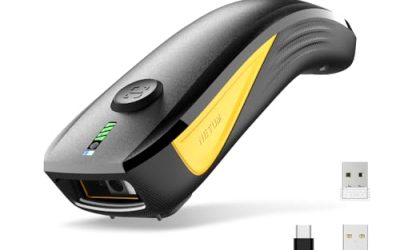
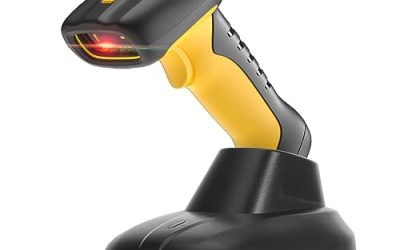
The Alacrity industrial scanner pairs a 1 megapixel 2D engine with a 433 MHz wireless link described as reaching up to 1968 feet, alongside Bluetooth connection, which is why it leads a shipping station list: the link is built for large floors and obstructed spaces where 2.4 GHz links fade. It sits in a wireless charging stand that doubles as a hands free holder, carries a 2200 mAh battery, supports trigger, continuous and hands free auto detection modes, and can store up to 50,000 codes for upload later. The housing is described as shock and dust proof for industrial use.
Who it suits: Busy shipping areas spread across a large floor, where one scanner must stay connected from bench to dock door without a receiver move.
Considerations: The very long link claims are open environment figures, so commission it with a walk test around your own racking. It is not compatible with some closed checkout (POS) ecosystems, which matters if the shipping desk doubles as a checkout counter.
2. JRHC 7106L Wireless Inventory Barcode Scanner with Screen

ASIN: B09MQ9DTZF
Amazon US: https://www.amazon.com/dp/B09MQ9DTZF
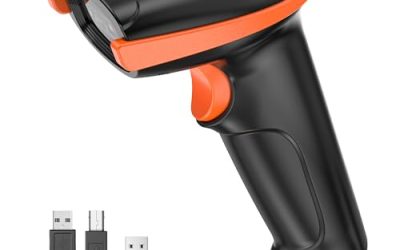
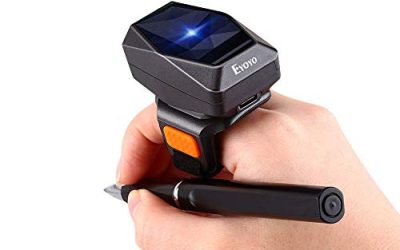
The JRHC 7106L is a data collector as much as a scanner: a 1D laser reader with its own screen, a charging base, and 2.4 GHz wireless plus USB connection. It works as a scan gun sending codes live, and as an inventory terminal holding collected data on the device, which suits shipping stations that batch verify carton codes against a dispatch list away from the desk. The base keeps it charged and located at the bench between runs, and the maker positions it for warehouse, retail and logistics data collection.
Who it suits: Shipping stations that do batch checking, staging lane verification and dispatch counts away from the PC, then upload in one pass.
Considerations: The laser engine is 1D only, so 2D carrier labels with QR or Data Matrix codes are beyond it. The collector workflow also needs a defined upload routine so batches are not left sitting on the device.
3. NADAMOO Bur3148 Mini Wireless Barcode Scanner with Charging Dock

ASIN: B07SNQ4SVG
Amazon US: https://www.amazon.com/dp/B07SNQ4SVG
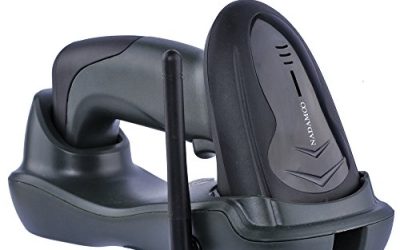
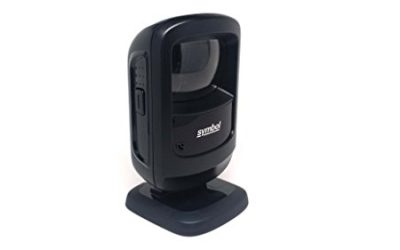
The Bur3148 is a miniature CCD scanner that lives on a charging dock at the bench and connects by Bluetooth, 2.4 GHz wireless or USB cable. Its 2.4 GHz link is described up to 100 metres in open space, which covers a shipping bench and its staging lanes from one dock position, and it reads the standard printed 1D set used on carton and carrier labels. The pocket format suits a station where the scanner is picked up for a pallet check and dropped back on the dock dozens of times a day.
Who it suits: Compact shipping benches where the scanner should always be in the same place, charged, and ready for the next carton or pallet check.
Considerations: Mini size and a 1D CCD engine limit it to printed linear codes at normal distances. Sites whose carriers have moved to 2D labels should look at the imagers in this list instead.
4. Tera HW0006 Pro Wireless Barcode Scanner with Display

ASIN: B0829R5J2X
Amazon US: https://www.amazon.com/dp/B0829R5J2X
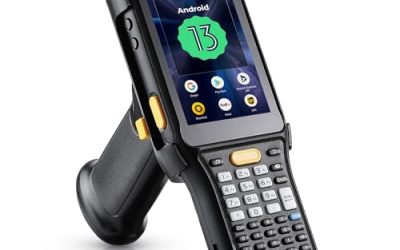
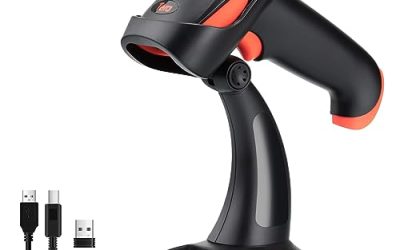
The HW0006 Pro adds a display screen to a cordless 1D and 2D imager, showing information such as battery level and time, and it works over Bluetooth and 2.4 GHz wireless or USB wired from a charging cradle base. For a shipping station, the screen is about confirmation: the operator can see the scanner state without walking back to the monitor. The cradle keeps the bench tidy, and the imager reads digital and printed codes, covering carrier labels that mix linear and 2D formats.
Who it suits: Shipping stations where operators dispatch away from the monitor and need on device confirmation that the scanner is connected and charged.
Considerations: Display equipped models draw more power than plain scan guns, so the cradle routine matters. As with all models here, check your shipping software accepts standard keyboard style input before a multi unit order.
Comparison Table
| Product | Type and connection | Standout trait | Best for |
|---|---|---|---|
| Alacrity Upgraded 2D Industrial Barcode Scanner | Industrial 2D, 433 MHz and Bluetooth | Very long transmission reach | Large shipping floors |
| JRHC 7106L Wireless Inventory Barcode Scanner with Screen | 1D data collector with screen | On device inventory screens | Shipping station counts |
| NADAMOO Bur3148 Mini Wireless Barcode Scanner with Charging Dock | Mini 1D CCD with dock | Charging dock included | Bench shipping points |
| Tera HW0006 Pro Wireless Barcode Scanner with Display | Cordless 2D with display | Screen shows battery and time | Supervised shipping work |
Link technology is the story of this group: 433 MHz, 2.4 GHz, Bluetooth and collector based storage all solve the same distance problem in different ways, detailed per product above.
FAQ
Why does transmission range matter more than scan range at a shipping station?
Because the code is usually on a carton in the operator’s hands or on a pallet a step away, while the shipping computer may be across the staging area. The link distance decides whether scans land live, and storage mode decides whether the ones taken in a dead spot land at all.
What is a 433 MHz link and why does it reach further?
Lower frequency radio generally travels through and around obstacles differently from 2.4 GHz links, and makers of 433 MHz scanners quote much longer distances for warehouse floors. The trade off is that it talks to its own receiver or cradle rather than pairing natively with phones, so it suits a fixed shipping system best.
Should a shipping scanner have its own screen?
A screen helps when the operator works away from the monitor: battery, connection state and, on data collectors, the collected codes themselves can be checked on the spot. For a bench only scanner next to a monitor, a screen adds little, and a simpler model is easier to run.
How many scanners does one shipping station need?
One per operator on shift is the comfortable minimum, plus a charging routine that leaves a full scanner ready at the start of each shift. Stations that also scan at the dock door often keep a second, simpler unit there rather than carrying the bench scanner back and forth.
Conclusion
The Alacrity industrial imager is the headline pick for a spread out shipping floor, because its long reach link and charging stand were designed for exactly that geography. The JRHC collector suits stations that batch verify away from the desk, the NADAMOO Bur3148 keeps a compact bench permanently ready, and the Tera HW0006 Pro adds the on device confirmation that reduces shipping mistakes. Walk your own staging area, test the link at the furthest pallet position, and choose the model that still delivers scans from there.
FAQ
Why does transmission range matter more than scan range at a shipping station?
What is a 433 MHz link and why does it reach further?
Should a shipping scanner have its own screen?
How many scanners does one shipping station need?
More from Amazon
Programs that pair well with the guide above. Offers and eligibility are set by Amazon and may change.
Free shipping on eligible items, Prime Video and more. Eligible new members can start with a free trial.
Start a Prime free trialA Prime membership for ages 18-24 with a trial period. Eligibility is set by Amazon.
See Prime for Young AdultsAudiobooks and podcasts to listen to on the go. Eligible new members can start with a free trial.
Try Audible freeAd-free music streaming. Eligible new subscribers can start with a free trial.
Try Music Unlimited freeAs an Amazon Associate we earn from qualifying purchases.