Key takeaways
- Compare four portable tire traction mats for slippery driveway exits, with lengths, materials, weights and load limits taken from Amazon listings for each pick.
A slippery driveway exit is a small problem: the car is fine, the road beyond the kerb is clear, but the slope between them is a sheet of ice and the tyres cannot find grip for the first few metres. The wheels spin, the car slides sideways toward the kerb, and every attempt polishes the surface further. The buying decision here is narrow and practical: which mat gives a tyre enough grip to climb a short icy slope, deploys in the few minutes before work, and stores by the door without becoming another chore.
This guide is for homeowners with sloped or shaded driveways, drivers who park on an incline overnight, and anyone whose morning exit crosses a frozen apron where the driveway meets the street. The four mats below are chosen from the names and specifications on their Amazon pages, with listed length, material, weight and load limit for each, so you can match the mat to your slope, your tyres and the space beside your front door.
Quick Picks
As an Amazon Associate we earn from qualifying purchases
| Product | Best for | Key spec from title |
|---|---|---|
| JOJOMARK Tire Traction Mat | Rubber grip on an icy driveway slope | 39-inch rubber mats, 2-pack |
| Maxsa 20333 Escaper Buddy Traction Mats | Long run-up for a steep exit | 48-inch polypropylene mats, 2-pack |
| ONECHOI Recovery Traction Boards | Heavy-duty exit for trucks and SUVs | 42-inch polypropylene boards, 2-pack |
| Reliancer 2PC Traction Tracks Mats | Roll-up tracks stored by the door | 31.5-inch TPR tracks with steel core |
How to Choose
Read the slope before you read the listing
A driveway exit is a slope problem, not a deep-snow problem, so the mat must help a tyre climb rather than dig out of a drift. Gentle slopes need only a short friction surface, while a steep or shaded exit needs a long mat with aggressive teeth that keeps the tyre moving all the way to the street. Walk the slope and note where the ice forms: at the kerb, mid-slope, or across the whole apron. A mat that covers only the bottom of the slope leaves the tyre spinning again halfway up. Choose a length that spans the worst section, and remember that a mat placed on a slope can slide downhill under load unless its underside grips.
Favour grip on ice over grip on snow
Driveway ice is usually smooth and hard, formed by meltwater refreezing overnight, and it behaves differently from fresh snow. Rubber mats conform to the surface and build friction, while rigid boards depend on raised teeth that must bite into the ice to work. Check the material line on the listing: rubber and flexible TPR suit polished ice, while hard polypropylene suits packed snow and slush. Some boards combine a toothed top with a textured underside, which helps the mat stay put on the slope. If your driveway ices over more often than it fills with snow, put ice grip first.
Think about where the mat lives between uses
A driveway mat gets used several mornings a week, so storage is a daily question rather than a seasonal one. A pair that lives by the front door or in the garage must be easy to grab, carry and rinse, while a pair stored in the trunk is only useful if the car is already out. Roll-up tracks hang on a hook, short boards stack on a shelf, and long boards need a flat spot against a wall. Weight matters here too, since you will carry the mats through the house or across the yard in slippers and a coat. Pick a format whose storage spot you can picture clearly.
Check the load limit against the vehicle on the slope
A slope multiplies the force on a mat, because the tyre pushes down and back at the same time. A pair rated for 7 or 10 tons handles most family cars and SUVs with margin, while a light pad with no stated limit may deform on the first climb. Compare the listed limit with your vehicle plus its usual load, and favour a mat that states its limit in the listing. A mat that flattens under load loses its tread pattern exactly when the tyre needs it most. When two mats look similar, the one with the clearer load figure is the safer choice for a slope.
The 4 Best Options
JOJOMARK Tire Traction Mat

JOJOMARK leads this guide because rubber is the most reliable material on the smooth ice that forms on a driveway overnight. The mats stay pliable in cold weather and grip the tread instead of skating, and the 39-inch length gives SUV and van tyres a solid run up the slope. At 7.47 kilograms for the pair the mats are heavy enough to stay planted on the incline while the tyre climbs onto them. The two-piece set covers the driven axle, and the rubber surface also works well on the frozen apron where the driveway meets the street, which is where most exits fail.
Specs
- Brand: JOJOMARK
- Model Number: JM01TC
- Manufacturer Part Number: JM01TC
- Size: 2 pieces, 39 inches each
- Material: Rubber
- Item Weight: 7.47 kilograms
- Vehicle Service Type: ATV, SUV, UTV, van
Best for: Homeowners whose driveway ices into a smooth slope and who need rubber grip to climb it.
Watch out for: Rubber mats collect slush and grit from the driveway, so rinse them before bringing them indoors or the entryway will track salty mud.
Maxsa 20333 Escaper Buddy Traction Mats

The Escaper Buddy suits a long, steep driveway because its 48-inch length gives the tyre the longest run-up in this guide. Each mat covers a full tyre footprint, so the wheel keeps climbing instead of reaching the end of the mat halfway up the slope. The high-grade polypropylene build is light for its size, which matters when you carry the pair from the garage to the driveway each morning. Raised tracks bite into packed snow and ice alike, and the two-mat set covers the driven wheels of a sedan or van. For a driveway that defeats a short mat, length is the fix.
Specs
- Brand: Maxsa Innovations
- Manufacturer Part Number: 20333
- Size: 48 inches long, 14.5 inches wide
- Material: High-grade polypropylene polymer
- Pack: 2 mats
- Compatible with: ATV, car, light truck, single truck, van
- Automotive Fit Type: Universal Fit
Best for: Steep driveways where a short mat ends before the tyre reaches clear pavement.
Watch out for: The mats do not fold, so you need a flat storage spot in the garage long enough for the 48-inch pair.
ONECHOI Recovery Traction Boards

ONECHOI builds the strongest option here, and a heavy vehicle on a slope shows it best. Each board measures 41.5 inches and the pair is rated for up to 10 tons, so a loaded SUV or pickup can climb without deforming the surface. Cross-shaped teeth bite the tread and stop the wheel rolling backwards down the slope, while the reinforced polypropylene flexes up to 150 degrees without breaking. The stated temperature range runs from minus 40 to 176 degrees Fahrenheit, so a board left in an unheated garage stays usable. A jack base in the centre adds a second use if a wheel ever needs lifting on soft ground.
Specs
- Brand: ONECHOI
- Model: Recovery Traction Boards black
- Size: 41.5 inches by 11.5 inches by 2.8 inches per board
- Material: Polypropylene (PP)
- Item Weight: 15.4 pounds
- Load capacity: Up to 10 tons
- Temperature range: -40°F to 176°F
- Includes: 2 traction mats, 4 mounting pins, jack base
Best for: Heavy SUVs and pickups that must climb a steep, icy driveway exit every morning.
Watch out for: At over 15 pounds the set is the heaviest here, so store the boards near the garage door to avoid a long carry across an icy yard.
Reliancer 2PC Traction Tracks Mats
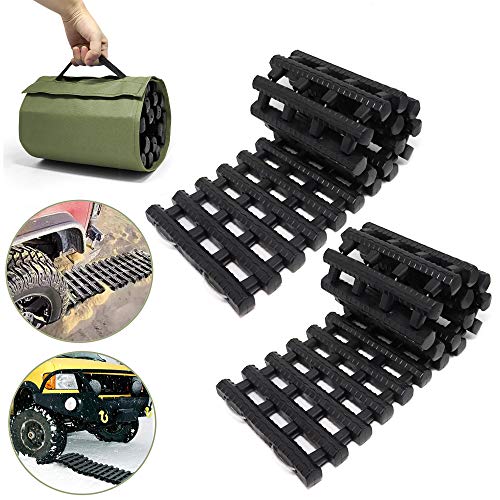
Reliancer fits the driveway routine because its tracks roll up and hang on a hook, ready in seconds. The TPR body wraps a galvanized steel core, and the pair carries a stated limit of up to 7 tons, which covers most family cars and SUVs. At 31.5 inches the tracks are shorter than a rigid board, but the flexible format conforms to a crowned driveway surface and the steel core keeps the track from stretching under load. Two canvas bags come in the box, so the pair stays together on the hook. This is the mat for a household that uses it often and wants storage to be effortless.
Specs
- Brand: RELIANCER
- Manufacturer Part Number: RESP17018
- Length: 31.5 inches
- Width: 8.6 inches
- Material: Thermoplastic rubber with galvanized steel core
- Steel core diameter: 0.15 inch
- Item Weight: 16.1 pounds
- Load capacity: Up to 7 tons
- Includes: 2 traction tracks, 2 canvas carrying bags
Best for: Households that use a mat several mornings a week and want roll-up storage by the door.
Watch out for: A rolled track can hold a curl in freezing weather, so unroll it flat for a minute before placing it on the slope.
Which One Fits Your Situation
Your driveway is a short, icy slope
Pick the JOJOMARK rubber mats, because rubber grips smooth ice where hard plastic skates. The 39-inch length covers the worst section of most short driveways, and the weight of the set holds each mat on the slope while the tyre climbs. Keep the pair by the door and rinse them after use so the entryway stays clean.
Your driveway is long and steep
Pick the Maxsa Escaper Buddy, because its 48-inch length gives the tyre the longest climb in this guide. A short mat ends before the car reaches the street, while the Escaper Buddy spans the slope and forgives placement errors in the dark. Store the pair flat in the garage and lay them out the night before a freeze if you can.
You drive a heavy SUV or pickup up the slope
Pick the ONECHOI boards, because the 10-ton limit and the cross-shaped teeth match the forces a heavy vehicle puts on a mat while climbing. The 41.5-inch boards give a large tyre a full run-up, and the polypropylene build survives a freezing garage. Accept the weight and keep the boards near the garage door.
You use a mat almost every winter morning
Pick the Reliancer tracks, because they roll up and hang by the door, so deployment takes seconds rather than a trip to the back of the garage. The 7-ton limit covers most family vehicles, and the canvas bags keep the pair together. This is the pick for a routine, not an emergency.
Common Mistakes
- Placing the mat on top of loose snow instead of clearing down to the ice first.
- Accelerating hard on a slope, which spins the mat out from under the tyre and down the driveway.
- Using a mat that is too short for the slope, so the tyre runs out of grip halfway to the street.
- Leaving the mats outside after use, where they freeze to the ground overnight.
- Forgetting that the apron where the driveway meets the street ices over first and needs the mat most.
Frequently Asked Questions
Why does my car slip at the driveway exit but not on the road?
The exit is where meltwater collects and refreezes, and where a slope meets the camber of the street. The road beyond is usually salted and driven over, while the apron gets less traffic and less treatment. Shade from the house keeps the exit frozen long after the road clears. A traction mat bridges that short icy section so the tyres reach the treated road.
Should I salt the driveway as well as use mats?
Yes, the two work together rather than replacing each other. Salt lowers the freezing point and breaks up ice over time, while a mat gives instant grip on the spot where the car is stuck. Spread salt the evening before a freeze, and keep mats ready for mornings when the ice forms faster than the salt can act. Clear loose snow first so the salt reaches the ice.
Can I leave traction mats on the driveway all winter?
No, a mat left outside becomes part of the problem: it freezes to the ground, collects snow, and turns into a slippery step. Bring the mats inside after each use, rinse off salt and grit, and store them flat or hung up. A mat that lives in the garage stays flexible and clean, while one left on the driveway degrades and can damage the surface beneath it.
How do I stop a mat sliding downhill on a slope?
Place the mat flat and press it into the surface before the tyre reaches it, and clear loose snow so the underside contacts the ice directly. Some mats have a textured underside that grips the slope, and a heavier mat resists sliding better than a light one. If the mat still moves, wedge its lower edge against a small ridge of packed snow.
FAQ
Why does my car slip at the driveway exit but not on the road?
Should I salt the driveway as well as use mats?
Can I leave traction mats on the driveway all winter?
How do I stop a mat sliding downhill on a slope?
More from Amazon
Programs that pair well with the guide above. Offers and eligibility are set by Amazon and may change.
Free shipping on eligible items, Prime Video and more. Eligible new members can start with a free trial.
Start a Prime free trialA Prime membership for ages 18-24 with a trial period. Eligibility is set by Amazon.
See Prime for Young AdultsAudiobooks and podcasts to listen to on the go. Eligible new members can start with a free trial.
Try Audible freeAd-free music streaming. Eligible new subscribers can start with a free trial.
Try Music Unlimited freeAs an Amazon Associate we earn from qualifying purchases.