Our Top Picks

Cold is the honest examiner of a car battery. A unit that starts the engine happily in September can fail on the first frosty morning, because cranking demand rises exactly as battery output falls. The decision that matters is not whether to test, but whether your tester reports the numbers that predict a cold-start failure: measured cranking amps against the rating on the label, and a state-of-health figure you can act on before the weather turns.
This guide is written for drivers who keep their own cars running through winter: commuters who cannot afford a no-start, parents checking the family car, and owners of vehicles that sit outside in the cold. The four testers below were picked from their Amazon product pages for CCA range, the battery types in their menus, and whether they add cranking and charging tests that expose a weak alternator before a freeze.
Quick Picks
As an Amazon Associate we earn from qualifying purchases.
| Product | Best for | Key spec from title |
|---|---|---|
| TOPDON BT100 | The autumn health check on a daily driver | 12V, 100-2000 CCA, battery, cranking and charging tests |
| ANCEL BA101 | A clear replace warning before the first freeze | 12V, 100-2000 CCA, bad cell test |
| MOTOPOWER MP0515A | Keeping records of a battery’s decline across winters | 12V, 100-2000 CCA, ripple view and data storage |
| Schumacher BT-100 | A true loaded test with no electronics to flatten | 6V and 12V, 100-amp load, batteries up to 1000 cranking amps |
How to Choose
Compare measured CCA with the rating on the label
Winter exposes the gap between a battery’s label and its reality. Every tester here accepts the rated CCA you type in, then reports a measured figure; a battery delivering well under its rating on a mild autumn day will deliver less again at freezing temperatures. Look for a tester that shows measured CCA and internal resistance as numbers, not just a pass light, so you can judge how much margin remains. Testing while the weather is still moderate is the point: the reading is a forecast, and forecasts only help if you get them early.
Read state of health as a winter warning
State of health condenses internal resistance and measured capacity into one percentage, and winter is when that percentage earns its keep. A battery in the middle band — healthy enough to start today, tired enough to worry about — is exactly the one that strands people in January. Choose a tester that separates state of health from state of charge, because a flat-but-sound battery needs charging while a charged-but-worn one needs replacing. Confusing the two leads to the classic winter mistake: jump-starting a dying battery every cold morning instead of replacing it once.
Check the charging system before blaming the battery
A weak alternator manufactures dead batteries all winter. Short trips, heated screens, lights, and blowers drain more than a tired charging system replaces, so the battery tests worse each week even if it began the season healthy. Three of the four testers here run a charging test with the engine running and report output and ripple; the fourth applies a real electrical load instead. Either way, run that check before the cold arrives. A battery condemned by a health test may simply be undercharged, and replacing it without fixing the charging fault buys you a repeat failure.
Think about testing conditions, not just the tester
Cold changes the test as well as the battery. A conductance reading taken on a freezing morning runs pessimistic, and a battery fresh off a charger runs optimistic, so consistent conditions matter more than chasing decimal places. Test after the car has sat for several hours, ideally overnight, and clear surface charge by switching the headlights on briefly before testing a recently driven car. Also consider the hardware: numb fingers favour big clamps and a backlit screen you can read in a dark driveway, and short leads are miserable when the battery sits low in the bay.
Safety Notes
Fit the red clamp to the positive terminal first and the black clamp to the negative second, removing them in reverse order, and keep metal tools off both posts at once. A battery that has just been charging can vent flammable gas, so keep sparks, cigarettes, and jump leads that might arc away from the caps. Never test, charge, or jump a battery that is frozen, swollen, or leaking; let a frozen battery thaw indoors first and have it inspected. Gloves and eye protection are worth wearing in the cold too.
The 4 Best Options
TOPDON BT100

The BT100 is the default recommendation for a pre-winter once-over. Its listing covers the full routine in one handheld unit: battery health with measured CCA and internal resistance, a cranking test that captures how low voltage dips as the starter turns, and a charging test for the alternator. The menu spans regular flooded, AGM flat plate, AGM spiral, GEL, and EFB batteries, so the stop-start cars that suffer most in cold weather are included. For a single family car, this is the checklist most drivers actually need.
Specs
- System voltage: 12V
- Test range: 100-2000 CCA
- Battery types: regular flooded, AGM flat plate, AGM spiral, GEL, EFB
- Tests: battery, cranking, and charging (alternator) tests
- Display: LCD screen with health, charge, and resistance results
Best for: The autumn health check on a daily driver before temperatures drop
Watch out for: It is a 12V-only tester, so it cannot run system checks on a 24V vehicle
ASIN: B07Z67MMGC
ANCEL BA101
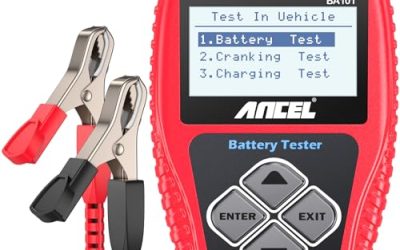
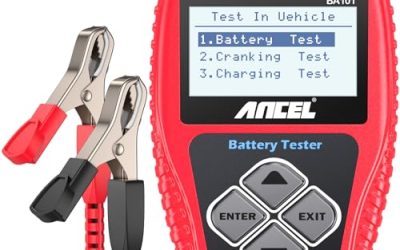
Pick the BA101 if the result you care about is an unambiguous verdict. Alongside the usual health, cranking, and charging tests, its page highlights a bad cell test — valuable in winter, because one failed cell often announces itself as a car that starts on mild days and refuses on cold ones. The listing also states reverse polarity and short-circuit protection, a forgiving trait when you are clamping up with cold hands. It reports in plain language, which suits drivers who want a decision rather than a data set.
Specs
- System voltage: 12V
- Test range: 100-2000 CCA
- Battery types: regular flooded, AGM flat plate, AGM spiral, GEL, EFB
- Tests: battery, cranking, and charging tests, plus bad cell detection
- Protection: reverse polarity and short-circuit protection stated on the listing
Best for: Drivers who want a clear replace warning before the first freeze
Watch out for: No result storage is highlighted on the page, so note readings down if you track them yearly
ASIN: B01M0ARG3X
MOTOPOWER MP0515A

The MP0515A suits owners who treat winter readiness as a trend rather than a single reading. Its page lists the expected battery, cranking, and charging tests, then adds ripple analysis, data storage, and a print function, so last autumn’s health figure can sit next to this year’s. The colour menu covers regular flooded, AGM, GEL, and EFB batteries across the same 100-2000 CCA span. Watching state of health slide a few points each season is the earliest warning most drivers will ever get, and this is the tool here built around that habit.
Specs
- System voltage: 12V
- Test range: 100-2000 CCA
- Battery types: regular flooded, AGM, GEL, EFB
- Tests: voltage, cranking, charging, and resistance tests, with state of health and state of charge
- Extras per listing: ripple analysis, data storage, and data print function
Best for: Owners who record a battery’s health each autumn and compare it year to year
Watch out for: AGM spiral is not named on the page, so check your battery type against the menu before ordering
ASIN: B08K3885C4
Schumacher BT-100

The BT-100 is the analogue outlier, and winter is where its approach makes sense. Instead of estimating, it switches in a genuine 100-amp load and watches the voltmeter, the same test workshops have run for decades. There is no internal battery to go flat in a cold glovebox and no menu to scroll with gloves on. It covers 6V and 12V batteries up to 1000 cranking amps and can check charging output too. What it will not give you is a health percentage or a stored history — the needle is the whole report.
Specs
- Type: analogue load tester and voltmeter
- Load applied: 100 amps
- System voltage: 6V and 12V
- Capacity: batteries up to 1000 cranking amps
- Use per listing: charging system diagnosis for automotive, powersport, and marine batteries
Best for: Drivers who trust a real loaded test and want a tool that always works in the cold
Watch out for: No digital health percentage, CCA estimate, or memory — and big batteries above 1000 cranking amps exceed its range
ASIN: B000AMBOI0
Which One Fits Your Situation
The family car that must start every school morning
Reliability here is about warning, not rescue. The TOPDON BT100 gives you measured CCA and a health percentage in autumn, while there is still time to charge or replace the battery on your terms. Its EFB support matters if the car has stop-start, which multiplies winter starting demands in traffic.
A car that lives outside on the street
Street-parked cars get the worst of winter: full cold soak every night and no garage recovery. The ANCEL BA101’s bad cell test and plain verdicts suit quick kerbside checks, and its stated clamp protection forgives a fumbled connection. Test monthly once temperatures fall, not just once in autumn each year.
An older vehicle you are nursing through one more winter
With an ageing car, the question is whether the battery or the charging system is failing first. The MOTOPOWER MP0515A answers it with charging and ripple tests plus stored results, so a midwinter retest can be compared with the autumn baseline instead of guessed at. That record also helps a workshop take the problem seriously.
A second car, quad, or boat battery in storage
Stored batteries fail silently, and a spring surprise helps nobody. The Schumacher BT-100 needs no power of its own and covers 6V as well as 12V, so it can load-test the quad and the boat battery alongside the spare car. Keep notes by hand, because the analogue needle keeps no records for you.
Common Mistakes
- Testing a battery immediately after driving, when surface charge hides how weak it really is.
- Reading state of charge as state of health and jump-starting a worn battery all winter.
- Skipping the charging test, then blaming a new battery for an alternator fault.
- Entering the wrong CCA rating or battery type, which distorts the health calculation.
- Waiting for the first frost to test, when replacement becomes urgent instead of planned.
Frequently Asked Questions
When should I test my battery for winter?
Test in autumn, while temperatures are still moderate and you have time to act on the result. A battery that measures well below its rated CCA in October will be weaker again in January. Retest midwinter if cranking slows, and always test after the car has sat for several hours.
What state of health means a battery will struggle in the cold?
There is no single magic number, but treat a falling trend as the warning. A battery near the bottom of its health range that still starts in mild weather has little reserve for a freezing start, when engines need more power and batteries deliver less. If health drops between autumn tests, plan the replacement.
Can I test a battery without removing it from the car?
Yes. All four testers here clamp onto the terminals in place, with the engine off for the battery test. Clean the posts first so the clamps bite on metal, not corrosion. The cranking and charging tests are also done in the vehicle, with the tester guiding you to start the engine when needed.
My battery tests fine but still goes flat. What else is wrong?
Look beyond the battery. A weak alternator undercharges it on short winter trips, which is why the charging test matters, and a parasitic drain can empty it overnight. If charging output tests normal and the battery still fades, have the drain measured. Repeated deep discharge also shortens a starter battery’s life, whatever the tester says today.
FAQ
When should I test my battery for winter?
What state of health means a battery will struggle in the cold?
Can I test a battery without removing it from the car?
My battery tests fine but still goes flat. What else is wrong?
More from Amazon
Programs that pair well with the guide above. Offers and eligibility are set by Amazon and may change.
Free shipping on eligible items, Prime Video and more. Eligible new members can start with a free trial.
Start a Prime free trialA Prime membership for ages 18-24 with a trial period. Eligibility is set by Amazon.
See Prime for Young AdultsAudiobooks and podcasts to listen to on the go. Eligible new members can start with a free trial.
Try Audible freeAd-free music streaming. Eligible new subscribers can start with a free trial.
Try Music Unlimited freeAs an Amazon Associate we earn from qualifying purchases.