Our Top Picks
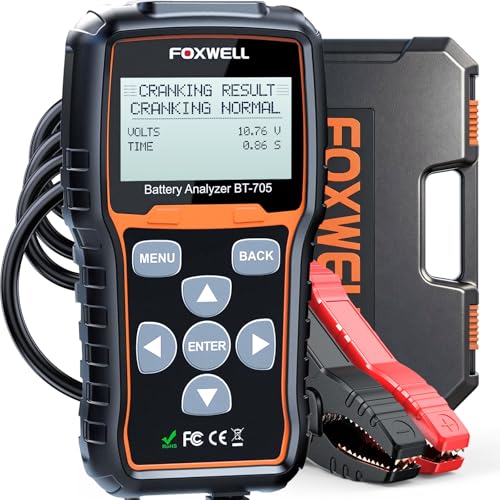 FOXWELL BT705 Car Battery Tester 24V 12Vcar battery tester13 x 3.2 x 9.1 inches0.7 poundsCheck on Amazon


Buying a used car turns on one uncomfortable fact: a weak battery can be disguised for exactly as long as your inspection lasts. A seller who charges a dying battery the night before gets easy starts all morning, and a simple voltage reading at rest will agree that everything looks fine. The decision a tester has to support is narrower and more practical than lab accuracy. It has to expose, in a stranger’s driveway and in a few minutes, the gap between what the battery is rated to deliver and what it can still deliver today.
This guide is for private-party shoppers, parents checking a first car for a teenager, and anyone inspecting a used truck or SUV before paying. The four testers below were chosen from their Amazon product pages for driveway work: clamp-on leads, power drawn from the battery under test, CCA ranges that cover ordinary car batteries, and cranking and charging tests you can run while the seller watches.
Quick Picks
As an Amazon Associate we earn from qualifying purchases.
| Product | Best for | Key spec from title |
|---|---|---|
| ANCEL BA101 | A quick verdict during a short viewing | 12V, 100-2000 CCA, battery, cranking and charging tests |
| TOPDON BT100 | Challenging a “nearly new battery” claim | 12V, 100-2000 CCA, internal resistance reading |
| KONNWEI KW208 | Reading results outdoors in bright light | 12V, 100-2000 CCA, color TFT display |
| FOXWELL BT705 | Used trucks and heavier vehicles | 12V/24V, 100-2000 CCA, heavy-duty analyzer |
How to Choose
Compare measured CCA with the rating on the battery label
Every tester here asks you to enter the battery’s rated CCA, printed on its top label, then reports the CCA it actually measures alongside a state-of-health figure. That comparison is the whole point of bringing a tester to a viewing. A battery rated at 700 CCA that measures near half of that is living on borrowed time, whatever its resting voltage says. Enter the rating carefully and use the CCA standard, not CA or MCA figures from the same label, because the health calculation is only as honest as the number you feed it.
Run the cranking test, not just the resting test
A battery topped up overnight can pass a static check and still collapse the moment the starter motor asks for real current. The cranking test exists for exactly this trick: with the tester still clamped on, you start the engine and the unit records how far voltage falls and how long cranking takes. A deep voltage sag on a warm engine, in mild weather, tells you the battery is weak in the way that matters, and it does so in the seller’s driveway rather than on your first cold morning of ownership.
Check the charging system while the clamps are on
A good battery in a car with a failing alternator is a different purchase from a tired battery in a healthy car, and the charging test separates the two. Run it with the engine idling and loads switched on, and the tester reports charging voltage and, on some models, ripple. If the battery tests borderline but charging output is low or unstable, the alternator may be the real problem, which changes what you should ask the seller to fix, replace, or account for in the deal.
Match the tester to driveway conditions
You will be working in someone else’s space, quickly, possibly in poor light, so ergonomics matter more than spec sheets. Clamps must open wide enough for corroded or side-post terminals, leads should reach from the battery to wherever you can stand and read the screen, and the tester should power itself from the battery so there is nothing to charge beforehand. Most cars need only a 12V unit with a 100-2000 CCA range; step up to a 12V/24V model if you shop for diesel trucks or commercial vehicles. The cheapest testers cut corners on cranking tests and lead length, the two things a used-car check depends on.
Safety Notes
Connect the red clamp to the positive terminal first, then the black clamp to the negative terminal or a solid ground point, and remove them in the reverse order. Work with the engine off while clamping on, keep the two clamps from touching each other, and wear eye protection, because a battery that has just been charging can vent hydrogen gas and even a small spark near the terminals is unwelcome. Never test a battery that is frozen, swollen, cracked, or leaking; a battery in that condition is a replacement and a careful cleanup job, not a test candidate.
The 4 Best Options
ANCEL BA101

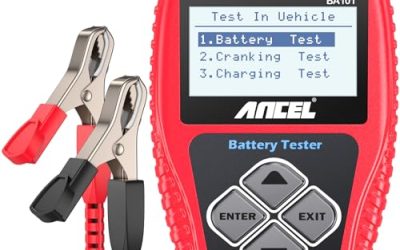
The BA101 suits the most common used-car scenario: a short viewing, a polite seller, and a need for a straight answer before you commit. Its battery test returns state of health, state of charge, measured CCA, and internal resistance in one pass, and its menu separates in-vehicle from out-of-vehicle testing, which keeps the driveway routine simple. The cranking and charging tests run from the same two clamps, so you can move from a static reading to a start test without changing tools or asking the seller for anything beyond the key.
Specs
- System voltage: 12V
- Test range: 100-2000 CCA, up to 220Ah
- Battery types: Regular Flooded, AGM Flat Plate, AGM Spiral, GEL, EFB
- Tests: Battery Test, Cranking Test, Charging Test
- Readings: state of health, state of charge, measured CCA, internal resistance, voltage
- Protection: reverse polarity and short-circuit protection listed by the maker
- Test modes: in-vehicle and out-of-vehicle
Best for: A first used-car purchase where you want one clear good-or-replace verdict on the spot.
Watch out for: It covers 12V systems only, so it will not help with 24V trucks.
ASIN: B01M0ARG3X
TOPDON BT100
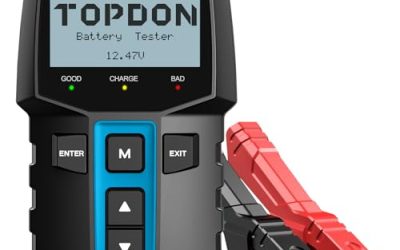
The BT100 is the pick when the listing or the seller insists the battery was replaced recently and you want numbers to test that claim against. Alongside the health verdict it shows internal resistance, a figure that climbs as plates age, which makes a freshly charged but worn battery harder to hide. Its charging test reports loaded and unloaded voltage with ripple, useful when a car has been sitting on a dealer lot or a driveway for weeks. Everything runs from the battery itself, so it works the same in a parking lot as in a garage.
Specs
- System voltage: 12V
- Test range: 100-2000 CCA
- Battery types: Regular Flooded, AGM Flat Plate, AGM Spiral, GEL, EFB
- Tests: Battery Test, Cranking Test, Charging Test
- Readings: voltage, internal resistance, health and aging status
- Use cases in title: car, truck, motorcycle, ATV, SUV, boat, yacht
Best for: Verifying a seller’s claim that the battery is recent, using resistance and health readings.
Watch out for: Confirm the battery type setting before testing, because an AGM battery judged as flooded skews the result.
ASIN: B07Z67MMGC
KONNWEI KW208
The KW208 earns its place through its color TFT screen, a small thing that matters when you are reading results over a fender in winter sunlight or in a dim parking structure. Its result screen lays out the rating you entered, measured CCA, state of health, state of charge, voltage, and internal resistance together, which makes it easy to photograph the outcome for your own records before you talk numbers with the seller. A review mode stores past results, handy when you are comparing several cars over a weekend of viewings.
Specs
- System voltage: 12V
- Test range: 100-2000 CCA
- Display: color TFT screen
- Tests: battery check, cranking test, charging test, ripple test
- Readings: state of health, state of charge, measured CCA, voltage, internal resistance
- Menu functions: Check, Review, Setup, About
Best for: Shoppers viewing several cars who want legible results they can save and compare later.
Watch out for: The brighter color screen is a convenience, not extra accuracy; judge it on the readings, not the display.
ASIN: B08MPXGSGN
FOXWELL BT705
The BT705 is the heavy-duty option, built for buyers looking at full-size trucks, diesels, and older vehicles where the battery is bigger and the electrical system may not be a simple 12V layout. It tests 12V batteries and also handles 24V cranking and charging systems, coverage none of the other picks here offer. That breadth makes it a sensible buy for someone who inspects vehicles often, helps family members shop, or is considering a work truck or boat as well as a car. It is the largest commitment of the four, justified only if the extra system coverage matches the vehicles on your list.
Specs
- System voltage: 12V and 24V
- Test range: 100-2000 CCA
- Battery types: Regular Flooded, AGM Flat Plate, AGM Spiral, GEL
- Tests: battery, cranking, and charging system analysis
- Positioning in title: heavy duty truck, boat, marine, shop and mechanic use
Best for: Used truck and diesel shoppers who need 24V system checks as well as 12V battery tests.
Watch out for: It is more tester than a single car purchase requires; the 24V coverage is wasted on ordinary cars.
ASIN: B01ANF1D7U
Which One Fits Your Situation
You get one short viewing before deciding
Take the ANCEL BA101. Its in-vehicle routine moves from battery test to cranking test without extra setup, and the plain good-or-replace style verdict is easy to act on while the seller waits. It answers the only question that matters in a short viewing: is this battery a near-term expense or not.
The seller says the battery was just replaced
Take the TOPDON BT100 and ask to see the internal resistance and state-of-health figures next to the battery’s date and rating labels. A genuinely recent battery reads close to its rating; a charged-up old one does not. The numbers give you a factual basis for asking the seller to replace the battery or adjust the deal.
You are shopping for a truck, diesel, or work vehicle
Take the FOXWELL BT705. Bigger vehicles bring bigger batteries and, in some cases, 24V starting and charging systems that a 12V-only tester cannot assess properly. Its wider coverage means one tool handles the family car you already own and the heavier vehicle you are inspecting. That headroom matters most when a weak result could mean two batteries to replace instead of one.
You plan to inspect several cars over a few weeks
Take the KONNWEI KW208. The color screen stays readable in the conditions viewings actually happen in, and the review function keeps earlier results on the device, so the third car you check can be compared with the first two without relying on memory or scattered phone notes. It also gives you a consistent record if a seller disputes what the screen showed during the viewing.
Common Mistakes
- Trusting a resting voltage reading on a battery the seller charged the night before the viewing.
- Entering the wrong rating from the label, such as CA or MCA instead of CCA, which makes the health figure meaningless.
- Clamping onto corrosion or loose terminals and treating the resulting low reading as the battery’s fault.
- Skipping the cranking test, the one check a freshly charged weak battery cannot fake.
- Ignoring the charging test and blaming the battery for what is actually a failing alternator.
Frequently Asked Questions
Can I test the battery without removing it from the car?
Yes. All four testers clamp onto the terminals with the battery in place, and each offers an in-vehicle test mode. You need the hood open and access to both terminals, nothing more. Removal is only necessary when terminals are too corroded or obstructed for the clamps to grip cleanly and make solid contact.
What result should make me walk away or renegotiate?
A measured CCA far below the rating on the label, paired with a low state-of-health reading, means replacement is near even if the car starts today. That is not always a reason to abandon the car, but it is a concrete, documented cost the seller should cover, fix, or reflect in the deal.
Will a tester catch a battery the seller charged just before I arrived?
Usually, yes. Charging raises voltage and state of charge, but it cannot restore lost capacity, so the measured CCA and state of health still expose a worn battery. The cranking test helps further, because a tired battery sags under starter load in a way a surface charge cannot disguise for long.
How long does a driveway battery check actually take?
Clamping on and running the battery test takes a couple of minutes once you have entered the battery’s rating from its label. Adding the cranking test means starting the engine once, and the charging test a short idle with lights and blower on. Ten unhurried minutes covers all three with time to note the results.
FAQ
Can I test the battery without removing it from the car?
What result should make me walk away or renegotiate?
Will a tester catch a battery the seller charged just before I arrived?
How long does a driveway battery check actually take?
More from Amazon
Programs that pair well with the guide above. Offers and eligibility are set by Amazon and may change.
Free shipping on eligible items, Prime Video and more. Eligible new members can start with a free trial.
Start a Prime free trialA Prime membership for ages 18-24 with a trial period. Eligibility is set by Amazon.
See Prime for Young AdultsAudiobooks and podcasts to listen to on the go. Eligible new members can start with a free trial.
Try Audible freeAd-free music streaming. Eligible new subscribers can start with a free trial.
Try Music Unlimited freeAs an Amazon Associate we earn from qualifying purchases.