Key takeaways
- Find the vehicle’s curb weight in the owner’s manual or on the certification label.
- Estimate the supported end as approximately 40–60 percent of that weight, depending on front- or rear-engine layout.
- Choose stands whose clearly stated combined capacity comfortably exceeds that supported load.
- Move up to 6-ton stands for heavy-duty trucks, vans, or frequent professional-style use.
The best jack stands are matched to your vehicle’s actual support points, the height you need, and the way you work—not simply the stands with the highest ton rating.
For most home garages, a pair of 3-ton ratchet stands with a broad, welded-steel base and a working height of roughly 11 to 17 inches is the best balance. Choose 6-ton stands for heavy trucks or extra margin, low-profile stands for lowered cars, and pin-lock stands when maximum resistance to accidental height movement matters more than quick adjustment.
Our top picks

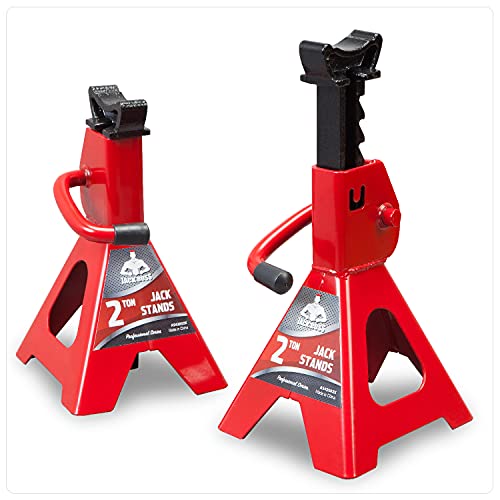


As an Amazon Associate we earn from qualifying purchases at no extra cost to you. Ratings are shown as listed on Amazon.
Best jack stands by situation
| Situation | Best choice | Useful target specifications | Why |
|---|---|---|---|
| Typical sedan, crossover, or compact SUV | 3-ton pair | 11–17 in. height; ratchet or pin lock; 6–8 in. saddle | Fits common pinch welds and subframes without excessive bulk |
| Full-size pickup or heavier SUV | 6-ton pair | 15–24 in. height; pin lock; wide base | Provides more height and a stronger footprint for heavier vehicles |
| Lowered sports car | Low-profile 2- or 3-ton pair | Minimum height under 10 in.; 14–20 in. maximum | Can reach the support point without lifting the car excessively high |
| Frequent brake, suspension, or exhaust work | Heavy-duty welded stands | Thick steel, replaceable saddle pads, 3–6 ton rating | Better resistance to repeated loading, scraping, and workshop wear |
| Occasional emergency use and limited storage | Compact ratchet pair | Foldable or low-footprint design; 2–3 ton rating | Stores easily, but gives up some base area and working height |
How much capacity do you need?
Jack-stand capacity is commonly stated per stand, although packaging can make this unclear. Read the label carefully: a pair rated at 3 tons may mean 3 tons total, while some manufacturers describe each stand as 3 tons. Use the manufacturer’s wording rather than assuming.
Do not size stands to the vehicle’s gross vehicle weight rating alone. When one axle is supported, the stands carry only part of the vehicle’s weight, but you still need a generous safety margin for load transfer, movement, and uneven floors. A practical selection method is:
- Find the vehicle’s curb weight in the owner’s manual or on the certification label.
- Estimate the supported end as approximately 40–60 percent of that weight, depending on front- or rear-engine layout.
- Choose stands whose clearly stated combined capacity comfortably exceeds that supported load.
- Move up to 6-ton stands for heavy-duty trucks, vans, or frequent professional-style use.
Example: if a 4,000-pound SUV is raised at one end, a conservative 60 percent estimate is 2,400 pounds. Two properly positioned stands rated for at least 3,000 pounds combined provide a stated capacity above that estimate. This does not make an unsafe lifting position safe; the stands must still contact approved support points on a solid, level surface.
Height range matters more than the headline rating
Compare both minimum and maximum height. A stand that is strong enough but cannot fit under the vehicle is useless, while one that reaches high enough may become unstable if extended near its limit.
Minimum height
Measure from the floor to the intended support point after the vehicle is lifted enough to place the stand. Lowered cars and vehicles with side skirts often need a minimum height below 10 inches. Standard 3-ton stands frequently start around 10–12 inches, while taller 6-ton models may begin around 15 inches and require a longer jack lift.
Maximum height
For wheel, brake, and suspension work, 15–20 inches is enough for many cars and crossovers. Trucks may need 20–24 inches or more. Avoid using a stand at its absolute highest setting unless the base remains broad and the locking mechanism is fully engaged. A taller stand is not automatically better if it forces the vehicle onto a narrow, top-heavy support.
Before buying, measure the distance from the floor to the vehicle’s approved stand location and allow room for the saddle. Also check that your floor jack can lift high enough to place the stand at the desired setting.
Locking systems: ratchet, pin, or screw?
Ratchet locks
Ratchet stands adjust quickly through a series of teeth. They are convenient for routine work, but the tooth, pawl, and release lever must be fully engaged. Never rely on the release handle’s position alone: visually confirm that the pawl has seated in a tooth and that the post cannot descend.
Pin locks
Pin-style stands use a hole in the center post and a solid retaining pin, often with a clip or lanyard. They take longer to adjust but provide a positive mechanical stop. They are a strong choice for long-duration storage, heavy vehicles, or anyone who prefers a lock that does not depend on a spring-loaded pawl.
Screw-adjust stands
Screw mechanisms offer fine height adjustment and can help level support points. They are less convenient for frequent height changes and must be kept clean and lubricated as specified by the manufacturer. A screw should never be used as a substitute for the stand’s primary locking feature.
Saddle shape and vehicle compatibility
The saddle must support the vehicle without crushing a seam, slipping sideways, or damaging a coated component. A flat saddle suits solid frame sections and some reinforced lift points. A V-shaped saddle can center a frame rail or axle tube. A saddle with a narrow slot may fit a reinforced pinch weld, but only when the slot width and depth match the vehicle’s lift point.
- Unibody cars: look for a saddle that fits the manufacturer-designated pinch weld or subframe location. Do not place a stand under thin floor pan metal.
- Body-on-frame trucks: a wide saddle or V-shaped saddle can work with frame rails, but avoid brake lines, fuel lines, wiring, and unsupported suspension arms.
- Axle work: a wide, stable saddle may support a solid axle only where the service procedure permits it. Keep the vehicle’s suspension and axle-loading requirements in mind.
- Corrosion-prone vehicles: use a saddle pad or protective adapter only if it remains stable and does not reduce contact area.
Rubber padding protects paint and undercoating, but it can tear, harden, or compress. Inspect it before each use. A damaged pad is not a reason to improvise with loose wood, stacked blocks, or random rubber pieces.
Base stability and construction
A wide, fully welded steel base is generally preferable to a narrow stamped base. Look for four feet that sit flat, a center post that does not wobble excessively, and welds without obvious cracks, porosity, or incomplete seams. A taller stand should have a proportionally broad footprint; height without base width increases the risk of tipping from a side load.
Cast-aluminum or lightweight stands can be convenient, but material alone does not determine safety. Verify the manufacturer’s capacity, applicable safety standard, and intended use. Avoid stands with bent feet, distorted teeth, missing pins, or posts that bind during adjustment.
Setup procedure that prevents common failures
- Park on a hard, level surface. Concrete is preferable to asphalt, soil, gravel, or sloped paving.
- Apply the parking brake and place the transmission in Park or in first gear, as appropriate.
- Chock wheels that remain on the ground. Use purpose-made wheel chocks rather than loose bricks.
- Consult the vehicle manual for lifting and support points.
- Lift with a correctly rated floor jack, then place the stands at matching heights on approved points.
- Lower the vehicle slowly until its weight rests on the stands. Keep the jack lightly positioned only if the service procedure allows it; never treat a hydraulic jack as the sole support.
- Give the vehicle a controlled side-to-side and end-to-end stability check without crawling underneath. If it shifts, lower it and correct the setup.
Use a pair at the same height. Do not support one corner with a stand while the opposite corner remains dangerously elevated, and never place any part of your body under a vehicle supported only by a jack.
Ownership, maintenance, and value
The first parts to wear are usually rubber saddle pads, ratchet teeth, release springs, retaining clips, and paint around the feet. After use, brush away grit, wipe off water and road salt, and store the stands dry. Keep ratchet teeth and pins free of grease unless the manufacturer specifically permits lubrication; excess lubricant can attract abrasive dirt.
Inspect stands before every use and after any drop or overload. A pair costing roughly $40–$80 is sufficient for occasional passenger-car work, while heavy-duty 6-ton or specialty stands commonly cost about $80–$180 per pair. If a $60 pair is used ten times a year for five years, its purchase cost is about $1.20 per use. That modest cost is not a reason to accept damaged welds, questionable capacity labeling, or a poor fit for the vehicle.
Final buying checklist
- Capacity is clearly stated as per stand or per pair.
- Minimum height fits beneath your vehicle’s approved support point.
- Maximum height reaches the work area without excessive extension.
- Locking system is fully mechanical and easy to verify visually.
- Saddle matches the frame, pinch weld, subframe, or axle support point.
- Base is wide, flat, and free from bent feet or damaged welds.
- Replacement pads, pins, or manufacturer support are available when relevant.
For the broadest range of cars, the best jack stands are usually sturdy 3-ton models with a verified positive lock, a working range around 11–17 inches, and a wide steel base. Choose by fit and stability first, then capacity and convenience; the largest number on the box is only one part of safe vehicle support.